Korea–Mongolia CEPA: Minerals Gambit
Seoul and Ulaanbaatar's strategic minerals deal
Model Diplomat7 min readAsia
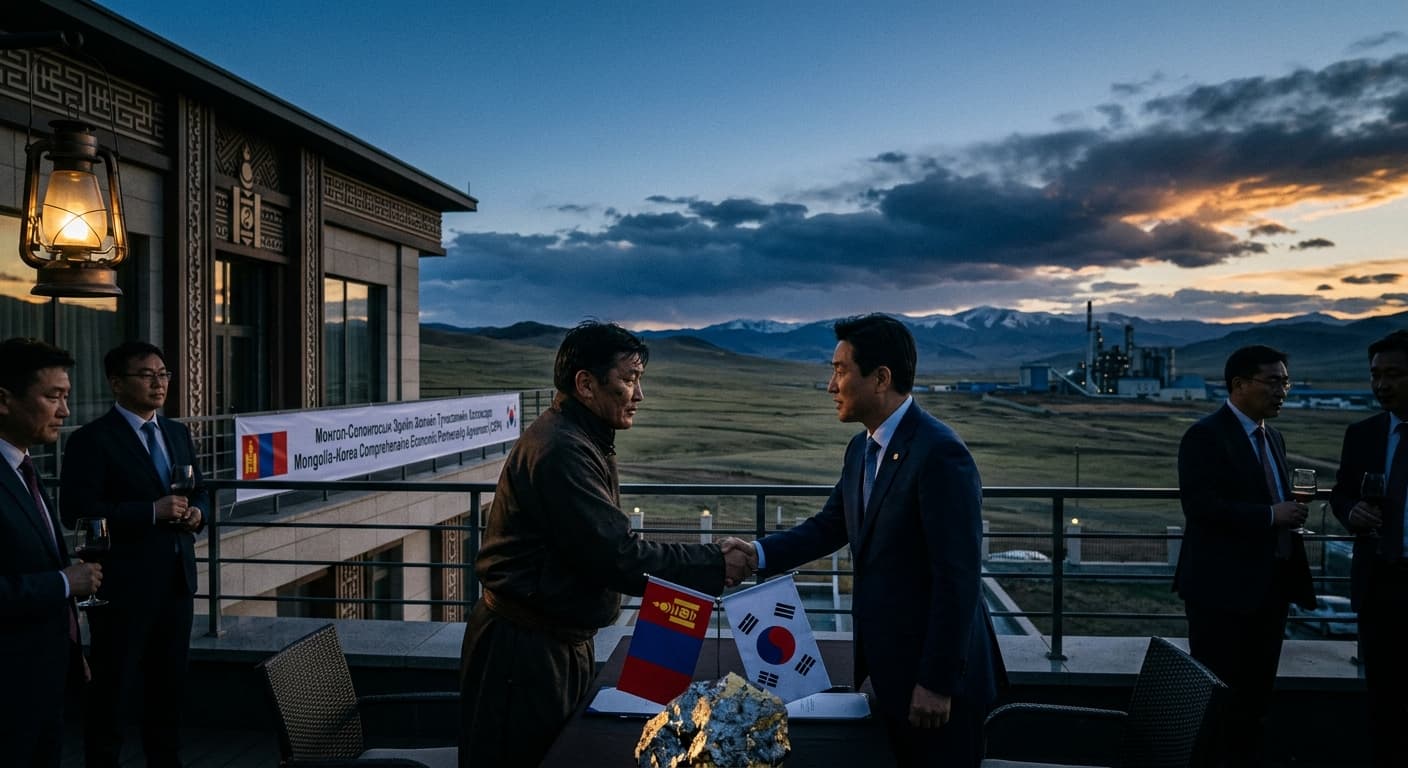
Korea–Mongolia CEPA: Seoul's minerals gambit on China's flank
South Korea and Mongolia agreed in principle on a Comprehensive Economic Partnership Agreement on July 9, 2026, unlocking critical-mineral supply chains and challenging China's near-monopoly on Mongolian ore.
South Korea and Mongolia sealed an agreement in principle on a Comprehensive Economic Partnership Agreement (CEPA) on July 9, 2026, at a summit in Ulaanbaatar — a deal whose real strategic payload is not the elimination of tariffs on ramyeon and cosmetics, but the first serious Western attempt to pry open Mongolia's mineral trade from a market where China absorbs 91% of its exports. The thesis is straightforward: Seoul is not chasing a trade surplus in a $400 million bilateral relationship; it is buying an option — a legal, tariff-preferential lane into copper, molybdenum and rare earths that, until now, have flowed almost exclusively south to Chinese smelters. Whether that option can be exercised depends less on the treaty text than on 4,600 kilometres of rail and refining capacity that does not yet exist.
President Lee Jae-myung, on his first state visit to Mongolia, declared the agreement alongside President Ukhnaa Khurelsukh at the Government Palace. According to Yonhap News Agency, Seoul's Ministry of Trade, Industry and Energy said the two sides had closed the substantive market-access and rules-of-origin chapters, leaving only technical items for working-level talks. In parallel, energy minister Kim Sung-whan and his counterpart Badrakh Naidalaa signed a memorandum of understanding on energy transition and renewables — a companion track
Yonhap described as designed to lock in Korean industrial participation from exploration through refining.
What the deal actually does
The tariff arithmetic is modest but pointed. Korea will scrap duties of 2–5% on Mongolian copper, molybdenum and rare-earth inputs. Mongolia will phase out tariffs on Korean cosmetics, instant noodles (ramyeon) and seasoned dried laver (gim), sectors where Korean exporters have been squeezed by the country's high MFN rates. Both sides will open more than 90% of bilateral imports, according to The Korea Herald. Beyond goods, the text extends to infrastructure, finance and healthcare cooperation — a scaffolding that mirrors South Korea's CEPA with India, which entered force in 2010 and remains Seoul's template for economic-security-linked trade pacts.
For Mongolia, this is only the second bilateral free-trade agreement in its history. The first, the Japan–Mongolia Economic Partnership Agreement, entered into force in June 2016 and — as the WTO recorded at the time — was the notification that finally gave every WTO member at least one regional trade agreement in force. That EPA is Ulaanbaatar's most useful reference point. A decade in, per the
WTO's 2021 trade policy review, the Japan pact runs a 20-year liberalisation schedule out to 2036 and has done little to shift the structural fact that Mongolia's minerals still travel south. That is the benchmark against which the Korea CEPA will be judged — and, quietly, why Seoul is layering the trade deal with a rare-metals cooperation committee, ODA-branded processing projects, and now an energy MOU. The treaty is the wrapper; the industrial policy inside it is the point.
The China exposure Seoul is trying to hedge
The scale of the diversification challenge is severe. Mongolia's mining sector generates 30% of GDP, 79% of foreign direct investment and 94% of exports, per ISPI's analysis of the country's mineral diplomacy. China took 84% of Mongolia's exports in 2022 and 91% in 2023, according to the U.S.
Congressional Research Service. Copper ore concentrates alone: $2.62 billion of $2.63 billion in 2023 exports went to China, per
World Bank WITS data. South Korea's share of that same trade in 2024 was $148,000 — a rounding error.
Seoul's own vulnerability supplies the demand side. According to an April 2026 Observer Research Foundation study, 95% of South Korea's rare-earth imports originate from China, alongside 78% of niobium, 84% of magnesium, 93% of indium and 98% of gallium. In 2023, Seoul committed to cutting China dependence from 70% to 60% by 2027 and 50% by 2030 across 33 "vital" minerals. That target — set out under the Ministry of Trade, Industry and Energy's supply-chain strategy — is the number the Mongolia CEPA is designed to help hit.
Why Ulaanbaatar signed now
Mongolia's incentive is Beijing-shaped but not Beijing-hostile. The Mongolian government caps investment from any single country at one-third of total FDI in strategic sectors and explicitly seeks to route exports through "third neighbours," per a 2024 Korea Institute for International Economic Policy brief. That policy — codified in Vision 2050 — is why Ulaanbaatar in 2023 co-founded the Korea-Mongolia Rare Metals Cooperation Committee, signed a critical-minerals MOU with the United States, and launched the first trilateral U.S.-Mongolia-Korea Critical Minerals Dialogue, as documented by
the U.S. State Department at its inception.
The CEPA extends that logic into legally binding tariff space. Crucially for Khurelsukh, the deal comes with cosmetic and consumer-goods concessions — retail cooperation that plays domestically without antagonising Beijing, which retains structural leverage through the coal-and-copper railway network. It is the classic Mongolian move: institutionalise diversification through a democratic third partner while keeping the physical export pipes unchanged. The European Parliament's 2024 briefing on EU-Mongolia relations noted that China holds 159 mining licences in Mongolia against South Korea's 11 — a gap the CEPA is meant to start narrowing without triggering Chinese retaliation.
The choke point the treaty cannot fix
Here the analyst's caveat matters. Roughly 88% of Mongolian minerals leave the country unprocessed, per CSIS, and there is no rail corridor from Mongolia's mining belt to a Korean port that does not transit either China or Russia. Any Mongolian copper concentrate destined for a Korean smelter today crosses Chinese territory. That is why the CEPA's tariff cuts of 2–5% are, in isolation, marginal — they lower the cost of a shipment that is already logistically hostage.
The real value of the deal is what it authorises next: joint processing ventures inside Mongolia. President Lee, in remarks reported by Aju Press, explicitly framed the vision as "participation throughout the entire supply chain of critical minerals, from exploration to refining." That language echoes the model Japan has piloted through JOGMEC's rare-earth separation facility in Malaysia — and which the CSIS analysis identifies as Tokyo's most successful de-risking play. If Seoul can replicate that inside Mongolia, using CEPA's rules-of-origin architecture to certify Korean-origin processing, it converts a Chinese-controlled commodity flow into a Korean-controlled industrial input. That is the second-order prize.
Who wins, who loses, who watches
The commercial winners are visible. Korean cosmetics majors — Amorepacific and LG H&H — gain duty-free access to a small but K-wave-receptive market of 3.4 million. Nongshim and Ottogi gain the same for ramyeon. Korea Mine Rehabilitation and Mineral Resources Corp (KOMIR) and the industrial conglomerates behind Korea's battery and semiconductor sectors — LG Energy Solution, Samsung SDI, POSCO — gain a legal beachhead for equity stakes in Mongolian processing.
The domestic losers in Korea are marginal: a handful of Mongolian minerals compete with legacy Korean processors, but the volumes are small. The strategic losers are two. First, Chinese smelters — particularly in Inner Mongolia — that today capture the value-added stage of Mongolian ore; the CEPA's rules of origin, if written tightly, create a legal path to divert that margin north. Second, Japanese firms, whose 2016 EPA head start is now matched by a Korean framework with a decade less legacy baggage and a more aggressive supply-chain security overlay.
Beijing's likely response is calibrated pressure rather than confrontation. When Lee visited Beijing on January 4–7, 2026 — his first China trip as president — Xi Jinping's team pushed rare-earth cooperation as a bilateral pull factor, per an Asan Institute assessment. That China has not extracted a public concession from Seoul on the Mongolia track is itself a data point: Beijing's leverage over Korea's minerals mix is loosening, not tightening.
Diplomat View
The Korea–Mongolia CEPA will not, on its own, break China's grip on critical-mineral processing — no bilateral trade agreement can. But it is the connective tissue in a Korean strategy that now spans a Central Asia summit, the K-Silk Road initiative, a Korea-Africa Critical Mineral Dialogue and an ongoing CEPA 2.0 upgrade with India, whose contours were reported by the NUS Institute of South Asian Studies after Lee's April 2026 New Delhi visit. Read together, these are not disconnected trade pacts; they are the legal scaffolding of Seoul's stated goal to cut China dependence in strategic minerals to 50% by 2030.
The forecast: the CEPA will be signed in final form within 12 months and enter force in 2027 or early 2028, on Japan-EPA precedent. It will underdeliver on Korean copper and rare-earth imports for at least three years — the logistics gap is real — but will overdeliver on processing joint ventures, particularly in molybdenum and tungsten, where Mongolia has both reserves and Korean industrial demand. The forecast revises if: (a) China tightens rare-earth export controls in response, forcing Korean firms to accelerate Mongolian processing investment; (b) Mongolia's parliament, historically resistance-prone on foreign mineral ownership, blocks equity ratification; or (c) a new Trans-Mongolian rail corridor bypasses Chinese territory — a decade-long project that would fundamentally reshape the calculation.
Forward-look — dates to watch:
- Q4 2026: Working-level technical text finalisation; ratification bill expected to enter Korea's National Assembly.
- October 2026: Next scheduled Korea-Mongolia Rare Metals Cooperation Committee meeting — first test of whether the CEPA framework accelerates joint processing project selection.
- 2027: Xi Jinping's fourth-term consolidation and any Chinese rare-earth export-control adjustment; the single largest external variable for the CEPA's strategic payoff.
The Bottom Line
The Korea–Mongolia CEPA is not a trade deal about trade. It is the legal instrument Seoul needed to convert its critical-minerals diversification target from a policy paper into an industrial footprint, and to give Ulaanbaatar a democratic counterweight to the 91% of its exports that flow to China. If the accompanying processing investments materialise, this is the moment South Korea stopped being a marginal player in Mongolian resources and started to become the third neighbour Mongolia has spent thirty years looking for.
Discover more

US Politics
SNAP Food Assistance Faces Legal Challenges
In 2026, SNAP faces stricter eligibility rules and mounting legal challenges, threatening food assistance for the millions of Americans who rely on the program.
Global Politics
Trump's Conflicting Messages on Iran War
Trump's mixed messages on Iran reflect a strategy of audience management, benefiting Tehran amid a complex geopolitical landscape.

US Politics
House Ethics Committee Pushes Sexual Miscond.
The House Ethics Committee has shifted responsibility for sexual harassment settlement records to the Office of Congressional Workplace Rights, complicating disclosure efforts.

Economics
Fed's Amex AML order puts correspondent banking on notice
Federal Reserve's Amex AML order requires board-level controls and a 90-day plan; OCC fined the bank $350 million over enterprise-wide deficiencies.