Kim's Warning on Seoul–Tokyo Pact
North Korea targets a logistics deal between allies.
Model Diplomat7 min readAsia
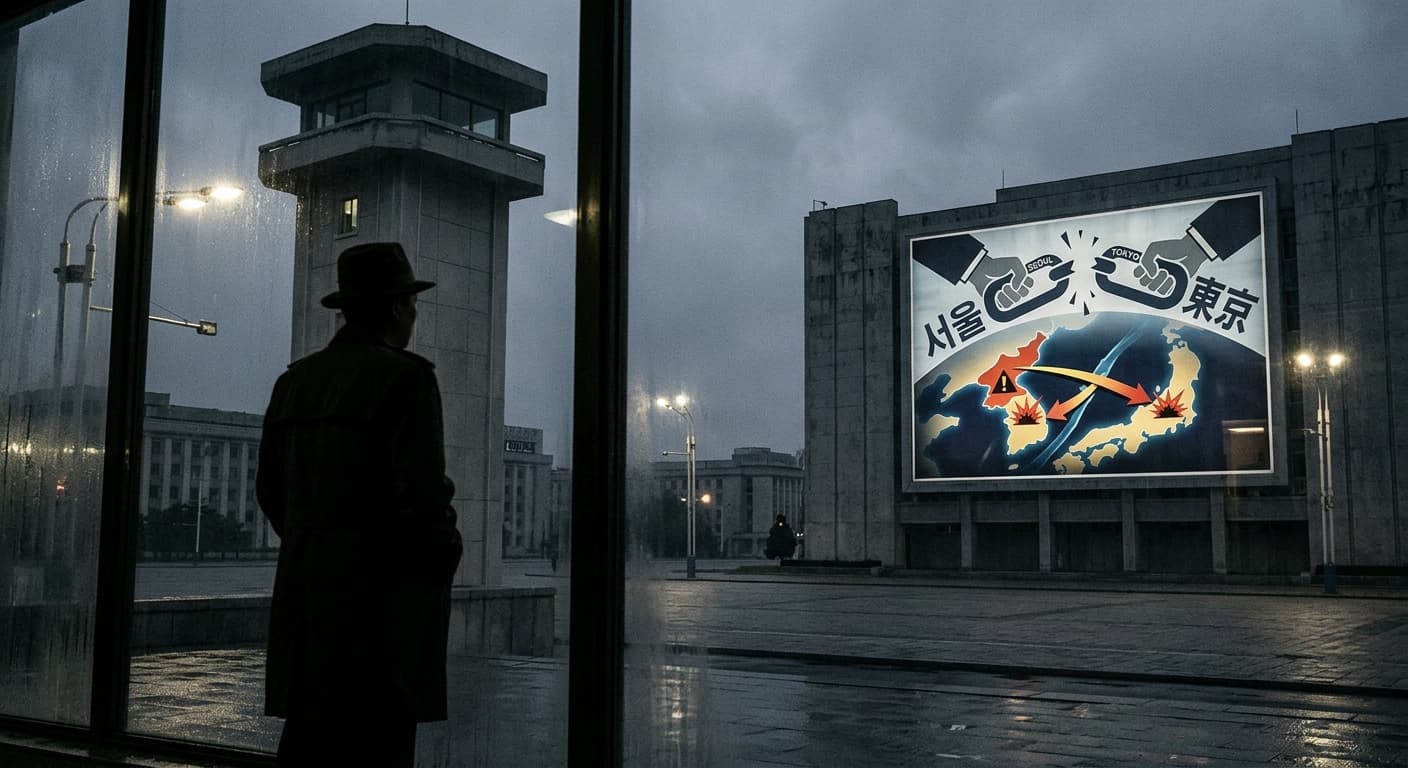
Kim's 'Self-Destruction' Warning Signals Fear of a Seoul–Tokyo Logistics Pact
North Korea's July 9 attack on South Korea–Japan defense ties targets a specific pending deal — a mutual munitions pact that would harden the U.S.–ROK–Japan triangle before Pyongyang's arsenal catches up.
Pyongyang's July 9, 2026 broadside against Seoul–Tokyo military cooperation is not a routine screed — it is a targeted attempt to derail a specific, pending arrangement: a Republic of Korea–Japan mutual logistics-support pact that would let the two U.S. allies swap ammunition and fuel in a contingency. The Korean Central News Agency (KCNA) commentary, attributed to Kang Chol-su of North Korea's Institute of Enemy State Studies, calls the emerging alignment "a foolish act of courting self-destruction," according to Yonhap. Read against the June visit of Chinese President Xi Jinping to Pyongyang and Kim Jong Un's naval nuclear build-out, the statement reveals what worries the regime most: not the rhetoric of trilateral cooperation, but the plumbing — the interoperable logistics that would let Washington, Seoul and Tokyo sustain a joint fight before Pyongyang's 60-warhead arsenal reaches operational maturity.
What Pyongyang actually said — and what it targeted
The KCNA text is unusually specific. Kang cited two concrete developments: the January 2026 South Korea–Japan defense ministers' meeting that reaffirmed Camp David–era commitments under the new Lee Jae Myung and Sanae Takaichi governments, and a recent instance in which Republic of Korea Air Force jets refueled at a Japanese base — a technical first that only makes sense inside a bilateral logistics framework.
Kang's warning that these steps are "laying the groundwork for a logistics support agreement" mirrors, almost word for word, the disclosure at last month's Shangri-La Dialogue that a Seoul–Tokyo mutual logistics pact was being discussed on the margins. Al Jazeera reported that Beijing raised the possible pact directly with Kim during Xi's June 8–9 Pyongyang visit, his first in seven years. Pyongyang did not invent this grievance — Beijing handed it to them.
The statement's core claim — that the cooperation is part of a "triangular cooperation system" among the United States, South Korea and Japan aimed at Pyongyang — restates the phrasing North Korea has used since June 2024, when it accused the three allies of building an "Asian NATO" after the inaugural Freedom Edge exercise. What has changed is the specificity of the target. This is no longer an attack on drills. It is an attack on a treaty.
The pact that would change the math
A ROK–Japan Acquisition and Cross-Servicing Agreement — the technical name for the kind of logistics pact under discussion — would let each military supply the other with fuel, spare parts, transportation and, in wartime, munitions. Japan already has such deals with the United States, the United Kingdom, Australia, France, Germany, India and Canada. South Korea has one with the United States and, since 2019, with the UK. The two U.S. treaty allies most exposed to the same North Korean threat do not have one with each other.
The June 1, 2024 Shangri-La agreement between then-Defense Ministers Shin Won-sik and Kihara Minoru normalized defense exchanges frozen since 2018. That paved the way for what CSIS at the time called the closest Seoul and Tokyo had come to "a joint security declaration." Two years of cabinet turnover in both capitals have not derailed the trajectory: Defense Minister Ahn Gyu-back hosted Japan's Shinjiro Koizumi in Wonju on June 27, 2026, and the pair appeared together at a Republic of Korea Air Force base — an image Yonhap made central to its coverage.
The pact matters because it converts political alignment into operational endurance. In a Korean-peninsula contingency, U.S. and South Korean forces would exhaust South Korean stockpiles quickly. Japan is the physical rear area — the U.S. Indo-Pacific Command's logistics spine sits on Japanese soil. Without a bilateral ROK–Japan mechanism, every munitions transfer must route through Washington. With one, Tokyo becomes a direct sustainment node for Seoul's war. That is exactly the "confrontation cooperation" Kang described.
Why now — the Kim–Xi–Takaichi geometry
Three shifts converged in the weeks before the KCNA statement, and each stiffens the regime's incentive to draw a line.
First, Xi Jinping went to Pyongyang. His June 8–9 summit with Kim, the first in seven years, was framed by both sides as a "new historical starting point," according to Al Jazeera's coverage of KCNA. Beijing's price for economic support — and its leverage as Russia's usefulness fades with the winding down of the Ukraine war — is Pyongyang's active participation in blunting the U.S. Indo-Pacific alliance system. Brookings scholar Andrew Yeo notes that Kim's "northern turn" now aims to negotiate as a nuclear peer with Washington while
bypassing Seoul entirely — a strategy the Seoul–Tokyo logistics pact would directly undermine.
Second, Takaichi's Japan is moving faster than any post-1945 government to dismantle constraints on offensive capability. At the Shangri-La Dialogue on May 31, 2026, Japanese Defense Minister Shinjiro Koizumi rejected China's "new militarism" label and defended plans for new surface-to-ship missiles, unmanned underwater vehicles and — in a decision his cabinet took in April 2026 — scrapping the ban on lethal weapons exports, Al Jazeera reported. North Korean state media picked up the thread on July 7, accusing Tokyo of preparing for "overseas aggression," per
The Hindu.
Third, and least noticed, is what Lee Jae Myung has not done. The South Korean president campaigned as a dove and has pursued outreach to Pyongyang, yet his government has kept the trilateral machinery running. Chatham House's Aditi Kanodia counts at least 80 trilateral defense meetings across 20 channels since Camp David. The real-time missile-warning link with U.S. Indo-Pacific Command in Hawaii, live since January 2024, has not been paused.
The arsenal Kim is racing against
Kang's insistence that trilateral cooperation "will do nothing to weaken North Korea's deterrence" is a statement of a race, not a fait accompli. SIPRI's 2026 Yearbook — a primary open-source assessment — estimates Pyongyang assembled roughly 60 warheads as of January 2026, up from about 50 a year earlier, with fissile material for at least 30 more. The trajectory matters: Kim's July 8 announcement, per KCNA, that a "weapons-grade nuclear materials" factory will expand production "exponentially" is meant to change the deterrence math faster than Seoul and Tokyo can integrate.
Kim is simultaneously rebalancing to naval nuclear capability. On June 23, 2026, he commissioned the 5,000-tonne destroyer Choe Hyon at Nampho with pledges to arm the navy with tactical nuclear weapons and to build 10,000-tonne "strategic warships," Al Jazeera reported. Analysts including Hans Kristensen at SIPRI have long argued that Pyongyang's naval nuclearization is aimed precisely at the U.S.–Japan sea lines that a ROK–Japan logistics pact would sustain.
What the analysts are actually watching
Independent expertise diverges on Kim's leverage. Andrew Yeo argues Japan now faces the "imminent challenge" of recalibrating strategy if Washington and Seoul quietly accept North Korean nuclear possession — a scenario the Lee government's shift toward the softer phrase "a nuclear-free Korean Peninsula" hints at, per his Brookings essay. Chatham House's Ramon Pacheco Pardo warns that
Trump-era U.S. unpredictability is the trilateral's biggest structural risk, not Pyongyang.
Foreign Affairs' Mireya Solís and Sheila Smith note Takaichi's October APEC meeting with Lee produced an "overwhelmingly positive" reset — capped, per the BBC, by the widely-shared K-pop drum duet in Tokyo — but caution the pair still have to convert atmospherics into deliverables like joint participation in the Quad or Squad minilaterals. The logistics pact would be that deliverable.
The dissenting view, from Foreign Affairs' proliferation analysts, is that the trilateral's success paradoxically raises the risk Seoul or Tokyo eventually crosses the nuclear Rubicon if U.S. commitments waver. South Korean polling shows 75–80% support for indigenous nuclear armament; 56% of Japanese back an open debate. If Kang's "self-destruction" line lands with any audience, it is that one.
Forward look
Three catalysts will test whether Pyongyang's warning changes anything:
- Late July 2026: The U.S., Japan and South Korea are expected to hold the third Freedom Edge multi-domain exercise. Expect a fresh KCNA cycle and possibly a short-range missile test.
- Autumn 2026: Watch for the Seoul–Tokyo mutual logistics pact to be initialed on the margins of an ASEAN- or APEC-related defense meeting. A vice-ministerial working track was reopened after the Shangri-La disclosure.
- National Assembly ratification window, early 2027: Any ACSA-style treaty will need Seoul's parliamentary approval. Democratic Party members of Lee's own coalition have signaled skepticism; historical grievance politics could still bury the pact even after governments sign it.
Diplomat View
The KCNA commentary is a leading indicator, not a lagging one. Pyongyang and Beijing are protesting the ROK–Japan logistics pact because they believe it will be signed — and they are trying to raise the domestic cost in Seoul before it happens. Our read: the pact reaches initialing by year-end 2026, but ratification slips into 2027 and could be blocked by a single wedge issue — most likely a Dokdo/Takeshima flare-up, a Yasukuni visit, or a labor-compensation court ruling — that Beijing and Pyongyang will actively try to exploit. What would revise the forecast: a Lee cabinet reshuffle that removes Ahn Gyu-back, a Takaichi concession on historical apology that neutralizes the wedge, or a Trump administration decision to relocate a substantial share of THAAD or F-35 assets out of Northeast Asia. The first would slow the pact; the second would accelerate it; the third would make it existential. Track the Assembly floor, not KCNA.
The Bottom Line
North Korea's "self-destruction" charge is not bluster — it is a targeted warning against a specific, imminent ROK–Japan logistics pact that would let Seoul and Tokyo sustain a joint fight without Washington in the loop. If the pact is signed, the U.S.–ROK–Japan triangle finally becomes an operational alliance rather than a political one, and Kim's 60-warhead arsenal starts racing a closing window. If it stalls — killed by a history dispute Beijing quietly amplifies — Pyongyang gets the strategic space its July 9 statement was designed to buy.
Discover more
Global Politics
Trump's Conflicting Messages on Iran War
Trump's mixed messages on Iran reflect a strategy of audience management, benefiting Tehran amid a complex geopolitical landscape.
US Politics
SNAP Food Assistance Faces Legal Challenges
In 2026, SNAP faces stricter eligibility rules and mounting legal challenges, threatening food assistance for the millions of Americans who rely on the program.
US Politics
House Ethics Committee Pushes Sexual Miscond.
The House Ethics Committee has shifted responsibility for sexual harassment settlement records to the Office of Congressional Workplace Rights, complicating disclosure efforts.

Economics
Fed's Amex AML order puts correspondent banking on notice
Federal Reserve's Amex AML order requires board-level controls and a 90-day plan; OCC fined the bank $350 million over enterprise-wide deficiencies.