Kim's Premier Visits Beijing: A New Era
North Korea's Premier Pak Thae Song visits China amid shifting alliances.
Model Diplomat9 min readEast Asia
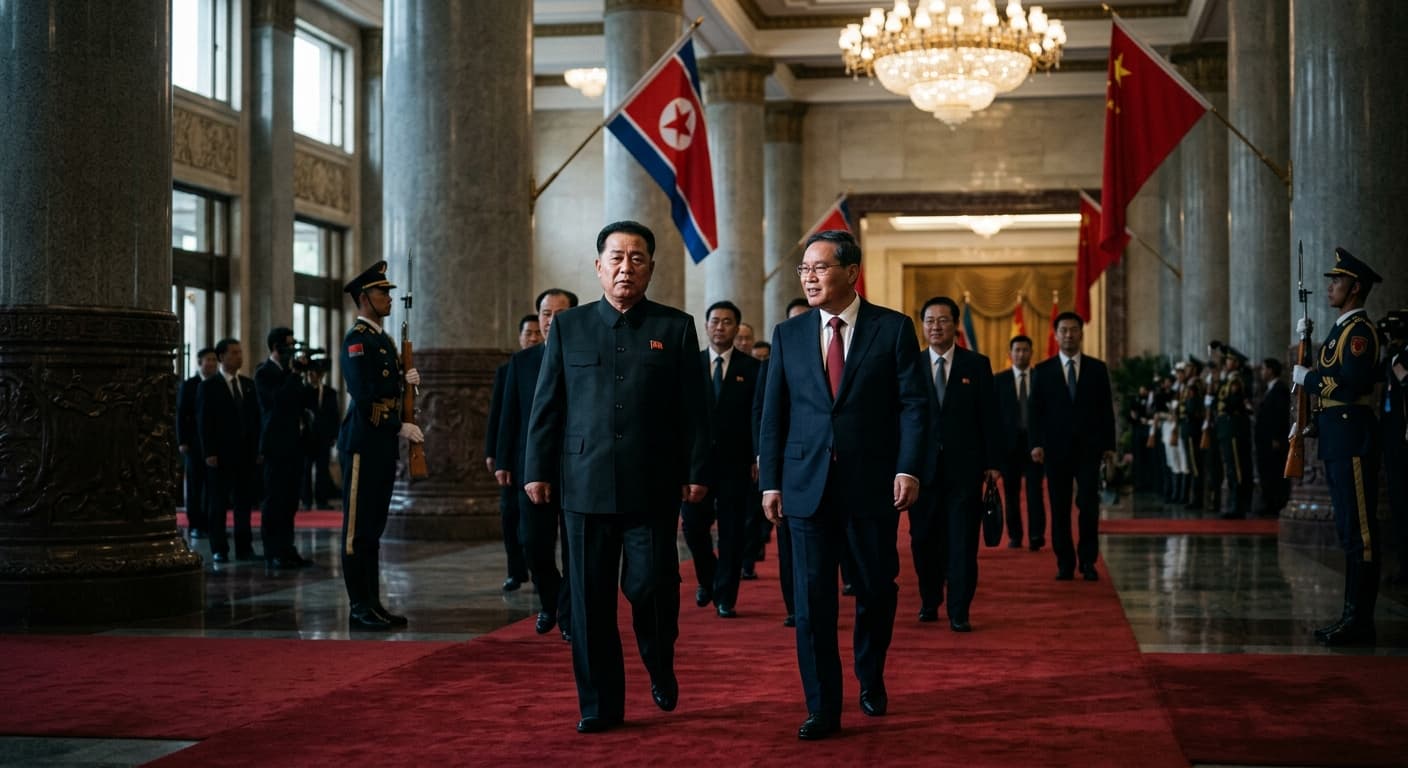
Kim's premier heads to Beijing: China's Only Ally Becomes Its Asset
North Korean Premier Pak Thae Song's July 10–12 Beijing trip marks the 65th anniversary of China's only defence treaty — and formalises Beijing's shift from managing Pyongyang to using it against US Indo-Pacific alliances.
North Korean Premier Pak Thae Song arrives in Beijing on July 10, 2026 for a three-day official visit — the first by a DPRK head of government to China in eight years, timed to a "grandly" staged commemoration of the 1961 Treaty on Friendship, Cooperation and Mutual Assistance. Confirmed by China's Foreign Ministry on July 9, the trip closes a 13-month cycle of high-level exchanges that has quietly rewritten Beijing's North Korea policy: Xi Jinping has stopped treating Pyongyang as a nuclear problem to be managed and started treating it as a strategic asset in the contest with the United States. That is the story behind the friendship banquets — and it is the single most consequential change in Northeast Asian security since Russia and North Korea signed their own mutual-defence pact in June 2024.
What the visit actually says
The choreography is unusually explicit. Pak leads a "party and government delegation" at the invitation of both the CPC Central Committee and the State Council, according to a statement by Foreign Ministry spokesperson Mao Ning — a dual-track invitation that reactivates the party-to-party channel Beijing has always used to distinguish its DPRK relationship from ordinary state ties. Mao described "maintaining, consolidating and developing China-DPRK relations" as an "unswerving strategic policy" of the CPC. That phrasing — repeated verbatim by
Wang Yi in Pyongyang in April and by Xi in June — is the new template.
The 1961 treaty itself is unlike anything else in China's diplomatic inventory. Article II obliges each side to render "immediate military and other assistance" if the other is attacked, and Article VII means the pact remains in force "until the Contracting Parties agree on its amendment or termination." A Lowy Institute analysis by Boston College's Khang Vu notes it is China's only such commitment to any state; the Russia–DPRK 2000 treaty, by contrast, only required consultation. In June 2024 Vladimir Putin restored the automatic-assistance clause with Kim Jong Un. Beijing now finds itself in a bidding war it did not want.
That is what the Pak visit is designed to answer.
The Xi doctrine on Pyongyang, unstated
The June 8–9 Xi–Kim summit in Pyongyang, Xi's first overseas trip of 2026 and his first DPRK visit since 2019, produced no signed deliverables. It produced something more valuable to Kim. Neither the Chinese MFA readout nor state media referenced denuclearisation. The
CSIS Korea Chair flagged this omission as "the most telling line was the one that never appeared," coming weeks after Washington claimed a "shared goal" of denuclearising North Korea that Beijing declined to echo.
Brookings senior fellow Patricia M. Kim wrote after the summit that "Russia is a major factor behind this visit" and that Beijing does not want Moscow "to displace it as North Korea's primary strategic partner." The consequence: China is now offering Pyongyang the two things it needs most — economic lifelines and diplomatic cover on the nuclear file — without asking anything on weapons in return.
That is the Xi doctrine, and Pak's Beijing itinerary implements it. Both governments have already agreed to leverage "the full reopening of border crossings and the resumption of civil flights and international passenger rail services," according to the Warsaw-based OSW Centre for Eastern Studies. Cross-border projects delayed for a decade are moving: the New Yalu River Bridge entered its final phase in 2025, and construction has resumed on a Tumen–North Hamgyong link, per an
ICDS analysis by Sejong Institute and Estonian researchers.
The numbers under the ceremony
The economic file is where the shift is easiest to measure. China–DPRK trade in 2025 hit $2.73 billion, up 25.4% year-on-year and effectively back to 2018–19 pre-sanctions levels, according to a Korea Institute for International Economic Policy analysis of Chinese customs data. Al Jazeera reported that in the first two months of 2026,
bilateral trade rose another 22 percent year-on-year. China accounted for roughly 98% of the DPRK's official trade in 2024, per Korea Trade-Investment Promotion Agency (KOTRA) data cited by OSW.
The revealing detail is not the total — it is the composition. The KIEP report finds import volumes for agriculture, chemicals, textiles and plastics have surpassed 2016–17 levels, the peak year before UN sanctions bit. That means Chinese customs officials are looking away from categories that ostensibly remain restricted under UNSCR 2397. Passenger rail between Beijing and Pyongyang resumed in early 2026 after a six-year pause, the BBC reported, and Chinese exports to the DPRK hit $2.3 billion last year — a six-year high.
Layered on top: the Russia–DPRK arms-for-oil trade the UN can no longer measure. The Multilateral Sanctions Monitoring Team's first report, published May 29, 2025, documented arms transfers, air-defence deliveries and petroleum supplies far in excess of UN caps. Its
October 2025 follow-up added cryptocurrency theft and DPRK IT-worker fraud netting "billions of dollars." China is not directly implicated in those transfers — but by publicly deepening ties with the sanctions-target, Beijing is signalling that the sanctions regime it once helped enforce in 2016–17 is a closed chapter.
Kim's leverage — and the pivot position
The strategic result is that Kim Jong Un has more room to move than at any point since 2018. Brookings' Patricia Kim called Pyongyang "the biggest beneficiary of this evolving strategic triangle." Ryan Hass, writing for the same forum, described the summit as a "significant endorsement of the Kim regime." An Observer Research Foundation analysis published July 6 titled its assessment bluntly: "From Burden to Asset."
Kim's leverage is visible in what he refused. On the eve of Xi's June arrival, his sister Kim Yo Jong issued a statement reaffirming that the DPRK's nuclear status is "irreversible"; Kim himself, at the March 2026 Supreme People's Assembly, described the arsenal in the same terms, per an AEI Korean Peninsula Update. Days before Xi landed, Kim toured a facility state media described as producing "weapons-grade nuclear materials" for exponential expansion. Xi arrived anyway. The IISS-adjacent
IRIS analysis concluded China is "implicitly recognising North Korea as a nuclear power."
Pak's own biography sharpens the point. He is a former chairman of the DPRK's space science and technology committee — the body that oversees ballistic missile and satellite launches — who travelled with Kim to Vladivostok in September 2023 for the Putin summit that seeded the arms-for-oil pipeline. In April 2025 he hosted
Russian Prime Minister Mikhail Mishustin by videolink to launch the first-ever Russia–DPRK road bridge across the Tumen River. The premier Beijing is welcoming this week is the same official who has personally built the DPRK's Russia track.
What this means for the Indo-Pacific
For Seoul, Tokyo and Taipei, three second-order effects matter more than the anniversary itself.
Taiwan. Kim publicly reaffirmed the "One China" principle in Pyongyang in June — a routine line, but one delivered alongside Xi's explicit call to "strengthen strategic coordination to safeguard sovereignty and security interests," per Al Jazeera's summit readout. In a Taiwan contingency, Beijing's calculus now includes a secured northern flank and a DPRK willing to tie down US Forces Korea's 28,500 troops through elevated missile activity. That is not a hypothetical: North Korea test-fired ballistic missiles on April 7 and 8, 2026, per
an MFA press conference at which Beijing declined to condemn.
Japan. IRIS notes Tokyo now views the Beijing–Pyongyang track as consolidation of a "Sino–Russian–North Korean bloc." Japanese defence planners face a scenario in which any Taiwan crisis coincides with DPRK missile overflights, which have twice crossed Japanese territory since 2017.
South Korea. The Lee Jae Myung government has publicly hoped Xi would "play a constructive role" on the peninsula. That hope is now stranded. As the Warsaw OSW analysis puts it, Beijing "has lost the ability to influence the domestic policies and strategic choices of the Kim family" and has responded by embracing Pyongyang rather than pressuring it. Seoul's diplomatic leverage — always thin — has collapsed further.
The United States. Donald Trump has told advisers he wants to meet Kim; South Korea's unification minister Chung Dong-young said last month he expected the topic to come up in Xi–Kim talks. It did not surface in the readouts. Brookings' Patricia Kim: "there is little evidence that Beijing is actively encouraging a return to U.S.–North Korea diplomacy." Trump's Kim outreach, if it happens, will now proceed on Kim's terms — not Xi's.

The historical parallel that matters
The 1961 treaty was itself a product of triangular rivalry. As Boston College's Khang Vu documented in the Journal of East Asian Studies, Mao Zedong rushed the pact through in July 1961 — five days after Kim Il Sung signed a parallel treaty with Khrushchev — specifically to prevent Moscow from monopolising influence in Pyongyang during the Sino–Soviet split. Beijing insisted that the Chinese draft mirror the Soviet one, clause by clause.
Sixty-five years later, Xi is running the same play against Putin. The parallel is not sentimental — it is structural. Every time Pyongyang has had two suitors, it has extracted more from both, and pledged less. In 1961 Kim Il Sung got automatic defence guarantees from two nuclear powers while committing to neither's line. In 2026 Kim Jong Un has an active mutual-defence pact with Moscow, a strategic embrace from Beijing, no denuclearisation pressure from either, and expanding trade with China rebuilding toward pre-sanctions norms.
The CSIS ChinaPower Project noted in 2025 that between 2023 and 2025, there were 25 Russia–DPRK engagements versus just 8 China–DPRK exchanges. That gap has closed. Since Kim's September 2025 Beijing visit, the trajectory has reversed: Wang Yi in Pyongyang in April, Xi in June, and now Pak in Beijing in July. The AEI's
October 2025 China–Taiwan Weekly Update recorded Pak telling Li Qiang in Pyongyang that the two sides must "jointly oppose hegemonism" — the DPRK's standard term for US-led alliances.
What to watch next
- July 11, 2026: The formal Beijing anniversary ceremony. Watch for any joint communique language that references "strategic cooperative relations" (Xi's June formula) or upgrades it; watch also for absence of nuclear-file language.
- APEC and East Asia Summit, autumn 2026: Trump's expected regional swing offers a possible Kim–Trump meeting. Brookings assesses this "unlikely" given Kim's improved leverage; a snub would confirm the pivot has hardened.
- New Yalu River Bridge opening: Expected late 2026. Its commissioning will functionally double Sinuiju–Dandong capacity and lock in the trade normalisation as infrastructure rather than politics.
- MSMT third report: Any finding that Chinese entities are directly enabling DPRK sanctions evasion would test whether Beijing's embrace has crossed a US redline. So far, MSMT reports have focused on Russia.
Diplomat View
The Pak Thae Song visit is the moment Beijing's North Korea policy stops being reactive and becomes offensive. For a decade, China treated the DPRK as a buffer state whose nuclear programme was a liability worth managing. That framework is dead. Xi has calculated — correctly, on the evidence — that a nuclear-armed, Russia-connected North Korea is more useful as pressure on the US Indo-Pacific alliance system than as a subject of joint denuclearisation diplomacy with Washington.
The forecast: absent a Trump–Kim breakthrough that Beijing cannot control, expect an accelerating tempo of party-to-party exchanges, a formal China–DPRK–Russia trilateral surface within 18 months (likely coinciding with a Xi–Putin summit), and continued erosion of the sanctions architecture — with Chinese customs quietly permitting categories UN resolutions still ban. The forecast would revise if Beijing publicly rebukes a DPRK nuclear test (signalling limits remain) or if Xi endorses a specific US–DPRK negotiating framework. Neither is likely before year-end. Kim, for the first time since 2018, is the actor with the most cards, and the two great powers courting him have every incentive to keep letting him play them.
Related coverage: Global Politics and
China.
Discover more

US Politics
SNAP Food Assistance Faces Legal Challenges
In 2026, SNAP faces stricter eligibility rules and mounting legal challenges, threatening food assistance for the millions of Americans who rely on the program.

India
BJP's Misunderstanding of Women's Quota Needs
The BJP's linking of the Women Reservation Bill to delimitation risks delaying women's empowerment in India, misreading the aspirations of female voters.
Global Politics
Trump's Conflicting Messages on Iran War
Trump's mixed messages on Iran reflect a strategy of audience management, benefiting Tehran amid a complex geopolitical landscape.

Economics
Fed's Amex AML order puts correspondent banking on notice
Federal Reserve's Amex AML order requires board-level controls and a 90-day plan; OCC fined the bank $350 million over enterprise-wide deficiencies.