Hun Sen's China Pivot: A Survival Strategy
Cambodia's alignment with Beijing is driven by domestic politics.
Model Diplomat4 min readasia
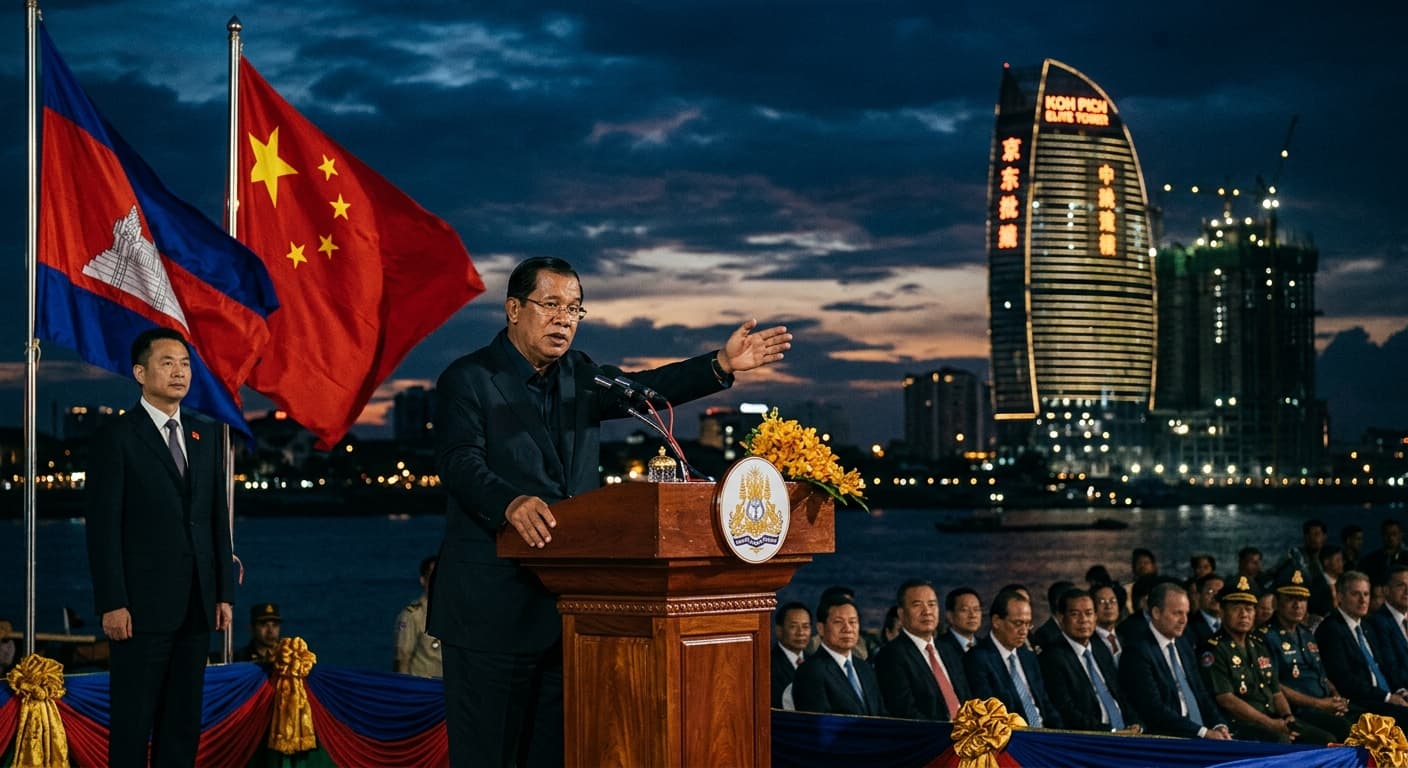
Cambodia's China Embrace Was Never About China — It Was About Hun Sen's Survival
A new study traces Cambodia's pivot to Beijing directly to Phnom Penh's domestic political battles. The finding explains why US tariffs are pushing Hun Manet deeper into the same embrace, not out of it.
Phnom Penh's alignment with Beijing is the most complete in Southeast Asia — and it has little to do with geopolitics. That's the core finding of a new study by Sebastian Strangio, Mingjiang Li, and Xirui Li published in the International Journal of Asian Studies, which traces Cambodia's Chinese embrace directly to the domestic survival calculations of Hun Sen and his Cambodian People's Party (CPP).
The causal chain is stark: when Hun Sen faced threatening political challenges from domestic rivals — most acutely from the now-dissolved Cambodia National Rescue Party (CNRP) — he responded with political repression. That repression triggered Western aid suspensions and democratization pressure. Cut off from traditional donors, Hun Sen had no choice but to turn to Beijing. Chinese investment, offered with no governance strings attached, became the regime's economic lifeline. In the authors' formulation, "the more severe the political challenges, the more Hun Sen sought China's support." Cambridge University Press
The timing matters. After the 1997 coup, Hun Sen's crackdown on the opposition led Western donors to withhold aid. China filled the vacuum. By 2012, Cambodia was blocking ASEAN statements on the South China Sea. By 2016, it had done so again — and was rewarded with $600 million in Chinese aid within months. Council on Foreign Relations
Why This Framework Matters Now
On the surface, Cambodia under Hun Manet — a West Point graduate who succeeded his father in 2023 — looks like it might be hedging. He has upgraded ties with South Korea and Thailand, pursued trade deals with the UAE and Brazil, and welcomed Japanese minesweepers to the Ream Naval Base in April 2025. NPR
But the Strangio-Li-Li framework suggests this diversification is tactical, not strategic. The underlying dynamic hasn't changed: the CPP still relies on Chinese economic patronage to deliver growth and legitimacy, and the West still ties engagement to democratic reform the CPP will never deliver. The paper notes that Hun Manet has "vowed to carry out his father's words," and that "legitimate democratic reforms in Cambodia are less likely to happen anytime soon."
The Trump administration's 49% tariff on Cambodian exports — among the highest rates globally — only tightens the lock. When Xi Jinping visited Phnom Penh in April 2025, he didn't need to threaten. The tariffs had already done the work. Cambodia, which sends the bulk of its garment and footwear exports to the US, suddenly needed China's market more than ever. As Chheang Vannarith, a Phnom Penh-based analyst, put it: "Cambodia is trying to diversify its export products and export markets... China is emerging to be another key destination." Al Jazeera
The irony is that Washington's tariff weapon is replicating the exact dynamic the Strangio paper describes: Western pressure pushes Cambodia toward Beijing. The Economist noted in January 2025 that Hun Manet's government was showing tentative signs of opening toward the West — but those signs predated the tariff shock. The Economist
The Realignment Was Never Ideological
A second insight from the research matters: Cambodia's China alignment isn't primarily ideological, despite the CPP and CCP sharing authoritarian affinities. It's transactional — a regime-survival bargain. China supplies what Cambodia's rulers need (infrastructure finance, diplomatic cover, non-interference), and Cambodia supplies what Beijing needs (an ASEAN veto, South China Sea acquiescence, a basing foothold at Ream).
That bargain predates the Belt and Road Initiative. It predates Xi Jinping. It began the moment Hun Sen calculated that Western donors would punish his consolidation of power and China would not.
What to Watch
The Funan Techo Canal. The $1.7 billion project to connect Phnom Penh to the Gulf of Thailand — reducing trade dependence on Vietnam — is the litmus test of whether China will continue bankrolling Cambodia's ambitions. Beijing has so far committed only 49% of financing, and disbursements have been slower than Phnom Penh expected. If China hedges, Cambodia's room for maneuver expands — marginally.
The US tariff reset. The 90-day pause on the 49% rate expires in July 2025. If Washington keeps the rate, expect Cambodia to sign more agreements with Beijing and deepen export dependence on China. If it negotiates downward, Hun Manet gets a diversification opening he can actually use.
The succession question. Hun Sen remains Senate President and the CPP's real power center. The Strangio paper is clear: as long as he lives, the domestic logic of the China embrace holds. The only variable is whether Washington recognizes this — or keeps treating Cambodia as a democracy project it can win back through pressure.
Discover more
US Politics
Virginia's Redistricting Referendum
Virginia's redistricting referendum is drawing a flood of dark money, shaping future elections and the fight for congressional control amid party stakes.
India
Women’s Reservation in India
India's 33% women's reservation law is enacted but won't take effect until after 2029 due to political setbacks and census delays.

US Politics
US Launches $166B Tariff Refund Portal
The US is launching a $166 billion tariff refund portal to aid importers hit by Trump-era tariffs, with major implications for trade and supply costs.
Global
Zimbabwe's 2030 Gambit: Mnangagwa's Rule
Zimbabwe's Constitutional Amendment No. 3 ends direct presidential elections, extending Mnangagwa's rule to 2030 and raising concerns over democratic integrity.