Katz vs. Trump: Israel's Lebanon Stance
Israel's defense minister rejects US withdrawal timeline.
Model Diplomat8 min readMiddle East
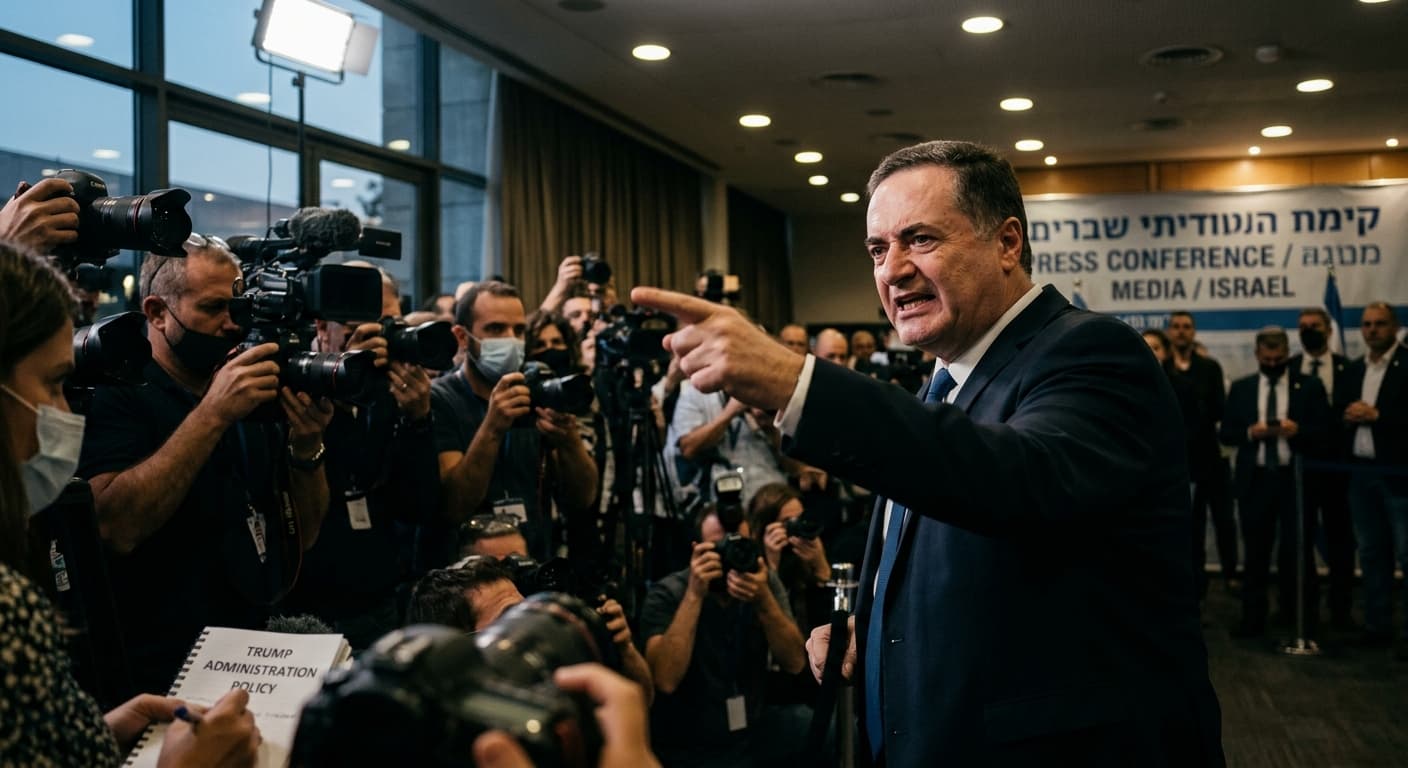
Katz vs. Trump: Israel Digs In for Open-Ended Lebanon Occupation
Israel's defence minister rejected a US-suggested withdrawal on July 9, 2026, tying troops to Hezbollah disarmament and locking in a 570-square-kilometre buffer zone.
Israel's Defence Minister Israel Katz publicly repudiated US President Donald Trump on July 9, 2026, declaring that Israel "did not ask anyone for permission to enter Lebanon, and we do not need permission to remain in Lebanon" — a deliberate signal that the June 26 trilateral framework signed at the State Department is now the ceiling of Israeli concessions, not the floor. The statement, reported by
JNS, came hours after Trump told reporters in Ankara that Prime Minister Benjamin Netanyahu had assured him Israeli forces "will leave." The gap between the two statements is the story: Washington wants an exit ramp; Jerusalem is publicly bolting the door shut and re-anchoring an open-ended occupation of roughly 570 square kilometres of southern Lebanon to a single trigger it alone gets to declare — the verified disarmament of Hezbollah.
The public break with Trump
Trump's remark, made alongside Syrian President Ahmed al-Sharaa, was unambiguous. "I talked to Bibi about that. I think they're going to. I think they want to. I don't think it's a question," he said, according to JNS. "They'll leave."
Katz's response, issued in Hebrew hours later, did not merely disagree. It denied that any external actor — the United States included — has standing to authorise or terminate Israel's presence. The Israel Defense Forces, he said, "established a strong security zone in Lebanon, stretching from the Mediterranean coast in the west to the Beaufort Ridge and the foothills of Mount Hermon in the east." That zone would remain "as long as necessary until Hezbollah is disarmed throughout Lebanon."
The framing matters. Katz has said versions of this before — telling Al Jazeera on June 24 that Israel would not withdraw "even if the US demands it," and warning that troops will stay "until further notice" in Lebanon, Syria and Gaza per
Emra News. What is new on July 9 is the sovereignty claim itself: Israel is asserting a unilateral right, not a bilateral or trilateral arrangement.
What the framework actually says — and doesn't
The July 9 statement is legible only against the text of the trilateral framework released by the US Department of State on June 26. Read closely, the document is a diplomatic win for Israel that has been widely misread as a withdrawal deal.
The operative clause commits the parties to "a reciprocal, sequenced process" in which the Lebanese Armed Forces "will restore effective sovereign authority over all Lebanese territory, pending the verified disarmament of non-state armed groups and dismantlement of associated infrastructure, enabling the Israel Defense Forces (IDF) to progressively redeploy out of the Lebanese territory." The sequencing is explicit: disarmament first, redeployment second, and only in agreed "pilot zones." As Al Jazeera's Zeina Khodr noted in her reading of the text, "the word withdrawal is not in the text."
The framework does contain one binding Israeli concession — the declaration that Israel "has no territorial ambitions in Lebanon" — but Finance Minister Bezalel Smotrich has already qualified it. "We are there until Hezbollah disarms, and I think also beyond that, because we need defendable borders," he told reporters, per Al Jazeera's explainer.
The territory in dispute
Israel's "security zone" is not a metaphor. Analysis of official IDF maps by the Al Jazeera Investigative Unit, published May 26, 2026, put the area under direct Israeli military control at approximately 570 square kilometres — around 6 percent of Lebanese territory and more than half of all land Israel has seized across Gaza, Syria and Lebanon since October 7, 2023. NPR reported in
April that five Israeli maneuvering divisions were deployed in Lebanon — matching the peak force level of the Gaza war — and that a person briefed on the matter said Israel had "no intention of withdrawing from the buffer zone for the coming months and maybe years."
The zone runs beyond the Litani River, the northern edge of the "Blue Line" that UNSC Resolution 1701 designated as the buffer boundary in 2006. On the ground, that means Israeli troops sit at Beaufort Ridge — the crusader-era hilltop that dominates the southern Nabatieh plateau — and along positions inside Lebanese customs territory that go well past the original five hilltops (al-Aziyah, al-Awaida, el-Hamames, Jabal Bilat, Labbouneh) that Israel refused to vacate under the November 2024 ceasefire.
The humanitarian footprint is the second measurable output. According to UN OCHA's Flash Update #35 of June 15, 2026, Lebanon's Ministry of Public Health has recorded at least 3,798 deaths and 11,781 injuries since renewed hostilities began on March 2, including 363 women and 247 children killed. OCHA's
June 25 update reports more than 523,000 displaced people beginning to return, but describes movements as "cautious and often temporary" in areas adjacent to the IDF-declared military zone.
Who wins from Katz's line
Three actors gain from the July 9 statement.
Netanyahu's coalition. Hardliners including Smotrich have made an open-ended Lebanon presence a coalition red line. By pre-empting any Trump-brokered exit ramp, Katz insulates the government from a repeat of the domestic backlash that followed the 2024 ceasefire, when far-right ministers accused Netanyahu of surrendering. The Al Jazeera analysis of Israeli reaction to the framework noted that even mainstream commentators frame the deal as validating Israel's terms.
The IDF's post-October 7 defence doctrine. RAND senior fellow Shira Efron, quoted by NPR, described the new doctrine plainly: "We clearly messed up judging adversaries' intentions. So now we're just looking at capabilities... We are preemptively taking out adversary capabilities, and we're creating buffer zones." Katz's statement operationalises that doctrine as public policy, not tactical posture.
Iran, paradoxically. Al Jazeera's July 1 analysis noted that Tehran needs to appear to hold the line on Hezbollah, but has no interest in the group's pre-2023 dominance being restored. Analyst Karim Emile Bitar told the outlet Iran may use Hezbollah's residual footprint "as a bargaining chip," incrementally traded against sanctions relief. An Israeli occupation that grinds Hezbollah down without triggering a full Iranian retaliation gives Tehran cover to concede on the ground while claiming solidarity in speech.
Who loses
Lebanon's state. President Joseph Aoun and Prime Minister Nawaf Salam gambled on the framework as, in Salam's words on X, a mechanism that "aims to achieve Israel's withdrawal from all Lebanese territories." Katz's rejection of external permission strips that reading of any leverage. The Lebanese Armed Forces, tasked with disarming Hezbollah in the two agreed pilot zones, gains no credible timetable in return.
Hezbollah. Secretary-General Naim Qassem called the framework "humiliating, shameful and a surrender of sovereignty" and rejected it as null and void. Excluded from Washington talks, its leadership decimated — Katz reiterated that Israel had killed Hassan Nasrallah and "destroyed most of Hezbollah's capabilities" — the group faces a strategic choice between accepting disarmament or triggering escalation that would forfeit remaining political capital in Beirut.
The US as mediator. Trump's Ankara remark was probably an attempt to give Aoun and Salam something to sell domestically. Katz's public correction demonstrates the limits of that leverage. As Al Jazeera reported, the Israeli position is "squarely at odds" with the first clause of the June 15 US–Iran Memorandum of Understanding, which called for an immediate, permanent halt to fighting "on all fronts." Washington now has two agreements — the MoU and the trilateral framework — whose implementation depends on an Israeli political choice it does not control.
The primary document, quoted
The framework's key sentence, from the State Department release:
"The Government of Israel and the Government of Lebanon commit to a reciprocal, sequenced process, with clear conditions, whereby the LAF will restore effective sovereign authority over all Lebanese territory, pending the verified disarmament of non-state armed groups and dismantlement of associated infrastructure, enabling the Israel Defense Forces (IDF) to progressively redeploy out of the Lebanese territory."
The word "pending" is doing the work. Verification authority, in practical terms, sits with the trilateral Military Coordination Group announced by Secretary of State Marco Rubio, and Israel is one of three voting members. That gives Jerusalem a de facto veto on any determination that Hezbollah has disarmed.
The historical parallel worth watching
Ronnie Chatah, host of The Beirut Banyan podcast, told Al Jazeera the current architecture echoes the 1983 May 17 Agreement between Israel and Lebanon, brokered by the United States, which collapsed within a year after Syrian and Iranian-backed forces — Hezbollah among them — mounted attacks on international peacekeepers and the US embassy in Beirut. The subsequent Israeli withdrawal in 2000 came under Hezbollah fire, not diplomatic pressure.
That precedent cuts both ways. It warns that a framework Hezbollah rejects is unlikely to hold. But it also tells Israeli planners that patience, not diplomacy, is what eventually forces the terms. Katz's July 9 statement suggests the second lesson has been internalised in Tel Aviv.
What to watch
- Security Annex publication. The framework promises a technical annex specifying verification, timelines and the two initial pilot zones. It has not yet been published. Whichever party first breaches its terms — or refuses to sign it — will define the deal's actual boundaries.
- US Congressional posture.
H. Res. 1379, introduced June 23, 2026 by Rep. Josh Gottheimer, condemns Hezbollah's ceasefire violations and endorses the framework's disarmament-first sequencing. A House floor vote would signal that Trump's Ankara softening is not shared on Capitol Hill.
- Hezbollah's next fire decision. Since June 15, Hezbollah has largely held fire while denouncing the framework. A resumption of rocket or drone launches — particularly on Israeli forward positions inside the security zone — would give Katz the operational pretext to expand, not contract, the occupation.
- The Netanyahu–Aoun meeting. Trump signalled in Ankara that both leaders would visit Washington "over the next couple of weeks." No date has been announced. If it happens, expect the pilot-zone timeline to be the central bargaining chip.
The Bottom Line
Katz's July 9 statement is not defiance for its own sake — it is a public re-declaration that the June 26 framework binds Lebanon and Washington, but not Israel, to a schedule. By anchoring the IDF's presence to Hezbollah's disarmament, verified by a committee Israel sits on, Jerusalem has converted a 570-square-kilometre occupation into an open-ended one at Trump's expense. The next test is not whether Israel withdraws, but whether Hezbollah accepts that the price of ending the occupation is its own end as an armed movement.
Discover more
Global Politics
Xi Jinping Calls China-Russia Ties 'Precious'
Xi Jinping's description of China-Russia ties as 'precious' reflects a strategic imbalance, with Beijing dictating terms in the partnership.
US Politics
U.S. House Passes Alert Act for Aviation
The House passed the ALERT Act 396–10, replacing the ROTOR Act after Pentagon intervention, impacting aviation safety regulations.

US Politics
SNAP Food Assistance Faces Legal Challenges
In 2026, SNAP faces stricter eligibility rules and mounting legal challenges, threatening food assistance for the millions of Americans who rely on the program.

Conflict & Security
Drone Warfare Killing Aid Workers at Unprec
Over 1,000 humanitarian workers killed in three years as cheap armed drones collapse legal protections. Gaza, Sudan, Ukraine, and DRC see deliberate targeting of aid convoys and hospitals with zero prosecutions.