Katz Defies Trump on Lebanon: No Permission
Israel's defense minister rejects U.S. withdrawal push.
Model Diplomat8 min readMiddle East
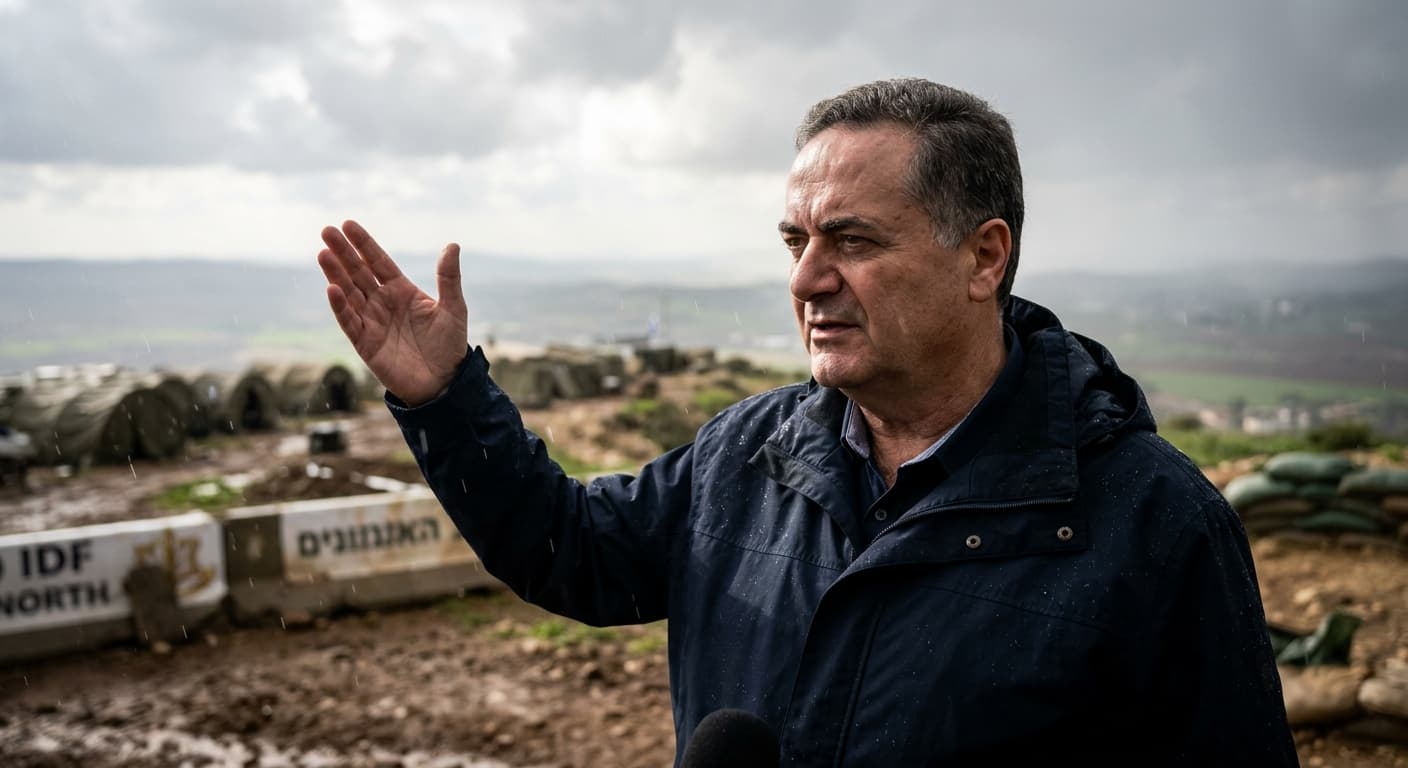
Katz Defies Trump on Lebanon: 'No Permission' Needed to Stay
Israel's defense minister rejected a U.S. withdrawal push on July 9, 2026, anchoring occupation of ~570 km² of southern Lebanon to Hezbollah's disarmament.
Hours after U.S. President Donald Trump told reporters in Ankara on July 8, 2026 that he believed Israel would leave Lebanon — "They'll leave" — Israeli Defense Minister Israel Katz put out a Hebrew-language statement declaring that Israel "did not ask anyone for permission to enter Lebanon, and we do not need permission to remain in Lebanon." The exchange, reported by JNS, is the sharpest public split between Jerusalem and Washington since the U.S.–Iran Memorandum of Understanding was signed on June 15. It exposes the operative logic behind Israel's continued occupation of roughly one-fifth of southern Lebanon: the Netanyahu government is treating the June 26 Trilateral Framework not as a ceasefire timetable but as a permanent license, and it is prepared to say so to an American president's face.
What Katz actually said, and why the timing matters
Katz's statement was not an off-the-cuff remark. It was a written rebuttal, issued through the Defense Ministry, to Trump's comments at a joint press conference in Ankara with Syrian President Ahmed al-Sharaa. "It is our right and our duty to protect the residents of the Galilee and the citizens of Israel from the threats posed by the jihadist Hezbollah terrorist organization," Katz said, adding that the IDF would remain in the security zone "as long as necessary until Hezbollah is disarmed throughout Lebanon," according to JNS.
The July 9 statement is the fourth escalation in five weeks. On June 9, Katz warned the IDF would keep operating in Lebanon even after the Iran ceasefire pause, reported Middle East News. On June 15, he told Israeli radio the IDF would remain in Lebanon, Syria and Gaza "for an unlimited period of time,"
per Al Jazeera. On June 24 he added that the army "will not withdraw a millimetre" even under American pressure,
per Times of Israel. July 9 is the first time he has framed the position as a sovereign right requiring no external sign-off — a rhetorical upgrade timed precisely to the Trump statement he was contradicting.
The Trilateral Framework: a permission slip in Israel's pocket
The document Katz is leaning on is the "Trilateral Framework Between the United States of America, the State of Israel, and the Republic of Lebanon," signed at the State Department on June 26, 2026 by Secretary of State Marco Rubio, Lebanese Ambassador Nada Hamadeh Moawad and Israeli Ambassador Yechiel Leiter. Rubio, in the U.S. announcement, described the deal as "the beginning of the beginning," and stated:
"This agreement establishes a clear and structured process to restore Lebanon's sovereignty, disarm Hezbollah and dismantle its terrorist infrastructure, and enable Israel to return to its borders once that threat to its citizens is removed."
Rubio's sequencing is the key. The framework does not require Israel to leave Lebanon. It describes a "sequenced process" in which the Lebanese Armed Forces "will gradually assume full and effective security responsibility" only "pending the verified disarmament of non-state armed groups," Al Jazeera reported from the released text. Two "pilot zones" near Nabatieh — one south of the Litani, one just north of it in ground the IDF says it does not need — are designated for a limited initial pullback. Everything else waits.
Israel's own think-tank world reads the deal as an unambiguous win. Orna Mizrahi of the Institute for National Security Studies wrote in an INSS analysis that the framework secures "implicit agreement that the IDF may, for the time being, continue to maintain a presence in the buffer zone (up to the Yellow Line)" and "recognition of the IDF's right to self-defense" against threats to its forces. The classified military annex, per Mizrahi, keeps every step of withdrawal contingent on U.S.-supervised verification.
Katz's July 9 statement, in other words, is not defiance of the Trilateral Framework. It is the framework — spoken aloud to the president who helped write it.
The MoU Israel is quietly nullifying
What Katz is defying is the earlier U.S.–Iran deal. On June 15, Washington and Tehran signed a 14-point Memorandum of Understanding whose first clause required "the immediate and permanent termination of military operations on all fronts, including in Lebanon," Al Jazeera confirmed. Iran extracted that clause specifically to shield Hezbollah and to demand full Israeli withdrawal from occupied Lebanese territory as a condition of any broader U.S.–Iran peace.
Eleven days later, the Trilateral Framework quietly gutted it. As Al Jazeera's Nils Adler put it in a July 1 analysis, the Israeli stance is "squarely at odds" with the MoU's first clause, and the U.S. has effectively brokered two agreements that cannot both be true. Katz's statement makes explicit what Netanyahu's government has been doing operationally: honoring the framework, ignoring the MoU.
That is the load-bearing strategic move. By insisting the security zone is unrelated to Iran, Israel is trying to strip Tehran of the leverage the MoU was designed to give it. Netanyahu said it plainly on June 27: "Israel, Lebanon and the United States are telling Iran — it is none of your business. You have no role in Lebanon."
The ground: what the security zone actually is
The zone Katz refuses to leave is not symbolic. Since Hezbollah resumed fire on March 2, 2026 — a day after U.S.–Israeli strikes killed Ayatollah Ali Khamenei — the IDF has occupied approximately 570 square kilometers of Lebanon, or roughly one-fifth of the country's south, Al Jazeera has reported. Katz has described the line as running "from the Mediterranean coast in the west to the Beaufort Ridge and the foothills of Mount Hermon in the east."
The humanitarian cost is documented in primary UN reporting. Lebanon's Ministry of Public Health has recorded at least 3,798 deaths and 11,781 injuries since March 2, according to OCHA Flash Update #35. Over 1.2 million people were displaced at the peak. By June 25, 59,700 were still in collective shelters and 523,000 had begun returning — cautiously —
per OCHA Flash Update #38. Since March 22, Katz has ordered "accelerated destruction" of Lebanese border villages on what he called the Rafah and Beit Hanoun model, satellite imagery examined by
BBC News confirmed.
UNIFIL reports the reality on the ground is not de-escalation but managed occupation. On one day in late June, peacekeepers observed 143 projectile trajectories — 119 attributed to Israel, the rest to Hezbollah — and a UNIFIL convoy in Tiri was blocked by two Israeli tanks that trained their weapons on the patrol, UN News reported. The Security Council extended UNIFIL's mandate through December 31, 2026, but then "for a final time," with a one-year drawdown afterward,
according to UN Peacekeeping. The U.S. voted for termination.
That U.S. vote matters. Washington has been simultaneously dismantling the international monitoring architecture in southern Lebanon while endorsing an Israeli security zone that requires monitoring. The contradiction is not an oversight.
Why Katz is escalating rhetoric now
Three pressures explain the timing.
First, Trump is publicly wavering. Alongside Syria's al-Sharaa on July 8 — itself a signal of shifting regional geometry — Trump said of Netanyahu, "I talked to Bibi about that. I think they're going to. I think they want to. I don't think it's a question." As JNS reported, Katz's statement is a direct rebuttal aimed at closing that door before it opens.
Second, Israel is heading into an election cycle. Israeli polling cited by Al Jazeera shows the public reluctant to end the Hezbollah offensive; Netanyahu and Katz have political incentives to be seen resisting American pressure, not accommodating it. Finance Minister Bezalel Smotrich has already floated staying "beyond" disarmament for "defendable borders."
Third, the disarmament process is stuck. The Lebanese army announced on January 8, 2026 that it had completed Phase 1 south of the Litani, BBC News reported. Netanyahu's office called this "encouraging" but "far from sufficient." Phase 2 — the stretch between the Litani and Awali rivers — has no timetable and, per Hezbollah MP Hassan Fadlallah, would trigger "civil war" if enforced. Hezbollah leader Naim Qassem has
called the framework "null and void". Since Israeli withdrawal is contingent on a disarmament that is not happening, the security zone becomes permanent by default. Katz is codifying that outcome.
The historical parallel Israeli policymakers should not ignore
Analysts point to 1983. That year a U.S.-brokered tripartite agreement between Lebanon and Israel collapsed within months; a wave of attacks on international peacekeepers and the U.S. embassy followed, and Hezbollah emerged as the dominant security actor in Lebanon as Israeli forces later withdrew under fire, political commentator Ronnie Chatah reminded Al Jazeera. The current framework rhymes uncomfortably: exclusion of the armed group whose disarmament is the deal's core condition; a Lebanese state that cannot compel it; an occupation whose duration is defined by an enemy's choice.
Alon Pinkas, a former Israeli consul general in New York, told Al Jazeera he is "very doubtful and sceptical that this will work out," because "the issue here is Hezbollah" and Hezbollah is not at the table. Six major human rights organizations, including Amnesty International and Human Rights Watch, warned in a July 3 joint statement that clauses 3 and 13 of the framework appear designed to shield both states from ICC and ICJ scrutiny — a further sign the agreement is built for operational latitude, not durable peace.
The Bottom Line
Israel's July 9 statement is not diplomatic freelancing — it is the strategy. The Netanyahu government has secured, through the June 26 Trilateral Framework, exactly what it wanted from a full year of war with Hezbollah: an occupation zone of roughly 570 km² of Lebanese territory whose duration is set by Hezbollah's own weapons, not by any calendar or by any American president. Katz is telling Trump, out loud, that the security zone is now a fact, not a negotiation.
What to watch
- The Nabatieh pilot zones: The two limited areas designated for initial Israeli redeployment under the June 26 framework are the only near-term test of whether the deal produces any territorial movement. The joint military liaison committee's first verification report is the earliest hard signal.
- UNIFIL's June 1, 2027 report: Under Resolution 2790 (2025), the UN Secretary-General must present options for the future implementation of Resolution 1701 by that date. It will determine what international monitoring, if any, replaces UNIFIL after its December 2026 mandate expires.
- Iranian re-engagement: Tehran conceded on Lebanon to sign the June 15 MoU. If Katz's rhetoric persuades Iranian leadership that Washington cannot deliver an Israeli withdrawal, Iran has every incentive to slow-walk the permanent peace agreement — and to quietly rearm Hezbollah in the interim.
- Phase 2 disarmament: The Lebanese army has no announced timetable for the Litani–Awali stretch, and Hezbollah has said it will resist. The first LAF operation north of the Litani will be the moment the framework either functions or collapses.
Discover more
US Politics
U.S. House Passes Alert Act for Aviation
The House passed the ALERT Act 396–10, replacing the ROTOR Act after Pentagon intervention, impacting aviation safety regulations.
US Politics
SNAP Food Assistance Faces Legal Challenges
In 2026, SNAP faces stricter eligibility rules and mounting legal challenges, threatening food assistance for the millions of Americans who rely on the program.
India
700 Activists Accuse PM Modi of MCC Breach
Over 700 activists allege PM Modi breached election code with a televised address attacking opposition parties just before state elections.

Conflict & Security
Drone Warfare Killing Aid Workers at Unprec
Over 1,000 humanitarian workers killed in three years as cheap armed drones collapse legal protections. Gaza, Sudan, Ukraine, and DRC see deliberate targeting of aid convoys and hospitals with zero prosecutions.