Israel's Katz Defies Trump on Lebanon
Israeli Defense Minister asserts autonomy in Lebanon
Model Diplomat5 min readMiddle East
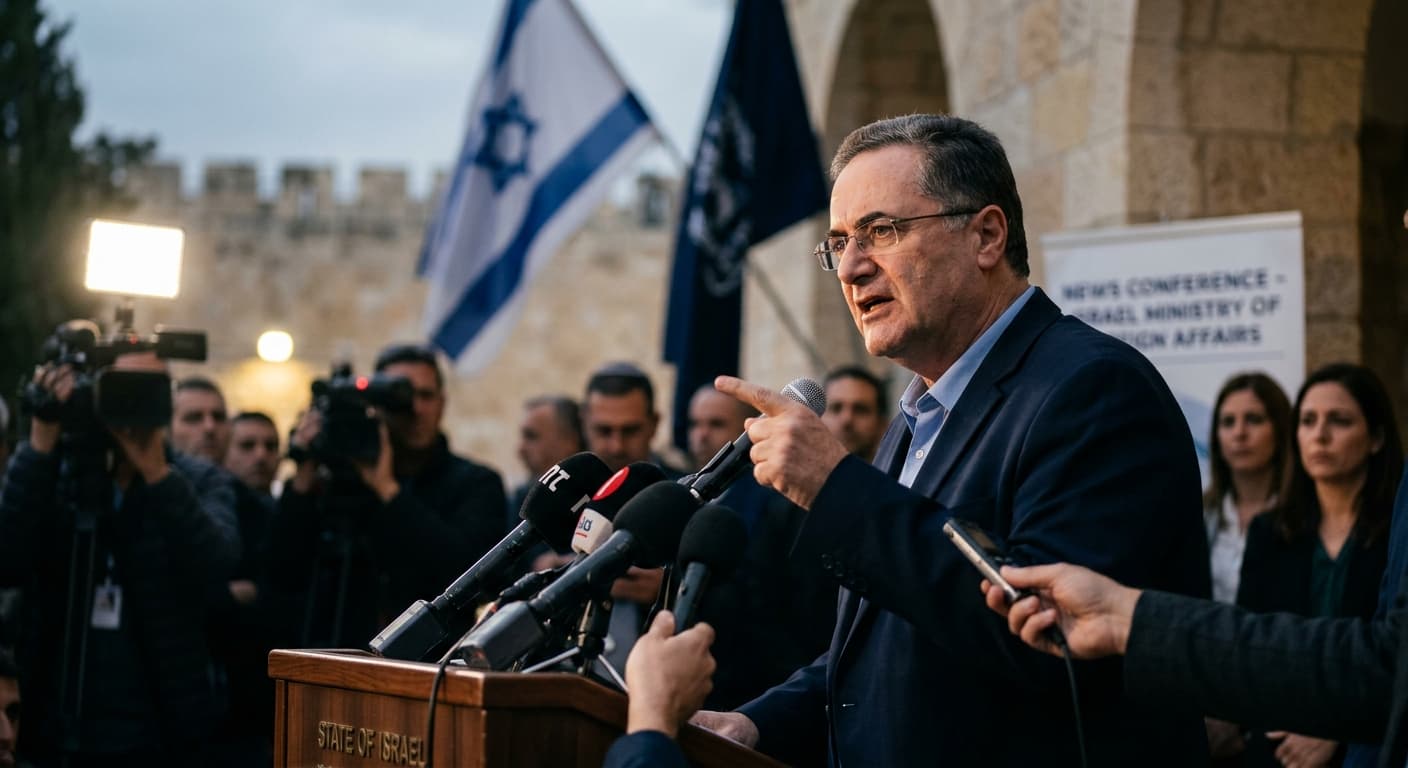
Israeli Defense Minister Israel Katz said Thursday that Israel needs no one's permission to stay in southern Lebanon — a direct rebuke of President Trump's remarks at the NATO summit in Ankara suggesting a withdrawal framework was in motion. Read together, the two statements function as a division of labor.
Who benefits from the split screen
Read together, Trump's Ankara comments and Katz's response function as a division of labor. Trump gets to tell al-Sharaa — and, indirectly, Tehran — that a withdrawal is coming. Katz gets to tell northern Israeli voters, and the settler right inside Netanyahu's coalition, that it is not. Both audiences hear what they need. The framework itself moves an inch.
Finance Minister Bezalel Smotrich said the quiet part out loud on June 25: "We are there until Hezbollah disarms, and I think also beyond that, because we need defendable borders," per Al Jazeera. This is the through-line of what Israeli analysts, including RAND senior fellow Shira Efron, describe as Israel's post-October 7 doctrine: judge adversaries by capabilities, not intentions, and pre-emptively hold buffer zones on foreign soil, as reported by
NPR.
The Lebanese state is the party that pays. President Joseph Aoun told a British delegation on June 24 that the framework "does not legitimise the continued Israeli occupation of Lebanon," and that the Lebanese army will assume responsibility only "after the withdrawal of Israeli forces," per Al Jazeera. That sequencing is the opposite of what Katz and the U.S. text require. Aoun's government has no leverage to close the gap. Hezbollah has the leverage but not the political room — Prime Minister Nawaf Salam has publicly told Tehran to stop treating Lebanon as a "bargaining chip," according to Al Jazeera reporting from June 5.
The humanitarian floor
The UN Office for the Coordination of Humanitarian Affairs (OCHA) has tallied the cost. Its Flash Update #35, dated June 15, 2026, records at least 3,798 deaths and 11,781 injuries since hostilities re-escalated on March 2, including 363 women and 247 children killed. UN Humanitarian Coordinator Imran Riza warned in
a June UN News briefing that "at minimum probably around 200,000" Lebanese may be unable to return to destroyed villages — three times the post-2024 displacement.
By June 25, OCHA reported, shelter caseloads had fallen to 59,700 as more than 523,000 displaced people began returning, though Flash Update #38 noted movements remained "cautious and often temporary" near the IDF-declared military zone. Six human rights groups, led by Amnesty International and Human Rights Watch, warned in
a joint statement carried by Al Jazeera that Clauses 3 and 13 of the June 26 framework appear designed to block Lebanon and Israel from taking cases to the ICC or ICJ.

The historical parallel that reframes this
Katz's promise of an open-ended security zone tied to a disarmament that Hezbollah refuses is not a new experiment. It is, almost line-for-line, the arrangement Israel imposed after its 1982 invasion. Ronnie Chatah, host of The Beirut Banyan podcast, pointed to the precedent in Al Jazeera's July 1 analysis: the 1983 tripartite Israel-Lebanon-U.S. agreement collapsed, was followed by attacks on international peacekeepers and the U.S. Marine barracks, and produced Hezbollah as a "dominant security actor" inside a Lebanon Israel was then forced to leave in 2000.
Every element of that trajectory is present now: a U.S.-brokered accord Lebanese factions reject as unequal, an Israeli occupation defined as temporary but administered as permanent, and a domestic Lebanese security force too weak to enforce it. What is different is that Hezbollah entered this war weakened — Katz's own statement claims "most of Hezbollah's capabilities and leadership" have been dismantled, including Hassan Nasrallah. Whether that attrition runs deep enough to prevent the 1983 pattern from repeating is the wager Israel is placing — and losing is not an option it has priced in.
Alon Pinkas, former Israeli consul general in New York, is skeptical. "If the idea is to eliminate, annihilate, eviscerate," he told Al Jazeera on June 5, "then effectively you need to occupy the entire state of Lebanon. That's not only not viable and immoral, it's also just not practical."
The second-order risk: the maritime line
The under-reported dimension is offshore. The IDF's Yellow Line map, published on April 19, extends into Lebanon's exclusive economic zone and overlaps two blocks of the Qana gas project — the same fields whose Lebanese exploration rights were guaranteed by the 2022 U.S.-mediated maritime border agreement, per Al Jazeera's June 12 investigation. Lebanese Energy Minister Joe Saddi told Reuters the map "doesn't change anything" legally. It changes plenty operationally: TotalEnergies and its partners will not drill under Israeli guns.
That is the quieter payoff of Katz's posture. A "security zone" that stays put also freezes Lebanon's most valuable energy asset. The 2022 maritime deal was the one uncontested U.S. diplomatic win in the Levant that decade. It is now, in effect, suspended.
What to watch
- Rome talks. Israeli and Lebanese delegations are heading to Rome for the next round of withdrawal negotiations,
per JFeed. The pilot-zone handover is the first test of whether the June 26 framework produces any actual Israeli movement.
- The US-Iran MoU sequencing. Tehran has tied a permanent nuclear deal to a full Lebanon ceasefire. If Trump wants the nuclear file closed before U.S. midterms, he needs at least the appearance of an Israeli withdrawal. The question is whether he escalates public pressure on Netanyahu beyond the Ankara comments.
- Hezbollah's disarmament posture. Parliament Speaker Nabih Berri has floated a conditional Hezbollah pullback from south of the Litani in parallel with an Israeli withdrawal,
per Al Jazeera on June 5. That is the only formula that could break the framework's chicken-and-egg. Qassem has publicly rejected it.
- Israeli elections, expected around October. Netanyahu cannot afford to be seen withdrawing from Lebanon before the vote. Any real redeployment clock starts the morning after.
The Bottom Line
Katz's line — that Israel needs no one's permission to stay in Lebanon — is not a break with Trump. It is a description of what the June 26 trilateral framework already permits: an Israeli occupation whose end is conditioned on a Hezbollah disarmament that will not happen, held together by a Lebanese state too weak to force either party's hand. The security zone is not a step toward the 2024 ceasefire's Litani River line. It is a step back toward the 1982 model — and, offshore, a quiet freeze on the only Lebanese gas play that mattered.
Discover more

India
Yamini Aiyar on Modi's Federalism Shift
Yamini Aiyar critiques Modi's shift from equity-based to performance-based federalism, highlighting implications for India's political landscape.
Global Politics
US-Iran Tensions Rise
Tensions escalate in the Strait of Hormuz as Iran and the US clash over maritime control, with a ceasefire hinging on a contested MoU paragraph.
Global Politics
Xi Jinping Calls China-Russia Ties 'Precious'
Xi Jinping's description of China-Russia ties as 'precious' reflects a strategic imbalance, with Beijing dictating terms in the partnership.

Conflict & Security
Drone Warfare Killing Aid Workers at Unprec
Over 1,000 humanitarian workers killed in three years as cheap armed drones collapse legal protections. Gaza, Sudan, Ukraine, and DRC see deliberate targeting of aid convoys and hospitals with zero prosecutions.