Ireland's Settlement-Import Ban Tests ICJ Rul
Dáil passes EU's first ban on Israeli settlement imports, testing ICJ ruling
Model Diplomat10 min readEurope
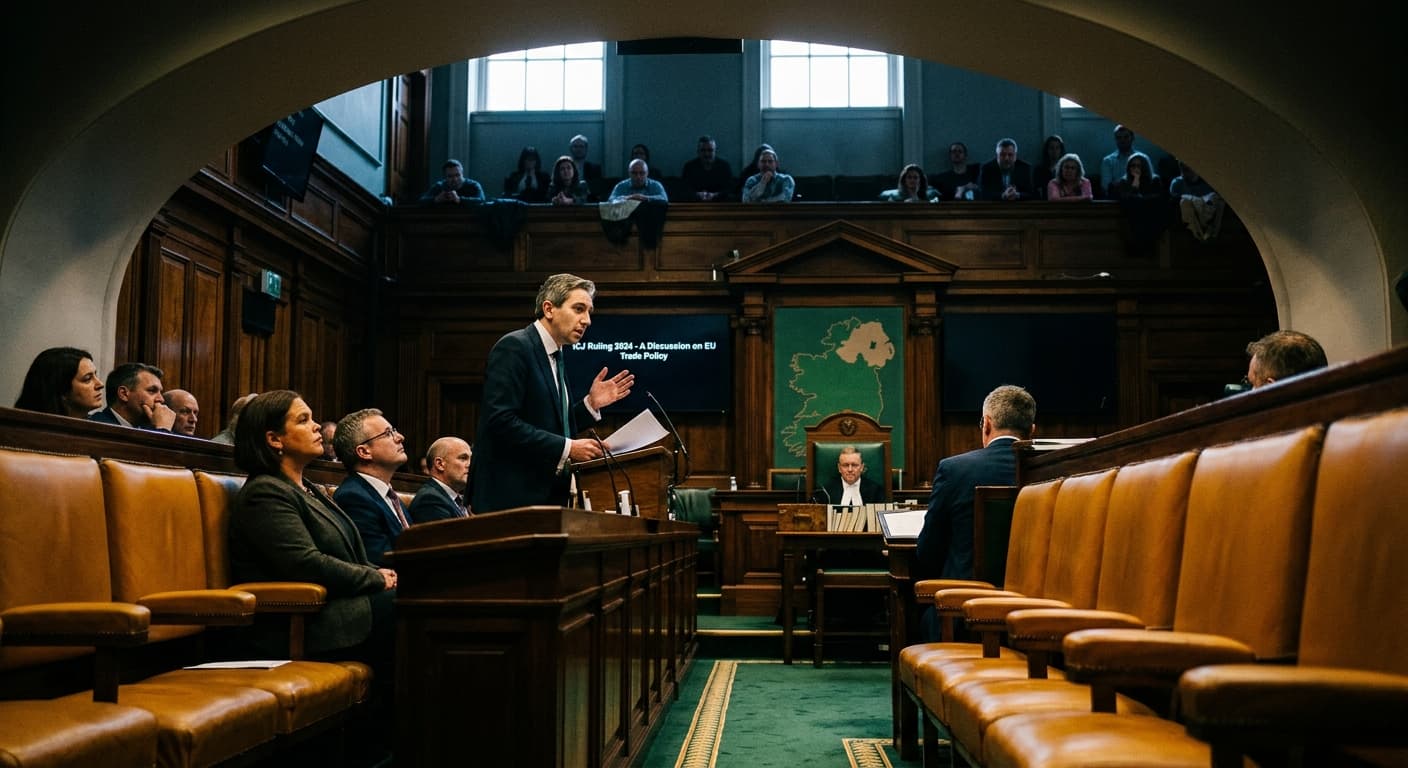
Ireland's Settlement-Import Ban Is the First Real Test of the ICJ's Occupation Ruling
Ireland's Dáil approved the EU's first ban on Israeli settlement goods on July 7, 2026 — the first national law built explicitly on the ICJ's July 2024 advisory opinion, and a test case for whether EU member states can act where the bloc has not.
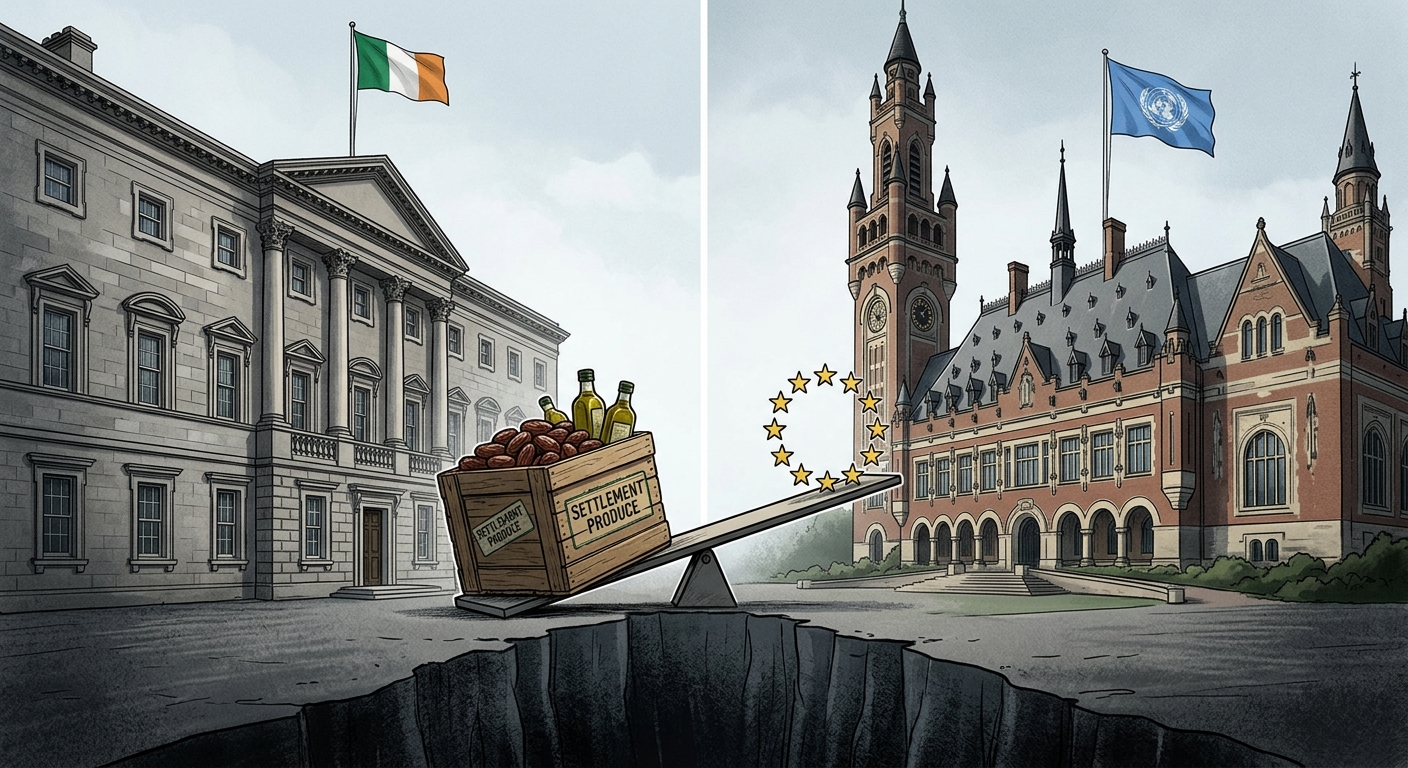
On July 7, 2026, Ireland's Dáil approved the Israeli Settlements (Prohibition of Importation of Goods) Bill, making Ireland the first EU member state to legislate a ban on imports from Israeli settlements in the West Bank and East Jerusalem. The decisive fact is not the ban's economic weight, which is negligible, but its legal architecture: the bill is the first national statute explicitly designed to operationalize the International Court of Justice's July 19, 2024 advisory opinion, which held that all states must "take steps to prevent trade or investment relations that assist in the maintenance of the illegal situation created by Israel" in the occupied territories (UN Question of Palestine). The bill moves to the Seanad for debate the week of July 13, where it is expected to pass. Its real significance is that it creates a working template — and a live legal test — for how an EU member state can restrict trade with settlements without breaching the bloc's exclusive competence over commercial policy, at a moment when the European Commission is itself under pressure to act.
The law, and what it does not do
The bill, drafted by Ireland's centre-right Fianna Fáil–Fine Gael coalition, prohibits the import of goods produced in "certain Israeli settlements" and gives customs officers powers to stop and seize restricted goods at the border. (Jewish News). Goods produced within Israel's internationally recognised borders remain unaffected. Ireland's trade with the settlements was worth less than €1 million combined between 2020 and 2024, according to
Novara Media, meaning the immediate material impact is close to zero. Ireland's annual trade with Israel proper, by contrast, runs to roughly $6 billion (
NPR), and that relationship is untouched.
The bill is also narrower than the long-debated "Occupied Territories Bill" first introduced by independent Senator Frances Black in 2018, which would have criminalised trade in both goods and services from occupied territories worldwide (Al Jazeera). The Black bill passed the Dáil 78–45 in January 2019 — Israel reprimanded Ireland's ambassador in response — but the government refused to advance it, citing EU law (
Al Jazeera). The government's 2026 version covers goods only. During the Dáil debate, People Before Profit–Solidarity TD Paul Murphy accused the coalition of having "absolutely gut" the legislation, arguing that services account for roughly 70% of trade and that excluding them "removes the majority of trade" (
Novara Media). Amnesty International's secretary-general separately urged Dublin to "strengthen" the bill to cover all imports, exports, services and investments, saying the legislation "is rooted in international law and would enable Ireland to fully comply with" the ICJ opinion (
Amnesty International).
The narrowing is not accidental. It is the product of years of wrangling over EU treaty law — and it is the feature that makes the bill a precedent rather than a gesture.
The competence problem
The central obstacle for any single EU member state that wants to ban imports is Article 207 TFEU, which gives the EU exclusive competence over the common commercial policy. As a customs union, the bloc applies common import rules uniformly; in principle, only the EU can decide to prohibit the importation of goods from third countries, and member states cannot adopt their own national rules in the absence of an express EU authorisation (European Parliament). The Commission's 2019 written submission to the Oireachtas was explicit: it recalled "the EU's exclusive competence on the common commercial policy" and warned that it "would take action to remove such measures, if it considered them not proportionate and justified" (
European Parliament).
That is why the Irish government stalled Frances Black's bill for years. The new government bill, by limiting itself to a defined set of settlement goods and framing the ban as compliance with international legal obligations rather than a general commercial-policy measure, is a deliberate attempt to thread that needle. Article 36 TFEU permits import restrictions on grounds of "public morality" or "public policy" — and the ICJ opinion, endorsed by the General Assembly in September 2024, gives any such restriction a treaty-law anchor that no prior national attempt has possessed.
The UNGA resolution is worth quoting directly, because it spells out what the ICJ opinion required:
All States are under an obligation not to recognize as legal the situation arising from the unlawful presence of the State of Israel in the Occupied Palestinian Territory and not to render aid or assistance in maintaining the situation created by the continued presence of the State of Israel in the Occupied Palestinian Territory (
UN General Assembly).
The resolution then specifies that states should implement this by "[a]bstaining from entering into economic or trade dealings with Israel concerning the Occupied Palestinian Territory or parts thereof which may entrench its unlawful presence" and "[t]aking steps to prevent trade or investment relations that assist in the maintenance of the illegal situation" (UN General Assembly). The Irish bill's drafters cite this language directly. Whether it survives a potential infringement challenge will turn on whether the European Court of Justice accepts that a measure narrowly tied to a specific ICJ advisory opinion — and a General Assembly resolution implementing it — falls within the Article 36 exception or, alternatively, whether the Commission considers the political cost of challenging Dublin too high.
The bloc-wide squeeze
Ireland is not acting in isolation. It is the most visible node in a coordinated pressure campaign aimed at forcing the European Commission to propose a bloc-wide ban — something the Commission has so far resisted. In February 2025, more than 160 NGOs and trade unions, led by Human Rights Watch, told Commission President Ursula von der Leyen that a ban on all trade and business with settlements "is not an option" but an obligation under the ICJ ruling, and that the EU's existing differentiation policy — which denies preferential tariff treatment to settlement goods but still allows them to enter the EU market — falls short (Human Rights Watch). HRW reiterated the argument on June 30, 2026, days before the Dáil vote, stating that "even if tariffs on settlement goods and services were applied as intended (which they aren't), that still would not prevent trade with the settlements" and that such trade "contributes to their economic viability, in breach of international law" (
Human Rights Watch).
The Commission has been cornered by its own legal logic. It has acknowledged that it has the authority to propose a ban on trade with settlements under the Common Commercial Policy. (Human Rights Watch). It has unanimously and repeatedly condemned the settlements as illegal. Yet it has refused to act, citing the need for a qualified majority of member states and the political reality that Germany, Italy, and Hungary have blocked stronger measures. In October 2025, a blocking minority prevented agreement on a Commission proposal to suspend trade provisions of the EU-Israel Association Agreement, and the proposal was frozen after the October 10 ceasefire deal brokered by U.S. President Donald Trump (
Centre for European Reform). The Commission proposal remains "on the table" but inert.
Ireland's move shifts the calculus. If Dublin enacts a national ban and the Commission declines to challenge it — or loses a challenge — other member states gain a template. Spain, Slovenia, and Ireland have already pressed for a bloc-wide response, and diplomats told Euronews that the Commission is expected to present a "list of options" to restrict settlement trade at the July 13 meeting of EU foreign ministers (Novara Media). If the Commission tables a proposal for a ban under the Common Commercial Policy, it would need approval by a qualified majority of member states and by the European Parliament (
Human Rights Watch). Ireland's law, by demonstrating that a national measure can be drafted to survive the competence question, raises the political cost of continued Commission inaction.
Corporate due diligence and the services gap
The bill's restriction to goods creates a gap that goes beyond the 70% services-trade figure cited by critics. Ireland is a corporate hub: Dublin hosts the European headquarters or major offices of dozens of multinationals, including Airbnb and Etsy, both of which have been challenged for listing or facilitating settlement-related business through their Irish subsidiaries (Al Jazeera). A goods-only ban does nothing to compel those companies to end settlement-linked activity conducted through digital platforms, financial services, or tourism listings routed through Irish-domiciled entities.
A separate piece of Irish legislation — the "Illegal Israeli Settlements Divestment Bill" — would prohibit Irish state investment in businesses that appear in the UN's database of companies involved in settlements, though it has not yet passed (Al Jazeera). Together, the two bills would address goods and state investment but still leave private-sector services untouched — the largest exposure Ireland has to the settlement economy, precisely because of its role as a corporate domicile. HRW has called for a reinforced EU business advisory discouraging all trade with settlements, including engagement with Israeli banks and enterprises operating there, and covering "the entire value chain" (
Human Rights Watch).
The due-diligence angle matters beyond Ireland. The EU's Corporate Sustainability Due Diligence Directive (CSDDD), adopted in 2024, requires large companies to identify and address adverse human-rights impacts in their supply chains. The ICJ advisory opinion explicitly found that Israel's policies constitute a breach of Article 3 of the International Convention on the Elimination of All Forms of Racial Discrimination, prohibiting racial segregation and apartheid (Human Rights Watch). Companies trading with settlements are therefore not only operating in legally occupied territory but in territory where a court has found systemic violations of peremptory norms. For corporate legal officers, the Irish bill — and any EU-wide successor — converts what was a reputational risk into a compliance risk.
The historical parallel
Ireland has been here before. In the 1980s, Dublin was one of the first Western states to impose a comprehensive import ban on apartheid South Africa — a move driven by the same coalition of civil-society activism, cross-party political consensus, and a legal framing rooted in international obligations. Mary Manning, a Dublin shop worker who in 1984 refused to handle South African fruit, became a national symbol; the Irish Congress of Trade Unions backed her; the government eventually legislated (NPR). The apartheid ban, like the settlement ban, had negligible direct economic impact on Ireland. Its significance was precedent: it demonstrated that a small member state could act alone and survive legal challenge, and it built momentum for a European Community-wide sanctions regime.
The apartheid ban operated in a pre-single-market legal framework. The 2026 bill operates inside the EU customs union, where the Commission has explicit treaty authority over trade policy and a record of enforcing it. The precedent value of the Irish bill is therefore not just political but jurisprudential: it tests whether the Article 36 public-morality exception can absorb an obligation derived from an ICJ advisory opinion — a question no European court has yet answered.
Who wins, who loses
The immediate winners are the Irish government and the coalition of civil-society groups, legal scholars, and parliamentarians who have pushed the measure since 2018. Fianna Fáil and Fine Gael gain domestically: they can claim they delivered a ban that the opposition advocated, while the narrowing to goods-only gives them a defensible legal posture. The ICJ and the UNGA gain an implementing actor — the first concrete national action under their July 2024 framework. Human Rights Watch and Amnesty International gain leverage in their campaign for a bloc-wide ban.
The immediate losers are the European Commission, which faces either the embarrassment of challenging a member state for complying with an ICJ ruling or the erosion of its trade-policy competence if it lets the law stand, and the blocking minority of member states — Germany, Italy, Hungary — that have resisted a EU-wide response. Israel loses diplomatically: the ban, even at sub-€1 million scale, is the first national import restriction by an EU member state explicitly grounded in the ICJ's finding of unlawful occupation. Israeli companies operating in settlements lose a market, albeit a tiny one. The larger corporate losers are companies like Airbnb and Etsy, whose Irish-domiciled operations remain legally exposed under existing and pending legislation even though the goods ban does not reach them directly.
What to watch
- Seanad vote, week of July 13, 2026: The upper house is expected to approve the bill, sending it to the president for signature. Watch for amendments attempting to expand scope to services.
- EU foreign ministers' meeting, July 13, 2026: The Commission is set to present options on restricting settlement trade. If it proposes a bloc-wide ban under the Common Commercial Policy, the Irish bill becomes a floor rather than a ceiling.
- Potential Commission infringement proceedings: No timeline, but if the Commission's legal service determines the bill breaches TFEU Article 207, it could open proceedings within months of enactment — a process that typically takes three to four years at the CJEU (
PISM).
- The Illegal Israeli Settlements Divestment Bill: A separate Irish measure targeting state investment in settlement-linked companies, still in earlier stages. If passed alongside the import ban, it would close part of the services gap.
The bottom line
Ireland's settlement-import ban is not about €1 million in dates and olive oil. It is about whether a single EU member state, armed with an ICJ advisory opinion and a UNGA resolution, can legislate where the bloc has refused to, and whether the Commission will challenge a law grounded in international law or let it stand. If Dublin succeeds, the template replicates. If it is struck down, the ICJ's July 2024 opinion becomes, for EU trade purposes, a document the bloc can cite but cannot operationalize.
Discover more

US Politics
SNAP Food Assistance Faces Legal Challenges
In 2026, SNAP faces stricter eligibility rules and mounting legal challenges, threatening food assistance for the millions of Americans who rely on the program.
India
700 Activists Accuse PM Modi of MCC Breach
Over 700 activists allege PM Modi breached election code with a televised address attacking opposition parties just before state elections.
India
Modi's Women’s Convention in Varanasi
Modi's Varanasi rally frames women's reservation as a national mission, targeting the 2027 Uttar Pradesh elections with a strategic narrative.

Economics
Fed's Amex AML order puts correspondent banking on notice
Federal Reserve's Amex AML order requires board-level controls and a 90-day plan; OCC fined the bank $350 million over enterprise-wide deficiencies.