Iran's UN Letter Signals Islamabad MoU Is D
Iran's legal maneuvering amid US strikes raises tensions.
Model Diplomat9 min readMiddle East
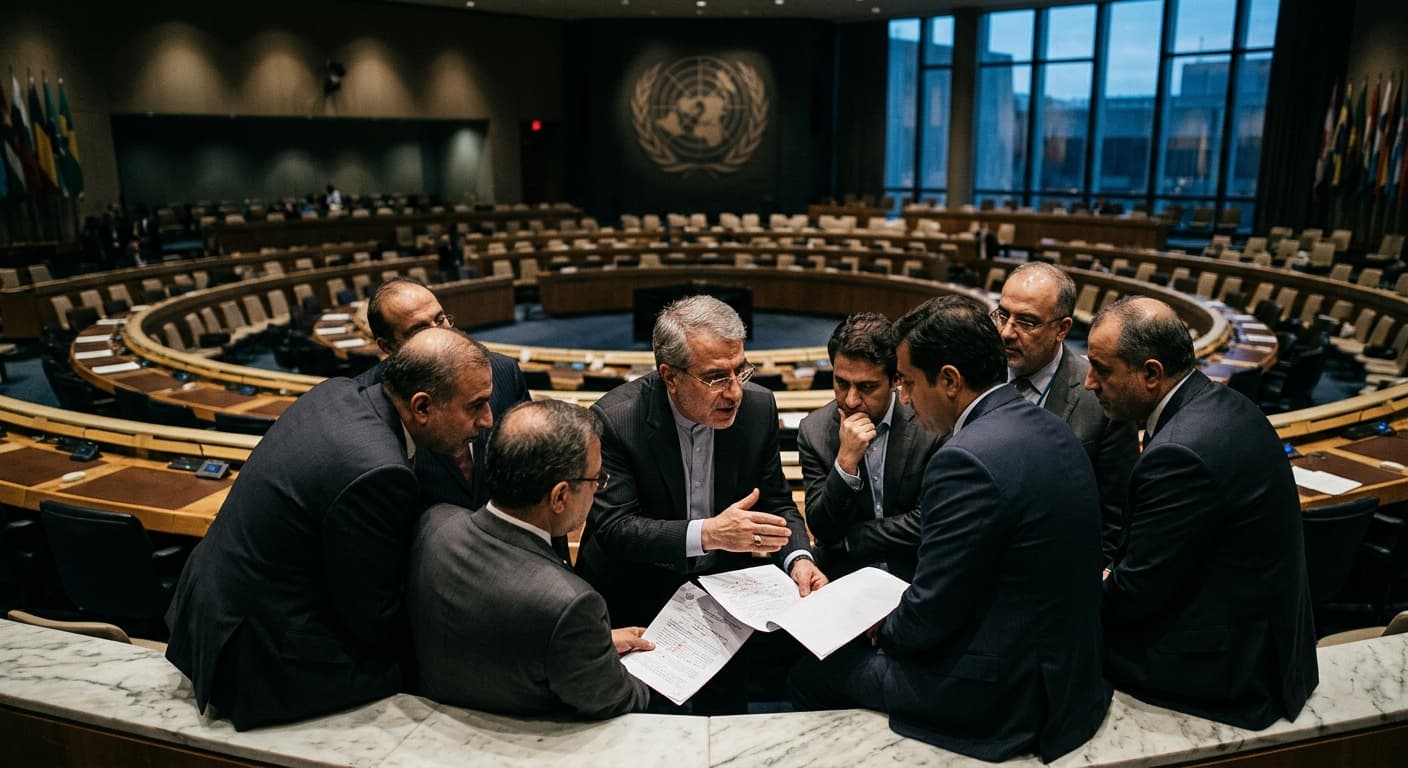
Iran's UN Letter Signals Islamabad MoU Is Dead in All But Name
Iran filed formal Article 2(4) letters at the UN Security Council on July 9, 2026, after US strikes on Chabahar, Bushehr and Bandar Abbas — a legal setup ahead of Islamabad talks on July 11.
Iran's UN ambassador Amir Saeid Iravani filed twin letters to the Security Council president and to Secretary-General António Guterres on July 9, 2026, formally accusing the United States of a "wide-scale" armed attack and a "fundamental breach" of Clause 1 of the Islamabad Memorandum of Understanding signed on June 17. The letter's real function is not protest — it is the legal predicate Tehran needs to strike back without walking out of the Islamabad talks scheduled for July 11. By parking the grievance at the UN in the language of Article 2(4) of the Charter and MoU non-compliance, Iran preserves optionality: retaliate, negotiate, or both, on a paper trail that Russia and China can now weaponise inside the Council chamber.
The filing follows two days in which US Central Command hit more than 80 targets across southern Iran — Chabahar, Bushehr, Bandar Abbas, Konarak, Iranshahr and Aq Qala — killing eight Iranian service members, according to state news agency IRNA cited by Al Jazeera. President Donald Trump, speaking from a NATO summit in Ankara, declared the June 17 memorandum "over" and called Iran's leaders "scum," per the
BBC. Yet Tehran did not walk. Instead it filed paperwork. That gap between rhetoric and process is the story.
What Iran actually filed — and why the wording matters
Iravani's letter, according to Iran's state broadcaster IRIB via Al Jazeera's live desk, cites two specific legal hooks: Article 2, Paragraph 4 of the UN Charter, which prohibits the threat or use of force against a member state's territorial integrity; and Clause 1 of the Islamabad MoU, which commits both sides to the "immediate and permanent termination of military operations on all fronts" — verbatim text released by the
BBC on June 17.
That double citation is deliberate. It repeats the template Iravani used on June 21, 2025 in letter S/2025/404 — the filing after the US bombed Fordow, Natanz and Esfahan — which relied on Article 2(4), Security Council resolutions 487 (1981) and 2231 (2015), and the NPT. It also mirrors letter
S/2026/125, filed on March 4, 2026 over Israeli threats against Iranian diplomats in Lebanon. Iran now has a documentary series — roughly a dozen letters over 18 months — building a legal case of continuous US aggression that any future ICJ filing, or Chapter VII debate, can draw on.
What Iravani did not invoke is as telling as what he did. There is no reference to Article 51, the self-defence clause. As University of Pennsylvania law professor Jean Galbraith wrote in the American Journal of International Law, Article 51 requires a member invoking self-defence to notify the Council immediately — the US did so on June 27, 2025, framing its 2025 strikes as collective self-defence of Israel. Iran, by contrast, keeps its future retaliation legally ambiguous: neither pre-declared self-defence nor Charter-authorised force, but a running record of aggrieved sovereignty. The
International Crisis Group's assessment called last year's US Article 51 letter "an unserious justification for an unnecessary war"; Tehran is now trying to weaponise that critique.
The historical parallel that matters is not 2003 Iraq — it is the 1987–88 Tanker War. Then, as now, the US claimed a right to protect commercial navigation in the Gulf; Iran retaliated with mines and missiles; and both sides confined the fight to a narrow maritime theatre without formally severing diplomatic channels. The endgame in 1988 was UN Security Council Resolution 598 and Iranian acceptance under duress. Iravani's letter reads as an attempt to deny Washington a comparable Council endorsement this time — locking the record in favour of Iranian sovereignty before any final MoU-endorsing resolution reaches the chamber under Point 14 of the deal.
The MoU that isn't dead — yet
Trump's declaration in Ankara that the MoU is "over" is not matched by his own negotiators. Speaking on Air Force One, the president said US envoys Steve Witkoff and Jared Kushner could keep talking. According to The Economist, the two delegations remain scheduled to meet in Islamabad on July 11. Iran's parliament speaker and chief negotiator Mohammad Bagher Ghalibaf posted "We don't fold" — but not "We walk."
The June 17 memorandum, whose full 14-point text was published by the BBC, gave the parties a 60-day window that runs to roughly August 16. Point 7 commits the US to terminate "all types of sanctions," including UN Security Council resolutions and unilateral measures. Point 9 obliges both to maintain the "status quo." Point 14 requires that a final deal be "endorsed by a binding United Nations Security Council resolution." The Council is therefore built into the deal's architecture. Iran's letter is not a rupture with the MoU; it is a claim on the venue where the MoU is supposed to be ratified.
Russia and China — the latter of which abstained on Council resolution 2817 (2026), which UN Meetings Coverage recorded as adopted 13–0–2 condemning Iran's Gulf strikes on March 11 — are now handed the paperwork to reopen the file on US conduct. On July 2, Guterres told the Council that the events of late June were "a stark reminder of the fragility of the current situation," per
UN DPPA. That restraint language is now the Secretary-General's baseline; a second Council briefing before month-end is almost certain.
The real fight is over Hormuz revenues, not sovereignty
The trigger for the July 7–8 escalation was not nuclear; it was maritime toll-taking. According to the Council on Foreign Relations, Iranian officials believe monetising Strait of Hormuz transit could generate up to $40 billion annually — roughly the country's pre-war oil-export revenue. The MoU's Article 5 lets Iran make "arrangements" for "safe passage" for 60 days "only" — language Tehran reads as recognition of its administrative authority; Washington reads as a temporary obligation to stay out of the way.
That interpretive fight became kinetic on July 7 when the Qatari LNG carrier Al-Rekayyat and the Saudi-flagged Wedyan were struck near Oman's coast. Qatar's foreign ministry spokesman Majed Al-Ansari held Iran "fully legally responsible," per Al Jazeera. The US Treasury revoked Iran's oil waiver the same day; CENTCOM struck the following night. During the war's peak in April, container shipping capacity in the region had plummeted from a pre-war 3.2 million TEU to as low as 740,000, according to Xeneta data cited by
Al Jazeera — a shock the Gulf economy cannot afford to repeat.
Markets read the signal instantly. Brent crude jumped 4.2% to $77.24 a barrel on July 8, a two-week high, according to Al Jazeera's economy desk. US petrol hit $3.79 per gallon — still above the $2.98 recorded on February 28, the war's opening day. The US Navy-led Joint Maritime Information Center raised the Strait's transit risk to "severe" for the first time since June 15.
Who benefits from a UN paper trail
Three actors gain from Iran's decision to route this crisis through the Council rather than through direct retaliation.
Russia and China. The March 11, 2026 vote on resolution 2817 exposed the split: 13 in favour, China and Russia abstaining. Beijing's representative said the US and Israel launched strikes "without Council authorization" and "must cease their actions immediately," per the UN press release. Iran's July 9 letter gives Moscow and Beijing fresh material for a mirror-image draft resolution condemning US strikes — a symmetry play that failed in March but has better odds now that Gulf tanker owners have watched their own vessels burn under US "protection." Note that Russia's March counter-draft picked up support from Pakistan and Somalia; Islamabad, the MoU's mediator, is also chairing the July 11 talks.
Pakistan and Qatar as mediators. Both governments have a documented interest in preserving the MoU: Prime Minister Shehbaz Sharif publicly took credit for brokering the deal in June, and Qatar's Emir Sheikh Tamim bin Hamad Al Thani met Witkoff and Kushner in Doha on July 1. Iran's decision to file at the UN rather than expel the US delegation or shut the strait wholesale hands Islamabad a reason to convene the July 11 session as scheduled. The OSW Centre for Eastern Studies noted that Vance and Ghalibaf both have personal political interests in closing this file — the former as vice-president leading his first major foreign-policy portfolio, the latter as the presumed successor-in-waiting to Iran's negotiating establishment.
Iran's parliament hardliners. Speaker Ghalibaf, who doubles as chief negotiator, needs cover from a hardline-dominated Majles that is watching Chabahar burn. The UN letter provides that cover: Tehran has "responded" without firing another shot beyond the June 28 Gulf-base attack. As Maziar Motamedi reported from Tehran for Al Jazeera, an adviser to Ghalibaf said flatly: "Either we hold on to this strait, or we go and become martyrs for it one by one."
The losers are the Gulf states whose flagged tankers are the collateral. Qatar and Saudi Arabia condemned the July 7 attacks in near-identical language and blamed Iran — yet both governments are also pressing for de-escalation because their own ports depend on Hormuz functioning. Bahrain, whose territory hosts the US Fifth Fleet, watched sirens go off again on July 8 as Iranian drones probed its airspace; it was Bahrain that drafted resolution 2817 in March. That is the contradiction Iran is exploiting: every hit on a Qatari LNG carrier makes Gulf capitals more, not less, willing to lean on Washington to close a deal — but every US strike on Chabahar makes those same capitals nervous about Iranian retaliation on their own soil.
The Article 51 argument Iran isn't making — but could
The legal literature suggests Iran has a stronger claim than it is using. Writing in the American Journal of International Law, Galbraith noted that the US 2025 self-defence justification rested on collective self-defence of Israel — a claim scholars found strained even in wartime. A US strike in July 2026, three weeks after a signed ceasefire, cannot plausibly invoke the same predicate. The
Australian Institute of International Affairs analysis by Professor Sascha-Dominik Bachmann underlined that the Caroline test requires an "instant, overwhelming" necessity — a bar tanker attacks in a commercial waterway do not clear on their face.
Yet Iran also cannot cleanly invoke Article 51 without acknowledging that its own drone strikes on the Al-Rekayyat and Wedyan constituted a use of force. As Hesham Alghannam argued in Al Jazeera in March, the Islamic Republic has "consistently evaded" Article 51's mandatory notification requirement in past escalations. Filing an Article 2(4) grievance letter without invoking self-defence is the least-bad legal posture available: it protests without conceding. It is also the posture that keeps the
Islamic Republic of Iran inside the diplomatic tent — a signal Tehran wants Beijing, Moscow, Islamabad and Doha to read clearly.
What to watch next
July 11 — Islamabad talks. If Iranian and US delegations show up, the MoU is not over regardless of Trump's Ankara rhetoric. If Ghalibaf sends only a technical team or cancels, the diplomatic scaffold collapses and Brent likely tests $85.
August 16 — 60-day MoU deadline. Point 3 of the MoU text allows extension by mutual consent. Without a final-deal breakthrough by mid-August, the memorandum's legal effect lapses and the Council is left holding Iran's letters as the operative record.
Russia-China draft resolution. Watch for a Moscow-Beijing text condemning US strikes; the March 11 precedent suggests it fails, but a 6–9 vote — Pakistan, Somalia, plus additional non-permanent members — would signal the erosion of the US Council coalition that Bahrain assembled in March.
Diplomat View
Iran's July 9 letter is not a warning; it is insurance. Tehran is buying itself the right to retaliate later — inside the Council, in the Strait, or through a proxy — without being seen as the party that killed the Islamabad process. The forecast: the MoU limps to Islamabad on July 11 and probably to a truncated extension past August 16, because neither Trump (facing $80 Brent and Gulf allies begging for de-escalation) nor Ghalibaf (facing $40 billion in potential Hormuz rents) can afford the alternative. What would revise this call: any of three signals. First, an Israeli strike inside Iran during the window — Netanyahu's government has never endorsed the MoU and can collapse it unilaterally. Second, a successful assassination attempt on the new Supreme Leader Mojtaba Khamenei, which Israeli officials have publicly threatened. Third, a Russian-Chinese draft resolution that draws more than five affirmative votes, signalling that the Council coalition Washington rebuilt in March has fractured. Absent those, expect noise, letters, and a deal.
Forward catalysts:
- July 11, 2026 — Scheduled US-Iran nuclear talks resume in Islamabad, per
The Economist.
- August 16, 2026 — 60-day MoU negotiating window under Point 3 expires absent mutual extension.
- UNSC agenda — Any Russia-China draft resolution on US strikes, or a US-led text on Iranian tanker attacks, would force P5 positions onto the record and reshape the diplomatic geometry ahead of the August deadline.
Discover more
India
Congress Accuses Modi of Stalling Women's Law
Congress accuses Modi of stalling women's reservation law by linking it to delimitation, revealing a deeper electoral strategy.
US Politics
Virginia's Redistricting Referendum
Virginia's redistricting referendum is drawing a flood of dark money, shaping future elections and the fight for congressional control amid party stakes.
Global Politics
US-Iran Tensions Rise
Tensions escalate in the Strait of Hormuz as Iran and the US clash over maritime control, with a ceasefire hinging on a contested MoU paragraph.

Economics
Fed's Amex AML order puts correspondent banking on notice
Federal Reserve's Amex AML order requires board-level controls and a 90-day plan; OCC fined the bank $350 million over enterprise-wide deficiencies.