Iran's IRGC Leverages Strait of Hormuz
Tehran's control over shipping routes impacts peace talks.
Model Diplomat4 min readMiddle East
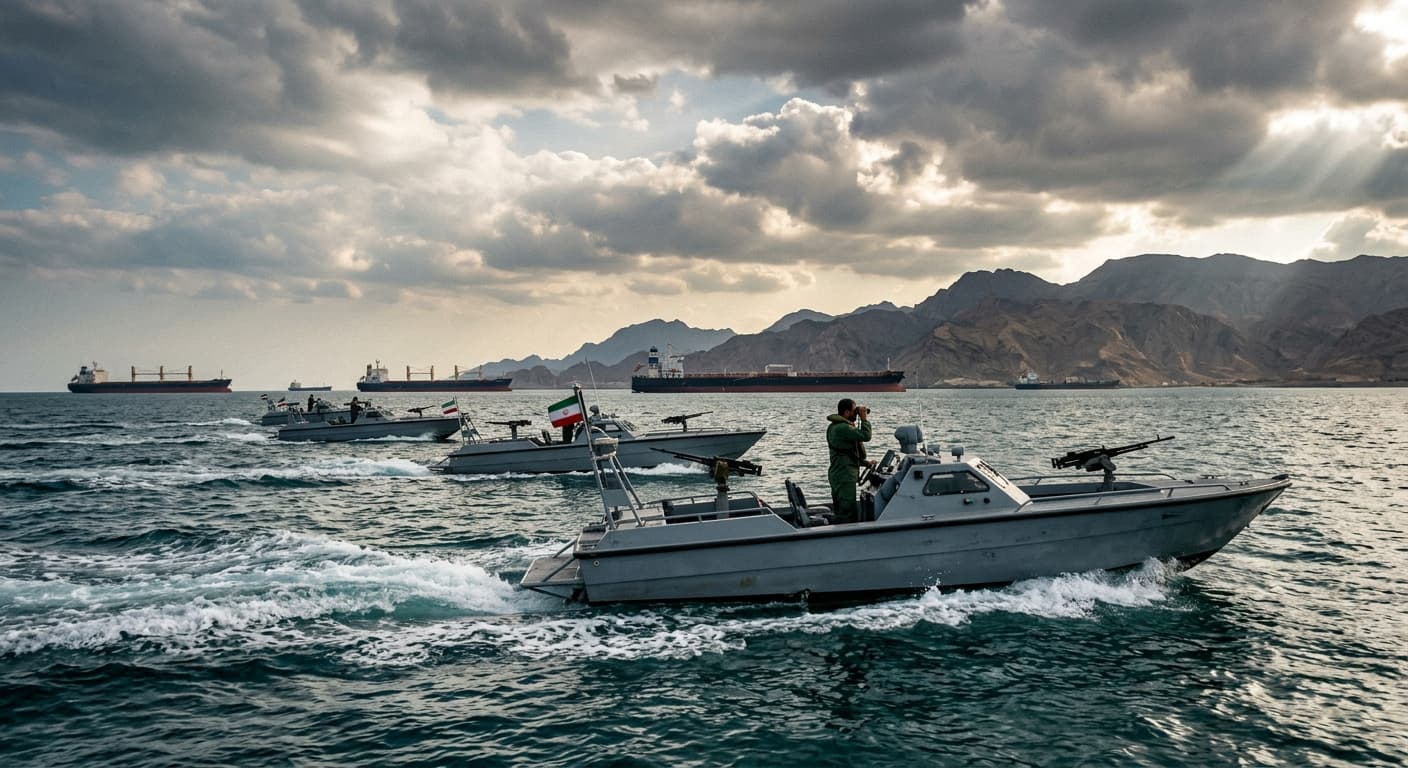
The Strait Is Tehran's Leverage — and the IRGC Just Proved It
The IRGC's warning against an Omani shipping corridor and a fresh vessel strike show that Iran's real power in the peace talks flows through Hormuz, not Versailles.
The 14-point memorandum of understanding that Donald Trump signed at Versailles on June 17 was supposed to end a four-month war. Instead, the Islamic Revolutionary Guard Corps is systematically rewriting the terms — and this week's events reveal who actually controls the pace of the peace.
On June 25, the IRGC warned commercial vessels against using a new shipping corridor announced by Oman and the International Maritime Organization, calling it "unacceptable and poses serious safety risks" because it was established "without prior notification to or coordination with the Islamic Republic of Iran." Al Jazeera Hours later, a cargo vessel was struck by projectiles in the Gulf of Oman. The IRGC has not claimed responsibility — and pointedly has not denied it either.
The IMO immediately paused its evacuation of roughly 11,000 stranded seafarers. Secretary-General Arsenio Dominguez said the plan would remain suspended "until further clarity is obtained." BBC
The route that broke the deal open
The dispute is over geography. The MoU commits Iran to using "best efforts for the safe passage of commercial vessels with no charge for 60 days." It also envisions Iran, Oman, and Gulf states negotiating future administration of the waterway. BBC
But the text is silent on which route ships should take. Traditionally, commercial traffic used international shipping lanes through the middle of the strait. Those lanes are now mined. The Joint Maritime Information Center has warned vessels to avoid them and recommended a narrower southern corridor closer to Oman's coast, which JMIC says "has been confirmed clear of mines." BBC
The IRGC rejects that corridor outright. It insists the "only authorised transit routes" are those designated by Iran — a route hugging the Iranian coastline — and that ships must maintain contact with the IRGC Navy. On June 25, Iranian state TV reported that three foreign oil tankers attempting to cross without Iranian authorisation were turned back after IRGC warnings. Al Jazeera
A Liberian-flagged tanker, the Stoic Warrior, successfully transited the Omani corridor on June 25 by hugging the UAE and Omani coastlines. The attack on a vessel came the same day.
Who benefits
The IRGC gains the most. By forcing ships onto Iranian-controlled routes, the Guard extracts the de facto recognition it sought throughout the war: that the Strait of Hormuz is an Iranian-administered waterway. Chief negotiator Mohammad Bagher Ghalibaf stated bluntly last week that "Hormuz will never return" to its pre-war status. Al Jazeera
The Trump administration entered the MoU betting that reopening the strait would be its signature deliverable — a visible win to calm oil markets and validate the president's "dealmaker" brand. Instead, the IRGC's maneuver forces Washington into an impossible position: accept Iranian control of the waterway or risk being blamed for the deal's collapse. Secretary of State Marco Rubio told Gulf allies on June 24 that "no country on Earth has the right to charge for the use of international waterways" and that the US "will never" accept tolls. Al Jazeera
Oman tried to play the honest broker, designing a corridor that complies with international law while restoring safe navigation. Foreign Minister Badr Albusaidi stressed that "future arrangements related to the strait do not involve imposing any transit fees." Tehran's rejection humiliates Muscat and exposes the limits of Gulf diplomacy.
Israel remains the unseen accelerant. The MoU requires a ceasefire on "all fronts, including Lebanon," but Israeli strikes on Hezbollah continue. On June 20, Iran cited those strikes as justification for closing the strait entirely — a closure that US Central Command disputed at the time. BBC Every round of Israeli-Hezbollah fighting gives the IRGC a pretext to tighten the noose.
What to watch next
Three decision points shape the coming days. First, whether the IMO's evacuation pause holds — 11,000 seafarers trapped in the Gulf creates humanitarian pressure that neither side can ignore indefinitely. Second, whether Iran follows through on discussions with Oman about "costs" for maritime services once the 60-day toll-free window expires — a conversation that Iranian and Omani officials confirmed on June 24. Third, whether the Switzerland technical track produces anything concrete on demining the central shipping lanes, which would render the IRGC's route monopoly less relevant.
The MoU set a 60-day clock. The IRGC just signaled it intends to run it.
Discover more

US Politics
House Ethics Committee Pushes Sexual Miscond.
The House Ethics Committee has shifted responsibility for sexual harassment settlement records to the Office of Congressional Workplace Rights, complicating disclosure efforts.

US Politics
SNAP Food Assistance Faces Legal Challenges
In 2026, SNAP faces stricter eligibility rules and mounting legal challenges, threatening food assistance for the millions of Americans who rely on the program.
Global Politics
Xi Jinping Calls China-Russia Ties 'Precious'
Xi Jinping's description of China-Russia ties as 'precious' reflects a strategic imbalance, with Beijing dictating terms in the partnership.

Economics
Fed's Amex AML order puts correspondent banking on notice
Federal Reserve's Amex AML order requires board-level controls and a 90-day plan; OCC fined the bank $350 million over enterprise-wide deficiencies.