Iran's Hormuz Gambit Kills Islamabad MOU
The collapse of the MOU reshapes oil market dynamics.
Model Diplomat9 min readMiddle East
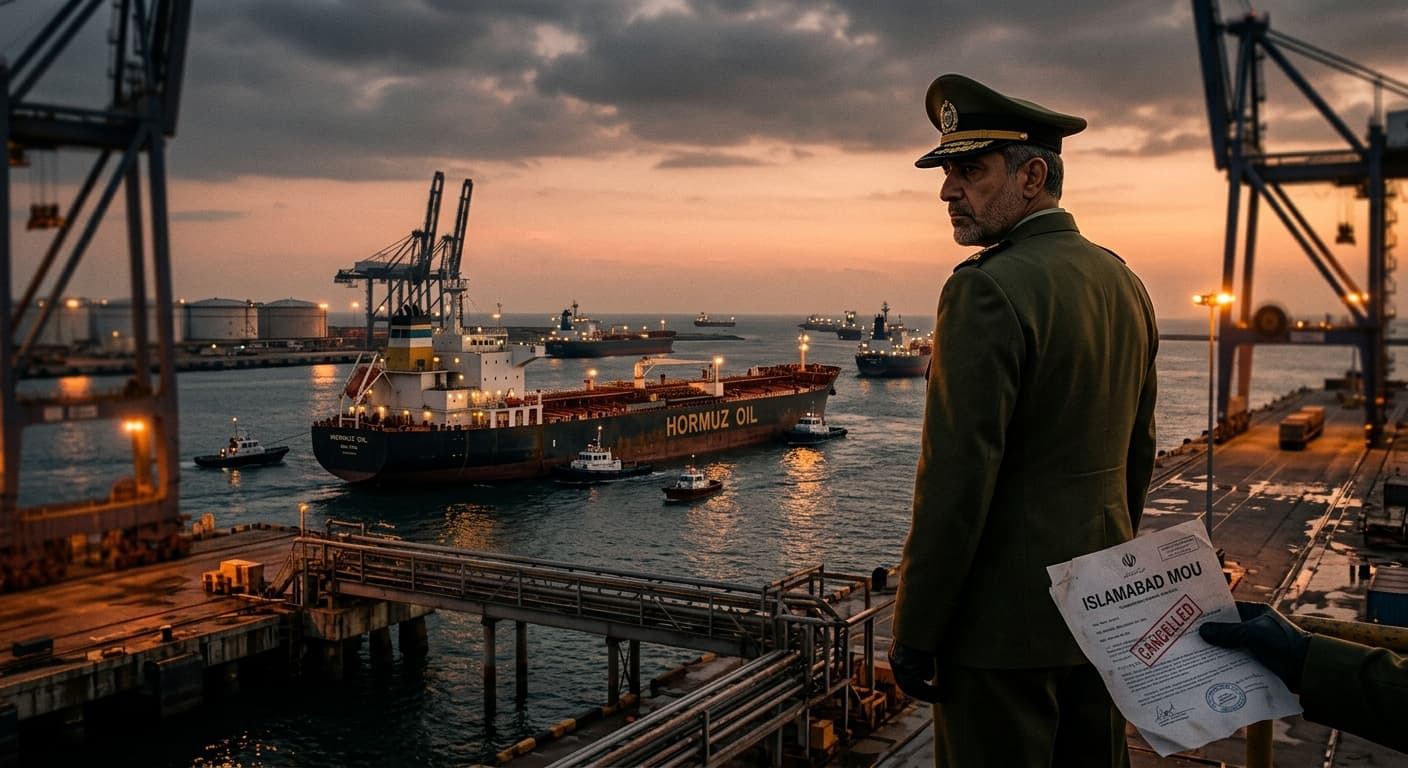
Iran's Hormuz Gambit Kills the Islamabad MOU — and the Oil Peace
The collapse of the US-Iran memorandum on July 8, 2026 restores a Hormuz risk premium markets had priced out. Brent is back above $78, and the SPR is thinner than in a generation.
The Islamabad Memorandum of Understanding is dead 21 days after it was signed, and with it the assumption that carried oil markets through June: that the world's most important chokepoint was on a glide path back to normal. The collapse hands Iran a functioning veto over the Strait of Hormuz, hands Washington a sanctions-only lever with a nearly empty Strategic Petroleum Reserve behind it, and locks in a structural risk premium of roughly $8-10 a barrel that markets had spent three weeks trying to erase. That is the story the tape is telling — Brent September futures traded at $78.76 as of July 9, up from near pre-war levels a week earlier, according to Al Jazeera's IMF write-up. What follows is who benefits, who is exposed, and what breaks next.
What actually collapsed on July 7
The 14-point MOU signed in Islamabad on June 17 was, per BBC News, a Hormuz deal wearing a peace deal's clothes. Washington lifted its naval blockade and waived sanctions on Iranian crude sales through August 21; Tehran agreed to "safe passage of commercial vessels with no charge for 60 days" and to leave the strait's long-term administration for the negotiating window. The MOU said nothing definitive about Iran's nuclear program — that was to be handled inside the 60-day talks.
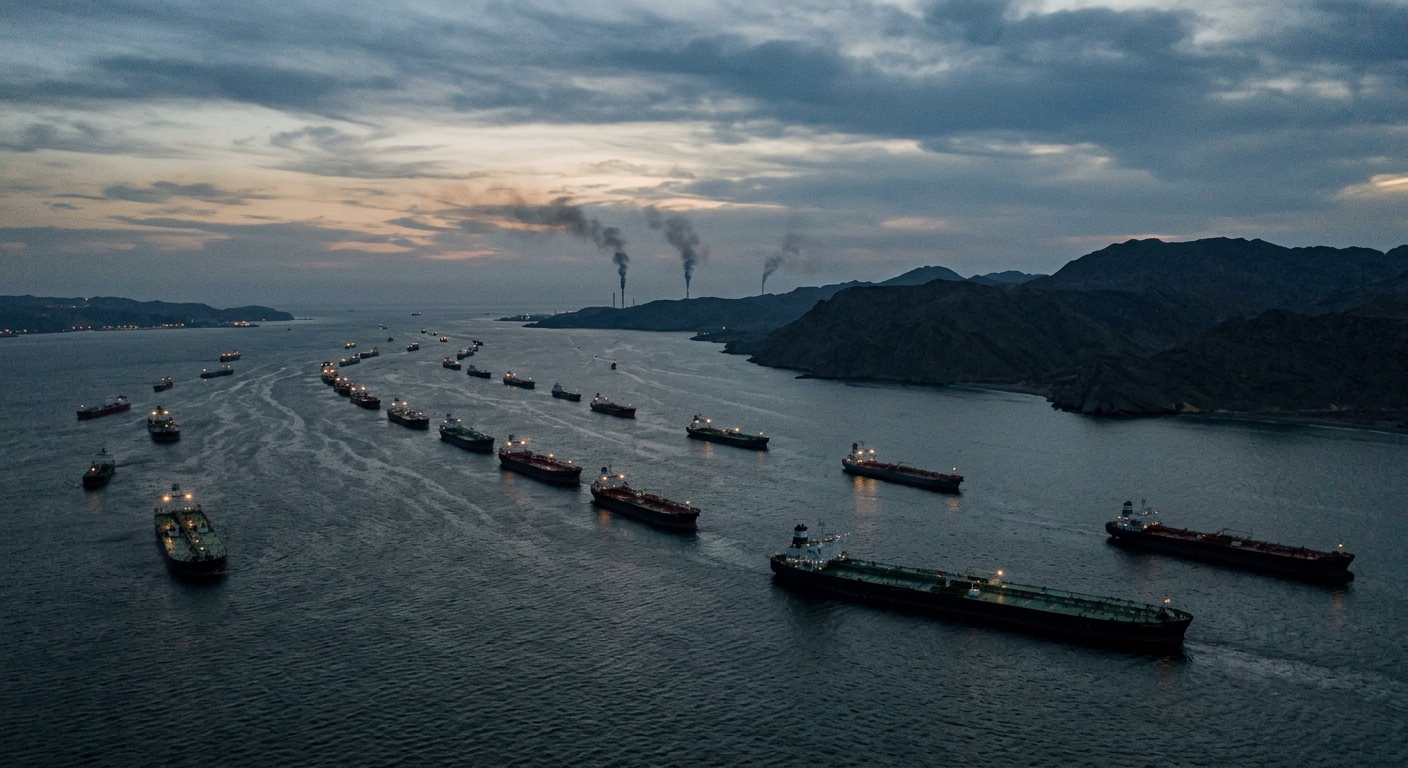
The deal broke on the fifth clause. Iran read "no charge for 60 days only" as an acknowledgement of its sovereign right to regulate the strait, and began enforcing an "Iranian-approved" northern transit route. On July 6 an Iranian drone struck the Qatari LNG carrier Al Rekayyat off Oman, and a Saudi-flagged VLCC, the Wedyan, was damaged in a separate incident, according to Al Jazeera's reporting on the tanker strikes. The US Navy-led Joint Maritime Information Center raised the Hormuz threat level to "severe" for the first time since mid-June.
Washington's response came in two tracks. On July 7 the Office of Foreign Assets Control revoked General License X1, the 60-day authorization for Iranian crude and petrochemical sales — new sales banned immediately, existing cargoes wound down by July 17 with proceeds parked in a blocked interest-bearing account. Hours later, US Central Command hit "over 80 targets" in Bandar Abbas, Bushehr and elsewhere; a second wave on July 8 struck 90 more. At the NATO summit in Ankara that afternoon, President Donald Trump declared the MOU "over," per
BBC coverage of his remarks, and told reporters he did not "want to deal with them anymore." Iran's chief negotiator, parliament speaker Mohammad Bagher Ghalibaf, posted that the strait "will only open with Iranian arrangements, not American threats."
The market read this precisely as an end to the ceasefire architecture. Brent jumped 6% intraday to touch $79; the US benchmark WTI moved in lockstep; travel and airline equities sold off while ConocoPhillips, Chevron and ExxonMobil rose, according to Al Jazeera's market wrap. The IMF, in its
July 8 World Economic Outlook Update, cut 2026 global growth to 3.0% and raised its inflation forecast to 4.7% — a downgrade Deputy Research Director Petya Koeva Brooks explicitly tied to "the lingering effects of the energy shock from the war in the Middle East."
Who holds leverage now
Iran does. The Council on Foreign Relations' Edward Fishman, writing in a July 8 CFR expert brief, estimates that monetizing Hormuz could yield Tehran roughly $40 billion a year — "roughly the same amount as the country's annual oil export revenues in recent years." Fishman's judgment is blunt: "Iran may emerge from this war in control of the Strait of Hormuz." Every week the MOU is inoperative, that control hardens into precedent.
Washington's counter-leverage is weaker than it looks. Three constraints matter. First, the SPR. The US Government Accountability Office reported in late June that DOE began a 172-million-barrel emergency release in March 2026 in response to the Iran war — the second-largest sustained drawdown in the reserve's history, after the 180-million-barrel Ukraine release of 2022. The SPR held just over 413 million barrels in December 2025 and has been drawing down since; on current trajectory it is heading toward levels that limit any further intervention. GAO warned that "investments in the SPR are again not keeping pace with the aging reserve's needs" — cavern integrity, not politics, is now the binding constraint on emergency drawdown rates.
Second, the sanctions lever is real but slow. Revoking General License X1 pushes Iran back toward its "shadow fleet" — the same STS-transfer, spoofed-AIS pipeline through Malaysian and Chinese waters that OFAC has been designating tanker-by-tanker since 2019. As of late June, roughly 147 million barrels of Iranian crude were floating on tankers according to Kpler data cited by Al Jazeera; about 67 million of those barrels are stranded inside the Gulf and Gulf of Oman, unable to move past the reinstated US enforcement line. That is Iran's short-term pain — but Kpler's Muyu Xu told Al Jazeera onshore storage in Iran only covers "roughly 20 days of production," meaning Tehran must either accept forced shut-ins or force buyers through the chokepoint it controls.
Third, China. The House Select Committee on the CCP's Crude Intentions report documented that Chinese onshore inventories rose to roughly 1.2 billion barrels by early 2026 — approximately 109 days of seaborne import cover, plus 46 million barrels of Iranian crude in floating storage and bonded tanks at Dalian and Zhoushan. Beijing built that cushion precisely so it could ride out episodes like this one. The result: US secondary sanctions bite Iran's economy but do not force Tehran to fold, because its principal customer is pre-loaded.
The insurance channel is where the crisis transmits
Oil price screens are the loud signal; marine war-risk premiums are the load-bearing one. Pre-war Hormuz transit cover ran around 0.25% of hull value. In reporting from late June, Al Jazeera documented rates falling from wartime peaks to a 1-3% range on optimism about the MOU. The July 6 tanker strikes reset that curve overnight. NSI Insurance Group CEO Oscar Seikaly, quoted in the same reporting, described underwriters "repricing war risks on a day-by-day basis" with rates between 2.5% and 5% of vessel value — meaning that a $100 million VLCC now pays $2.5-5 million per transit, versus $250,000 before the war.
The US backstop is unusual and probably decisive in keeping the strait even partially open. On March 3, 2026 Trump ordered the International Development Finance Corporation to provide war-risk cover for "ALL Maritime Trade, especially Energy," and DFC subsequently announced a reinsurance facility to "insure losses up to approximately $20 billion on a rolling basis" for qualifying hulls and cargo. Even with that program in place, commercial traffic through the strait has recovered only to one-third to one-fifth of pre-war levels, according to the
Council on Foreign Relations. The MOU collapse widens the gap between the reinsurance ceiling Washington has offered and the risk private underwriters see on the water.
The knock-on for LNG is more acute than for crude. The Qatari cargo hit on July 6 was an LNG carrier, and Qatar routes essentially all of its ~110 million tonnes per year of LNG through the strait. LNG restart economics — a point the IMF's April 2026 World Economic Outlook emphasized — are harder than for crude "because of the technical complexity of restarting production and the comparatively lower level of reserves to fall back on." European gas storage entered the summer above 80%, which cushions the near term; a Northern Hemisphere winter with Qatari LNG below full flow is the scenario that turns this from a price shock into a policy crisis.
The winners no one is naming
Three sets of actors quietly benefit from an MOU that stays broken.
US shale producers and refiners. The Financial Times' Lex piece on the ceasefire's collapse flagged that "US oil producers and refiners are set to post record profits from the Iran war," and Treasury Secretary Scott Bessent's on-the-record view that US barrels should "trade at a premium to the rest of the world" is now the administration's stated policy floor. Every week Brent holds above $75 while Permian marginal cost sits in the mid-$40s is a transfer from Gulf importers to Midland, Texas.
China's strategic reserve. Beijing accumulated 1.2 billion barrels precisely so it could keep buying Iranian crude at distressed prices during exactly this sort of episode. The revocation of General License X1 will not stop those flows; it will widen the discount at which Iran sells to state-owned Chinese refiners and the "teapots" of Shandong.
Russia. Every incremental dollar on Brent is roughly a $0.90 pass-through to Urals given current discounts, and every ton of Qatari LNG that does not reach European buyers is a ton Gazprom's replacement pipelines and Novatek's Arctic cargoes can potentially quote against. Moscow gains without firing a shot.
The losers are equally concrete: India, whose refiners are the world's fourth-largest and now face both higher Brent and a re-imposed sanctions regime that constrains Iranian barrel access; Japan and South Korea, both of which draw more than 80% of their crude via Hormuz; and the low-income energy importers the IMF's WEO singled out — cumulative 2026-27 growth revised down 0.5 percentage points for that cohort, versus 0.2 points for energy-importing advanced economies.
Diplomat View
The MOU is not coming back in its original form. Iran's post-Khamenei leadership — Ghalibaf, the IRGC command, and the negotiators who have watched the strait deliver more leverage than four decades of proxy warfare — will not concede the "no charge" clause, and Washington cannot accept an Iranian toll on international waters without setting a precedent every other chokepoint state (Egypt at Suez, Turkey at the Bosphorus, Indonesia at Malacca) will study carefully. Expect the next stable equilibrium to be a de facto Iranian "safety fee" collected via Omani intermediaries, rejected in Washington's rhetoric but tolerated in practice so long as tankers move. Brent settles in a $75-90 range with periodic $10 spikes on each incident; the SPR remains the single biggest US vulnerability and the single most important number to watch.
What would change this forecast: an Iranian strike that sinks a laden VLCC or hits an LNG carrier badly enough to cause a Ras Laffan outage — that pushes Brent past $100 and forces a NATO-flagged escort regime with rules of engagement Tehran would treat as a casus belli. Alternatively, a durable Islamabad-2 that codifies the Iran-Oman administration structure would cap the premium near $70 but effectively hand Tehran the $40 billion revenue stream Fishman identifies. Both are within one bad news cycle.
What to watch
- July 11, Islamabad: US and Iranian negotiators are expected to resume MOU talks. A no-show by either delegation confirms the deal is dead; a return signals both sides still want the framework, even wounded.
- July 17: OFAC's grace period for wind-down of in-transit Iranian oil cargoes expires. Any barrels not offloaded by 12:01 a.m. EDT become sanctioned property; watch for stranded VLCCs off Malaysia and Zhoushan.
- August 21: Original MOU expiry. If nothing replaces it by then, the 60-day window closes with no permanent framework and Iran's claimed authority over strait "arrangements" hardens into de facto policy.
- SPR balance: Weekly EIA inventory releases. Below ~300 million barrels, Washington's ability to intervene in a further shock becomes GAO-flagged as operationally constrained.
The Bottom Line
The Islamabad MOU's collapse is not just a diplomatic setback — it is the moment global energy markets learned that Iran has converted a wartime nuisance into permanent leverage over 20% of the world's oil and LNG. Brent's $8 rebound in a week understates the shift: the structural risk premium is back, the SPR cannot backstop another shock the way it did in March, and the actors quietly best positioned for a broken peace are US shale, China's strategic reserve, and the Kremlin. Everyone else pays the toll. *
Discover more
Global
Turkey Secures 12-Month Oil Pipeline Deal
Turkey and Iraq near a 12-month extension for the Kirkuk-Ceyhan pipeline, enhancing Ankara's energy leverage while Hormuz remains closed.
Climate & Energy
Saudi Arabia's Syria Pivot Rewires IMEC
Saudi Arabia is considering a Syria route for the IMEC, potentially sidelining Israel and redirecting trade and energy flows.
Climate & Energy
Repsol's Horcón Deal Tests Trump's Oil Order
Repsol's June 2026 deal with PDVSA marks Spain's entry into US-controlled Venezuelan oil, sidelining Chinese interests.
Climate & Energy
Pentagon's $300M Lithium Stockpile Move
The Pentagon plans to buy $300M worth of lithium carbonate, marking its first addition to the strategic stockpile, amid rising concerns over China's export controls.