Turkey Secures 12-Month Oil Pipeline Deal
Ankara's new deal with Iraq strengthens its energy leverage.
Model Diplomat10 min readMiddle East
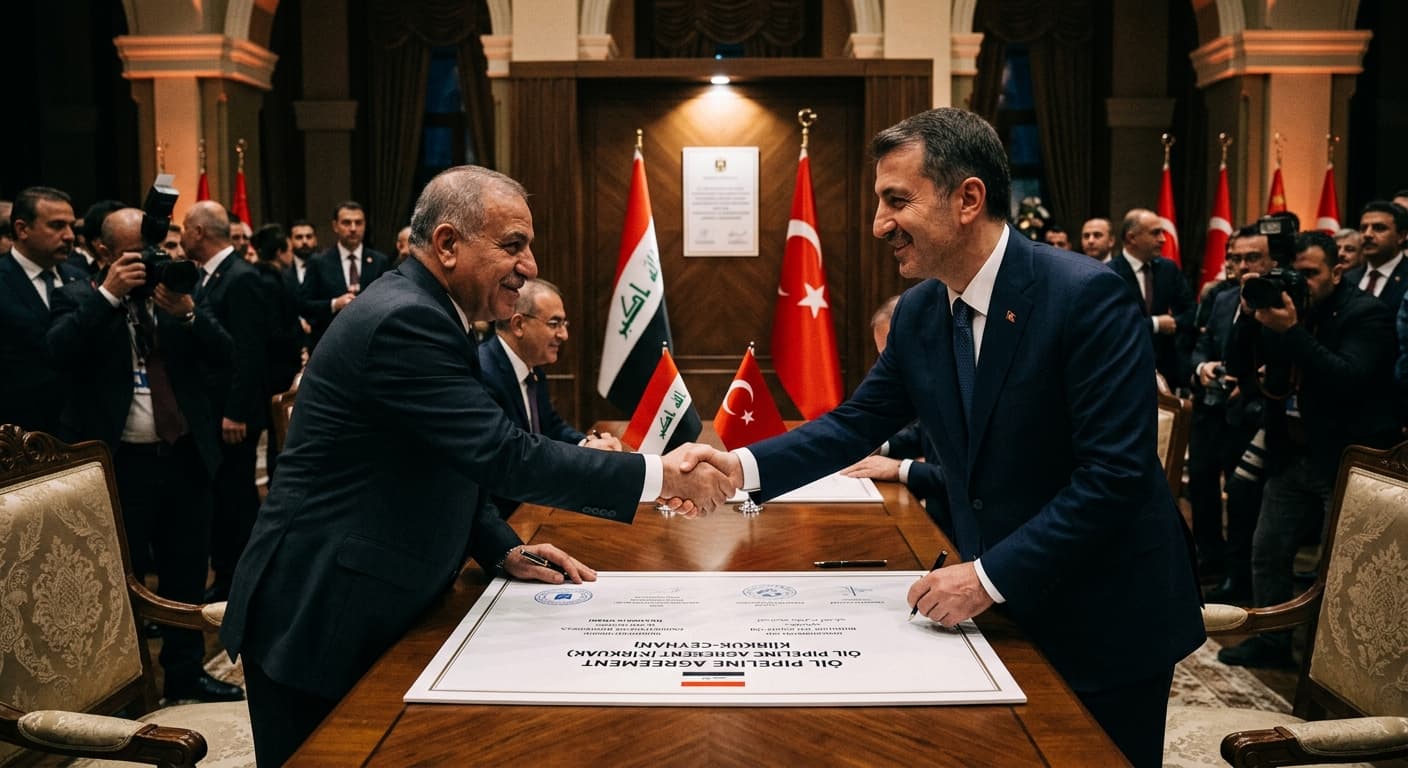
Turkey Turns Iraq's Hormuz Panic Into a 12-Month Pipeline Prize
Ankara is close to a 12-month Kirkuk–Ceyhan deal that locks in Baghdad's dependence on Turkish transit while the Strait of Hormuz stays effectively shut.
Iraq and Turkey are within days of signing a 12-month extension to keep crude pumping through the 970-km Kirkuk–Ceyhan pipeline, Turkish Energy Minister Alparslan Bayraktar said in Baghdad on July 9, 2026 — a deal that on the surface rescues a broken export artery but in substance hands Ankara its biggest geoeconomic win in a decade. With the Strait of Hormuz effectively closed since March, Iraq has lost the leverage it earned in a 2023 arbitration ruling against Turkey; the interim protocol now on the table extends Baghdad's flows for a year but embeds Turkish demands — pipeline reuse rights, an expanded gas-electricity-petrochemicals framework, and integration with the Development Road corridor — that a functioning Hormuz would have made unthinkable. As The National reported, Bayraktar delivered the message in person to Prime Minister Ali Al Zaidi and Oil Minister Bassem Mohammed Khudair, with the current treaty set to expire at the end of this month.
The thesis is simple: the pipeline treaty is being renegotiated not on the merits of 2023, but on the desperation of 2026.
The leverage inversion
Six months ago, Iraq was the plaintiff. It held a $1.47 billion ICC arbitration award against Turkey for unauthorised Kurdish exports between 2014 and 2018, a ruling issued in Paris on February 13, 2023 and confirmed in Iraq's petition to the US District Court for the District of Columbia. Ankara refused to pay, closed the pipeline in retaliation, and left roughly 450,000 barrels per day stranded — around 370,000 from the Kurdistan region and 80,000 from Kirkuk fields, per the International Crisis Group's
reconstruction of the shutdown. Baghdad's position — reinforced by the ruling's finding that Turkey breached Articles 3 and 7 of the 1976 Protocol governing the ITP — was that the 1973 treaty framework would be enforced by the sovereign of the pipeline, not the transit country.
Then the Strait of Hormuz shut. The Congressional Research Service confirms that Iranian forces declared the strait "closed" on March 4, 2026, following the US–Israeli attack on Iran that began February 28, and that the U.K. Maritime Trade Operations Centre logged 10 attacks on ships within four days. Ship traffic collapsed. The Atlantic Council's
Katherine Walla documented the consequences for Iraq: production fell from roughly 4.3 million bpd in February to below 1.3 million by May, the steepest drop in OPEC+. Roughly 93% of Iraqi crude — around 3.3 million bpd — normally moves through Basra's Gulf terminals. When those terminals went dark, Baghdad had exactly one plausible bypass, and it ran through Turkey. The Al-Bayan Center's
analysts warned in August 2025 that Iraq's 89% concentration on southern ports had "evolved from an operational issue into a geo-legal predicament" — and predicted, months before the war, that Turkey would exploit exactly this vulnerability.
They were right. Ankara pre-positioned itself for this moment by cancelling the 50-year-old pipeline agreement in July 2025 via a law published in the Turkish Official Gazette, timed to take effect on July 27, 2026, as Stiftung Wissenschaft und Politik's Nebahat Tanrıverdi Yaşar documents. The termination was not an act of pique. It was the setting of a deadline — one that would fall due precisely when Iraq needed the pipeline most.
The scope of Turkey's ask has quietly tripled
The 12-month interim protocol is a bridging instrument, not the successor treaty. Its purpose is to keep oil flowing past the July 27 expiry while a broader package is negotiated. But the price of the bridge is written into every side conversation Bayraktar has had this summer, and the price has escalated well beyond crude.
First, scope creep. SWP's analysis confirms Ankara submitted a "comprehensive draft agreement" to Baghdad that goes beyond crude to natural gas, petrochemicals and electricity — and foresees extending the pipeline south to Basra's fields. That is not a maintenance deal. It is an infrastructure merger. TRT World's own coverage of the visit describes the two sides "exploring wider cooperation in oil, gas, electricity and investment as both sides seek to turn the Development Road Project into a regional economic hub," per TRT World.
Second, corridor lock-in. The Development Road — a 1,190-km road and dual-rail network from Basra's Al-Faw port to Faysh Khabur on the Turkish border — is being underwritten by multilateral money. Carnegie Endowment's Renad Mansour documented that the freight train's transport capacity is expected to reach 3.5 million containers and 22 million tons of bulk cargo annually by 2028, rising to 33 million tons by 2038. The
World Bank approved a $2 billion loan on March 31, 2026 for the Istanbul North Rail Crossing, explicitly citing the "Iraq Development Road" as one of three intercontinental corridors it will feed. A separate
World Bank appraisal document of the Iraq Railways Extension and Modernization project confirms the initiative could attract up to 14 million tons of international freight by 2040 and lift Iraqi exports by 3.4%. Once Iraqi crude, Iraqi gas and Iraqi containers all run through Turkish territory, the leverage question is settled.
66% — Fall in Iraqi crude output between February and May 2026, from 4.3 million bpd to 1.4 million, the steepest drop among OPEC+ producers after Iran closed the Strait of Hormuz. Source: The National / Atlantic Council, July 2026.
Third, arbitration burial. The ICC award has not been paid. It remains, in Gulf International Forum's phrasing, "less a legal issue than a diplomatic tool." Every month Turkey withholds payment while Iraq needs Ceyhan is a month the award depreciates as a bargaining chip. Ankara is separately pursuing a counter-arbitration for over $4 billion in claimed maintenance costs, according to Al-Bayan Center's Baghdad-based
research paper. TRENDS Research's
assessment notes Turkey also won nearly $600 million in ICC counterclaims and could seek to recover a net $900 million from the KRG under a 2013 export contract protection clause. Netted together, Iraq's headline win of $1.5 billion becomes something much closer to a wash — before the political leverage of Hormuz is even applied.
Who loses
The Kurdistan Regional Government is the immediate casualty. The Association of the Petroleum Industry of Kurdistan (APIKUR) puts pipeline-closure losses at more than $35 billion since March 2023, per Al Jazeera. The September 2025 Baghdad–Erbil deal restored flows at 180,000–190,000 bpd but stripped the KRG of independent marketing authority: SOMO, the federal marketer, now handles exports, and international oil companies receive $16 per barrel via Baghdad, not Erbil. The Atlantic Council's
Ellen Sennett documented that the KRG must hand over a minimum of 230,000 bpd to Baghdad while retaining only 50,000 for domestic use — a settlement she called a fudge that "manages rather than resolves" the underlying dispute. LSE Middle East Centre's
Jack McGinn provided the granular data behind that fragility: KRI crude production had recovered only to roughly 295,000 bpd by end-2024, versus 456,000 bpd in 2021, with IOC arrears still around $1 billion.
The Ceyhan bargain: what each side wants from the 12-month deal
| Actor | Immediate ask | Underlying goal | Leverage in July 2026 |
|---|---|---|---|
| Turkey (Ankara) | 12-month bridge past July 27 expiry | Successor treaty covering oil + gas + electricity + Development Road; unilateral BOTAŞ rights inside Turkey | High — sole functioning bypass while Hormuz is shut |
| Iraq (Baghdad) | Restore ~200,000 bpd flow; keep federal budget solvent | Recognition of SOMO's exclusive marketing role; preserve $1.47bn ICC award | Low — output collapsed 66% since February |
| KRG (Erbil) | Payment of $1bn IOC arrears; retain some export role | Fiscal survival; prevent further loss of autonomy to Baghdad | Marginal — stripped of independent marketing in Sept 2025 |
| IOCs (APIKUR) | Binding payment mechanism at $16/bbl + contract recognition | Recover $35bn in lost revenue since March 2023 | Weak — selling at deep discounts into KRI domestic market |
| United States | Iraq off Iranian oil-import dependence; stable Ceyhan flows | Contain China in Iraq; secure Trump-era "maximum pressure" baseline | Decisive — brokered Sept 2025 and March 2026 deals |
The second loser is OPEC+ discipline. Brookings' Kari Heerman and David Wessel note OPEC production has fallen more than 30% since the war began, the IEA has called it "the largest supply disruption in the history of the global oil market," and the UAE quit the cartel on May 1, 2026. Iraq's newfound urgency to lock in northern export capacity — including a July 8 contract with US-based HKN Energy to develop the Hamrin field to a peak of 140,000 bpd with 40 million standard cubic feet a day of associated gas, per The National — is not about OPEC quotas anymore. It is about resilience against the next Hormuz shock. Gulf International Forum's
reporting on the Hamrin deal shows how far Iraq's ambitions have escalated: an initial HKN framework in 2025 targeted only 60,000 bpd from Hamrin's existing 20,000–25,000 base; the new contract more than doubles that ceiling.
The third loser is Iran. RUSI's analysis is blunt: "Turkey emerged as the only stable and reliable route for exporting Iraq oil coming through the Ceyhan pipeline." Bilateral Iraq–Turkey trade hit $16.8 billion in 2025, with Turkish exports dominating at $12.4 billion — a market Iran once contested. Al Jazeera's
energy-sector post-mortem quotes Sparta oil analyst June Goh describing a sustained producer push toward "more pipeline evacuation routes from the Middle East" — a pivot that geographically favors Turkey over every other bypass. Tehran's war has effectively financed Ankara's takeover of Iraqi transit infrastructure. Iran-aligned Iraqi factions understand this; the Middle East Institute has
long documented how the 2023 ICC ruling "gave the coup de grace to the KRG's independent production and export," but the same ruling now shackles Baghdad to Ankara's terms.
The historical parallel: 2007 all over again, in reverse
There is a precedent for this dynamic, and it cuts uncomfortably against Baghdad. In 2007, Turkey used its territorial control of the ITP to sign a separate energy deal with the KRG, bypassing federal Iraq entirely — the arrangement the 2023 ICC award eventually invalidated, as Al Jazeera's contemporaneous coverage recorded. Ankara's 2013 pipeline agreement with Erbil gave Turkey stakes in Iraqi exploration blocks and provided for direct KRG exports through Turkish territory, in defiance of Baghdad's marketing monopoly. It took Iraq nine years of arbitration to unwind that arrangement legally. Ankara is now positioned to write a new arrangement that achieves — through the successor treaty rather than through workarounds — most of what the 2007-13 deals gave it, but this time with Baghdad's signature on the document.
That is the deeper reversal. In the 2007–2018 period, Turkey circumvented Iraqi sovereignty. In the 2026 framework, Iraqi sovereignty will be used to ratify Turkish preferences. Al-Bayan Center's Baghdad analysts warn Ankara is likely to extend the pipeline south to Basra's fields and raise transit fees, capitalising on Iraq's fiscal exposure. They call it Turkey's pursuit of a "godfather role" in Iraq's energy sector — a formulation that would be dismissed as polemic if the underlying facts did not confirm it.
The KRG dimension is now a Turkish one
A subtle but important shift: for two years, the pipeline standoff was framed as a Baghdad–Erbil problem, with Ankara as a reluctant bystander enforcing an arbitration ruling it disliked. That framing is finished. As McGinn's LSE study made clear, the $16-per-barrel formula rests on a 2023–25 federal budget whose validity expires with the next government-formation cycle after the October 2025 parliamentary elections. Iraq is now in a caretaker phase under Prime Minister Ali Al Zaidi. Any successor treaty Ankara signs will bind a coalition that does not yet exist — and MP-IDSA's analysis of post-war corridor dynamics argues Ankara is deliberately racing to embed itself in the Middle Corridor and Development Road architecture before Baghdad regains political coherence. The Stimson Center's
Joaquin Matamis reports Trump publicly threatened on July 8 to revoke the US–Iran memorandum of understanding entirely — meaning even the fragile Hormuz reopening that would restore Baghdad's leverage cannot be counted on.
Diplomat View
The 12-month deal will get signed, likely before month-end. That is the easy part. The consequential move is the successor treaty Ankara wants concluded before Iraq forms a new government — because the current Baghdad has neither the mandate nor the market leverage to say no. Expect a framework that legalises BOTAŞ's use of the Iraqi segment inside Turkey, integrates gas and electricity, ties transit fees to Development Road throughput, and quietly discounts the ICC award through offset accounting. The Council on Foreign Relations' Hormuz analysis makes clear that even a durable strait reopening will not restore pre-war shipping patterns; insurance premiums remain punitive and roughly 80 mines are still in the main navigation lanes. That structural risk is exactly what Ankara is monetising.
The forecast is falsifiable on three conditions. First, a durable Hormuz reopening under the US–Iran MoU would restore Iraq's Basra option and collapse Turkey's monopoly — but Stimson's evidence of continued Iranian attacks on the Al Rekayyat LNG carrier and the Wedyan tanker on July 6 argues against near-term stability. Second, a coalition emerging from Iraq's government-formation talks with a strong Iran-aligned bloc could refuse to ratify a successor treaty that concedes BOTAŞ rights — a political fight that could shut the pipeline again. Third, a court enforcement action on the ICC award in a jurisdiction that seizes Turkish state assets — the US District Court petition remains live — would give Baghdad leverage it currently lacks. Absent one of those triggers, the 12-month deal is not a bridge. It is a threshold.
What to watch:
- On or before July 27, 2026: signature of the interim protocol and Turkish parliamentary action on the successor treaty framework.
- Q4 2026: Iraqi government formation post-October 2025 elections; Ankara's draft law reportedly awaits ratification by whichever coalition emerges.
- Ongoing: US District Court for DC proceedings on Iraq's petition to confirm the $1.47 billion ICC arbitration award — any enforcement order would reset the negotiation.
The Bottom Line
Turkey is converting Iraq's Hormuz emergency into a permanent geoeconomic role: the 12-month Ceyhan deal is not a rescue of Iraqi exports but the down payment on a successor treaty that folds crude, gas, electricity and the Development Road into a single Turkish-controlled transit architecture. If it holds, the 2023 arbitration award becomes a bargaining chip Baghdad cannot cash — and Ankara, not Baghdad, will decide the terms on which northern Iraqi oil reaches the world.
Discover more
Global Politics
Xi Jinping Calls China-Russia Ties 'Precious'
Xi Jinping's description of China-Russia ties as 'precious' reflects a strategic imbalance, with Beijing dictating terms in the partnership.
US Politics
House Ethics Committee Pushes Sexual Miscond.
The House Ethics Committee has shifted responsibility for sexual harassment settlement records to the Office of Congressional Workplace Rights, complicating disclosure efforts.
India
Rajnath Singh's Durga Squad for 2026 Polls
Rajnath Singh's Durga Squad promised women's safety in Bengal but has since disappeared from the agenda, revealing BJP's true priorities.

Conflict & Security
Drone Warfare Killing Aid Workers at Unprec
Over 1,000 humanitarian workers killed in three years as cheap armed drones collapse legal protections. Gaza, Sudan, Ukraine, and DRC see deliberate targeting of aid convoys and hospitals with zero prosecutions.