Iran War Oil Shock: Gulf Diplomacy Rewired
How the Iran war reshaped Gulf state relations and OPEC.
Model Diplomat8 min readMiddle East
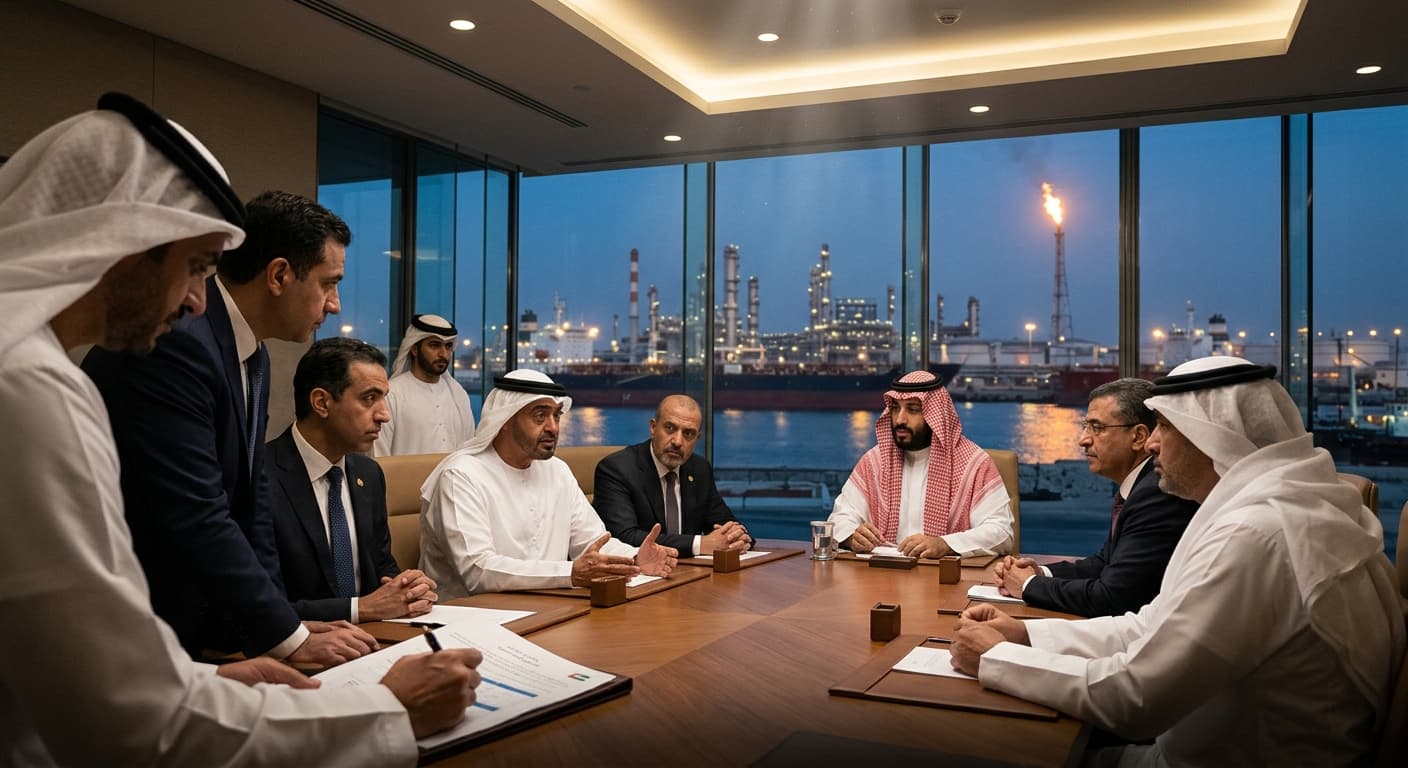
Iran War Oil Shock: Gulf Diplomacy Rewired After Hormuz Crisis
The world absorbed a billion-barrel supply loss from the Iran war — but the real story is how it broke OPEC, empowered the UAE, and left Gulf capitals hedging against Washington.
The world just absorbed the largest oil supply disruption in history without a global recession — and the geopolitical bill for that quiet miracle is now landing on Gulf capitals, not oil traders. Brent crude sits at $72 on July 6, 2026, below its pre-war close, even after the loss of more than a billion barrels of supply since February 28. The war did not deliver the price spike everyone feared; it delivered something more consequential — a permanent restructuring of Gulf-state diplomacy in which the UAE has exited OPEC, Saudi Arabia has been forced into open hedging against Washington, and Iran now believes chokepoint leverage is worth the ruin it brought on itself.
That reordering is why the Reuters analysis of "absorbed" supply loss underplays what happened. Markets did not survive because the system was resilient. They survived because three states — Saudi Arabia, the UAE, and China — each made choices that quietly rewired the Gulf's political economy. Each is now demanding something in return.
The three cushions — and what each one cost politically
The disruption itself is not disputed. The International Energy Agency called it the "largest supply disruption in the history of the global oil market," with 10.1 million barrels per day lost in March 2026 alone. Brookings analysts put the peak shortfall from affected countries above
"14 million barrels per day". That the world escaped $200 crude, as Iran's Islamic Revolutionary Guard Corps threatened it would, reflects three interventions.
First, Saudi Arabia and the UAE rerouted. Riyadh restored its East-West pipeline to 7 million barrels per day capacity after Iranian-linked strikes on a pumping station, according to the Saudi Energy Ministry via Al Jazeera. The UAE ran its Habshan-Fujairah line at a full 1.8 mbd and, on May 15, announced acceleration of a second bypass line to Fujairah. That is not resilience by accident — it is a decade of infrastructure that Gulf capitals built precisely because they did not trust Iran, or the US Fifth Fleet, to keep Hormuz open in a crisis.
Second, the IEA released 400 million barrels — one-third of member governments' emergency stockpiles and more than double the 182 million released after Russia's 2022 invasion of Ukraine, per Al Jazeera's reporting on the drawdown. The US contribution alone was 172 million barrels. According to the
Congressional Research Service, IEA government-controlled stocks stood at more than 1.2 billion barrels entering the crisis; roughly a third of that buffer is now gone.
Third, China cushioned demand. Beijing entered the war with roughly 1.4 billion barrels in strategic and commercial oil stocks — the world's largest cushion — and, per Brookings, drew primarily from commercial inventories rather than its strategic reserve while accelerating electric-vehicle adoption. The Crisis Group notes that China quietly worked through Pakistan during ceasefire negotiations rather than pressuring Tehran directly — "influence without military presence," as one Beijing analyst described it.
Each cushion carried a political price. Saudi Arabia's rerouting exposed how little it wants to depend on the strait — or on US naval protection of it. The IEA release drained the buffer that would defend Europe and Japan in a future crisis. And China's restraint bought Beijing a credibility with Tehran that Washington cannot match.
The UAE broke the cartel — and rewrote Gulf politics
The single largest structural shift came on May 1, when the UAE quit OPEC after decades of chafing against production quotas. The move, reported by Al Jazeera, was described by BBC economics editor Faisal Islam as
"the beginning of the end of OPEC as we knew it". Abu Dhabi is targeting 5 million bpd — up from a quota-restricted 3.2 mbd — and ADNOC announced $55 billion in accelerated projects for 2026–2028.
Read this as an oil story and it is a market event. Read it as a diplomatic story and it is the most consequential fracture in Gulf politics since the 2017 Qatar blockade. As Brookings' Jeffrey Feltman puts it, the war has "intensified existing regional rivalries, including among Saudi Arabia, Qatar, and the United Arab Emirates", with the UAE — struck by more than 3,000 Iranian missiles and drones, more than all other GCC states combined — now openly resentful that Riyadh, Doha, and Muscat played mediator while Abu Dhabi absorbed retaliation.
UAE presidential adviser Anwar Gargash captured that grievance in a blunt May 19 post: "The victim's role has merged with that of the mediator … while the friend has turned into a mediator instead of being a steadfast ally." Translation: Abu Dhabi will not accept a Saudi-led GCC that treats Iranian aggression as a bargaining position.
The Carnegie Endowment lays out the three scenarios now facing the bloc — deepening integration, competitive drift, or open bidding wars for scarce US missile-defense stockpiles. The evidence so far points to drift. Saudi Arabia is quietly probing accommodation with Iran, hedging against a Trump who could bomb Tehran again on 60 days' notice, per the memorandum of understanding. The UAE is going the opposite direction, deepening security ties with Israel and pursuing a "sell fast" oil strategy premised on peak demand arriving within the decade.
The MoU: what Trump actually signed
The framework that ended active hostilities is worth reading precisely, because it explains the price collapse — and the fragility beneath it. The 14-point memorandum of understanding published by the BBC, signed by Presidents Trump and Pezeshkian in Versailles on June 17, commits both sides to negotiate a final deal within 60 days. It reopens Hormuz "with no charge for 60 days," lifts the US naval blockade within 30 days, and pledges the eventual termination of "all types of sanctions" including UN Security Council measures.
"Immediately upon the signing of this MOU, the United States of America will begin the removal of its naval blockade … and it will fully end the naval blockade within 30 days. During this period, the traffic of vessels will be in proportion to the numbers of pre-war traffic being restored by the Islamic Republic of Iran."
Read the fifth paragraph carefully. Iran commits only to "make arrangements using its best efforts" for safe passage — and then to conduct dialogue with Oman on the "future administration and maritime services in the Strait of Hormuz." Iranian Parliament Speaker Mohammad Bagher Ghalibaf told state TV that Hormuz "will not return to pre-war conditions" and that Iran will collect fees for services after the 60-day grace period expires.
That is what a chokepoint sovereignty claim looks like on paper. The Atlantic Council's MENA program is blunter: Beijing is studying this precedent — "sovereign toll collection over a global chokepoint" — for "potential application in the Taiwan Strait," writes analyst Daniel Hojnacki. If Iran can charge for Hormuz transit, the argument that Washington underwrites the global commons weakens everywhere at once.
Meanwhile, the nuclear file — the war's original casus belli — remains unresolved. The IAEA's June 2026 Board of Governors report (GOV/2026/33) states that inspectors have been unable to verify Iran's uranium stockpile since the February 28 strikes and cannot confirm the size of the country's HEU inventory, describing this as "a matter of proliferation concern." The MoU calls for down-blending on site under IAEA supervision — but only after the 60-day negotiation, and only if Iran agrees. Director General Rafael Grossi told the
UN Security Council on May 19 that "agreements without the verification of the exclusively peaceful use of nuclear material and facilities do not help."
The depleted-stocks problem: Europe and Japan are exposed
Here is what markets have not priced. The IEA release is largely spent. Brookings estimates the coordinated drawdown added 2.5 to 3 mbd to the market — enough capacity to run through "July or August." The US Strategic Petroleum Reserve, which held 415.4 million barrels on February 18 per the Department of Energy figure cited by Al Jazeera, is now approaching an estimated 300 million barrels — with roughly 150 million barrels of that being an operational floor below which the reserve cannot be drawn without infrastructure damage.
Refilling it is a decade-long project. A January 2025 Congressional Research Service memo noted that the Trump administration inherited an SPR at 394 million barrels and that filling it to 714 million barrels of physical capacity would require congressional appropriations. Energy Secretary Chris Wright has
"reportedly intends to seek $20 billion to refill the SPR" — before the war depleted it further.
The exposure is asymmetric. Europe, which imports the bulk of its crude and drew heavily on its own emergency stocks, now faces what one industry analyst called a "thinner defence against another Gulf crisis." Japan started releasing 80 million barrels in mid-March. Only China exits this crisis with its buffer largely intact. If Hormuz closes again — and Iranian Parliament Speaker Ghalibaf is already asserting a right to charge tolls — the market will not have a second 400-million-barrel cushion to draw on.
Diplomat View
The consensus reading — that markets "absorbed" the shock and the war is over — misreads the political ledger. The world did not absorb this crisis; it burned down its emergency infrastructure to buy time, and traded structural OPEC discipline for Emirati independence. The Gulf that emerges from July 2026 has three new features: an unrestrained UAE running toward maximum production, a Saudi Arabia hedging its bets between Washington and Beijing, and an Iran that has proven chokepoint leverage works. The falsifiable call: if Iran collects transit fees after the 60-day grace period expires around August 16, expect Brent to reprice sharply — not because supply tightens but because sovereignty over Hormuz shifts. What would revise this thesis: a final US-Iran deal that includes explicit Iranian renunciation of Hormuz tolls, verified IAEA access to enrichment sites, and Emirati re-entry to some quota mechanism. None of those look likely in the current window.
What to watch
- August 16, 2026 — the 60-day MoU deadline for a final US–Iran agreement, and the expiry of the "no charge" Hormuz grace period.
- OPEC+ August ministerial meeting — will Saudi Arabia extend the 188,000 bpd monthly hike, or start defending price against UAE volumes flooding the market once shipping normalises?
- IAEA Board of Governors, September 2026 — the next verification report on Iran's undeclared HEU stockpile, and the first real test of whether the down-blending mechanism in Point 8 of the MoU has any operational meaning.
Read today's full |
Discover more
Global Politics
Xi Jinping Calls China-Russia Ties 'Precious'
Xi Jinping's description of China-Russia ties as 'precious' reflects a strategic imbalance, with Beijing dictating terms in the partnership.
India
Congress Accuses Modi of Stalling Women's Law
Congress accuses Modi of stalling women's reservation law by linking it to delimitation, revealing a deeper electoral strategy.

US Politics
House Ethics Committee Pushes Sexual Miscond.
The House Ethics Committee has shifted responsibility for sexual harassment settlement records to the Office of Congressional Workplace Rights, complicating disclosure efforts.

Economics
Fed's Amex AML order puts correspondent banking on notice
Federal Reserve's Amex AML order requires board-level controls and a 90-day plan; OCC fined the bank $350 million over enterprise-wide deficiencies.