Iran Appeals to UN Amid US Strikes
Iran seeks UN condemnation of US airstrikes as tensions rise.
Model Diplomat7 min readMiddle East
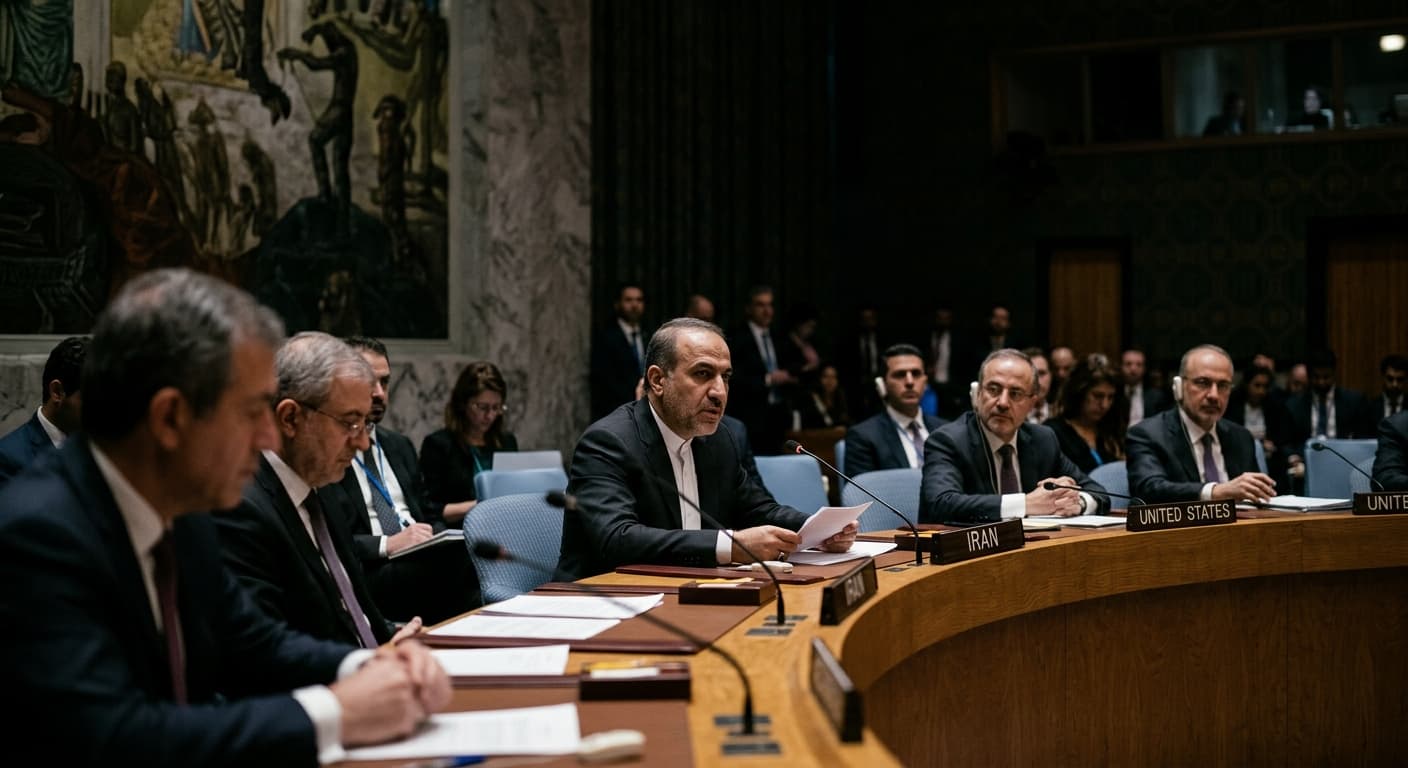
Iran Takes US Strikes to UN Security Council as Islamabad Truce Frays
Iran's UN envoy formally asked the Security Council on July 9, 2026 to condemn US airstrikes — a legal move to preserve leverage before the August 21 MoU deadline.
Iran's Permanent Representative to the United Nations, Amir Saeid Iravani, transmitted parallel letters on July 9, 2026 to Secretary-General António Guterres and the president of the Security Council, demanding condemnation and "immediate action" against a US bombing campaign that CENTCOM says destroyed roughly 170 targets across Iran over 48 hours. The appeal is not really aimed at winning a resolution — Washington's veto has already killed that path. It is a legal manoeuvre to lock in Iran's status as the aggrieved party under Article 2(4) of the UN Charter and Article 1 of the Islamabad Memorandum of Understanding, so Tehran can keep control of the Strait of Hormuz — its only real leverage — until the 60-day negotiating window expires on August 21.
What actually happened this week
Between the small hours of July 7 and the afternoon of July 9, US Central Command executed two of the largest strike waves since the April ceasefire. CENTCOM said it hit approximately 80 targets on Tuesday night and roughly 90 more on Wednesday night, aimed at "Iran's ability to threaten freedom of navigation in the Strait of Hormuz," according to Al Jazeera's coverage of the CENTCOM statements. Iranian state media reported strikes in Bushehr province — home to the country's only civilian nuclear power plant — as well as Bandar Abbas, Chabahar, Jask, Konarak, Abu Musa island and two railway bridges in the northeast,
the BBC reported.
Tehran's response was two-track. The IRGC launched ballistic missiles and drones at US installations in Kuwait, Bahrain, Qatar and Jordan — sirens went off three times over Manama, home to the US Navy's Fifth Fleet, per NPR's wire report. At the same time, Iran filed its 40th-plus letter to the Security Council since the war began, this one citing casualties among Iranian armed forces and demanding accountability, according to
Iran International.
Speaking from Air Force One en route from the NATO summit in Ankara, Donald Trump said the Islamabad MoU signed at Versailles on June 17 was "over" — then hedged that Iran "wants to make a deal," a formulation preserved verbatim in Al Jazeera's transcript of his in-flight remarks.
Why Iran is going to the Council it cannot win in
The letter is a legal instrument, not a diplomatic one. Iran already knows the arithmetic: the United States, France and the United Kingdom hold three of the five permanent vetoes. When Bahrain tabled a Gulf-state resolution on April 7 demanding Iran cease attacks on shipping, China and Russia jointly vetoed it — the UN meetings record shows Beijing's envoy arguing the text ignored "the root causes of the crisis." Any resolution condemning the United States would meet an equal and opposite fate.
What Iravani's letter does instead is build a paper trail. Every one of his 2025–26 communications has been formally circulated as a Security Council document — the June 21, 2025 letter after the US strikes on Fordow, Natanz and Esfahan; the
March 4, 2026 letter on Israeli threats to Iranian diplomats in Lebanon; the
January 13, 2026 letter after Trump urged Iranians to "take over your institutions." These letters are exhibits Tehran is compiling for a future forum — the International Court of Justice, a compensation claim, or a General Assembly "Uniting for Peace" push where no P5 veto applies.
The strategy has precedent. Iran successfully used the same letter-trail approach in 2020 after the killing of Qassem Soleimani, and it now has an even clearer legal hook: two Articles of a signed, electronically executed, presidentially-endorsed memorandum that the US itself read out to reporters on June 17.
The MoU is the fight, not the pretext
The document Iran keeps invoking is worth reading carefully. Its first clause commits both sides to "the immediate and permanent termination of military operations on all fronts," and Point 5 obliges Iran to arrange safe passage through the Strait of Hormuz — with no fee — for 60 days, per the BBC's verbatim text. Iran's Foreign Ministry now accuses Washington of breaching Articles 1 and 5,
Mehr News reported.
The interpretive fight sits on one word. Iran reads Point 5 to mean it has sole authority to determine "arrangements" for safe passage. That is why Tehran attacked three tankers on July 7 for using what Foreign Ministry spokesman Esmaeil Baghaei called an "unauthorised route." Washington reads the same clause to require unimpeded transit for any commercial vessel, full stop. This is the whole war in miniature: whoever controls the Strait controls global oil pricing during a summer when, UN News reported, some 6,000 seafarers remain stranded and strategic oil reserves are at their lowest levels in decades.
The Council itself is aware of the vacuum. At a June 9 meeting, Liberia's envoy warned the P5 that "the impasse over the 1737 Committee is the organ's most immediate institutional challenge," creating an oversight gap precisely when it matters most, UN meetings coverage recorded. Nothing came of it.
The unexpected beneficiary: Beijing and Moscow
China and Russia are the quiet winners of Iravani's letter. They do not have to spend political capital vetoing anything — the veto math protects Iran on its own. Meanwhile, every Iranian filing further degrades Council legitimacy in the Global South, which is exactly the argument China's UN mission has been making since the February 28 opening strikes. When Foreign Minister Wang Yi told his Israeli counterpart on March 3 that Beijing "opposes any military strikes launched by Israel and the US against Iran," Al Jazeera reported, he was framing a longer game about UN Charter enforcement — one Iran's letters are now doing his work for him.
Russian Foreign Minister Sergey Lavrov extended the argument, warning that Israel and the United States could produce "the very outcome they claimed they wanted to prevent" — a nuclear-armed Iran — because "the US doesn't attack those who have nuclear bombs." That single sentence, delivered on March 3, has become the analytic frame Moscow uses in every subsequent Council session.
The costs of the Council's dysfunction are also concrete. UNECE energy director Dario Liguti told UN News that price volatility and supply disruption will continue "even if the situation normalizes rapidly," with fertilizer costs already hammering African import bills.
The forecast
Three concrete catalysts sit in the next six weeks:
- July 10–15: An emergency Security Council session is virtually certain once Iran's letter is formally circulated as an S/2026 document; expect a US–UK–France bloc pushing a Gulf-tilted text and a Russia–China counter-draft that will likely die 4–2–9, mirroring the April 7 outcome.
- August 4 (approximate): Iran and the US are due to resume technical talks after the mourning period for Ayatollah Khamenei ends; the venue is expected to be Bürgenstock, Switzerland, per Swiss foreign-ministry confirmation cited by
Al Jazeera.
- August 21: The MoU's 60-day negotiating window expires. Point 3 allows extension only "with mutual consent" — if Trump refuses, the last legal architecture holding the ceasefire together dissolves.
Diplomat View
Iran is not trying to win at Turtle Bay. It is trying to time-shift the fight. Every letter Iravani files is a brick in a legal wall designed to make three things harder later: a US-drafted snapback of nuclear sanctions, a Gulf-led resolution condemning Iranian attacks on shipping, and a future Israeli or American case at the ICJ over Iran's nuclear programme. The bet is that if Tehran can survive to August 21 with the "aggrieved party" narrative intact, it enters final-status talks holding the Strait — the only card that has ever moved Washington.
The forecast that follows: expect no Council resolution against the United States, expect the MoU to be neither formally cancelled nor honoured, and expect the negotiating window to be quietly extended in late August under Pakistani and Qatari cover — because neither Trump nor Pezeshkian can afford full war during a US midterm cycle and an Iranian post-Khamenei succession. What would falsify this call: a US strike on Kharg Island (Trump's stated threat), an Iranian move to formally exit the NPT, or a Chinese decision to escort tankers militarily through Hormuz. Any one of those turns a legal proxy war into a real one — and Iravani's letters stop being paper and start being evidence.
The Bottom Line
The bottom line: Iran's July 9 appeal to the Security Council is a legal hedge, not a diplomatic gambit — Tehran is stockpiling the paperwork it will need to preserve control of the Strait of Hormuz through the August 21 MoU deadline. The winners are Russia and China, who get an eroded Council for free. The loser is the Council itself, now watching a signed, presidentially-endorsed ceasefire being enforced by missile strikes rather than by the resolution that Point 14 promised.
Discover more
US Politics
Virginia's Redistricting Referendum
Virginia's redistricting referendum is drawing a flood of dark money, shaping future elections and the fight for congressional control amid party stakes.
India
Congress Accuses Modi of Stalling Women's Law
Congress accuses Modi of stalling women's reservation law by linking it to delimitation, revealing a deeper electoral strategy.
US Politics
House Ethics Committee Pushes Sexual Miscond.
The House Ethics Committee has shifted responsibility for sexual harassment settlement records to the Office of Congressional Workplace Rights, complicating disclosure efforts.

Economics
Fed's Amex AML order puts correspondent banking on notice
Federal Reserve's Amex AML order requires board-level controls and a 90-day plan; OCC fined the bank $350 million over enterprise-wide deficiencies.