India's UN Pitch on Critical Minerals
India's UN pitch for resource sovereignty is a strategic bid to shape critical-mineral governance before China's dominance hardens.
Model Diplomat7 min readSouth Asia
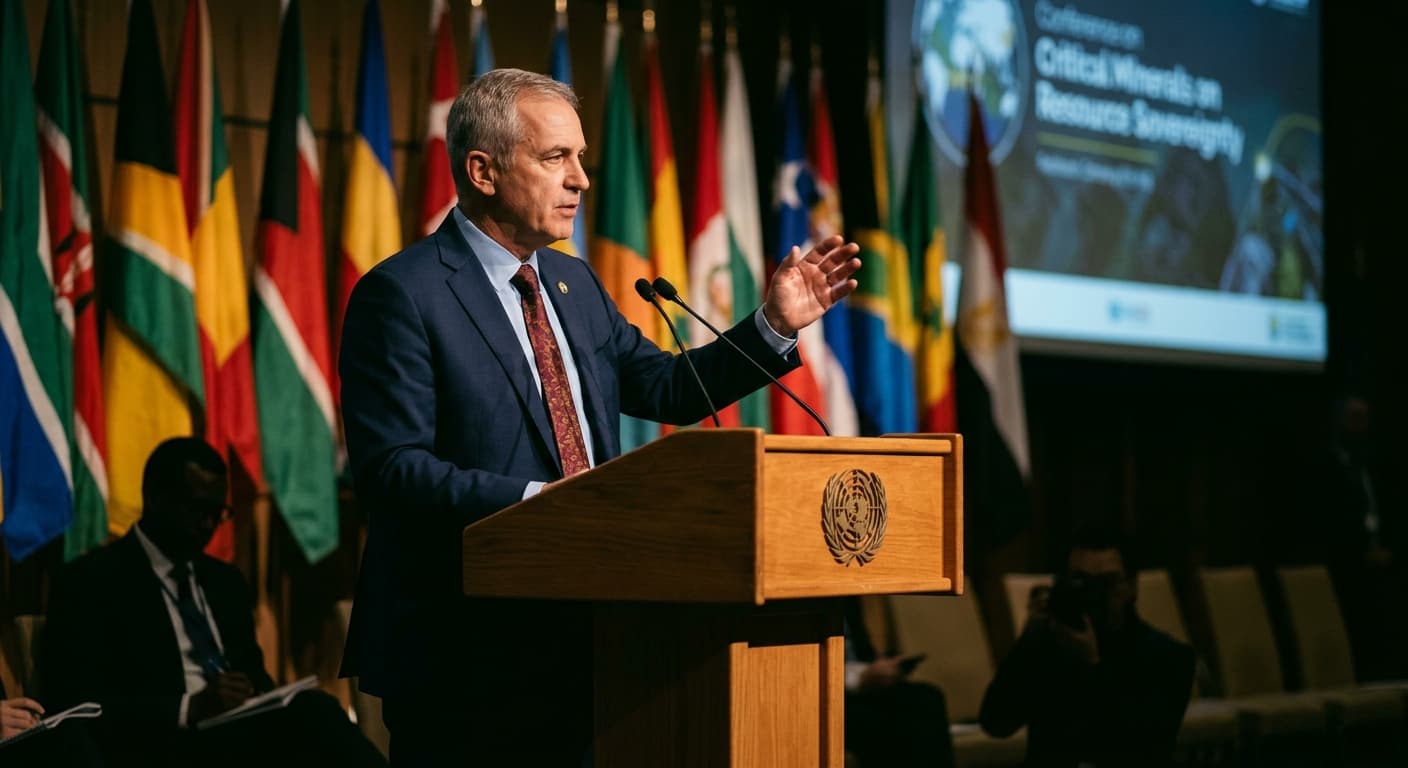
India's UN Pitch on Critical Minerals Is a Bid to Write the Rules Before China Does
At the first UN High-Level Meeting on Critical Energy Transition Minerals, India called for resource sovereignty and value addition, a normative move that doubles as cover for New Delhi's parallel scramble to lock down bilateral supply and build domestic capacity before China's dominance hardens.
India's Ambassador to the United Nations, Harish Parvathaneni, told the plenary of the first-ever UN High-Level Meeting on Critical Energy Transition Minerals on July 14, 2026, that critical minerals "should become an engine for sustainable development, not another source of inequality," insisting that national ownership and resource sovereignty remain "the foundation of global cooperation" The Economic Times. The framing sounds moral. It is strategic. New Delhi is trying to enshrine principles that would protect developing producers, including a future India, while simultaneously racing through bilateral deals with Washington and Brasília and a ₹73 billion domestic magnet push to avoid being trapped as a raw-materials appendage in a China-dominated chain.
The venue matters more than the speech
The July 14 meeting was no routine UN side-event. It capped a two-year process. Secretary-General António Guterres launched the Panel on Critical Energy Transition Minerals in April 2024, co-chaired by South Africa's Ambassador Nozipho Mxakato-Diseko and the EU's Ditte Juul Jørgensen, to fill what Guterres called a "normative gap" on critical minerals governance United Nations. The Panel's September 2024 report, Resourcing the energy transition, set out seven Guiding Principles and five Actionable Recommendations centred on benefit-sharing, local value addition and human rights
United Nations. A UN Task Force, co-chaired by UNEP, UNCTAD and UNDP, was launched in Nairobi in December 2025 with five technical clusters on value addition, traceability, mining legacies, artisanal mining and circularity
United Nations.
Deputy Secretary-General Amina Mohammed told the July 14 plenary that the priority must be "strengthening governments' capacity to negotiate equitable mining agreements, while expanding domestic processing and refining that drive local economies" United Nations. UNCTAD's closing statement was blunter: demand for copper, lithium, cobalt, nickel, graphite and rare earths is surging on a supply base "this concentrated," and what happens on the ground "will decide whether this transition sets a new standard, or reproduces the patterns of the old extractive economy"
UNCTAD.
India did not just attend. Parvathaneni positioned India as a partner ready to "collaborate with global partners to create resilient, transparent, and diverse supply chains that foster shared prosperity," citing the National Critical Mineral Mission and Khanij Bidesh India Limited (KABIL), the state joint venture for overseas mineral security The Economic Times. The pitch lets India claim Global South leadership on a stage the South co-chairs, while the substance of its policy runs through Washington and Tokyo.
The gap between rhetoric and capacity
India's UN advocacy leans on the language of resource sovereignty and value addition. Its domestic reality is a near-total dependence on imported processed minerals. India today produces only four of the 30 minerals it itself designated critical in 2023 — copper, graphite, phosphorous and titanium — owing to limited exploration and processing technology, according to the US International Trade Administration Al Jazeera. It imports 80–90% of its rare-earth magnets and related materials from China, which controls more than 90% of global rare-earth processing
BBC News.
India holds roughly 8% of global rare-earth reserves, largely in the monazite sands of Kerala, Tamil Nadu, Odisha and Andhra Pradesh, yet accounts for less than 1% of global mining BBC News. It has surpluses of lighter rare earths such as neodymium but lacks extractable quantities of heavier elements like dysprosium and terbium, which are essential for high-performance magnets used in electric vehicles and wind turbines. Even if India builds magnet capacity, the raw materials may still come from China. As Neha Mukherjee of Benchmark Mineral Intelligence put it: "If we do not scale capacity, the problem doesn't get solved. We'll still be dependent on China — and China will scale"
BBC News.
This is the structural tension behind the UN speech. India is championing a governance framework premised on producer leverage it does not yet possess. The value-addition logic it promotes at the UN — move up the chain, capture processing rents, resist raw-export dependency, is precisely the logic mineral-rich states from Indonesia to Zimbabwe have begun to act on, often through export restrictions that have triggered WTO disputes and importer pushback SSRN. The IMF has warned that such measures, absent fundamental capacity constraints being resolved, "may actually deter investment and shift mining and processing activities to alternative markets"
IMF. India's own magnet scheme, approved in November 2025, will produce an estimated 6,000 tonnes a year by the early 2030s against current demand of roughly 7,000 tonnes — a shortfall that leaves it exposed even as it preaches self-reliance
BBC News.
The bilateral track is where the real bets sit
India's multilateral posture is one ledger. Its bilateral supply-chain diplomacy is another, and it is moving faster. In May 2026, India and the United States signed a framework agreement covering mining, processing and recycling of critical minerals and rare earths, with the US embassy framing it as an effort to "protect sensitive supply chains from coercive market practices and reduce our collective vulnerability to single-source monopolies" Al Jazeera. In February 2026, Modi and Lula signed a critical minerals agreement in New Delhi, with Modi calling it a "major step towards building resilient supply chains" and framing India-Brazil cooperation as strengthening "the voice of the Global South"
Al Jazeera. The Quad has separately outlined plans to mobilise up to $20 billion in loans, guarantees and purchase agreements for critical mineral supply chains among like-minded countries
Al Jazeera.
Domestically, India's FY2026-27 budget created "rare earth corridors" in Odisha, Kerala, Andhra Pradesh and Tamil Nadu as hubs for mining, processing and magnet manufacturing BBC News. KABIL, formed in 2019 as a joint venture of NALCO, Hindustan Copper and MECL, is tasked with acquiring overseas mining assets and securing supply through government-to-government deals
Brookings Institution. India has also applied for additional deep-sea exploration licences in the Indian Ocean through the International Seabed Authority, competing directly with China and Russia for polymetallic nodules and cobalt-rich crusts
BBC News.
Christopher Vandome, who leads the Chatham House Critical Minerals Initiative, assessed the US-India deal candidly: for Washington it secures diversified supply and curbs Chinese dominance, "but it is also a long-term strategic move to do a deal with India to prevent it from gaining significant market share and being able to exercise market dominance in the same way the Chinese have done" Al Jazeera. The bilateral architecture is not altruism. It is a hedge on both sides.
The second-order risk India is not naming
The governance model India backs at the UN — producer sovereignty, local value addition, restrictions on raw-mineral export — has a catch India's own industrial strategy exposes. If every mineral-rich state follows the logic India espouses, the input costs for India's downstream manufacturers rise. India wants to build EV batteries, solar panels and magnets; it does not yet produce the cobalt, lithium or heavy rare earths those need. A world of proliferating export bans and beneficiation mandates, of the sort Indonesia and Zimbabwe have already begun imposing, raises the price of exactly the feedstocks India must import SSRN.
The Council on Foreign Relations frames India's broader climate statecraft as a dual track: emphasising equity and conditional mitigation timelines in multilateral fora while separately prioritising economic growth, energy access and industrial strategy through bilateral mechanisms CFR. The UN speech fits the first track. The KABIL acquisitions, the Quad financing and the rare-earth corridors fit the second. The risk is that the two tracks pull in opposite directions — a normative framework that empowers producers colliding with a manufacturing strategy that depends on cheap, accessible raw inputs.
CEPR scholars have warned of a "new curse of critical minerals" if the rush reproduces commodity dependence rather than building genuine downstream capacity, arguing that advanced economies must deliver technology transfers, not just capital, and that producer states must avoid opaque resource-backed loans CEPR. India's pitch at the UN gestures at exactly this: "partnerships must foster mutually beneficial investment, technology sharing, and skill-building," Parvathaneni said
The Economic Times. Whether India's bilateral partners will accept technology-transfer terms stringent enough to make that real is the open question.
Diplomat View
India's UN intervention is not a development plea. It is a bid to shape the rules of the next commodity order before they are written without it. New Delhi's calculation is that the country can occupy the Global South's moral high ground at the UN, championing resource sovereignty and value addition, while quietly locking down bilateral supply through the Quad, the US framework, the Brazil deal and KABIL overseas acquisitions. The strategy is coherent only if India actually builds domestic processing and magnet capacity at scale; on current trajectories, the ₹73 billion scheme produces 6,000 tonnes against 7,000 tonnes of demand by the early 2030s, and the heavy rare earths still come from China.
The forecast hinges on three things. First, whether India's rare-earth corridors and KABIL acquisitions translate into refined output by 2028-30, not just announcements. Second, whether the UN Task Force's Country Support Mechanism delivers tangible technical assistance to producer states — the proof case for the multilateral track India champions. Third, whether the very export-restriction logic India endorses at the UN raises its own input costs fast enough to constrain the manufacturing ambition it pursues bilaterally. If those tensions bite, India's dual-track posture stops looking like strategy and starts looking like contradiction.
What to watch next:
- Q4 2026: India's promised updated climate plan (NDC), delayed past COP30, due by end-December 2026 — will critical minerals feature as an industrial-policy pillar?
- 2026-27: UN Task Force Country Support Mechanism first-cohort delivery — the first concrete test of whether the multilateral track produces anything beyond principles.
- Through 2028: KABIL overseas asset acquisitions and rare-earth corridor commissioning milestones — the make-or-break for whether India's producer-sovereignty rhetoric is backed by actual capacity.
Discover more
US Politics
House Ethics Committee Pushes Sexual Miscond.
The House Ethics Committee has shifted responsibility for sexual harassment settlement records to the Office of Congressional Workplace Rights, complicating disclosure efforts.
US Politics
SNAP Food Assistance Faces Legal Challenges
In 2026, SNAP faces stricter eligibility rules and mounting legal challenges, threatening food assistance for the millions of Americans who rely on the program.

International Relations
Pakistan's Key Role in US-Israel-Iran Meddle
Pakistan is seeking to mediate the US-Israel-Iran conflict, balancing high-stakes diplomacy against severe economic pressures and steep regional challenges.

Economics
Fed's Amex AML order puts correspondent banking on notice
Federal Reserve's Amex AML order requires board-level controls and a 90-day plan; OCC fined the bank $350 million over enterprise-wide deficiencies.