India's Forced-Labour Ban: Tariff Tier Pivot
New Delhi's tariff-tier pivot, not a moral conversion
Model Diplomat10 min readSouth Asia
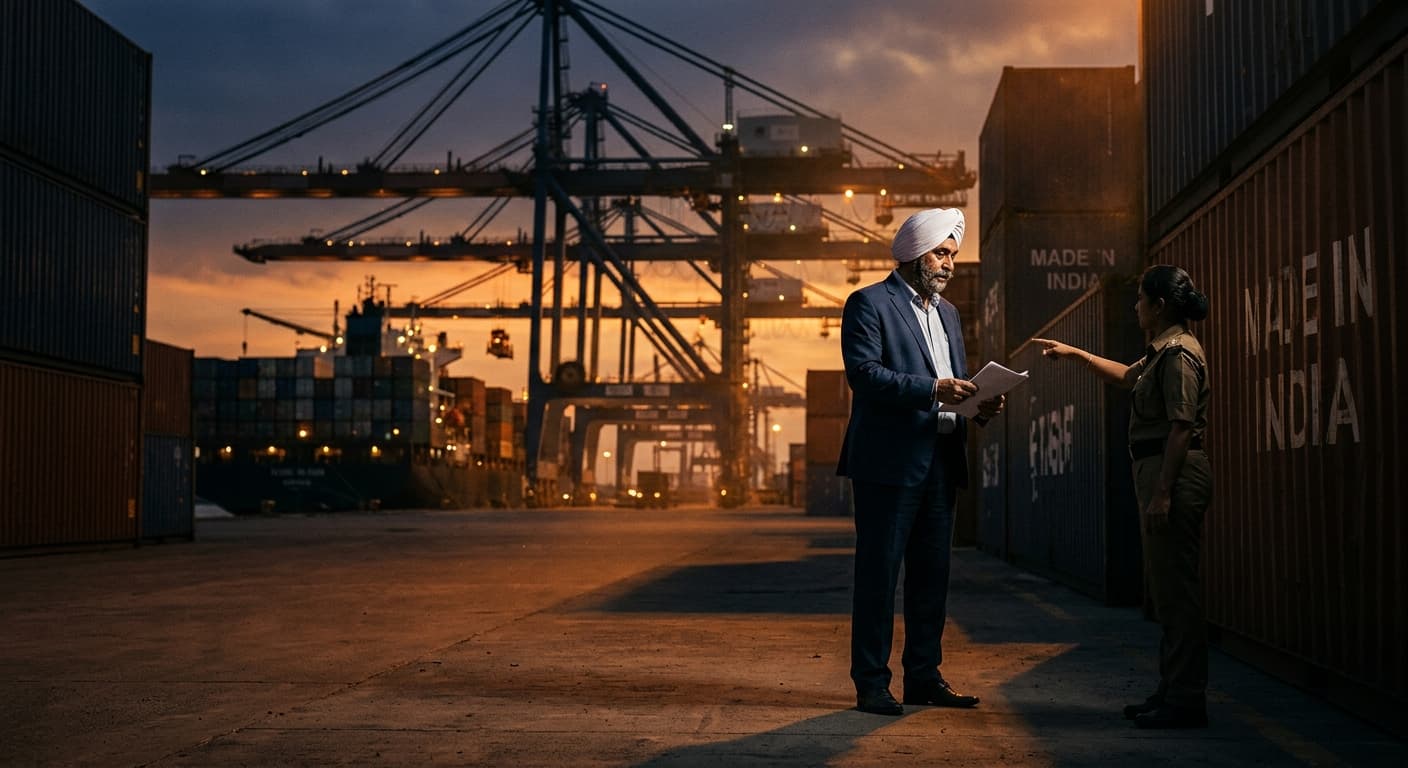
India's Forced-Labour Import Ban Is a Tariff-Tier Pivot, Not a Moral Conversion
New Delhi's July 13, 2026 gazette amendment prohibits forced-labour imports just as Washington's Section 301 probe threatens 12.5% duties — a legal repositioning aimed at the tariff tier, not the textile loom.
On July 13, 2026, India's Directorate General of Foreign Trade (DGFT) slipped a single paragraph into the Foreign Trade Policy 2023: "The import of goods produced or manufactured, wholly or in part, through the use of forced labour is prohibited," effective 30 days after gazette publication, according to a Rediff Money report citing the notification. The move lands in the middle of a US Trade Representative (USTR) Section 301 investigation that has proposed 12.5% tariffs on 54 countries — India included — for lacking such a prohibition. Read as a labour-rights milestone, the amendment looks overdue. Read as trade strategy, it is something sharper: India is rewriting its statute book to climb down one tariff tier — from the 12.5% "no legal prohibition" category into the 10% "prohibition exists, enforcement gaps remain" band — while preserving leverage in the bilateral trade agreement (BTA) talks. The substance of enforcement — what USTR actually investigates — is deferred to a Handbook of Procedures inquiry mechanism New Delhi controls.
The Two-Tier Architecture
The two-tier structure is not incidental — it is the mechanism. USTR's June 2, 2026 determination found that all 60 investigated economies failed to "impose and effectively enforce" a prohibition on forced-labour imports, rendering those failures "unreasonable and burdens or restricts U.S. commerce," as USTR stated. The proposed remedy splits the offenders: 12.5% additional duties for economies with no legal prohibition at all, and 10% for those that had imposed one — even partially — but failed to enforce it. India sat in the higher band alongside China, Vietnam, Japan, South Korea, and Australia. The lower band captured the EU, Canada, the UK, Mexico, Pakistan, and eight others that already operated "full or partial programmes," according to
Al Jazeera. The 2.5-point spread is the entire incentive structure. India's July 13 amendment is a precise response to it.
The USTR received testimony from nearly 60 witnesses and 500 written comments during the public-comment process that opened in March 2026, per Brookings, which described the forced-labour investigation as examining not whether countries use forced labour domestically, but whether their laws prohibit forced-labour imports and whether those prohibitions are enforced. The distinction is crucial: India's amendment addresses the first prong (existence of a prohibition) but leaves the second prong (effective enforcement) entirely within DGFT's discretion. The procedure for conducting inquiries "will be as prescribed in the Handbook of Procedures, 2023," as the
Economic Times reported — a document DGFT controls and can amend without legislative debate.
The Post-IEEPA Legal Landscape
India's amendment does not exist in a vacuum; it is a move in a game Washington reset in February 2026. On February 20, the US Supreme Court ruled 6-3 that President Trump's use of the International Emergency Economic Powers Act (IEEPA) to impose across-the-board tariffs was unlawful, as Al Jazeera reported. Chief Justice John Roberts wrote that the power to "regulate importation" under IEEPA "does not" encompass the power to impose tariffs. The ruling invalidated Trump's "reciprocal" and "fentanyl" tariffs overnight. Within hours, Trump imposed a temporary 10% global tariff under Section 122 of the Trade Act, a measure that expires July 24, 2026, unless Congress extends it, according to
BBC.
The administration then pivoted to Section 301 of the Trade Act of 1974, which requires formal investigations, public comment, and administrative determinations before tariffs can be imposed — a slower but more legally durable vehicle, as CFR noted. USTR launched two groups of Section 301 investigations on March 11-12, 2026: one targeting 16 economies for excess manufacturing capacity, and another targeting all 60 economies for forced-labour import failures, per
Brookings. Unlike IEEPA's emergency powers, Section 301 tariffs are "much harder to change" once established, as the Atlantic Council's Chalecki told
Al Jazeera. They cannot be raised, lowered, or suspended overnight by executive order. Any future changes require a legal record, public consultation, and formal action.
This legal landscape creates a narrow window. The July 24 expiration of the Section 122 tariff and the ongoing Section 301 process have put all 60 investigated economies on a countdown. India's July 13 amendment — timed 11 days before the Section 122 cliff edge and amid active BTA negotiations — is designed to demonstrate compliance before USTR finalizes its determinations, not after.
The BTA Leverage Play
India and the US reached a framework trade agreement on February 2, 2026, with Trump cutting India's reciprocal tariff from 50% to 18%, as BBC reported. India committed to purchasing $500 billion of US goods over five years. But talks "lost momentum after the US Supreme Court invalidated Trump's tariff regime," as India's commerce ministry told
Al Jazeera. The IEEPA ruling stripped Washington of its primary bargaining tool — the threat of sweeping emergency tariffs. Section 301 is the replacement leverage.
Ajay Srivastava, founder of the Delhi-based Global Trade Research Initiative (GTRI), told BBC that "after the US Supreme Court's February 2026 ruling struck down the reciprocal tariffs, Washington lost much of its leverage in trade negotiations" and that "Section 301 investigations now appear to be the new pressure tool — using the threat of additional tariffs to discourage countries from abandoning existing deals and to push others, including India, to conclude negotiations quickly." He separately told
BBC that India should challenge the legal basis of the proposed tariffs, arguing they stretch the scope of Section 301, and should "consider stepping away from the bilateral trade agreement, as Malaysia has done."
India has taken the opposite path. Instead of walking away, New Delhi is conceding on the narrowest point, the absence of a legal prohibition, while keeping the broader BTA negotiation alive. The Times of India framed the amendment as serving "dual purposes: labour-rights compliance with international norms, and strategic tariff-tier positioning and leverage in U.S.-India trade talks." The
Indian Express noted that the amendment "does not automatically resolve the USTR case or remove India from the 12.5% tariff tier" — USTR's final determination depends on whether it views India's inquiry mechanism as credible enforcement.
The EU Precedent: A Prohibition Is Not Enough
The EU's experience is the warning India is studying. The EU passed a forced-labour import ban in 2024, but USTR still placed it in the 10% tier because the ban "only came into force in December 2027 and lacked key elements," as Al Jazeera reported. Bernd Lange, chair of the European Parliament's trade committee, called the US findings "utterly absurd" given the EU's existing legislation — but the 10% tariff was proposed nonetheless, according to
BBC.
This precedent tells India that inserting a prohibition into the FTP is necessary but not sufficient. The DGFT inquiry mechanism — which operates under the Handbook of Procedures and allows the government to issue product-specific bans after investigation — is the enforcement architecture USTR will scrutinize. But the specifics of that inquiry process (evidence standards, timelines, penalties, appeal rights) remain to be prescribed, as the Business Standard noted. India has bought the legal-prohibition ticket. The enforcement ride is still being assembled.
The Financial Express noted that India's prohibition "could reduce India's exposure to the 12.5% tariff tier if enforcement and scope align with USTR expectations; it does not automatically 'remove' India from the case without USTR engagement and determinations." The
Moneycontrol report added that India's amendment arrived "days after defending itself before US trade body" — indicating New Delhi is simultaneously complying and contesting.
Domestic Reality: The Ban Targets Imports, Not Production
The amendment defines "forced labour" per the ILO Forced Labour Convention, 1930 (No. 29): "all work or service which is exacted from any person under the menace of any penalty and for which the said person has not offered himself voluntarily," as the Economic Times reported. India's Constitution already prohibits forced labour under Article 23, and the Supreme Court's 1982 ruling in PUDR v. Union of India expanded that prohibition to include economic compulsion — work at below-minimum wages — as an
SSRN legal analysis documented. The Bonded Labour System (Abolition) Act, 1976, outlawed debt bondage.
Yet enforcement has been chronically weak. In June 2026, police in Uttar Pradesh's Muzaffarnagar district rescued 12 men held as bonded labourers at a disposable-plate factory — lured with job promises, confined, beaten, and fed one dry roti per day, as BBC reported. Some had been held for 18 months. An
ILO Working Paper by Ravi S. Srivastava documented the incidence of bonded labour across Indian agriculture, brick kilns, quarries, mines, power looms, and carpet weaving — sectors that also feed export supply chains.
The import ban does not address this domestic production. It targets goods entering India. The LSE analysis noted that India has "blatantly refused to enforce existing laws on bonded labour, contract labour and inter-state migrant labour" — a gap the July 13 amendment leaves untouched. The US Section 301 investigation, by design, examines import prohibitions, not domestic labour conditions.
Named Winners and Losers
Winners:
- DGFT and the Commerce Ministry — gain a new enforcement tool and procedural discretion that strengthens their hand in BTA negotiations without binding them to specific enforcement metrics.
- India's BTA negotiating team — can now point to a legal prohibition when USTR asks what India has done, potentially shifting the conversation from "impose a ban" to "how fast can you enforce it" — a slower, more controllable timeline.
- Compliant Indian exporters in textiles, gems, leather, and seafood — the
Economic Times noted these sectors face high forced-labour exposure risk; if the ban reduces the 12.5% tariff threat to 10% or lower, their competitive position against China and Vietnam improves.
- US Trade Representative Jamieson Greer — gets a tangible compliance result from a major trading partner, validating the Section 301 approach as leverage.
Losers:
- Indian importers sourcing from high-risk regions — particularly those importing raw cotton, textiles, or intermediates from Xinjiang or Southeast Asian supply chains with documented forced-labour risks. Compliance costs rise; supply-chain due diligence becomes mandatory rather than optional.
- Chinese exporters to India — if DGFT invokes the prohibition against Chinese goods (a politically easy first target given Xinjiang's documented forced-labour profile), the
RAND Corporation documented how US enforcement under the Uyghur Forced Labor Prevention Act (UFLPA) already reshaped global supply chains by creating a "rebuttable presumption" that goods from Xinjiang are forced-labour products. India's inquiry mechanism could replicate that logic selectively.
- Small and medium Indian manufacturers reliant on cheap imported inputs — the
Financial Express flagged higher compliance costs and potential supply-chain disruption for these firms.
- India's farm unions — already protesting tariff cuts on US agricultural imports under the BTA, as
BBC reported; adding forced-labour import enforcement could compound their concerns about domestic competitiveness.
The Historical Parallel: UFLPA 2022
India's amendment mirrors the architecture of the US Uyghur Forced Labor Prevention Act of 2021 (UFLPA), which created a rebuttable presumption that any goods produced "wholly or in part" in Xinjiang are made with forced labour — shifting the burden of proof to importers. The RAND study found that UFLPA "imposes significant compliance obligations on importers and has reshaped global supply-chain due diligence practices," even as direct shipments from Xinjiang decreased and indirect supply-chain linkages persisted. India's FTP amendment uses the same "wholly or in part" language and defers to an administrative inquiry — a structurally similar but as-yet-untested mechanism.
The parallel is instructive but incomplete. UFLPA came with DHS enforcement resources, entity lists, and congressional oversight. India's DGFT inquiry mechanism has none of those institutional supports yet. The gap between passing a prohibition and building enforcement infrastructure is where the EU's December 2027 timeline faltered — and where India's 30-day effective date may overpromise.
The Bottom Line
India's forced-labour import ban is a tariff-tier optimization maneuver dressed as a labour-rights milestone. By inserting a legal prohibition where none existed, New Delhi positions itself to move from USTR's 12.5% tariff band to the 10% band — potentially saving 2.5 percentage points across its entire export base to the US — while keeping the enforcement details within DGFT's discretionary control. Whether USTR accepts the move as sufficient depends on the credibility of the inquiry mechanism India has yet to build. The decisive question is not whether India banned forced-labour imports on July 13, 2026, but whether DGFT can show a functioning enforcement record before USTR finalizes its Section 301 determinations — and whether the BTA negotiations conclude before the next tariff cliff arrives.
What to watch:
- August 12, 2026 (approx.): India's forced-labour import prohibition takes effect, 30 days after the July 13 gazette notification. The first DGFT product-specific inquiry or prohibition order will signal whether enforcement is real.
- USTR final Section 301 determinations: No fixed date, but USTR's June 2 notice invited public comments through July 6 and held hearings July 7. Final determinations and tariff implementation could follow within 60-90 days, potentially by September-October 2026.
- July 24, 2026: The temporary 10% global tariff under Section 122 expires unless Congress extends it — a deadline that increases pressure on both sides to show BTA progress.
- BTA negotiation rounds: India's commerce secretary described the next round as putting "final touches" on the deal, per
Discover more

India
Delhi CM Rekha Gupta Blasts Opposition's Delm
Delhi CM Rekha Gupta's remarks on women's quota defeat reveal BJP's strategy for the 2029 Lok Sabha elections, focusing on delimitation.
India
Congress Accuses Modi of Stalling Women's Law
Congress accuses Modi of stalling women's reservation law by linking it to delimitation, revealing a deeper electoral strategy.
US Politics
SNAP Food Assistance Faces Legal Challenges
In 2026, SNAP faces stricter eligibility rules and mounting legal challenges, threatening food assistance for the millions of Americans who rely on the program.

Economics
Fed's Amex AML order puts correspondent banking on notice
Federal Reserve's Amex AML order requires board-level controls and a 90-day plan; OCC fined the bank $350 million over enterprise-wide deficiencies.