India's Forced-Labor Ban: Tariff Shield, Not
India's forced-labor import ban is a tariff shield, not a labor reform
Model Diplomat9 min readSouth Asia
India's Forced-Labor Import Ban Is a Tariff Shield, Not a Labor Reform
India's July 13, 2026 amendment banning forced-labor imports mirrors US law word-for-word — but the real target is a 12.5% Section 301 tariff and a stalled bilateral trade deal, not the 11 million Indians in modern slavery.
On July 13, 2026, India's Directorate General of Foreign Trade inserted a single paragraph into the Foreign Trade Policy 2023: "The import of goods produced or manufactured, wholly or in part, through the use of forced labour is prohibited," according to a gazette notification reported by Rediff Money. The provision takes effect 30 days after gazette publication — roughly August 12, 2026. The amendment is a compliance move engineered to neutralize a 12.5% US tariff threat and rescue a stalled bilateral trade agreement, not a crackdown on the bonded labor embedded in India's own supply chains.
The wording is no accident. India's "Forced Labour" definition tracks the ILO Forced Labour Convention, 1930 (No. 29) verbatim: "all work or service which is exacted from any person under the menace of any penalty and for which the said person has not offered himself voluntarily." That is the same definition codified in 19 USC 1307, Section 307 of the US Tariff Act of 1930, which has barred forced-labor goods from American ports for nearly a century. India ratified Convention No. 29 in 1954 — the year the
Prime Minister's Office later confirmed when Cabinet approved the 2014 Protocol supplementing it. The Indian Constitution's Article 23 already prohibits begar and forced labor. The Bonded Labour System (Abolition) Act outlawed debt bondage in 1976. What was missing — the specific legal instrument the US demanded — was an import prohibition on goods tainted by forced labor from any source.
The tariff trigger
The immediate pressure is American. On June 3, 2026, the Office of the US Trade Representative proposed additional duties of up to 12.5% on imports from 60 economies after concluding they had failed to prohibit or enforce bans on forced-labor goods, Al Jazeera reported. India landed in the higher tier — 12.5% — alongside China, Japan, South Korea, Vietnam, and Australia. Fifteen economies, including the EU, UK, Canada, and Mexico, faced 10% because they already operated full or partial import-ban programs, according to
BBC. The tiering was explicit: countries with existing prohibitions got a lower rate. Countries without them got the full 12.5%.
The investigation began on March 12, 2026, under Section 301 of the Trade Act of 1974, after the US Supreme Court struck down President Donald Trump's across-the-board IEEPA tariffs on February 20, Brookings documented. Section 301 — which lets USTR investigate and penalize "unjustifiable," "unreasonable," or discriminatory foreign practices — became the administration's replacement tariff vehicle. USTR Jamieson Greer framed the probe as leveling the playing field: "The failure of our most important trading partners to address the importation of goods made with forced labour is unacceptable," he said, per
Al Jazeera. But the investigation's architecture — 60 economies simultaneously, with identical findings of failure to enforce — suggested a tariff-reconstruction exercise more than a targeted anti-labor-abuse strategy.
The US Senate's own Finance Committee leadership thought so. A July 9, 2026 letter to USTR warned that "statements by Administration officials clearly indicate that this Section 301 action is merely an effort to reconstruct President Trump's global tariff regime after it was invalidated by the Supreme Court," according to the Senate Finance Committee. The letter noted that the Forced Labor Enforcement Task Force had not added a single entity to the UFLPA Entity List since January 15, 2025 — evidence, the senator wrote, that the administration was "not serious about maintaining strong enforcement."
The timing of India's response is not subtle. The ban arrives six weeks after the US tariff proposal and two weeks before the July 24 expiration of a 10% temporary duty imposed on February 20 — the same day the Supreme Court ruling came down, Al Jazeera noted. Both sides have been racing to finalize a framework bilateral trade agreement announced February 2, 2026, when Washington cut Indian goods tariffs from 50% to 18% and India committed to $500 billion in US purchases over five years,
BBC reported. Talks stalled after the Supreme Court ruling. The forced-labor amendment is New Delhi's down payment on restarting them.
The mirror-image statute
What India has built is, in substance, a Section 307 clone. US law, codified at 19 USC 1307, states: "All goods, wares, articles, and merchandise mined, produced, or manufactured wholly or in part in any foreign country by convict labor or/and forced labor or/and indentured labor under penal sanctions shall not be entitled to entry at any of the ports of the United States." India's notification prohibits "goods produced or manufactured, wholly or in part, through the use of forced labour." The "wholly or in part" standard — the same one the US uses to capture goods tainted at any supply-chain link — is now Indian law.
The enforcement architecture echoes the American model. Under Section 307, US Customs and Border Protection issues withhold-release orders based on information that "reasonably but not conclusively indicates" forced labor, according to the Congressional Research Service. India's amendment empowers the central government to ban specific goods "based on an inquiry or any other relevant evidence," with procedures to be prescribed in the Handbook of Procedures 2023, per the Rediff report. CBP enforced 55 active withhold-release orders and 8 findings globally as of January 2026. India's DGFT starts from zero.
There is one critical gap. The US strengthened its regime in 2021 with the Uyghur Forced Labor Prevention Act, which created a rebuttable presumption that any goods from Xinjiang are forced-labor-made and thus barred, as detailed in the UFLPA statute. India has no equivalent — no region-specific presumption, no entity list, no statutory reversal of burden of proof. Its ban is a general prohibition with enforcement mechanics yet to be written.
The enforcement gap
India has had a domestic forced-labor problem for decades, and it is not small. The Walk Free Foundation estimates 11.05 million Indians live in modern slavery — the highest absolute number of any country, as reported by Al Jazeera. The US Department of Labor's List of Goods Produced by Child Labor or Forced Labor identifies eight product categories from India, including bricks, cotton, garments, and carpets — making India one of the top four countries for forced-labor goods by category count, according to the
Congressional Research Service.
The new import ban does not address any of this. It governs what enters India, not what is produced within it. A garment stitched in a Tamil Nadu power loom by a bonded worker can still be exported under Indian law. The ban targets goods produced by forced labor abroad — which, for India's import profile, is a comparatively narrow problem. India's major import sources are China, the US, the UAE, and Saudi Arabia — dominated by electronics, crude oil, machinery, and precious metals, not sectors historically flagged for forced-labor transit into India.
The domestic enforcement record is stark. India consolidated 29 federal labor laws into four codes between 2019 and 2020, reducing compliance provisions from over 1,200 to 479. The stated aim was improving ease of doing business. The Indian Supreme Court's landmark ruling in PUDR v. Union of India held that Article 23's prohibition on forced labor includes the "compulsion of economic circumstances" — effectively redefining sub-minimum-wage work as constitutionally barred forced labor, as a legal scholarship analysis reconstructed. That 1982 ruling's promise remains unfulfilled, the analysis concluded. Meanwhile, the Indian state has "blatantly refused to enforce existing laws on bonded labour, contract labour and inter-state migrant labour," according to an
LSE study on India's anti-trafficking framework. The political economy of labor enforcement points inward, not outward.
The trade-deal calculus
The ban's real function is to shift India's position in the Section 301 tiering. By enacting a statutory import prohibition, New Delhi moves from the "no prohibition" category — the 12.5% tier — toward the "partial program" or "full prohibition" category that earned 15 other economies the lower 10% rate. Whether USTR accepts India's amendment as sufficient enforcement remains an open question. The EU, which passed its own forced-labor import ban in 2024 (taking force in December 2027), was nonetheless included in the US proposal — a fact the European Parliament's trade committee chair called "utterly absurd," per Al Jazeera. Having a ban on paper, in other words, does not guarantee tariff relief.
Ajay Srivastava of the Delhi-based Global Trade Research Initiative called the Section 301 probe "broader US pressure tactics" and recommended India "reassess its participation and consider stepping away from the bilateral trade agreement, as Malaysia has done," per Al Jazeera. That is the maximalist view. The minimalist view — which the Modi government has adopted — is that a surgical legal amendment is cheaper than a tariff war. India's Commerce Ministry said it "remains engaged with the US on the matter as both sides are negotiating a bilateral trade agreement," according to the Rediff report. The language is transactional.
The CSIS framed the July 24 tariff expiration and the two pending Section 301 investigations as the window for completing the first tranche of the BTA. India's forced-labor amendment narrows that window's political cost. It gives Washington a deliverable — "India now has a forced-labor import ban" — without requiring New Delhi to open dairy, agriculture, or other politically toxic sectors. It is the cheapest concession in the negotiating portfolio.
The winners and losers
The immediate winner is India's Commerce Ministry, which gains a bargaining chip at no domestic political cost. No Indian industry group lobbied for an import ban on forced-labor goods. No Indian farmer union or textile exporter loses from it. The amendment's 30-day implementation window and unspecified enforcement procedures mean it costs nothing in the short term.
The second winner is USTR, which can point to a concrete policy change from a major trading partner as evidence that Section 301 investigations produce results. Greer's office can cite India's amendment in future filings to Congress and in the Federal Register as proof the tariff tool works.
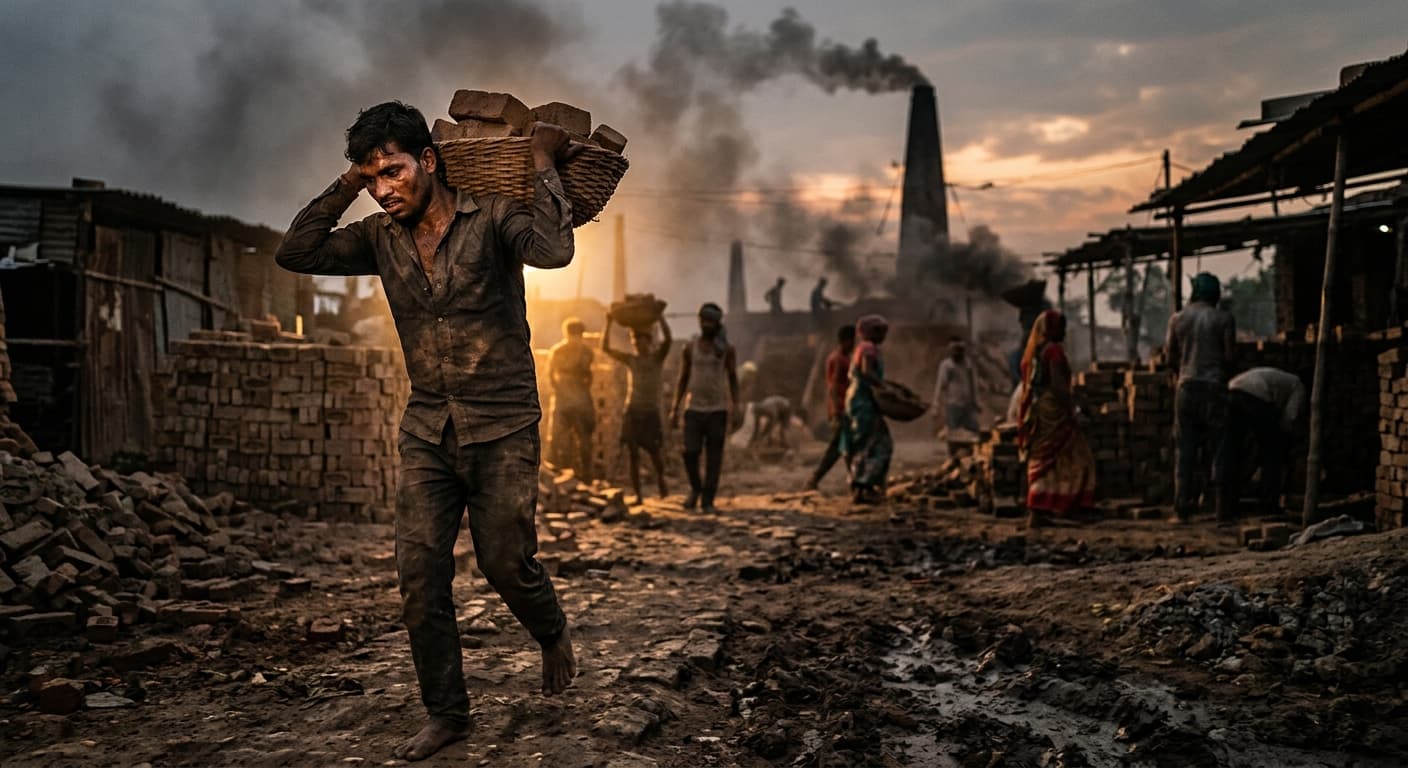
The loser is the cause of forced-labor enforcement itself. India's ban governs imports, not production. The 11 million Indians in modern slavery — the brick kiln workers in Uttar Pradesh, the power-loom operators in Tamil Nadu, the migrant laborers in Gujarat quarries — see no change in their legal standing. The ILO's own commissioned research on bonded labor in India documented the pattern across agriculture, brick kilns, quarries, mines, power looms, and handlooms — sectors that export to the US and EU. None of those supply chains are touched by the July 13 amendment.
The structural loser is the credibility of forced-labor import prohibitions as instruments of labor protection. If the US accepts India's amendment as sufficient — without evidence of enforcement infrastructure, entity lists, or region-specific presumptions — it validates a model where the existence of a statute matters more than its operation. That is precisely the critique the Senate Finance Committee raised: the administration is using forced labor as a "pretext for pursuing broad tariffs," not as the basis for a "genuine strategy to combat forced labor in global supply chains," per the Senate letter.
What to watch
- August 12, 2026: India's import ban takes effect, 30 days after the July 13 gazette notification. Watch for any DGFT procedural rules issued under the Handbook of Procedures 2023 before this date.
- USTR Section 301 determination: No firm date, but the July 24 tariff expiration creates a natural decision point. USTR must decide whether India's amendment moves it from the 12.5% tier to the 10% tier — or whether the investigation continues.
- Bilateral trade agreement talks: The
CSIS identified the post-July 24 window as the realistic opening for BTA tranche one. India's amendment is a down payment; the question is what Washington asks for next.
Diplomat View
India's forced-labor import ban is a trade-policy instrument wearing a labor-rights costume. It mirrors Section 307 of the US Tariff Act of 1930 verbatim — same ILO Convention No. 29 definition, same "wholly or in part" scope, same inquiry-based enforcement trigger — because its purpose is to satisfy a US statutory checklist, not to protect workers. The 11 million Indians in modern slavery are unaffected. The amendment governs imports into India, not production within it.
The forecast: USTR will likely cite India's amendment as evidence the Section 301 process works, and India will avoid the 12.5% tariff or earn a reduction to the 10% tier. This would validate the "statute-on-paper suffices" model and marginalize the enforcement-capacity critique the Senate Finance Committee raised. The bilateral trade agreement talks restart in September 2026. What would change the forecast: if USTR demands evidence of operational enforcement — a withhold-release mechanism, published entity lists, detention statistics — before granting tariff relief, India's cheap concession becomes expensive, and the BTA timeline stalls again.
Discover more

India
Delhi CM Rekha Gupta Blasts Opposition's Delm
Delhi CM Rekha Gupta's remarks on women's quota defeat reveal BJP's strategy for the 2029 Lok Sabha elections, focusing on delimitation.
US Politics
U.S. House Passes Alert Act for Aviation
The House passed the ALERT Act 396–10, replacing the ROTOR Act after Pentagon intervention, impacting aviation safety regulations.

International Relations
Pakistan's Key Role in US-Israel-Iran Meddle
Pakistan is seeking to mediate the US-Israel-Iran conflict, balancing high-stakes diplomacy against severe economic pressures and steep regional challenges.

Economics
Fed's Amex AML order puts correspondent banking on notice
Federal Reserve's Amex AML order requires board-level controls and a 90-day plan; OCC fined the bank $350 million over enterprise-wide deficiencies.