India-Maldives Investment Treaty Signed
India secures strategic hold over Maldives with new treaty.
Model Diplomat8 min readSouth Asia
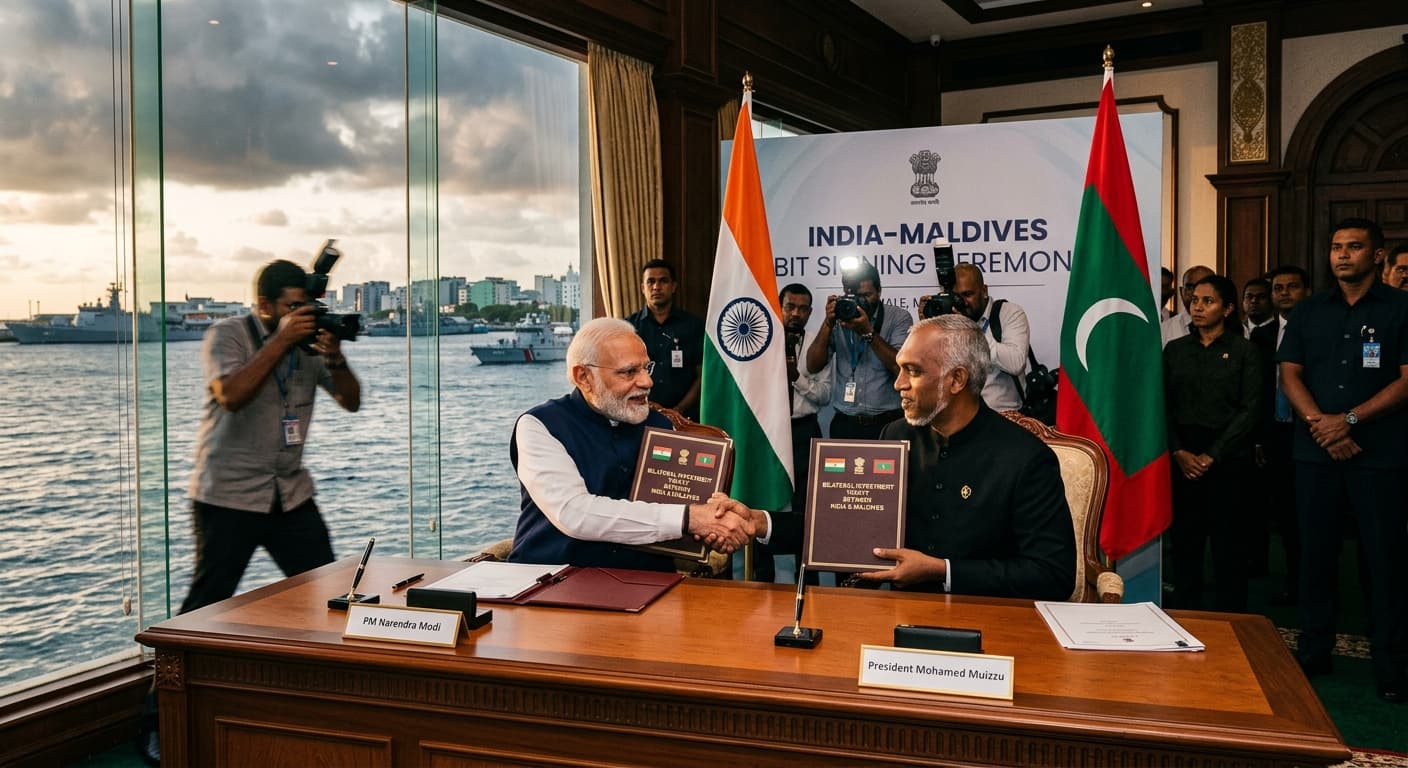
India-Maldives Investment Treaty: How Delhi Bought Back Its Backyard
India and Maldives concluded a Bilateral Investment Treaty on July 8, 2026, alongside fast-tracked FTA talks — locking Malé into rupee-denominated dependence and blunting China's Indian Ocean pivot.
The India–Maldives Bilateral Investment Treaty (BIT) whose negotiations concluded in New Delhi on July 8, 2026, is not really a trade instrument — it is the closing brace on an 18-month operation in which India converted a $1.4 billion debt lifeline into the deepest strategic hold it has ever had over Malé, at the exact moment President Mohamed Muizzu's "India Out" campaign collapsed under Chinese non-delivery. Two-way trade is only $771.76 million a year. What the BIT and the accompanying Free Trade Agreement (FTA) do is legalise a rupee-denominated economic architecture — swap lines, UPI, RuPay, INR credit — that will make it structurally difficult for any future Maldivian government to pivot back toward Beijing.
That is the story: the treaty text matters less than the leverage it ratifies.
What was actually agreed on July 8
Commerce Minister Piyush Goyal and Maldivian Economic Development, Transport and Trade Minister Mohamed Saeed announced in New Delhi that BIT negotiations are "concluded" and the text has entered legal scrubbing before signature, according to a PTI report carried by Orissa Post. Saeed told reporters the two delegations "meet almost every day" on the parallel FTA track; the first formal round of FTA negotiations ran June 29 to July 7, 2026, per an
IANS dispatch in City Air News, with the two sides targeting signature by year-end.
Bilateral trade rose 13.5% to $771.76 million in fiscal 2025-26 — Indian exports of $458.71 million against imports of $313 million, according to the same PTI wire. But the FDI number is the tell: between April 2000 and March 2026, cumulative Maldivian FDI into India was just $12.65 million. There is almost no investment stock to protect. The BIT is prospective; it is a forward instrument for a future Indian corporate footprint in Maldivian tourism, fintech, ports and MSMEs — sectors flagged in the Goyal-Saeed communiqué carried by Corporate Maldives.
The primary anchor for the diplomatic architecture is the Government of India's July 26, 2025 "List of Outcomes" framework — signed when Prime Minister Narendra Modi visited Malé as guest of honour on the Maldives' 60th Independence Day and formally launched FTA negotiations alongside a ₹4,850 crore ($565 million) rupee line of credit.
The leverage nobody in Malé can wish away
To understand why this BIT is a strategic instrument and not a commercial one, look at the Maldivian balance sheet. The World Bank's Maldives Development Update 2026 puts public and publicly guaranteed debt at an estimated 129.7% of GDP in 2025 and projects it above 140% over the medium term. External debt service in 2026 is $1.7 billion. Growth is projected to collapse to 0.7% this year before rebounding to 6.7% in 2027. The Bank calls Malé's debt-distress risk "high" and warns of a "high sovereign-bank nexus" amplifying macro-financial risks. Malé averted default on a $500 million sovereign Sukuk in April 2026 only by burning through reserves, according to the
Manohar Parrikar Institute for Defence Studies and Analyses, which notes Fitch still holds the country at 'CC' — one notch above imminent default.
Muizzu inherited that mess and expected Beijing to bail him out. It didn't. The Observer Research Foundation reports that Chinese loans to Malé actually fell — from $613 million in 2021 to $473 million in 2025 — because Beijing declined new commercial lending, offering only community-project grants and a $130 million refinance. India, by contrast, has extended roughly $1.4 billion in direct assistance to the Muizzu administration, nearly $900 million of it now denominated in rupees. As the BBC reported at the height of the crisis, Muizzu arrived in Delhi in October 2024 with reserves of just $440 million — "just enough for one-and-a-half months of imports" — and left with a $400 million currency swap and a redrawn foreign policy, according to
BBC News.
That switch to rupees is the load-bearing pillar. India's July 2025 amendatory agreement replaced a dollar line of credit with a ₹4,850 crore rupee LoC, cutting Malé's annual debt-service obligation on that facility from $51 million to $29 million — a 40% reduction, per ORF's analysis of the Modi visit. Add the UPI network-to-network agreement between NPCI International and the Maldives Monetary Authority, RuPay rollout, and permission for the Bank of Maldives to open INR accounts — and the Maldivian economy is now plugged into an Indian rupee circulatory system that did not exist 24 months ago. The BIT ratifies this dependence as investor protection.
The China variable — and why the BIT quietly counter-programs it
The strategic subtext that Delhi will not say aloud: on January 1, 2025, Malé finally implemented the China-Maldives FTA it had signed but frozen since 2017. ORF's Aditya Gowdara Shivamurthy warned that between 2010 and 2022, Chinese exports to the Maldives grew from under $60 million to $562 million while Indian exports climbed only from $126 million to $485 million. The China FTA eliminates tariffs on 96% of goods, including any China-produced good re-exported from a third country. Left alone, that architecture would have hollowed Indian market share in Malé over a decade.
The India BIT-plus-FTA is the mirror-image response — and one Delhi has learned to build quickly. Piyush Goyal's ministry closed the India–EU FTA on January 27, 2026, inked an
India–New Zealand FTA on April 27, 2026 in a record nine months, and, per a
Press Information Bureau backgrounder, signed Terms of Reference for FTAs with Israel and the Gulf Cooperation Council in the same window. The Maldives deal fits an aggressive new template: BIT + FTA combined, negotiated in months not years, with investor protection deliberately upstream of tariff cuts.
That sequencing matters. India's 2016 Model BIT — the template for the Maldives text — is unusually state-protective. Legal scholarship in the Brookings analysis of the Model BIT notes the model replaces the traditional broad "asset-based" definition of investment with an "enterprise-based" definition, strips the Most-Favoured-Nation clause, excludes taxation from the treaty's purview, and requires foreign investors to exhaust local remedies for five years before initiating international arbitration. Academic assessments in
SSRN research on the 2015 Model BIT describe the framework as "a particularly radical departure" — one that emerged after Delhi lost the White Industries arbitration in 2011 and faced a wave of investor claims. Applied to Malé, this template will give Indian tourism, telecom and infrastructure firms treaty cover while leaving Muizzu's successor limited scope to challenge Indian-owned assets — say, in a nationalist re-do of the 2018 airport contract row.
Who wins, who loses
The clear winners are Indian corporate India Inc. and the Ministry of External Affairs. Adani, which lost the GMR-Malé Airport contract in 2012 under Yameen's presidency and has since eyed re-entry, gains treaty protection for any future bid. Indian pharma companies win under the MoU recognising Indian Pharmacopoeia in the Maldives; Reliance Jio and payments firms benefit from the UPI/RuPay corridor; Larsen & Toubro and NBCC benefit from the $565 million rupee LoC pipeline for housing, roads, and the Hanimaadhoo airport expansion, which Modi remotely inaugurated on July 25, 2025, per Al Jazeera.
The Maldives wins short-term oxygen. Malé cannot service $1.7 billion in external debt in 2026 without Indian rupee assistance, and Muizzu has publicly framed the credit line as underwriting "priority projects" in defence, healthcare, housing and education. ORF's Gulbin Sultana of MP-IDSA writes that the country's shift is a "pragmatic recalibration" driven by economic reality, not ideology — and that "Muizzu will not revert to the 'India First Policy' of the previous administration" but has separated domestic politics from geopolitics.
The loser is Beijing — quietly and by degrees. China holds around $1.1–1.5 billion of Maldivian sovereign debt but declined to convert it into leverage. The Al Jazeera analysis of the 2024 Muizzu-Modi meeting quoted the Wilson Center's Michael Kugelman noting Muizzu "recognises that there can't be any impression that he wants to back away from India." Twelve months later, that impression is settled diplomatic fact. The BIT plus rupee corridor now embed asymmetric switching costs: any successor government tilting back toward China would have to unwind investor-protection obligations, currency infrastructure, and a defence-cooperation channel that India has kept alive through the
MP-IDSA-tracked High-Level Core Group Meetings.
The historical parallel is Bhutan-1949 or Sikkim-1975 — not because sovereignty is at stake, but because Delhi is again converting a neighbouring economy's crisis into a treaty architecture that binds successor governments. What is different in 2026 is that the instruments are commercial and multilateral-compatible: an ICSID-consistent BIT, a WTO-compatible FTA, a payments network. This is soft-power containment, dressed as market access.
What to watch next
Three catalysts will determine whether Delhi's bet holds:
- BIT signature (expected Q3 2026): Watch whether the legal-scrubbing phase produces a text that follows the 2016 Model BIT's five-year exhaustion-of-local-remedies rule, or a lighter dispute-resolution framework tailored to a debt-distressed partner. The PTI dispatch confirms India "recently implemented such pacts with Israel and the UAE" as templates.
- FTA signature target (end-2026): Goyal and Saeed have committed to formal signature by year-end. Sectoral irritants — Maldivian fears about being flooded by Indian agricultural exports, Indian concerns about Chinese trans-shipment through Maldivian ports — will surface at the second and third negotiating rounds. Watch the tariff-line coverage: New Zealand got zero-duty access for 100% of Indian exports; a similar asymmetry favouring India would signal Delhi is extracting maximum leverage.
- Maldives 2028 presidential contest: Muizzu's People's National Congress supermajority protected the pivot in 2024-26. If economic pain intensifies — the World Bank projects a 20.6% current-account deficit in 2026 — the opposition Maldivian Democratic Party could return with an "India First" mandate, or a fringe candidate could revive "India Out." The BIT is designed to make the second scenario expensive.
The Bottom Line
The India–Maldives BIT is not about the $12.65 million of Maldivian FDI in India — it is about locking a debt-distressed Indian Ocean choke-point into a rupee-denominated, treaty-protected orbit before Muizzu's term ends. Delhi has learned from the 2017 China-Maldives FTA episode that legal architecture, once ratified, outlasts political cycles. If the BIT is signed by end-2026 as scheduled, India will have converted a 30-month diplomatic crisis into the most durable strategic instrument it has ever held over Malé — and quietly written the playbook for how a rising power neutralises Chinese economic diplomacy in its own neighbourhood.
Discover more

US Politics
SNAP Food Assistance Faces Legal Challenges
In 2026, SNAP faces stricter eligibility rules and mounting legal challenges, threatening food assistance for the millions of Americans who rely on the program.
India
Women’s Reservation in India
India's 33% women's reservation law is enacted but won't take effect until after 2029 due to political setbacks and census delays.

US Politics
US Launches $166B Tariff Refund Portal
The US is launching a $166 billion tariff refund portal to aid importers hit by Trump-era tariffs, with major implications for trade and supply costs.

Economics
Fed's Amex AML order puts correspondent banking on notice
Federal Reserve's Amex AML order requires board-level controls and a 90-day plan; OCC fined the bank $350 million over enterprise-wide deficiencies.