India-Maldives Investment Treaty Secures Ties
New Delhi strengthens economic influence over Malé.
Model Diplomat7 min readSouth Asia
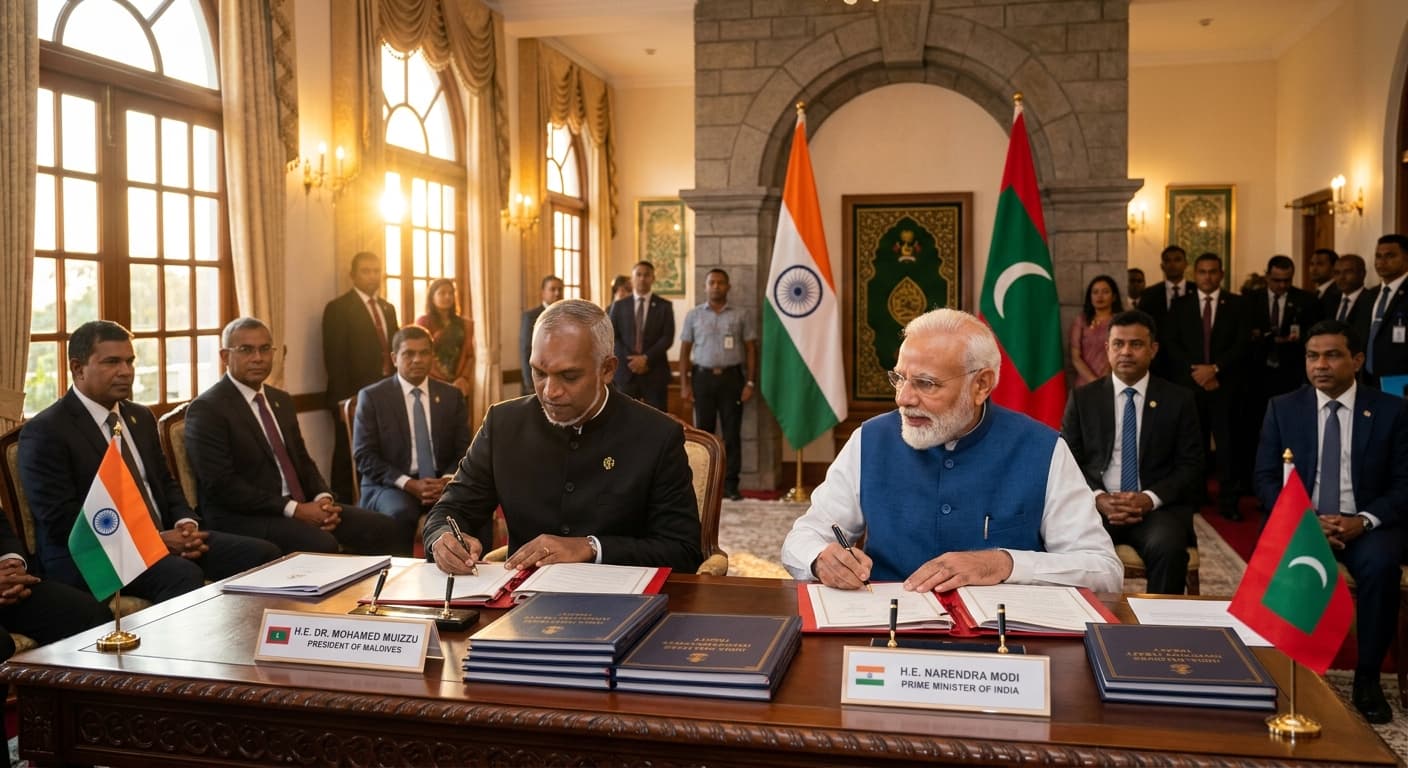
India Locks In Maldives With Investment Treaty, Blunting China's FTA
India and the Maldives closed bilateral investment treaty talks on July 8, 2026, ring-fencing New Delhi's economic leverage over Malé 18 months after the China-Maldives free trade deal took effect.
India and the Maldives concluded negotiations on a bilateral investment treaty (BIT) on July 8, 2026, and finished a fresh round of free trade agreement talks the day before — the clearest signal yet that New Delhi, not Beijing, sets the pace on Maldivian economic policy despite a China-Maldives FTA that entered force on January 1, 2025. The pact will be signed after legal scrubbing, according to a PTI report carried by Orissa Post after Commerce Minister Piyush Goyal met visiting Maldives Minister of Economic Development, Transport and Trade Mohamed Saeed in New Delhi. The thesis: this is not about Maldivian exports, which are trivial. It is about the Indian Ocean's most strategically located archipelago binding its investment regime to India's rulebook at the moment its debt cliff peaks — a soft-power lock-in that a tariff-only deal with China cannot match.
What was concluded, and what it changes
"We have seen the fast, quick progress of FTA dialogue… both sides meet almost every day. BIT is concluded. We are just seeing the legal scrubbing process," Saeed told reporters, according to Rediff Moneynews. Goyal said an FTA would follow the BIT, expanding cooperation into tourism, startups, digital payments and MSMEs.
The BIT will be India's first with a South Asian neighbour negotiated under the 2016 Model BIT text — the framework the Union Cabinet approved to "provide appropriate protection to foreign investors" while "maintaining a balance between the investor's rights and the Government obligations," per a Press Information Bureau release. That model is deliberately state-friendly. It requires investors to exhaust local remedies before international arbitration, uses a narrow "enterprise-based" definition of investment, and strips out the Most-Favoured-Nation clause. A
Brookings analysis of India's Model BIT called it "pro-state with limited rights to foreign investors."
That matters here. Bilateral trade rose 13.5% to $771.76 million in FY2025-26, with India exporting $458.71 million against imports of just $313 million — mostly scrap metal, per the PTI account. Maldivian FDI into India from April 2000 through March 2026 totalled a token $12.65 million. The BIT is therefore less an investor-protection tool for Maldivian capital than a legal chassis for Indian firms — the State Bank of India, Adani Ports (a Thilafushi commercial-port bidder), NPCI, Bharti Airtel — to entrench themselves in Maldivian infrastructure, payments and logistics on Indian terms.
The China contrast — same map, different playbook
Beijing got there first on paper. The China-Maldives FTA, signed in 2017 and stalled by President Ibrahim Solih, finally entered force on January 1, 2025 under President Mohamed Muizzu. It eliminates tariffs on 96% of goods, categorised into three tranches. But an Observer Research Foundation assessment is blunt: "Despite constant emphasis on a 'mutual' partnership, Maldivian exports to China are negligible compared with imports… the trade deficit… has remained unchanged" after implementation.
The NUS Institute of South Asian Studies flagged the fiscal damage in advance. In an ISAS Brief, analysts estimated the Maldives would forfeit roughly 3% of total government revenues in customs duties by letting Chinese goods enter duty-free — losses that widen if Chinese imports displace dutiable third-country supplies. In a fiscal regime where import tariffs contribute around 20% of government revenue, that is not a rounding error.
India's approach inverts the sequence. Rather than a duty-cut headline, New Delhi has built the plumbing — Rupay cards launched in Malé in October 2024, UPI adoption underway, trade settlement in local currencies — and is now hardening it with a BIT before the FTA lands. According to the Ministry of External Affairs' list of outcomes from Modi's July 25, 2025 visit, Terms of Reference for the India-Maldives FTA were exchanged the same day India extended a fresh INR 4,850 crore (~$565 million) line of credit and cut Maldivian annual debt-servicing on Indian LoCs by 40%, from $51 million to $29 million.
Why Malé is signing now: the debt calendar decides
The BIT is being finalised in the narrow window between Malé's two worst debt-service years on record. The World Bank's Maldives Development Update 2026 states that external debt-service needs jumped to $1.7 billion in 2026 from $630 million in 2025. Reserves recovered to $1.3 billion in March 2026 but then collapsed to $717.9 million — just 1.4 months of imports — in April, after Malé repaid the $500 million sovereign Sukuk and the $400 million currency swap with the Reserve Bank of India.
The World Bank warns the country "remains at high risk of debt distress," projects growth crashing to 0.7% in 2026 and public debt exceeding 140% of GDP over the medium term. The IMF's 2024 Article IV report had already flagged that "external refinancing pressures are expected to peak in 2026." China, despite Muizzu's repeated public claim that Beijing had greenlit a five-year debt deferral, has delivered no visible restructuring. India has: the currency swap, the T-bill rollovers, the LoC extension, the amendatory agreement on repayment schedules.
That asymmetry is the leverage. As Michael Kugelman of the Wilson Center told Al Jazeera, "as long as India continues to be perceived by the Maldives as a critical economic partner, particularly at a moment of economic stress, India will continue to retain leverage." The BIT converts that acute financial leverage into a durable legal one. Under India's Model BIT, the treaty carries a five-year sunset — investor protections survive termination for that period, per an
ORF legal analysis — meaning any future Maldivian government cannot unwind the framework overnight, even one elected on the next "India Out" wave.
The regional read: India's neighbourhood FTA doctrine is shifting
For years India's default reflex toward South Asian FTAs was defensive. New Delhi paused talks with Bangladesh for fear that Chinese goods would enter via Dhaka. The Maldives push is different. An Observer Research Foundation commentary argues India "can counter China's economic advances in the neighbourhood only by proactively engaging its neighbours" — precisely what the BIT-then-FTA sequencing with Malé now demonstrates.
The context extends beyond one archipelago. India signed a comprehensive trade deal with the UK in July 2025, is expediting the ASEAN-India Trade in Goods Agreement review around $128 billion in two-way trade, and struck a defence-and-critical-minerals package with Indonesia this week. The Maldives BIT is the smallest of these deals by volume — and arguably the highest-leverage per dollar. Malé sits astride the sea lanes through which, according to the
Council on Foreign Relations, "nearly 80 percent of Chinese oil imports flow."
New Delhi has also hedged materially. The MP-IDSA notes India is developing a naval base on Minicoy in the Lakshadweep archipelago, 130 km from the Maldivian border, giving it maritime domain awareness that no longer depends on Malé's political weather. The BIT is the economic mirror of that hedge: bind the archipelago legally so the political oscillations of the next Maldivian election cycle matter less.
Who wins, who loses
The clearest winners are Indian infrastructure and financial-services firms that need contractual predictability in an economy the IMF still rates deep in speculative territory — Fitch at "CC," Moody's at Caa2. The BIT's investor protections against arbitrary expropriation are meaningful in a country where credit ratings imply high default risk and where a hostile government previously scrapped a hydrographic survey agreement with India overnight.
The most exposed loser is not China — Beijing keeps its FTA and its $1.4 billion debt claim — but Malé's fiscal autonomy. Every treaty commitment narrows the space to raise duties, restructure state-owned enterprises with foreign shareholdings, or renegotiate infrastructure concessions without triggering an arbitration risk. The World Bank has repeatedly urged "state-owned enterprise reform" and "rationalizing capital expenditure." Both become harder once foreign investors hold BIT-grade protections.
Muizzu's political base is the second-order loser. The BBC reported in 2024 that Muizzu's hardline "India Out" rhetoric was cheered by ultra-conservative Salafi constituencies. A signed BIT with New Delhi, on India's model text, is the definitive burial of that campaign posture.
Diplomat View
The India-Maldives BIT is not a trade story — it is a lock-in story. In the 30 months since Muizzu flew to Beijing before Delhi, the balance of leverage has moved decisively toward India, and Malé is now signing legal instruments that will outlast the Muizzu presidency itself. The FTA, when it lands, will be secondary; the BIT is the load-bearing beam. Our call: the treaty is signed before the end of Q4 2026, followed by an FTA framework in the first half of 2027, timed to demonstrate delivery before the next Maldivian presidential cycle begins to overheat. The forecast would change if two things happen together — (a) a Chinese debt-restructuring offer materialises on terms Malé can present as a face-saving alternative, and (b) India stumbles on delivering the $565M LoC disbursement or the promised Thilafushi port. Absent both, the BIT signs on schedule and the Maldives' economic geography becomes, for the first time since independence, formally tethered to New Delhi's rulebook rather than merely dependent on its goodwill. For deeper context on New Delhi's neighbourhood posture, see India.
What to watch
- Q3 2026: Completion of legal scrubbing and cabinet approval of the BIT text in New Delhi; the treaty needs Union Cabinet sign-off, following the 2016 Model BIT precedent set by the Cambodia deal.
- October 2026: Next Maldives Monetary Authority reserve print — a fall below one month of imports would trigger a fresh Indian liquidity intervention and likely pull the FTA signing forward.
- January 1, 2027: Second anniversary of the China-Maldives FTA in force. Watch whether Malé publishes trade-deficit and customs-revenue data — the ORF and ISAS forecasts of a widening deficit and 3% revenue loss will be testable, and Indian negotiators will use the numbers at the FTA table.
Discover more

Climate & Energy
US DFC Invests in Madagascar Rare Earths
US DFC commits $4.84 million to Harena Rare Earths' Ampasindava project in Madagascar, the first direct US government investment in a deposit that could break China's near-monopoly on heavy rare earths.

Climate & Energy
Harena's $4.84M DFC Deal Is a Strategic Down
The US DFC commits $4.84M to Harena Rare Earths' Madagascar project, signalling a strategic shift to secure critical mineral assets before China acquires them. The deal positions Washington as an anchor financier for one of the largest ionic clay heavy rare earth deposits outside China.
Global
China Wins the Lithium Race at Manono
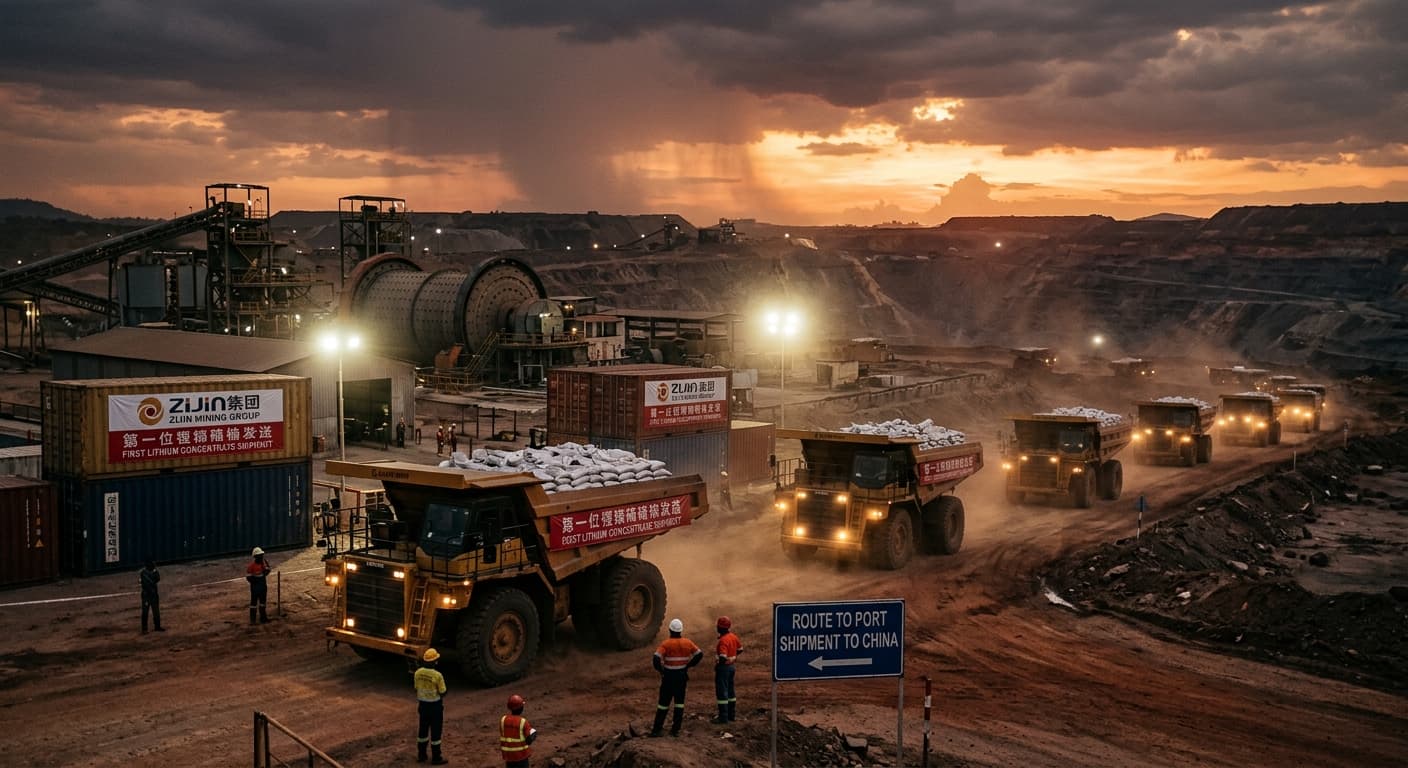
China's Zijin Mining ships first lithium concentrate from DRC's Manono deposit, winning a three-year legal and infrastructure race against Western rivals. The $1 billion bet on production over arbitration cements Beijing's control of Africa's largest hard-rock lithium deposit.

Economics
USMCA Annual Reviews: Investment Uncertainty
The USMCA's annual reviews keep trade rules intact but introduce significant uncertainty for North American investment, impacting economic growth.