Saudi Arabia's $6.4B Investment in Syria
Gulf capital reshapes regional transport dynamics
Model Diplomat6 min readMiddle East
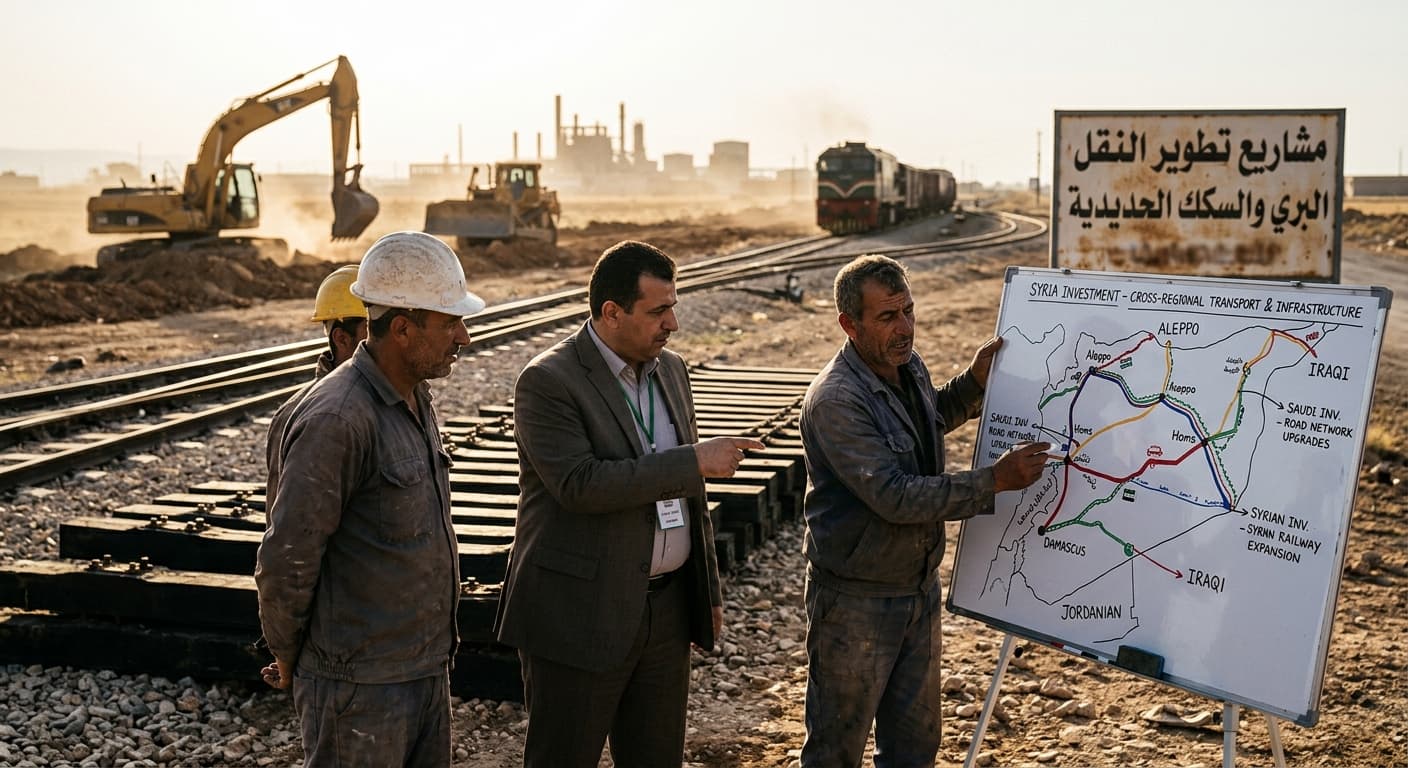
The Gulf capital moving through Damascus is now systemic. Al Jazeera reported in July 2025 that Saudi Investment Minister Khalid al-Falih announced $2.9 billion in real estate and infrastructure investment as part of a broader $6.4 billion package; in February 2026, a further tranche including a $2 billion Elaf-fund commitment for two Aleppo airports and a "SilkLink" telecoms backbone was
signed in Damascus. UAE-owned DP World is running a 30-year, $800 million concession at Tartus. France's CMA CGM has the equivalent at Latakia — a port that already handles roughly 95% of Syria's container traffic, per IISS analysis of the
Tartus deal.
The rail geometry is nearly complete. According to the MP-IDSA brief, Turkey, Jordan and Syria signed a trilateral transport MoU on April 7, 2026; Turkey's transport minister Abdulkadir Uraloğlu and Saudi counterpart Saleh al-Jasser signed a bilateral railway MoU on June 9, 2026 to close a 400 km gap between Saudi rail-head at Al-Haditha and Turkey's Gaziantep terminus. What remains is a 100 km stretch of the Hejaz Railway inside Jordan — a modest financial ask against $6 billion in pledged Gulf capital.
Why Israel loses more than a rail link
For Israel, IMEC was never just about container throughput. It was an anchor of the Abraham Accords economic thesis: that regional integration would make normalisation with Riyadh irreversible. The Middle East Institute notes that a Washington Institute poll in early 2026 found 99% of Saudi respondents view normalisation with Israel negatively — a floor that renders the original IMEC route politically inoperable for Mohammed bin Salman regardless of Riyadh's strategic preferences.
The Israel Institute for National Security Studies (INSS) is candid about the sequencing risk. Its June 2026 assessment by Yoel Guzansky warns that Riyadh "might try to bypass Israel through more expensive and longer routes — a move that would undermine the original objectives of the project." That "more expensive and longer" premise is the argument Israeli officials have leaned on to reassure themselves. The Atlantic Council's June report demolishes it: with three Mediterranean exit clusters (Haifa, Egypt's Port Said complex, and Syria's Tartus–Latakia), the Syria route becomes redundant capacity, not an inferior detour.
The Mitvim Institute's post-Gaza IMEC 2.0 paper flags the real Israeli risk as "marginalisation through delay" — a slow-motion exclusion in which the network is completed around Israel while Jerusalem waits for a Palestinian political track it cannot politically deliver.
The unexpected beneficiary: Ankara
Turkey was the conspicuous omission from the 2023 IMEC MOU. The Syria pivot inverts that snub. Every plausible Levantine routing now runs through Turkish-brokered infrastructure: the Bab al-Hawa border crossing reopened in February 2026 after fifteen years, and Ankara's revived Hejaz Railway plan runs from Istanbul to Damascus. As the MP-IDSA analysis puts it, the Iran war has allowed Turkey to "consolidate its position as a regional logistics and energy hub" — the outcome IMEC was originally designed to prevent.
This is the second-order effect Washington did not price. IMEC's original strategic purpose, framed by then-Secretary Antony Blinken, was to counter Belt and Road while binding the Abraham Accords bloc together. A Syria–Turkey routing keeps the anti-China logic intact but hollows out the Israel-normalisation logic. It also makes Ankara indispensable to European supply-chain diversification — leverage President Erdoğan will use.
What India thinks — and cannot say publicly
New Delhi's dilemma is acute. As the ISPI's April 2026 analysis, Too Much at Stake, Too Little Room to Move, documents, no IMEC signatory oriented its regional strategy around the corridor more comprehensively than
India. Prime Minister Narendra Modi's visit to Prime Minister Benjamin Netanyahu two days before the Iran war outbreak was the visible expression. The Hormuz shock, ISPI argues, exposed that "IMEC needed US security guarantees. Gulf investment needed Gulf stability. India's Middle East pivot needed a rules-based maritime order. None of those was India's to provide."
Delhi has responded by hedging into Syria itself. The Observer Research Foundation documents an Indian Arab ministerial meeting scheduled for February 2026 with Syrian Foreign Minister Assad al-Shaibani in attendance, following a July 2025 MEA visit to Damascus. India will not publicly endorse cutting Israel out. It also will not let the corridor die because Israel cannot deliver.
The energy sub-plot
Buried in the corridor debate is the pipeline. The 2023 MOU commits signatories to laying "pipe for clean hydrogen export" alongside the rail. A Syria route re-opens the historic Qatar–Turkey gas pipeline concept that Assad-era Damascus blocked. The Gulf International Forum documents Qatar, Saudi Arabia and the UAE now competing for Syrian upstream, port and pipeline contracts. According to the
European Parliament briefing on EU-India relations, EU-GCC bilateral trade in goods reached €170.1 billion in 2023, giving Brussels a direct stake in whichever Mediterranean exit gets built first.
Trieste, Piraeus and Marseille are already lobbying to host the European terminal. The European Parliament question E-003122/2025 submitted by MEP Anna Maria Cisint on July 28, 2025 confirms Italy formally applied for Trieste — and notes IMEC still lacks "formalised multilateral governance, a public timetable and dedicated European resources." A Syrian exit cluster changes which European port wins: Trieste and Piraeus benefit from a Tartus feeder; Marseille from Haifa. That is a €10 billion decision hiding inside the routing debate.
What to watch
- IMEC ministerial, autumn 2026: An IMEC ministerial was announced at the Atlantic Council's Middle East Corridors Conference. The updated route map is the pressure point. If Saudi Arabia and India bless a Syria annex, Israel's role is downgraded on paper.
- Jordan's Hejaz rail decision: The 100 km gap in Jordan is the physical bottleneck. Watch for a Saudi-led financing announcement — likely bundled with the Nasib–Jaber crossing upgrade — through Q4 2026.
- Trump–MBS calendar: Mohammed bin Salman's next Washington visit will test whether the US will formally accept a two-track IMEC (Syria and Israel) or force reversion to the 2023 blueprint. The Atlantic Council's
Emily Sennett argued in November 2025 that MBS's visit could revive IMEC; the July 2026 leak suggests he arrived with a rewritten map.
- Hormuz transit data: If transits stay below 50% of pre-war levels into Q4 2026, as MST Financial projects, the political case for a redundant Mediterranean exit through Syria becomes irresistible for every IMEC signatory except Israel.
Diplomat View
The Syria rerouting is not a hypothetical Saudi lever — it is an executed strategy that only awaits ministerial ratification. Riyadh built the North–South Railway, pre-financed Syrian ports through Emirati and French concessionaires, and locked in Turkish and Jordanian transport MoUs before the Jerusalem Post story broke. The forecast: within twelve months, IMEC formalises as a network with two Mediterranean exits — Haifa on paper, Tartus–Latakia in practice — and Israel's transit share falls below 20% of projected volumes. This call is falsifiable in two ways. It would be wrong if the Trump administration conditions Syria sanctions relief or Saudi security guarantees on preserving Haifa's centrality; or if al-Sharaa's government fractures, forcing DP World and CMA CGM to write down concessions. Absent one of those, the corridor Israel helped design in 2023 is now being finished around it. That is the durable geopolitical fact of July 2026, and it is why "climate and energy" and "grand strategy" are, this month, the same beat.
The Bottom Line
Saudi Arabia's IMEC pivot through Syria converts a stalled corridor into an executable one — at the price of Israel's designated role and the Abraham Accords economic logic. Post-Assad Damascus, backed by $6.4 billion in Saudi money and 30-year Gulf-owned port concessions, is now the corridor's most-financed Mediterranean exit. The winners are Riyadh, Ankara and Damascus; the loser is Jerusalem, and the mechanism of loss is not exclusion but redundancy.
Discover more
Global Politics
Trump's Conflicting Messages on Iran War
Trump's mixed messages on Iran reflect a strategy of audience management, benefiting Tehran amid a complex geopolitical landscape.
US Politics
House Ethics Committee Pushes Sexual Miscond.
The House Ethics Committee has shifted responsibility for sexual harassment settlement records to the Office of Congressional Workplace Rights, complicating disclosure efforts.
India
BJP's Misunderstanding of Women's Quota Needs
The BJP's linking of the Women Reservation Bill to delimitation risks delaying women's empowerment in India, misreading the aspirations of female voters.

Economics
Fed's Amex AML order puts correspondent banking on notice
Federal Reserve's Amex AML order requires board-level controls and a 90-day plan; OCC fined the bank $350 million over enterprise-wide deficiencies.