India-Indonesia Relations: Ganga-Mahakam
Exploring the evolving partnership between India and Indonesia.
Model Diplomat5 min readSoutheast Asia
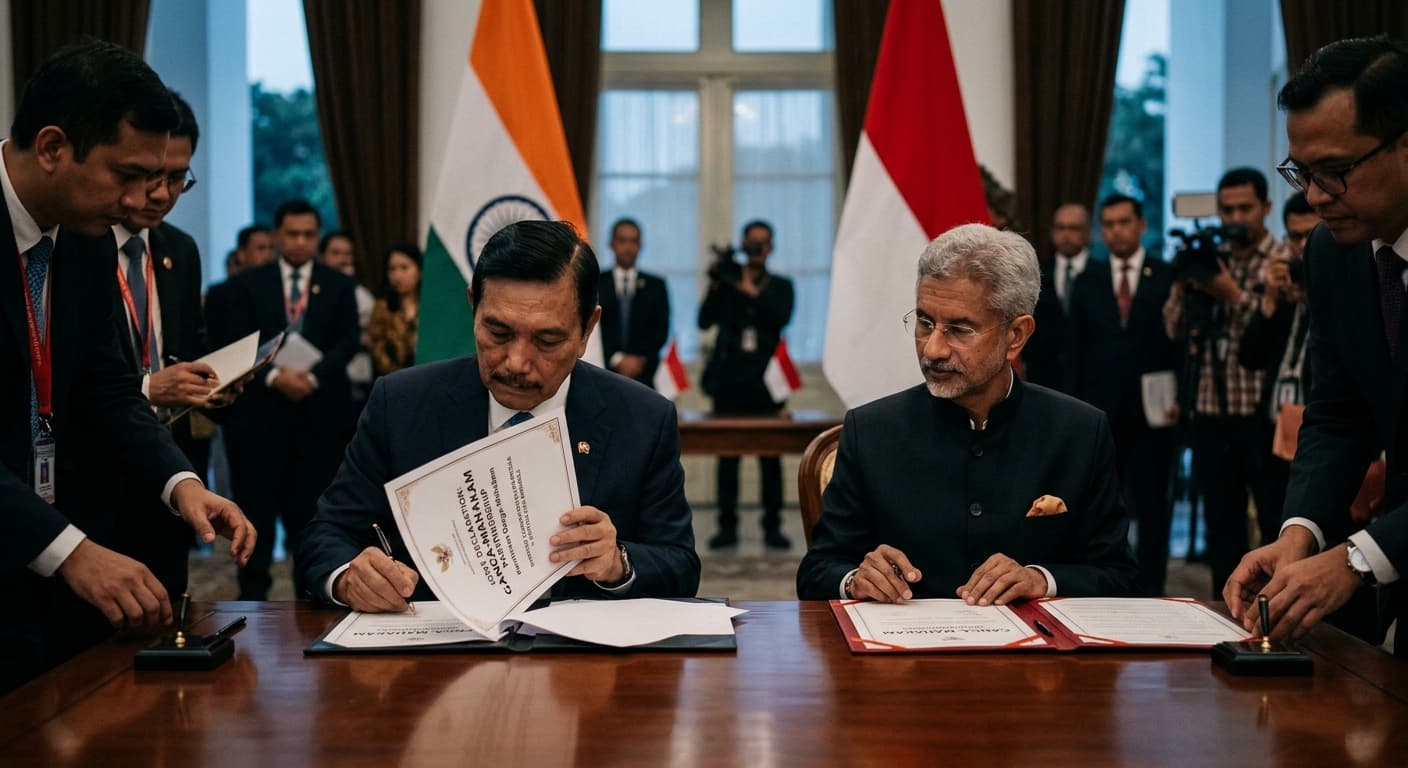
The joint statement's paragraph 11 goes further, committing both sides to "constructive discussions on maritime issues of mutual interests… in accordance with… the principles of international law, including 1982 UNCLOS." That phrasing is doing real work. Indonesia's Foreign Ministry has repeatedly cited UNCLOS to reject China's nine-dash line claim over the Natuna Sea — most recently in November 2024, after a joint Prabowo-Xi statement acknowledging "overlapping claims" triggered domestic uproar and forced a clarifying rebuttal from Jakarta, BBC News Indonesia reported. New Delhi is now formally on Jakarta's side of that argument.
The nickel problem India is trying to solve
The other half of the deal is minerals. Indonesia sits on roughly 21% of global nickel reserves and produces more than half of the world's refined nickel supply — the single most important input for electric-vehicle batteries. Jakarta's problem: the sector was built with Chinese money. As the Clingendael Institute documented in 2024, Chinese entities hold controlling stakes in two of Indonesia's three major high-pressure acid leach facilities and majority ownership of the two flagship nickel industrial parks. That dependence has blocked Indonesia from qualifying for tax credits under the US Inflation Reduction Act.
India has the mirror problem. It is 100% import-dependent for lithium, cobalt and nickel; China supplies over 80% of India's lithium imports and processes roughly 68% of the world's refined nickel, per Observer Research Foundation analysis published this year. The Australian Institute of International Affairs
reports that Prabowo is now hunting for non-Chinese investors as royalty hikes and quota cuts squeeze Chinese smelters.
Modi's offer — state-owned Khanij Bidesh India Ltd. (KABIL) plus private battery makers as an alternative capital source, sketched out in ORF's India-Indonesia nickel-to-EV proposal — arrived at the precise moment Jakarta needs to diversify. Both sides expressed "interest in joint exploration and downstream projects for nickel and other strategic minerals" during Prabowo's January 2025 Republic Day visit; the July 2026 package operationalises it.
The Ganga-Mahakam framing
Rhetorically, Modi wrapped all of this in what he called a "Ganga-Mahakam Vision" — pairing India's Ganges with Indonesia's Mahakam river of East Kalimantan as twinned symbols of a shared civilisational and maritime destiny. The Statesman reported the phrase framed the entire address, covering "trade, technology, maritime security, connectivity and the voice of the Global South."
The Ramayana and Nalanda invocations covered in Outlook India are not decoration. They are the ideological scaffolding for an India-Indonesia axis that presents itself as culturally organic — in contrast to the "transactional" American relationship (bruised by a February 2026 US-Indonesia reciprocal trade agreement widely viewed as unfair in Jakarta) and the "extractive" Chinese one (which Prabowo's own royalty hikes are now unwinding). Modi received the Bintang Adipurna and became the fourth Indian leader to address the Indonesian Parliament — both gestures signalling that Jakarta is reciprocating the symbolic investment at the highest level.
What the data actually shows
The gap between rhetoric and delivery, however, is the story of India-Indonesia relations for the past decade. Bilateral trade stood at US$29.4 billion in 2023-24, according to the Ministry of External Affairs bilateral brief — below the US$50 billion target Modi and Joko Widodo set for 2025. The
NUS Institute of South Asian Studies noted in February that "the existing pace of tangible outcomes remains underwhelming… there is more veneer than intensity."
Chatham House's Ben Bland was blunter in a February 2025 assessment: if two large democracies with "no major bilateral disputes" cannot cooperate meaningfully, "what hope is there for cooperation across the broader Global South?" The structural problem is that India and Indonesia have too often functioned "as competing foreign investment destinations" — both pitching themselves as the China-plus-one alternative to Western supply chains.
What China sees
Beijing's reaction to the visit has been muted but pointed. The Modi trip follows the May 2026 Quad foreign ministers' meeting in New Delhi, where the four countries — India, US, Japan, Australia — announced a $20 billion critical minerals initiative and a "Quad Ports of the Future Partnership" starting in Fiji, per Al Jazeera. Chinese Foreign Ministry spokesperson Mao Ning warned then that regional cooperation "should not target any third party" and denounced attempts to "patch up small groupings."
An Indonesian BrahMos deployment would insert a hard-kinetic Indian capability into Southeast Asia's littoral for the first time; combined with the ILO exchange at India's Information Fusion Centre-Indian Ocean Region in Gurugram, formalised in paragraph 12 of the joint statement, it creates a maritime domain awareness backbone stretching from the Andaman Sea to the Arafura. Constantino Xavier of Brookings, testifying before the US-China Economic and Security Review Commission in February 2026, described India's turn as a shift "from seeing China as a potential enabler to more of an obstruction" — a shift now being exported.
Diplomat View
The Modi visit will be judged on three specific deliverables, not the Bintang Adipurna medal. First, whether the BrahMos contract with Indonesia is signed and delivered within 18 months — or slips into the same limbo that has swallowed several ASEAN defence talks. Second, whether Indian conglomerates — Vedanta, Tata, Adani — actually put equity into Indonesian nickel processing at scale sufficient to dilute Chinese ownership below 50% in at least one flagship park. Third, whether the ASEAN-India Trade in Goods Agreement review, ongoing through 2026, produces market access for Indian pharma, autos and IT services that closes any part of the US$44 billion trade deficit India runs with ASEAN.
The forecast: this partnership is real but structurally slower than the headlines suggest. India lacks Chinese-scale capital and American-scale defence-industrial throughput; Indonesia under Prabowo is a strategic hedger, not a bloc-joiner. If Jakarta buys the J-10 and the BrahMos, that is the tell — Indonesia is diversifying suppliers, not picking sides. The forecast would flip if two things happen: a serious South China Sea incident involving Natuna, and a US tariff escalation that pushes Prabowo further from Washington. Either would give New Delhi the opening it currently lacks.
Three dates to track: Indonesia's defence budget (Q3 2026 parliamentary window) will show whether BrahMos gets a line item or a footnote. The ASEAN-India Summit in Kuala Lumpur (October 2026) is the first test of whether the Ganga-Mahakam framing scales beyond the bilateral. The India-Indonesia CEO Forum readout, due late 2026, is the concrete-nickel test: dollar figures on downstream investment, not MOUs.
The Bottom Line
Modi's Jakarta trip is India's most credible attempt yet to build an Indo-Pacific coalition that does not run through Washington or Beijing — anchored on a BrahMos sale that gives Indonesia a hard deterrent in its own littoral, and on nickel diplomacy that offers Jakarta an off-ramp from Chinese capital dominance. Whether it holds depends on delivery, not rhetoric: if the missile ships and the money moves within 18 months, the Ganga-Mahakam Vision becomes the template for India's Southeast Asia strategy. If it does not, the Ganga-Mahakam Vision joins the Comprehensive Strategic Partnership of 2018 on the shelf where India keeps its good intentions about Southeast Asia.
Discover more
India
Women’s Reservation in India
India's 33% women's reservation law is enacted but won't take effect until after 2029 due to political setbacks and census delays.

US Politics
US Military Funding Request for Iran Looms
The White House Budget Director signals a formal funding request for military operations against Iran, foreshadowing rising tensions and congressional clashes.
India
Women's Reservation Bill 2026: A Political Sh
India's Lok Sabha rejected the Women's Reservation Bill, exposing a political maneuver to redraw electoral maps favoring the north over the south.

Conflict & Security
Drone Warfare Killing Aid Workers at Unprec
Over 1,000 humanitarian workers killed in three years as cheap armed drones collapse legal protections. Gaza, Sudan, Ukraine, and DRC see deliberate targeting of aid convoys and hospitals with zero prosecutions.