India Fights US 12.5% Forced-Labour Tariff
India's pushback against US tariffs tests trade relations.
Model Diplomat8 min readAsia
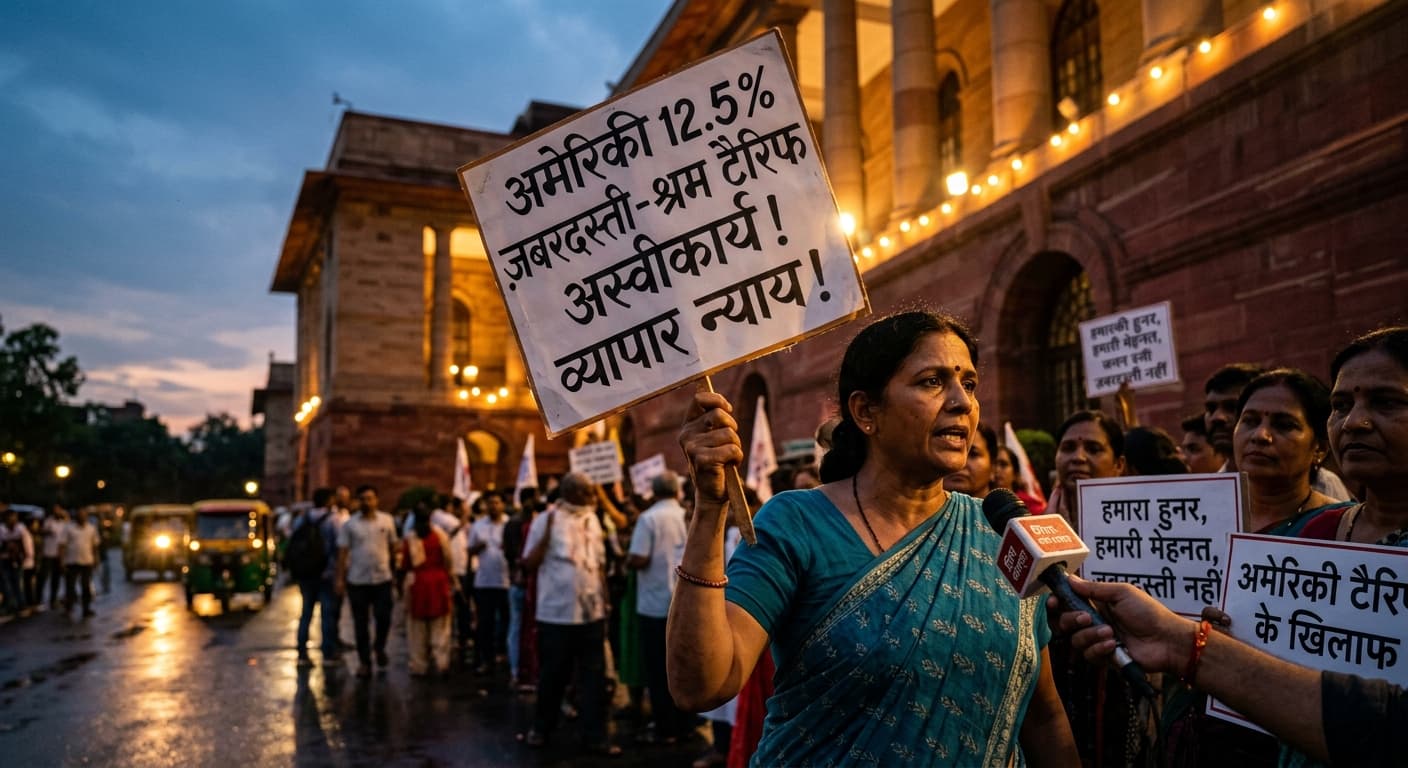
India Fights US 12.5% Forced-Labour Tariff, Betting on Trade Deal
India's July 8 pushback against a US 12.5% forced-labour tariff is a stress test of the post-IEEPA tariff regime — and a template for how mid-sized economies escape it.
India told the Office of the US Trade Representative on July 8, 2026 that a proposed 12.5% "forced labour" surcharge on Indian goods lacks legal basis, evidence and country-specific analysis — and offered to fold the entire dispute into ongoing bilateral trade agreement (BTA) talks. The forced-labour label is largely a legal wrapper: Washington needs the Section 301 process to survive because the Supreme Court struck down the president's emergency tariff powers in February, and July 24 is the day the last stopgap expires. Whether India can carve itself out inside the BTA will set the pattern for every mid-sized economy on the 60-country list.
The Section 301 workaround, in plain sight
Read the Supreme Court's February 20 opinion in Learning Resources v. Trump and the tariff calendar snaps into focus. Chief Justice John Roberts, writing for a 6-3 majority, held that the phrase "regulate . importation" in the International Emergency Economic Powers Act "does not include the power to impose tariffs." The ruling wiped out the "reciprocal" and "fentanyl" tariffs that had underpinned the second Trump administration's trade architecture.
Within hours, the president signed a Section 122 emergency order imposing a 10% global tariff — a tool the Atlantic Council flagged can only last 150 days without congressional extension. That clock runs out on July 24, 2026. USTR needed a legally durable replacement before that date. A
Congressional Research Service brief confirms USTR "initiated two investigations under Section 301 into the practices of dozens of countries related to excess industrial capacity and action on forced labor on an 'accelerated timeframe'" — with a stated aim of "finalising those tariff actions by late July 2026, when a 10% tariff imposed under Section 122 of the Trade Act of 1974 expires."
Brookings analysts Maricarmen Barron Esper and Christopher Sands put it more bluntly: Section 301 has become "the main vehicle for rebuilding tariff authority" after IEEPA. The forced-labour framing is the substantive predicate; the accelerated calendar is the tell.
What India actually submitted
At the USTR public hearing on July 8, Joint Secretary in the Ministry of Commerce Brij Mohan Mishra made a narrow, procedural argument. India's written submission dated July 6 argues that USTR "adopted a broad approach instead of evaluating each country's legal framework and enforcement mechanisms individually," according to the KNN India readout. Delhi's core legal claim: the mere absence of a Section 307–style forced-labour import ban cannot on its own satisfy Section 301's statutory threshold of being "unreasonable" and burdening US commerce.
Mishra also exposed two contradictions in the USTR's own record. As reported by Newspublicly, he noted that USTR exempted roughly 1,600 tariff lines "that cannot be produced or grown domestically" — including many with well-documented forced-labour risk, such as coffee, cocoa and certain seafood. He also singled out the proposed textile mechanism, which offers reduced rates for garments made with US-origin cotton and inputs.
"By providing reduced tariff rates on the basis of imports of US-origin textile inputs, the textiles mechanism operates as an arbitrary requirement that influences and constrains the sourcing decisions of foreign manufacturers, without fully addressing the concern of forced labour." — Brij Mohan Mishra, Joint Secretary, Ministry of Commerce, July 8, 2026
The subtext is that Washington drafted the tariff to protect politically sensitive consumer goods and to nudge sourcing back to US cotton — not to cure a forced-labour problem. FICCI's Poornima Shenoy told the same hearing the surcharge "would simply make trusted supply chains more expensive" rather than surface abusive ones.
The numbers behind the fight
India sits in the higher of the two tariff tiers USTR proposed on June 2. According to BBC News, the report concluded that 54 of the 60 economies investigated "failed to impose a legal prohibition on the importation of goods produced wholly or in part with forced labour." Six others — Canada, the EU, Ecuador, Indonesia, Mexico, Pakistan — were said to have failed to enforce an existing ban. The former face a 10% surcharge; India, alongside China, Japan, South Korea, Vietnam, Australia and New Zealand, faces 12.5%.
India's merchandise exports to the US ran at roughly $86 billion in FY2024-25 and already carry an 18% reciprocal tariff under the February interim deal. A 12.5% Section 301 duty piled on top would push effective duties on the largest labour-intensive categories — textiles, leather, gems, engineering goods — past 30%. India's Ministry of Commerce data show US exports rebounded 14.5% month-on-month in October 2025 even under the 50% peak tariff, but Global Trade Research Initiative's Ajay Srivastava estimates monthly shipments had already dropped 28.4% between May and October.
Why New Delhi is arguing procedure, not substance
India is not defending its forced-labour record on the merits — because it cannot. According to the Walk Free Foundation's Global Slavery Index 2023, India has "the highest estimated number of people living in modern slavery worldwide," with 11.05 million individuals affected. The
UN International Labour Organization's 2022 Global Estimates put 27.6 million people worldwide in forced labour and identify South Asia's brick-kiln, garment and seafood supply chains as high-risk. Al Jazeera
has documented forced labour inside Indian shrimp-processing facilities that ship to the US.
India's own Bonded Labour System (Abolition) Act, 1976 and Article 23 of the Constitution outlaw forced labour domestically, but Delhi has never enacted a Section 307–equivalent ban on importing goods made with forced labour — which is USTR's specific complaint. That legal gap is real. So the Indian submission does not contest it; it contests whether the gap alone can trigger Section 301.
That's a defensible position. Section 301(d)(3)(B)(iii)(III) makes a "persistent pattern of conduct that permits any form of forced or compulsory labor" actionable, per the USTR notice of initiation in the Federal Register. But the statute still requires a finding that the practice "burdens or restricts US commerce." India's argument is that USTR has produced no product-level evidence linking Indian exports to forced-labour inputs, and no economic analysis showing measurable US injury. GTRI's Srivastava has argued India should challenge the tariff on precisely that ground.
The real prize: keeping the BTA alive
The deeper Indian move is diverting the fight into the US-India Bilateral Trade Agreement track. The
February 9, 2026 White House joint statement committed both sides to a "framework for an Interim Agreement" and to "concluding a mutually beneficial BTA consistent with the roadmap agreed in the Terms of Reference." India's Press Information Bureau
described the interim deal as reducing tariffs on $30.94 billion of Indian exports from 50% to 18%, and on another $10.03 billion to zero.
If Section 301 duties are layered on top of that architecture, the interim deal's economic content collapses. Mishra's demand that "concerns need to be dealt with in the framework of the India-US bilateral trade negotiations and not in a specific unilateral manner" is not rhetoric; it is a request to fold the forced-labour surcharge into a package that also touches Russian oil, agricultural market access and India's $500 billion five-year US purchase pledge.
The February joint statement contains an escape clause India can lean on: "In the event of any changes to the agreed upon tariffs of either country, the United States and India agree that the other country may modify its commitments." Translation: pile on the 12.5%, and the $500 billion pledge is renegotiable.
Who benefits, who loses
The winners from a full-tier 12.5% surcharge are narrow: US domestic textile mills that use American cotton (favoured by the exemption mechanism), Mexican and Central American apparel producers who sit in the 10% tier or under USMCA carve-outs, and Vietnamese and Bangladeshi producers already re-routing on India's demand ceiling. The losers include US retailers exposed to Indian garments and jewellery, US manufacturers dependent on Indian generic pharma inputs (partly exempt) and engineering components (not exempt), and Indian MSMEs in Tirupur, Surat and Ludhiana.
The stealth winner is Beijing: India's 12.5% matches the rate proposed for China, erasing the tariff differential the interim BTA was supposed to lock in. If the Section 301 duties bite before the BTA closes, India's carefully engineered price gap against Chinese exporters in the US market — the entire industrial-policy premise of Delhi's tilt toward Washington since 2023 — narrows sharply.
What to watch
Three catalysts sit between now and Labor Day:
- July 24, 2026. The Section 122 10% global tariff expires; USTR aims to have Section 301 duties finalised by then, per the CRS. If Congress extends Section 122 or USTR misses the deadline, the pressure to publish a final schedule eases — and India gains negotiating time.
- August 2026 BTA round. Indian officials have signalled a summer round of BTA negotiations. A carve-out from the forced-labour surcharge — even a phased or partial one — is the concrete Indian ask.
- Court challenges. The
Court of International Trade already ruled the interim Section 122 duties illegal in June 2026. Litigation against any final Section 301 tariff, likely filed by importer coalitions the day it publishes, will test whether the "unreasonable" standard can be stretched to cover the absence of a foreign statute.
Diplomat View
The 12.5% tariff will probably be published — but India will get a carve-out inside the BTA before it bites at full strength. The Section 301 forced-labour case is legally thin (the record does not show country-specific US commercial injury from Indian exports), the political case is domestically popular, and the administration needs something to point to on July 24. That gives USTR every incentive to publish, and every incentive to trade India's rate down at the negotiating table for a deeper $500 billion purchase package and Russian-oil concessions. Expect a two-track outcome: the tariff order is finalised near the statutory ceiling for most of the 48 Tier-2 economies; India secures either a delayed application or a textile/gems carve-out under the BTA before Labor Day. The forecast changes if Delhi hardens on Russian oil, or if the Court of International Trade enjoins the final Section 301 order on the "unreasonable" standard — in either case, the tariff bites at full strength and the interim BTA's economic content unravels. If the USTR's final Federal Register notice publishes before an Indian carve-out is announced, the interim BTA's $500 billion architecture collapses — and Delhi will have traded its leverage for a tariff it couldn't stop.
Discover more

India
Delhi CM Rekha Gupta Blasts Opposition's Delm
Delhi CM Rekha Gupta's remarks on women's quota defeat reveal BJP's strategy for the 2029 Lok Sabha elections, focusing on delimitation.

US Politics
White House Pressures Congress for Crypto Leg
The Trump administration's push for the CLARITY Act aims to reshape crypto regulation, impacting trillions in market value and the Trump family's wealth.
US Politics
US Military Strikes Drug Traffickers Pacific
A U.S. military strike in the eastern Pacific killed two amid an anti-drug trafficking campaign, raising questions over sovereignty and regional cooperation.
Tech Policy
U.S. Grants UAE License-Free AI Chip Access
U.S. Commerce reclassifies UAE to Country Group A:5, granting license-free AI chip access to G42 and American tech giants, rewarding Emirati China divestment and Operation Epic Fury sacrifices.