Trump's Greenland Push and Self-Government
The 2009 law shapes the Greenland diplomatic crisis.
Model Diplomat4 min readamericas
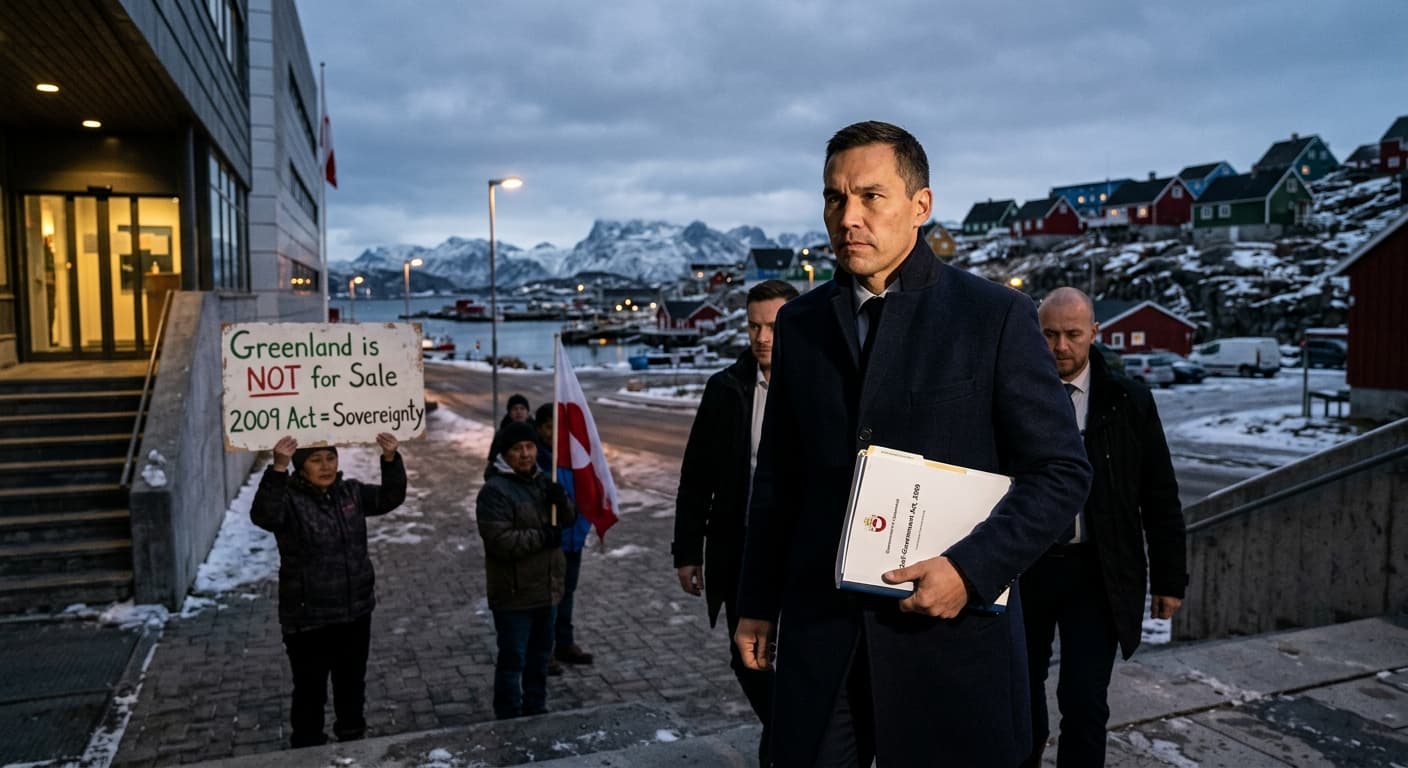
The Self-Government Act Is the Real Battlefield in Trump's Greenland Push
The 2009 law that gave Greenlanders self-determination is now the terrain on which Washington, Copenhagen, and Nuuk are fighting for control of the Arctic's most strategic island.
The diplomatic crisis over Greenland is usually framed as a contest of wills between Donald Trump and Copenhagen. But the decisive actor is neither the White House nor the Danish prime minister. It is a 17-year-old statute — the 2009 Act on Greenland Self-Government — whose provisions on subsidies, resource revenue, foreign policy, and independence are structuring every move in this negotiation.
The Act, which replaced Greenland's 1979 Home Rule arrangement, did three things that now define the chessboard. First, it fixed Denmark's annual block grant at DKK 3.4 billion (2009 price and wage levels) while carving out a path to economic self-sufficiency: 50% of mineral revenues above DKK 75 million are deducted from the subsidy. If the subsidy ever falls to zero, Denmark and Greenland must renegotiate their entire economic relationship. Second, it recognised Greenlanders as a "people pursuant to international law with the right of self-determination" and laid out an independence procedure — a Greenlandic referendum, parliamentary consent in both Nuuk and Copenhagen, and a negotiated separation agreement. Third, it gave Naalakkersuisut (Greenland's government) authority to negotiate and conclude international agreements in fields where competence has been transferred, while keeping foreign and security policy under Danish constitutional control. Statsministeriet
The result is a paradox that Trump's pressure campaign has exposed. Greenland controls its mineral wealth — the very rare earth deposits Washington covets — but cannot independently sign the kind of security and investment deal the US wants. Denmark controls defence and foreign policy but has no veto over what Greenland does with its resources. Neither can deliver what Trump is demanding alone, and both have publicly drawn sovereignty as a red line. Al Jazeera
The subsidy trap
Greenland's five political parties all favour eventual independence, but the DKK 3.4 billion subsidy — roughly 30% of Greenland's GDP — makes that aspiration impractical for now. Prime Minister Jens-Frederik Nielsen's January declaration that "if we have to choose between the United States and Denmark here and now, we choose Denmark" was as much a fiscal statement as a geopolitical one. BBC
The Self-Government Act's resource-revenue clause was designed as an incentive, not a trap. But it has become one. For Greenland to reduce its dependency on Denmark, it needs large-scale mineral extraction — precisely the kind that would require US or Chinese investment, and precisely the kind that would, under the Act, reduce the Danish subsidy and trigger renegotiation. This is the structural tension Trump is exploiting when he speaks of a "framework of a future deal" involving mineral rights. BBC
The foreign-policy handcuffs
Under Section 11 of the Act, Naalakkersuisut can act internationally — but only in fields where it has assumed responsibility, and always subject to Denmark's constitutional authority over foreign and security policy. The 1951 US-Denmark defence agreement, which already permits Washington to station unlimited troops at Pituffik Space Base, sits squarely in the Danish domain. So do any negotiations over the three new bases the US is now seeking in southern Greenland under that pact. BBC
This means Copenhagen — not Nuuk — holds the pen on the military dimension of any deal. Denmark has already signalled openness to expanded US basing, provided it remains within the existing sovereignty framework. The Danish foreign ministry confirmed in June that "an ongoing diplomatic track with the United States" is underway, while Greenlandic PM Nielsen acknowledged negotiations have "taken some steps in the right direction." BBC
But the Act also means Greenland can negotiate its own resource agreements — and the Trump administration is reportedly pursuing a parallel track on minerals, potentially outside Danish oversight. The risk of the US playing Copenhagen and Nuuk against each other is not hypothetical; it is built into the architecture the 2009 Act created. Chatham House
What to watch next
The three-base negotiation under the 1951 agreement is the immediate decision point. If the US secures something resembling sovereign basing rights — the Cyprus model of Akrotiri and Dhekelia has been floated — it would represent the most significant erosion of Danish territorial integrity since the Act was passed. Trump has already backed off his tariff threat and ruled out military force after his Davos meeting with NATO Secretary General Mark Rutte, but he continues to insist the deal gives the US "total access" with "no time limit." BBC
The deeper question is whether this crisis accelerates Greenland's independence timeline. All five parties want it. The Act provides the mechanism. What it does not provide is an answer to the question that follows: whether an independent Greenland, suddenly free to negotiate its own security and resource deals, would find itself more or less vulnerable to the power that just spent months threatening to take it by force.
Discover more
Global Politics
Trump's Conflicting Messages on Iran War
Trump's mixed messages on Iran reflect a strategy of audience management, benefiting Tehran amid a complex geopolitical landscape.
US Politics
House Ethics Committee Pushes Sexual Miscond.
The House Ethics Committee has shifted responsibility for sexual harassment settlement records to the Office of Congressional Workplace Rights, complicating disclosure efforts.
US Politics
SNAP Food Assistance Faces Legal Challenges
In 2026, SNAP faces stricter eligibility rules and mounting legal challenges, threatening food assistance for the millions of Americans who rely on the program.
Conflict & Security
Guatemala: El Niño 2026–27 becomes regional security test
UNICEF: 25.8M children face El Niño risks in Latin America; Guatemala maps 188 municipalities for drought and food insecurity amid regional security test.