French Peacekeeper Killed in Lebanon
France loses key leverage in Lebanon policy.
Model Diplomat7 min readMiddle East
French Peacekeeper Killed in Lebanon: Paris Loses Its Last Lever
France buried two soldiers from the April 18, 2026 Ghandouriyeh ambush — and lost its last real instrument of Lebanon policy in the same month.
Staff Sergeant Florian Montorio, 39, was killed by direct small-arms fire on April 18, 2026, while clearing suspected roadside bombs on a road between two isolated UNIFIL positions in the southern Lebanese village of Ghandouriyeh. Four days later, Corporal Anicet Girardin, 31, a specialist dog handler wounded in the same ambush, died at a Paris hospital. The two French deaths matter beyond the grim tally because they arrived at the precise moment France was being written out of the diplomacy that will decide southern Lebanon's next decade: the UN Security Council has already voted to shut UNIFIL down at the end of 2026, and the trilateral framework signed by the United States, Israel and Lebanon on June 25 was negotiated without a French seat at the table. The soldiers died defending a mission Washington is dismantling — and Paris no longer has the leverage to save either.
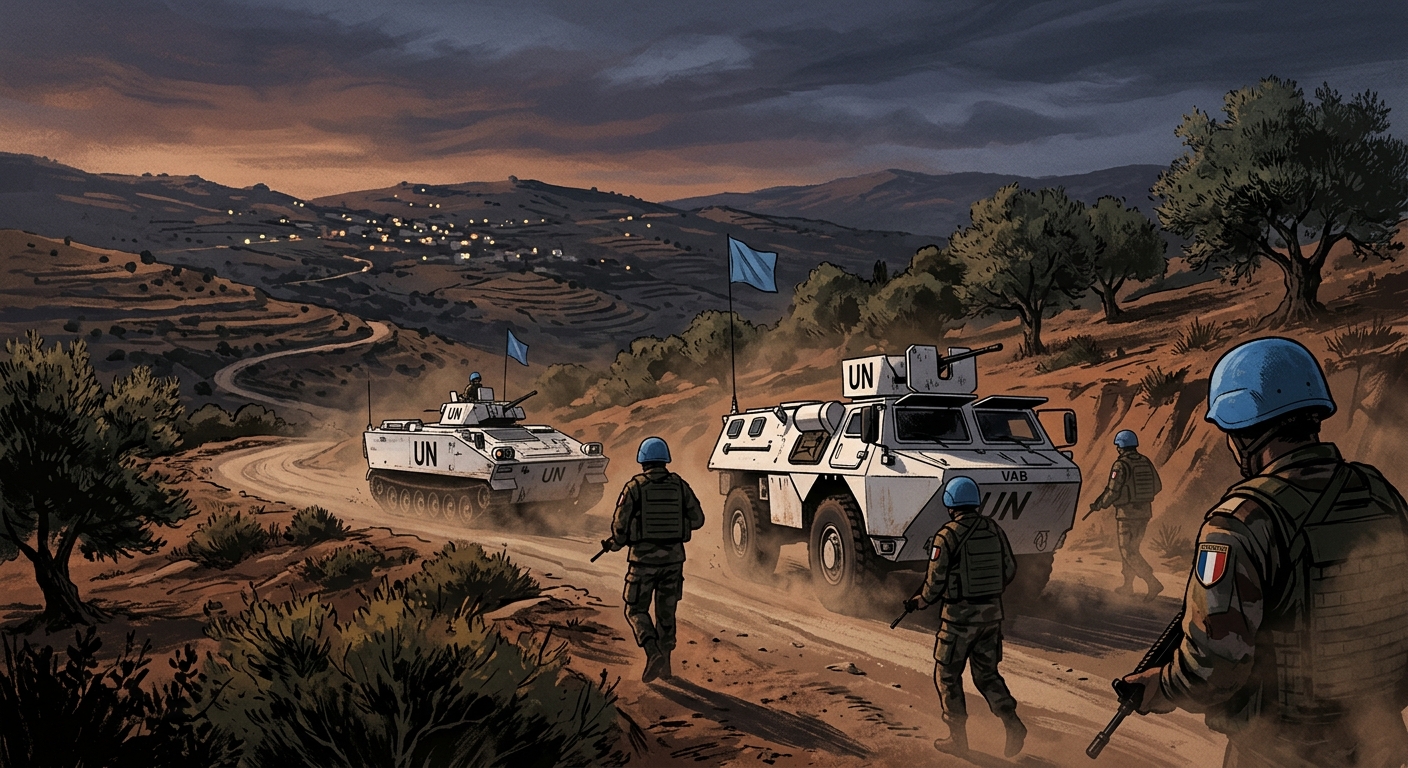
What happened in Ghandouriyeh
The patrol was not on offensive duty. According to the UN Secretary-General's noon briefing of April 20, 2026, Montorio's team from the 17th Parachute Engineer Regiment in Montauban was investigating a location where improvised explosive devices had reportedly been placed on a road between two UN positions in UNIFIL's area of operations — an engineering task to reconnect bases cut off by the March–April fighting. The UN's initial assessment was blunt: the peacekeepers "came under fire from non-state actors, presumed to be Hizbullah."
French Armed Forces Minister Catherine Vautrin told reporters the patrol had been "ambushed by an armed group at very close range," with Montorio "hit immediately by a direct shot from a small arms weapon," according to the BBC. President Emmanuel Macron went further within hours. "Everything suggests that responsibility for this attack lies with Hezbollah," he said, quoted by
France 24, demanding that Lebanese authorities "immediately arrest the perpetrators."
Hezbollah denied any role, calling the accusation "rushed" and "baseless" and urging that judgement wait for the Lebanese army's probe, Al Jazeera reported. The group's denial matters less than the pattern: the December 2022 killing of Irish Private Seán Rooney in nearby al-Aqbiya produced
a Lebanese military tribunal indictment of five men allegedly linked to Hezbollah — four of whom remain at large nearly three years later. That is the accountability template Paris is now trying to force in Beirut.
On April 22, the UN reported that Corporal Girardin had "succumbed to his wounds days after the death of Staff Sergeant Florian Montorio in the same incident." In the noon briefing of April 22, 2026, Secretary-General António Guterres's spokesperson noted Girardin was "the fifth UNIFIL peacekeeper to lose his life due to the current hostilities."
The wider siege on the blue helmets
The Ghandouriyeh ambush is not an isolated tragedy — it is one node in a pattern of lethal risk that has escalated since Hezbollah re-entered the war on March 2, 2026, following the US–Israeli strike that killed Iran's supreme leader on February 28. Within four weeks, three Indonesian peacekeepers were killed: one by a projectile at Adchit al-Qusayr on March 29, and two by what UN peacekeeping chief Jean-Pierre Lacroix later described to the Security Council as a roadside IED near Bani Hayyan on March 30. The Israel Defense Forces publicly denied responsibility for the Bani Hayyan blast; UNIFIL's own investigation remains open.
The operational reality is that UNIFIL is being attritted by both belligerents. Israel has "damaged or destroyed roads and established roadblocks, while Hezbollah has set up landmines on certain roads," UNIFIL public information officer Tilak Pokharel told Al Jazeera. The force has shrunk from a peak of roughly 15,000 to just over 7,000, with around 3,000 troops leaving without replacement in the last six months as budgets contract. Resupply of forward positions — the very task the French patrol was performing — has become a killing ground.
In its May 5 update to the Security Council, the UN reported 619 IDF launches into Lebanon and 30 launches toward Israel in a single day — the heaviest exchange since the April 17 cessation-of-hostilities framework. Lebanese authorities have counted 2,679 dead and more than one million displaced since March 2, according to the same briefing. UNIFIL's peacekeepers are trying to hold a "buffer" in a corridor where neither side has stopped shooting.
Why the timing is the story
Rewind eight months. On August 28, 2025, the Security Council unanimously adopted Resolution 2790 (2025), extending UNIFIL until December 31, 2026, and mandating "an orderly and safe drawdown and withdrawal" through 2027. The resolution was, as the UK's explanation of vote at the UN put it, driven by "the penholder" — France — as a compromise against a US-Israeli push to terminate the force immediately. Acting US Ambassador Dorothy Shea told the chamber flatly, per
Al Jazeera: "This will be the last time the United States will support an extension of UNIFIL."
That is the frame for the two French deaths. France holds nearly 700 troops in Lebanon under Operation DAMAN, providing the Force Commander's Reserve — the rapid-response element of the entire mission. UNIFIL is Paris's single most important instrument of Middle East policy outside its own bilateral channels. As Théa Delval writes in a July 1, 2026 analysis for the International Centre for Defence and Security, the mission's end "risks depriving Paris of one of its most important instruments of regional engagement." France is losing that instrument on a US-Israeli timetable, at the exact moment its soldiers are dying to keep it running.
The leverage Paris does not have
Macron's demand that Lebanese authorities "arrest the perpetrators" is the tell. It is the language of a power that has run out of independent options. Lebanese President Joseph Aoun told Macron by phone that those responsible would be brought to justice, and Prime Minister Nawaf Salam ordered an investigation, according to the BBC. Both are now dependent variables in a US-mediated process. The trilateral framework agreement of June 25, 2026 — the document that will shape what happens after UNIFIL leaves — was signed in Washington. France was not in the room.
That absence is remarkable given the depth of the France–Lebanon file. Paris drafted Resolution 1701 with Washington in 2006; French forces have been in southern Lebanon almost continuously since 1978; Macron personally led post-Beirut-explosion diplomacy in 2020. Yet as the ICDS analysis notes, France now finds itself "sidelined from key US-led negotiations involving Israel," reduced to a parallel humanitarian track — roughly 100 tonnes of medical aid delivered since March 2026. Aid is what powers with no leverage provide.
The second-order beneficiary here is not Israel or the United States alone. It is the operational logic that says peacekeeping should be replaced by hard security guarantees underwritten by the country that can actually push Israel — Washington. The Institute for National Security Studies in Tel Aviv had argued in an August 2025 paper that ending UNIFIL "would require a US veto — something Washington may wish to avoid exercising at this time." Six months later, Washington did not need the veto. It needed only the credible threat of one, and France folded into a 16-month wind-down.
Not the first time — and that is the point
Southern Lebanon has swallowed French soldiers before. In 1983, 58 French paratroopers of the multinational force were killed by a bomb in the Drakkar building in Beirut. Fifty years on, the two chevrons on Montorio's coffin belong to the same regimental lineage that took casualties in that campaign. What is different now is the political container. In 1983, France pulled its troops but kept its diplomatic centrality. In 2026, France keeps deploying troops but has lost the diplomatic centrality. The blood-and-legacy argument that has underwritten French Lebanon policy for four decades no longer converts into a chair at the table.
There is a domestic dimension. Macron's government, running short of parliamentary room after the 2024 legislative reshuffle, cannot easily absorb further UNIFIL casualties without a public accounting. A Lebanese investigation that fingers "unidentified armed men" — the pattern in the Rooney case — will not satisfy Paris. But there is no obvious escalation ladder. France cannot sanction Hezbollah alone in ways the group would feel; it cannot force Israeli restraint; it cannot rewrite Resolution 2790.
What to watch
- The Lebanese army's Ghandouriyeh investigation. In December 2025, Lebanese intelligence
arrested six suspects within 48 hours of an earlier attack on a UNIFIL patrol. The speed and identity of any arrests in the Montorio–Girardin case will signal whether Beirut can deliver accountability against Hezbollah-linked actors — or whether the Rooney pattern of at-large indictees repeats.
- The Security Council's next 1701 report. The Secretary-General reports on Resolution 1701 implementation on a four-month cycle under Resolution 2749 (2024). The next briefing is the natural forum for France to press for enforcement language before UNIFIL's December 31, 2026 sunset.
- The UNIFIL replacement question. European diplomats have told Al Jazeera there is "strong support in Europe and Lebanon to continue some form of monitoring body" after 2027. Whether France leads that architecture — or whether it is a US-Gulf construct built around Saudi and Emirati backing for the Lebanese Armed Forces — is the real fight now.
The Bottom Line
The bottom line: two French soldiers were killed in Ghandouriyeh on April 18 defending a mission the United States has already voted to shut down, and France's inability to convert those deaths into either accountability from Beirut or influence over the Washington-led framework is the clearest measure yet of Paris's diminished Middle East hand. The next test is not whether Hezbollah is punished — it is whether France still has a seat when southern Lebanon's post-UNIFIL security order is designed.
Discover more
Conflict & Security
Vance Claims Progress in Iran Talks
Vance says nuclear talks with Iran are advancing, though key sticking points stay unresolved as Washington weighs sanctions, oil, and regional security stakes.
Global Politics
Iran's De-confliction Cells Face Lebanon Test
The US-Iran ceasefire's de-confliction cells face an early test as Israel presses strikes in Lebanon, straining the fragile deal and wider US-Iran relations.
International Relations
Vance Heads to Switzerland for Iran Talks
Direct US-Iran talks in Switzerland face mounting strain from Lebanon violence and renewed threats to the Strait of Hormuz, complicating fragile diplomacy.
International Relations
Nabatieh Ceasefire Unravels Amid Attacks
Israeli airstrikes resumed in southern Lebanon, killing 16 near Nabatieh as a fragile ceasefire with Hezbollah collapses and regional tensions escalate.