French UNIFIL Soldier Killed in Lebanon
Two French soldiers killed in Lebanon's Ghandouriyeh ambush.
Model Diplomat8 min readMiddle East

French UNIFIL Soldier Killed in Lebanon: What Ghandouriyeh Means
Two French peacekeepers died after an April 18, 2026 ambush in southern Lebanon. The killings hand Paris a case it cannot walk away from — even as the UN mission dies.
Two French soldiers of the UN Interim Force in Lebanon (UNIFIL) are dead after a small-arms ambush at Ghandouriyeh on April 18, 2026 — an attack Paris and the UN blame on Hezbollah and the group denies. The deaths are more than a peacekeeping tragedy: they arrive eight months after the UN Security Council voted to shut UNIFIL down, and they hand France the political capital to build the coalition it wants to replace it. The question this feature answers is not who fired the shots. It is whether Ghandouriyeh accelerates the end of one mission and forces the birth of another — one with the rules of engagement UNIFIL never had.
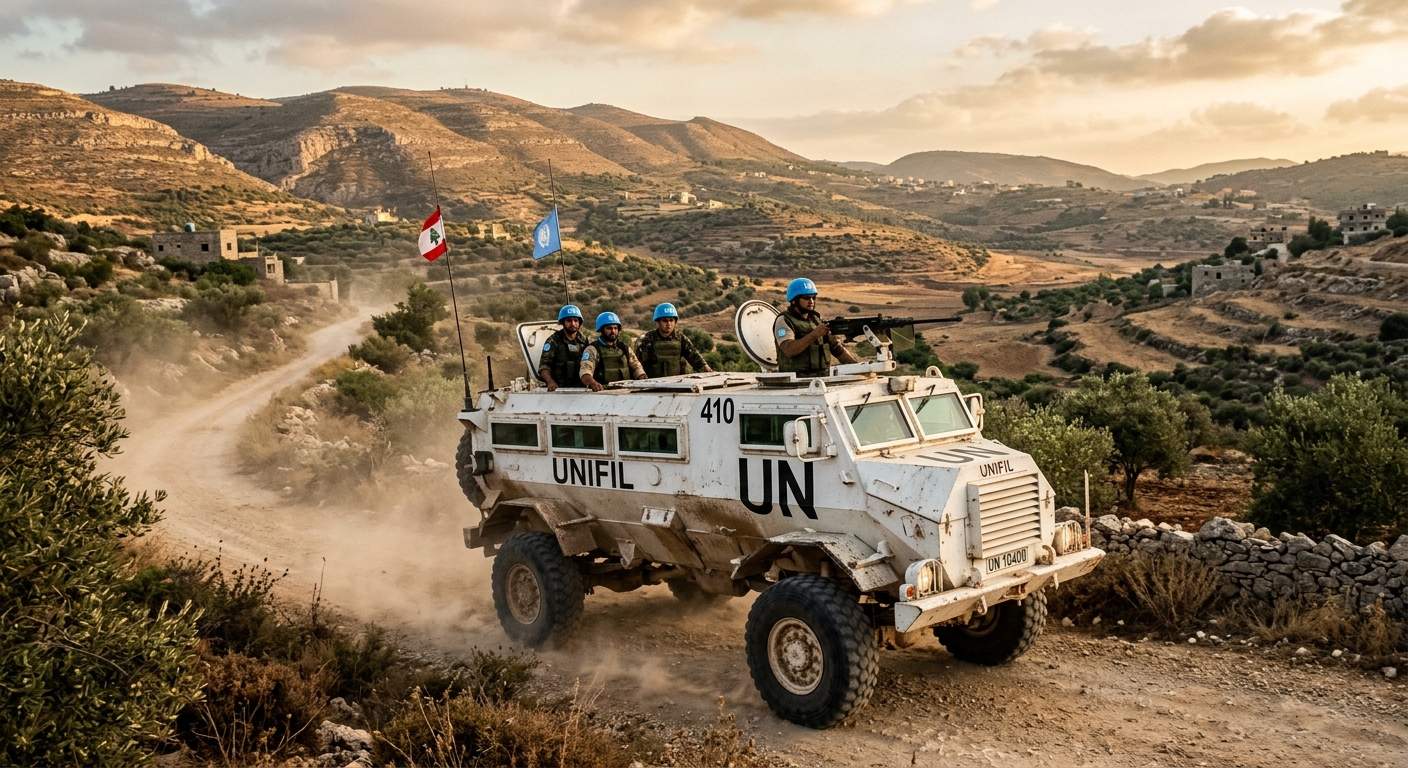
The ambush at Ghandouriyeh
On the morning of April 18, 2026, an explosive-ordnance disposal patrol from UNIFIL's French contingent was clearing a road through Ghandouriyeh, a village in Bint Jbeil district, to re-establish access to a UN position isolated by weeks of fighting. According to Al Jazeera, the patrol came under fire at close range. One soldier was killed on the spot; three were wounded, two of them seriously.
French Armed Forces Minister Catherine Vautrin, cited by the BBC, said the peacekeeper was "hit immediately by a direct shot from a small arms weapon" and could not be revived by comrades. The soldier killed on the day was later identified as Staff Sergeant Florian Montorio. Four days later, Corporal Anicet Girardin — a 31-year-old specialist dog handler evacuated to Paris — died of his wounds.
The confirmation came from the UN itself. In a noon briefing on April 22, 2026, the Secretary-General's office stated:
"A specialist dog handler, Corporal Anicet Girardin was 31 years old. He was seriously wounded when his explosive ordnance disposal team, operating under UNIFIL's French contingent, came under attack while clearing a road in Ghanduriyah in order to re-establish access to isolated UNIFIL positions. He succumbed to his wounds days after the death of Staff Sergeant named Florian Montorio in the same incident."
That is the primary record: two French soldiers dead, one incident, and — in the UN's own words — an "initial assessment" that the fire came from "non-state armed groups, presumably Hezbollah."
President Emmanuel Macron went further. "Everything points to Hezbollah being responsible for this attack," he wrote on X, urging Lebanese authorities to arrest the perpetrators, according to Channel News Asia. Hezbollah rejected the allegation, calling it "rushed" and "baseless" and demanding Beirut wait for the Lebanese army's inquiry. Lebanese President Joseph Aoun and Prime Minister Nawaf Salam both condemned the shooting and ordered investigations, according to the
BBC.
Why this ambush is different
UNIFIL has buried peacekeepers before. What sets Ghandouriyeh apart is timing, target and attribution.
The attack came two days into a 10-day Israel–Lebanon ceasefire that began on April 16, 2026, and against a backdrop of Israeli ground operations that pushed past the Litani River — the very line Resolution 1701 was meant to freeze. In late March 2026, three Indonesian peacekeepers were killed in two separate incidents near Bani Hayyan and Aadshit al-Qusayr; UN peacekeeping chief Jean-Pierre Lacroix told the Security Council the deaths were "most likely" caused by an improvised explosive device, according to the BBC. Israel denied involvement. UNIFIL's Naqoura headquarters had been hit weeks earlier by what the UN called "a non-state actor."
Ghandouriyeh is different because the shooter is named, the weapon is a rifle, and the target was a bomb-disposal patrol trying to reach cut-off UN posts. As UN News reported on April 23, 2026, Girardin was the fifth UNIFIL peacekeeper killed in the current hostilities. That is the deadliest concentrated stretch for the mission since the 2006 war.
The pattern matters for a legal reason. UNIFIL warned that "deliberate attacks" on peacekeepers are "grave violations of international humanitarian law" that "could amount to war crimes," per the BBC. If a Lebanese investigation confirms Hezbollah authorship, Paris will have a case-ready dossier just as the UN drawdown clock runs out.
The mission is already dying
This is the leverage point most wire coverage misses. UNIFIL is not an ongoing mission grieving its dead — it is a terminated mission being buried on schedule.
On August 28, 2025, the Security Council voted unanimously to extend UNIFIL only through December 31, 2026, then to "wind down" the force through 2027, according to Al Jazeera. The U.S. representative was explicit: "This will be the last time the United States will support an extension of UNIFIL." The Trump administration had already cut U.S. funding to the force. Israel had spent two years accusing the mission of failing to constrain Hezbollah. Ireland's contingent — 300 troops — is on its way out by 2027, the
BBC reported.
The Danish Institute for International Studies warned that the terminated mandate "reflects US and Israeli pressure" over European objections, and that the Lebanese Armed Forces (LAF) will inherit a terrain "where state presence continues to be uneven and Hezbollah retains significant military and political influence." The Atlantic Council was blunter: UNIFIL was seen by its critics "to have fundamentally failed in its mission," unable to stop either Israeli overflights or Hezbollah's construction of firing ranges inside its zone of operations, according to the
Atlantic Council.
Two French soldiers died patrolling a mission that has been told to leave.
Why Paris cannot walk away
France has 700 troops in UNIFIL — its second-largest overseas deployment after the Sahel drawdown — and a claim on Lebanon that predates the state itself. Since 1978, more than 330 peacekeepers have died in UNIFIL colors, per the BBC. Two dead French citizens in April 2026, killed by name-brand adversaries, is a domestic political fact for Macron before it is a diplomatic one.
That fact is already reshaping post-UNIFIL planning. On March 30, 2026, France requested an urgent Security Council meeting after the Indonesian deaths, according to Al Jazeera. By late June, Paris and Rome had put a joint initiative on the table for "an international coalition to help manage security arrangements and support Lebanon's armed forces following the exit" of UNIFIL,
Al Jazeera reported after the trilateral U.S.–Lebanon–Israel framework was signed in Washington. Lebanese President Aoun endorsed the idea publicly.
The direction of travel is toward a harder mission. Analysts Pierre Vimont and colleagues, writing for the Carnegie Endowment days after the Ghandouriyeh attack, argued France, Italy and Spain — the trio that already contributes some 2,000 UNIFIL troops — should form the nucleus of a new force with "robust rules of engagement" that could "kinetically" back the LAF against Hezbollah while also shooting down Israeli drones violating Lebanese airspace. That is not a UN peacekeeping formula. It is a coalition-of-the-willing formula, closer in spirit to the Multinational Force that entered Beirut in 1982 than to anything the UN has fielded since.
The ambush at Ghandouriyeh strengthens the Carnegie argument in one specific way: it undercuts the case for a monitoring-only successor. If UNIFIL's blue helmets can be shot at close range on a road-clearing mission during a ceasefire, the political case in Paris and Rome for keeping their soldiers in Lebanon under the same rules is finished. Either they get authorization to fight, or they leave with the flag.
Who benefits, who loses
Israel and the United States get the outcome they wanted — UNIFIL's end — plus a European commitment to fill the void. Washington had pushed for termination since January 2025 and got it. Any successor force led by France, Italy and Spain will operate under bilateral agreements with Beirut, not a UN mandate, which frees it from Russian and Chinese veto power on rules of engagement. That is a strategic gain for the West, and it was inconceivable a year ago.
Hezbollah loses politically, whatever it did or did not do on April 18. As the International Centre for Defence and Security noted, the group's denial has been received with skepticism in European capitals precisely because its historical playbook — pressuring UNIFIL patrols away from sensitive corridors — is well documented. A diplomatic source told Al Jazeera bluntly, in the context of UNIFIL harassment, that Hezbollah "want no witnesses" in the south, per the outlet's
June 1, 2026 feature. The optics of a French bomb-disposal team being shot while trying to reach isolated posts fit that narrative regardless of forensic outcomes.
The Lebanese state loses too — but in a way it may not resist. Prime Minister Nawaf Salam has repeatedly asked France to keep an international presence in the south, according to the Atlantic Council. Beirut cannot afford a security vacuum in which the LAF is expected to disarm Hezbollah alone while Israel occupies five positions inside Lebanese territory. A French-Italian coalition provides political cover for what Beirut cannot say plainly: it wants foreign troops as a buffer against both its enemy and its own strongest domestic actor.
China loses — modestly. Beijing publicly urged reversal of UNIFIL's departure, according to Al Jazeera, arguing this is not the time to withdraw. That call went nowhere. The post-UNIFIL architecture is being built in Washington, Paris and Rome, not at Turtle Bay.
The historical parallel worth watching
UNIFIL was born from an ambush too — the 1978 Israeli invasion that followed a Palestinian raid inside Israel. It was scaled up after the 2006 war on the assumption that a blue-helmet buffer could substitute for a political settlement. Nearly two decades and 330 dead peacekeepers later, that assumption is being retired. Ghandouriyeh is the funeral, not the cause.
The parallel to watch is 1982–1984. The Multinational Force in Beirut arrived with robust rules and left after 241 U.S. Marines were killed in a single bombing. Any French-Italian coalition entering southern Lebanon in 2027 will do so knowing that the historical downside of "harder" missions is not indecision — it is casualties that break domestic consent. The two French coffins from Ghandouriyeh are a stress test for whether Paris can absorb losses in a mission with its own name on it.
What to watch
- The Lebanese army investigation. PM Salam and President Aoun ordered inquiries into the April 18 ambush. A finding that formally names Hezbollah — or that exonerates it — will shape whether France can pursue accountability through courts or the Security Council. Beirut has structural incentives to delay.
- The UNIFIL wind-down clock. The mission ends December 31, 2026 under the
August 2025 UNSC resolution, with drawdown through 2027. Any French–Italian successor coalition must be politically formed and legally scaffolded before that date, or southern Lebanon enters 2027 with only the LAF and the "Mechanism" cell in place.
- The next trilateral round in Washington. The Lebanon–Israel–U.S. framework signed in late June 2026 opened a track for direct negotiations. The next round will test whether Hezbollah's rejectionist parliamentary bloc — which has
- French domestic politics. Two flag-draped coffins arriving at Villacoublay create parliamentary pressure Macron cannot ignore. Watch for a National Assembly debate on rules of engagement for any successor mission — the first signal of whether Paris is preparing to fight, not just to monitor.
The Bottom Line
The two French soldiers killed at Ghandouriyeh did not die defending a mission with a future. They died defending one the Security Council has already voted to terminate — and their deaths are now the strongest argument for what replaces it. Ghandouriyeh will be remembered less for who pulled the trigger than for closing the era of UN blue helmets in southern Lebanon and opening the door to a European coalition with orders to shoot back.
Discover more
Conflict & Security
Vance Claims Progress in Iran Talks
Vance says nuclear talks with Iran are advancing, though key sticking points stay unresolved as Washington weighs sanctions, oil, and regional security stakes.
Global Politics
Iran's De-confliction Cells Face Lebanon Test
The US-Iran ceasefire's de-confliction cells face an early test as Israel presses strikes in Lebanon, straining the fragile deal and wider US-Iran relations.
International Relations
Vance Heads to Switzerland for Iran Talks
Direct US-Iran talks in Switzerland face mounting strain from Lebanon violence and renewed threats to the Strait of Hormuz, complicating fragile diplomacy.
International Relations
Nabatieh Ceasefire Unravels Amid Attacks
Israeli airstrikes resumed in southern Lebanon, killing 16 near Nabatieh as a fragile ceasefire with Hezbollah collapses and regional tensions escalate.