FBI's Shift: Counterintelligence to Chip Law
FBI's focus on semiconductor export controls grows amid foreign spy arrests.
Model Diplomat9 min readNorth America
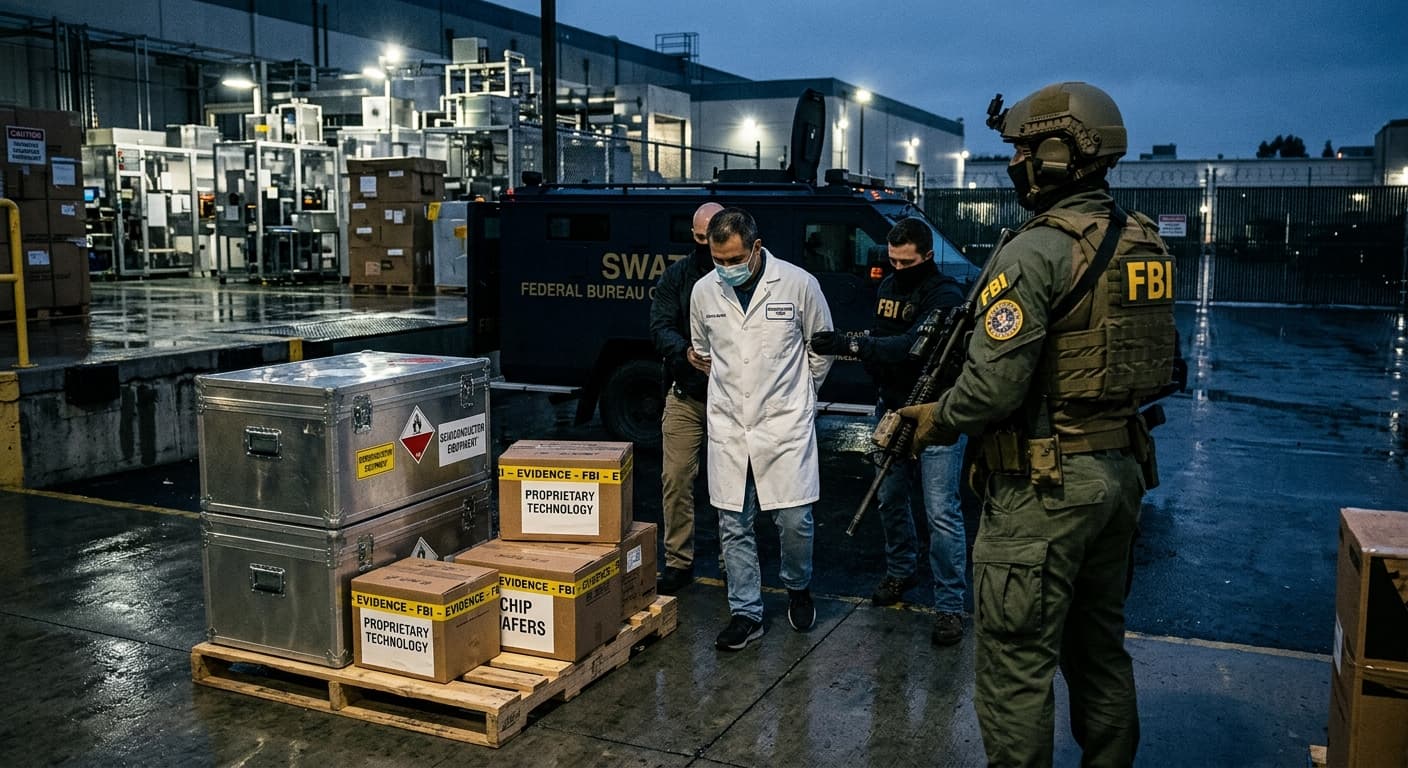
FBI's 113-Spy Tally Masks a Bigger Shift: Counterintelligence Is Now Chip Enforcement
FBI Director Kash Patel's 113 foreign-spy arrests and 53% jump in cyber indictments reflect a bureau redirected toward semiconductor export controls and state-linked hacking.
FBI Director Kash Patel's July 2026 boast of 113 foreign spies arrested and 850 active plots disrupted since January 2025 lands as a political metric, but the operational reality is narrower and more consequential: the bureau's counterintelligence engine has been re-tooled around U.S. semiconductor export controls and a handful of named state-linked cyber groups. The number that matters for U.S. tech policy is not 113. It is the roughly $2.7 billion in Nvidia-controlled AI hardware already tied to unsealed indictments since November 2025 — cases that are converting Commerce Department rules from paper into prison exposure, while the FBI simultaneously reassigns thousands of agents to immigration work. Patel's tally is a symptom of that trade-off, not a rebuttal to it.
According to IBTimes UK, Patel's public post cited the 113 arrests, a 53% year-on-year rise in cyber indictments, and a bureau tempo built around Operation Riptide, an FBI–Spanish police push against pro-Russian hacking group Cyber Army of Russia Reborn (Z-Pentest), inside the wider Operation Red Circus initiative. The FBI has not released the underlying case list.
What Patel actually claimed — and the primary numbers underneath
The 113 figure is not the first version of this statistic. In sworn House Judiciary testimony on September 17, 2025, Patel told lawmakers the FBI had "arrested 59 foreign intelligence operatives for spying or smuggling dangerous substances into the country since January 20, 2025," per the committee record. Two months later, in his November 2025 defamation complaint against The Atlantic filed in the U.S. District Court for the District of Columbia, Patel's lawyers documented an updated bureau scorecard: espionage arrests up 43% from 2024, more than 456 cyber indictments (up 27%), 257 cyber arrests, 190 cyber convictions, 358 cyber disruptions, and 29 cyber dismantlements, per the
Patel v. Atlantic complaint.
By March 2026, DNI Tulsi Gabbard's presentation of the 2026 Annual Threat Assessment to the Senate Intelligence Committee framed the same environment from the collection side: China and Russia as the "most persistent and active" cyber threats, North Korea's 2025 crypto heists valued at "probably $2 billion," and Iran's first destructive cyberattack on a U.S. company since 2014, per Gabbard's statement for the record.
The July 2026 numbers Patel cited are consistent with — but not audited against — those disclosures. Neither the inkl summary nor the underlying FBI post breaks out state-sponsored versus criminal cyber cases, or names the countries behind the 113 arrests. A separate report from
News247Plus claims 62 Chinese agents were expelled inside the total, a figure the bureau has not independently confirmed.
Two structural caveats matter for reading these figures. First, "foreign spies arrested" is not a legally defined FBI category — it aggregates FARA violations, Section 951 unregistered-agent cases, export-control smuggling, and Espionage Act charges into one headline number. Second, Patel's own courtroom filings are the most detailed source, which means the bureau is now litigating its performance metrics in a defamation suit while declining to release the case list to reporters. That is a governance oddity worth naming.
The real story: counterintelligence has become chip enforcement
Strip the political framing and what the case docket shows is a pivot. The FBI's counterintelligence resources are increasingly tied to Bureau of Industry and Security (BIS) enforcement of the 2022–2024 semiconductor export rules — not classic HUMINT unmaskings.
Four cases in eight months tell that story. In November 2025, four defendants including Cham "Tony" Li were charged in the Middle District of Florida with conspiring to divert 400 Nvidia A100 GPUs to Chinese end-users via Malaysia and Thailand, receiving nearly $4 million in wire transfers from the PRC, according to the government's detention memorandum filed in a related California proceeding. In December 2025, DOJ announced Operation Gatekeeper, which dismantled a China-linked network that had exported or attempted to export at least $160 million in Nvidia H100 and H200 chips, per testimony to the House Select Committee on the CCP by CrowdStrike co-founder Dmitri Alperovitch on April 16, 2026, filed with
Congress.gov. In January 2026, a former Google engineer was convicted on seven counts of economic espionage for stealing more than 2,000 pages of TPU and GPU design documents, per the same testimony. And in March 2026, Southern District of New York prosecutors unsealed an indictment naming Super Micro Computer co-founder Yih-Shyan "Wally" Liaw and two others in a scheme prosecutors valued at roughly $2.5 billion in diverted AI servers, per
Al Jazeera and the
BBC.
Add the 2015–2021 EDA-tool scheme at Cadence Design Systems, filed in the Northern District of California — at least 56 unlawful exports to China's National University of Defense Technology totaling roughly $45 million, per the criminal information — and the enforcement pattern is unmistakable: the counterintelligence division is running a semiconductor beat.
The tradecraft on display is also striking. In the Super Micro matter, prosecutors allege the defendants used hair dryers to peel serial-number labels off real machines and reapply them to dummy servers left behind for auditors, per Al Jazeera. That is not spycraft in the Cold War sense — it is compliance fraud, and it is what modern counterintelligence increasingly looks like inside the semiconductor supply chain.
Who benefits, who loses
Nvidia is the paradoxical winner. Every one of the flagship 2025–2026 diversion cases involves Nvidia silicon — A100, H100, H200 — because that is what the PRC AI sector needs and cannot legally buy. Enforcement wins reinforce Nvidia's political argument in Washington that BIS should permit its calibrated-for-China products (H20, and any successor) to ship, on the grounds that rigorous downstream enforcement, not blanket bans, is what stops diversion. Nvidia said as much in its statement to the BBC, calling the enforcement mechanisms "rigorous and effective." That framing is now aligned with the FBI's own scoreboard.
Super Micro and its Southeast Asian channel partners are the clear losers. The unsealed indictment does not name the company, but Super Micro confirmed it was informed by federal prosecutors, according to Al Jazeera. Second-order damage extends to the transhipment hubs — Malaysia, Singapore, Thailand — whose regulators are now being pressed by Washington to align with U.S. controls or face reputational and financial exposure. That leverage is exactly what H.R. 8170, introduced April 2, 2026, is designed to codify: countrywide controls on covered semiconductor manufacturing equipment and criteria for identifying "allied supplier" jurisdictions, per the
bill text.
The FBI's traditional counterintelligence bench is a quieter loser. Senator Patty Murray, citing Cato Institute figures, told Patel at an April 2026 appropriations hearing that "more than two thousand FBI agents were reassigned to work on immigration enforcement in 2025," per Murray's own release.
NPR reported that agents working Chinese counterintelligence had been pulled onto street-level DWI patrols in Washington. If both accounts are accurate, the 113 number was generated by a shrinking specialist workforce — a productivity story that is either impressive or brittle, depending on whether the pipeline of cases can be sustained.
The cyber half: Russia in the crosshairs, China untouched at the top
The 53% jump in cyber indictments Patel cites tracks a specific operational focus: pro-Russian hacktivist networks that are politically easier to arrest than PLA cyber units.
Operation Riptide's arrest of an alleged Z-Pentest member in Spain fits the template set by July 2025's Operation Eastwood, in which 19 countries coordinated through Europol to disrupt NoName057(16), a pro-Russian DDoS network that had claimed responsibility for more than 1,500 attacks on NATO-aligned targets since 2022, per CSIS analysis.
Al Jazeera reported that FBI participation was formal but the arrests happened in France and Spain; the U.S. was a coordinator, not a captor.
The pattern reveals what Patel's numbers cannot capture. The intelligence community's most alarming attribution — the PRC-linked Salt Typhoon intrusion into multiple U.S. telecommunications carriers, and the PRC-linked Volt Typhoon pre-positioning inside U.S. critical infrastructure — produced almost no arrests, because the perpetrators sit inside China's Ministry of State Security. DIA's 2026 written statement to House Armed Services notes that Salt Typhoon has targeted U.S. and allied "telecommunications, government, transport, lodging, and military infrastructure networks" since at least 2021, and Volt Typhoon has been pre-positioning on U.S. critical infrastructure since at least 2019, per the DIA statement. The 2025 DoD China Military Power Report added that China-linked intrusions rose 150% across all sectors in 2024, according to the
Pentagon's annual report to Congress.
None of that shows up as an arrest number. What shows up instead are Russian ransomware affiliates and hacktivist volunteers who make the mistake of holidaying in Schengen countries — plus indictments of Chinese and Taiwanese nationals inside the U.S. semiconductor supply chain, where physical presence and financial trails make cases prosecutable. The FBI's arrest metrics are, in other words, structurally biased toward the low-hanging fruit of the threat landscape the ODNI identifies as most severe.
Historical parallel: the 1999 Cox Report moment
The closest analogue is not Cold War counterintelligence but the aftermath of the 1999 Cox Report on Chinese nuclear-weapons espionage, which briefly turned every DOE lab into a counterintelligence beat and produced the Wen Ho Lee prosecution — a case that collapsed and left institutional scars. The current chip-enforcement wave carries the same structural risk: a headline-driven surge, a real underlying threat, and prosecutorial incentives that reward volume. The Super Micro and Cadence indictments are on stronger evidentiary ground than Wen Ho Lee ever was, but the political economy is similar. Patel's numbers create pressure to keep the pipeline flowing.
What to watch next
- BIS rulemaking on H20 successors. Whether the Commerce Department finalizes country-wide controls under H.R. 8170's framework or preserves the case-by-case licensing regime that let Nvidia's H20 ship to China will determine whether the enforcement pipeline scales or plateaus.
- The Super Micro trial calendar in the Southern District of New York. A conviction of a founder-level executive would be the first of its kind under ECRA and would recalibrate corporate compliance across the AI hardware stack.
- Operation Red Circus follow-on arrests. Whether the FBI names additional foreign nationals — particularly any linked to Salt Typhoon or Volt Typhoon rather than to Russian hacktivist groups — will indicate whether the bureau can move up the attribution ladder or remains stuck at its base.
- The FY27 FBI budget markup. Senator Murray's line of questioning suggests appropriators will press Patel on the counterintelligence-versus-immigration trade-off; the resulting allocation will be the most honest indicator of what the bureau actually prioritizes.
Diplomat View
Patel's 113-spy tally is best read as a leading indicator of where U.S. tech policy is heading, not a report on threat volume. The counterintelligence apparatus is being repurposed as the enforcement arm of a semiconductor containment strategy: catch the smugglers, prosecute the compliance failures, and let those cases carry the political weight that BIS rulemaking cannot. The forecast: expect at least two more nine-figure chip-diversion indictments before year-end 2026, at least one naming a publicly traded U.S. or Taiwanese firm, and a growing gap between the cyber threats the ODNI identifies as most dangerous (Salt Typhoon, Volt Typhoon) and the cyber actors the FBI can actually arrest (Russian hacktivists, cryptocurrency launderers). The forecast would revise if Patel's reassignment of agents to immigration reverses under FY27 appropriations, or if a Salt Typhoon–linked defendant is extradited from a third country — either would signal the counterintelligence bench is being rebuilt rather than repurposed.
The Bottom Line
The bottom line: Patel's 113 arrests are a scoreboard for a bureau that has quietly become the enforcement backbone of U.S. semiconductor policy, not a defense of counterintelligence as it existed before 2025. The names on the indictments — Liaw, Li, Ding, Cadence — matter more than the headline number, because they are the ones telling Nvidia's customers, Southeast Asia's transhipment hubs, and Beijing's procurement networks that export controls now carry decades of prison exposure. Everything else in Patel's post is politics.
Discover more

US Politics
SNAP Food Assistance Faces Legal Challenges
In 2026, SNAP faces stricter eligibility rules and mounting legal challenges, threatening food assistance for the millions of Americans who rely on the program.
India
Congress Accuses Modi of Stalling Women's Law
Congress accuses Modi of stalling women's reservation law by linking it to delimitation, revealing a deeper electoral strategy.

US Politics
House Ethics Committee Pushes Sexual Miscond.
The House Ethics Committee has shifted responsibility for sexual harassment settlement records to the Office of Congressional Workplace Rights, complicating disclosure efforts.

Conflict & Security
Drone Warfare Killing Aid Workers at Unprec
Over 1,000 humanitarian workers killed in three years as cheap armed drones collapse legal protections. Gaza, Sudan, Ukraine, and DRC see deliberate targeting of aid convoys and hospitals with zero prosecutions.