Europe's Drone Race
Britain and EU powers aim for independence in drone production.
Model Diplomat3 min readEurope
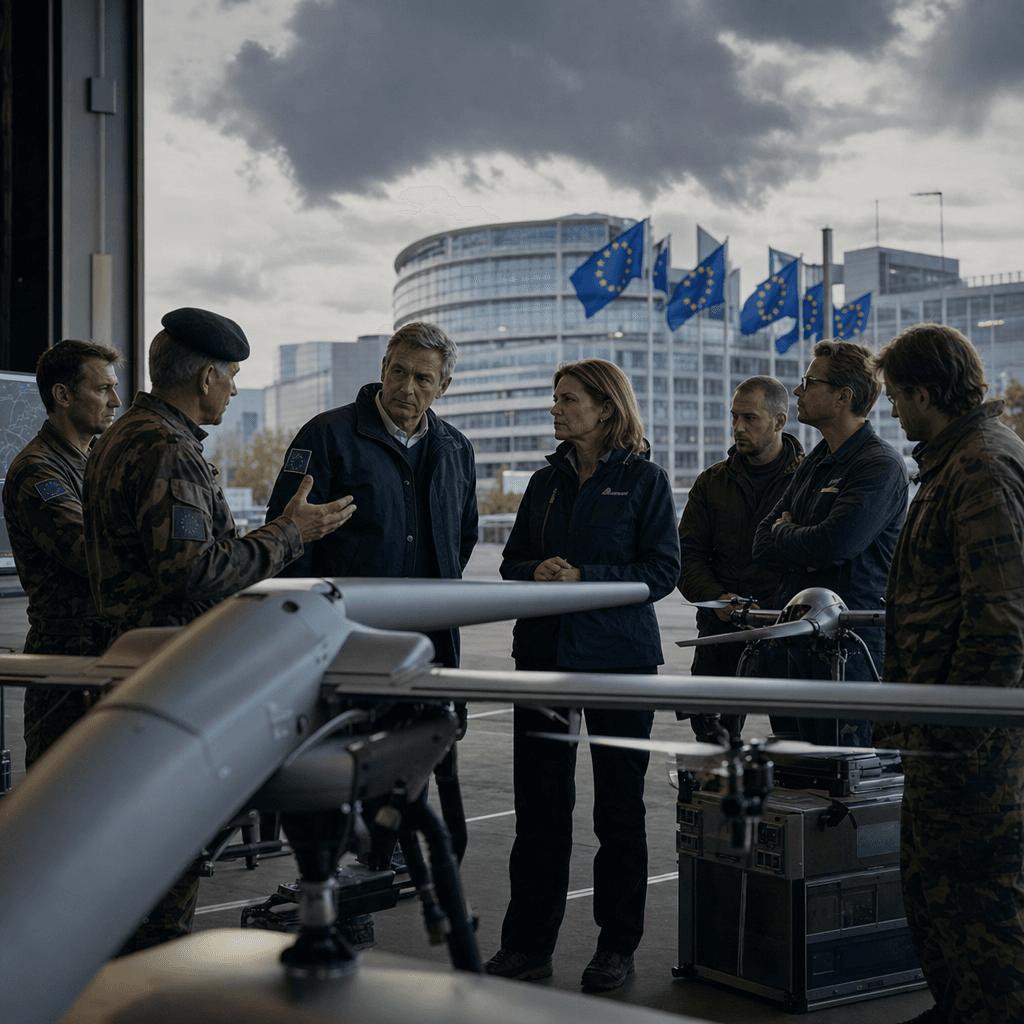
Europe’s drone race is really a sovereignty fight
Britain and four EU powers are trying to build cheap drones and interceptors fast — to cut reliance on US suppliers and reset the cost of air defence.
Europe’s military powers are moving to build the low-cost weapons that modern air war now rewards, and they are doing it for one reason: leverage. Britain, Germany, France, Italy and Poland have agreed to push jointly for cheap drones and interceptors under the E5 format, with the first systems meant to arrive within a year, according to BBC and
POLITICO. The political message is plain. Europe does not want to keep spending multimillion-euro missiles to shoot down drones that cost a fraction of that.
The real target is dependence, not just drones
This is bigger than battlefield adaptation. The Guardian’s framing of “defence sovereignty” is the key signal: Europe wants the ability to make and use its own weapons without relying on US firms, or on fragile supply chains that run through China and other non-aligned suppliers (The Guardian). That matters because air defence has become a political vulnerability as much as a military one. Every recent Russian drone incursion has reinforced the same lesson: the West’s current model is too expensive to scale.
The beneficiaries are clear. Start-ups and smaller defence-tech firms in Britain and across the EU now have a direct route into procurement, while national ministries can argue that spending at home is not just industrial policy but strategic risk reduction (BBC,
The Guardian). That should help companies that can produce autonomous systems quickly, especially those betting on rapid iteration rather than the long contract cycles of traditional primes.
The losers are just as obvious. US weapons makers lose a degree of market dominance if Europe succeeds in buying more locally designed systems. Traditional European contractors also face pressure: the new model rewards speed, modularity and lower cost, not just scale and heritage. And if the E5 states cannot agree on common standards, the initiative risks becoming another European procurement layer instead of a production base.
The constraint is supply chain control
Europe is trying to do this while also redefining what “sovereign” means. The Guardian reports that the UK is consulting on how much of a product must be British to count as sovereign, precisely because manufacturers cannot assume they can source critical parts and materials from China (The Guardian). That is the hard part. Cheap drones are only cheap if the electronics, explosives, batteries and software can be sourced and scaled reliably. Otherwise, sovereignty becomes branding.
This is why the E5 grouping matters. It gives London, Berlin, Paris, Rome and Warsaw a flexible mechanism to move faster than the larger EU machinery, while still signalling that Europe’s defence market is tilting toward joint procurement and shared industrial capacity (POLITICO). In practice, the group is trying to solve a strategic mismatch: Russia is using mass and cheapness; Europe has been using precision and expense.
What to watch next
The test is whether this produces contracts, not communiqués. Watch for three things: whether the E5 names a lead system, whether the EU and UK settle sovereignty rules that keep components out of hostile supply chains, and whether the first production orders land before year-end (BBC). If that happens, Europe will have started to rebuild deterrence on a cheaper industrial base. If it doesn’t, the continent will still be buying time with expensive missiles.
Discover more

International Relations
Pakistan's Key Role in US-Israel-Iran Meddle
Pakistan is seeking to mediate the US-Israel-Iran conflict, balancing high-stakes diplomacy against severe economic pressures and steep regional challenges.
Global Politics
Trump's Conflicting Messages on Iran War
Trump's mixed messages on Iran reflect a strategy of audience management, benefiting Tehran amid a complex geopolitical landscape.

Economics
Fed's Amex AML order puts correspondent banking on notice
Federal Reserve's Amex AML order requires board-level controls and a 90-day plan; OCC fined the bank $350 million over enterprise-wide deficiencies.

Conflict & Security
Guatemala: El Niño 2026–27 becomes regional security test
UNICEF: 25.8M children face El Niño risks in Latin America; Guatemala maps 188 municipalities for drought and food insecurity amid regional security test.