DR Congo, M23 Rebels Sign Humanitarian Pact
Montreux Protocol aims to aid civilians amid ongoing conflict
Model Diplomat7 min readCentral Africa
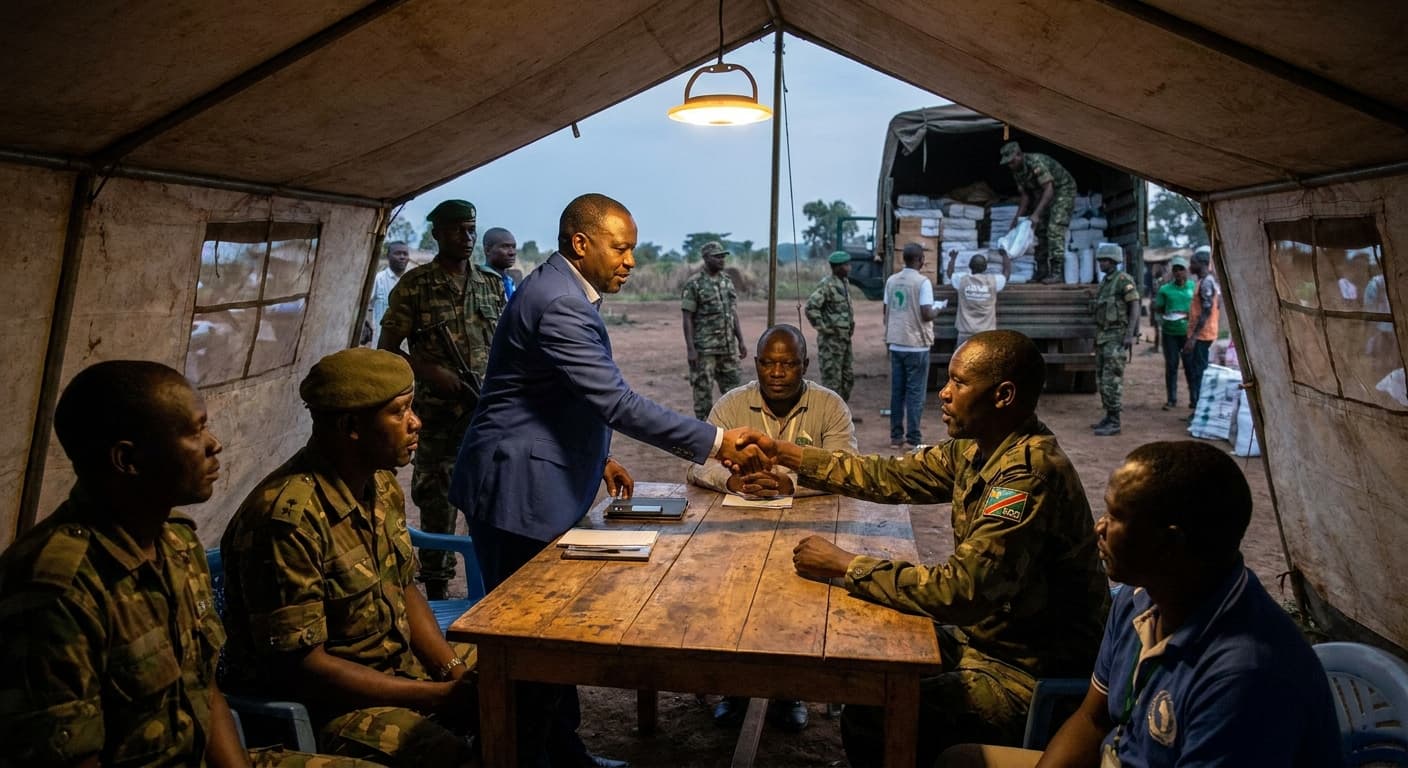
DR Congo, M23 Rebels Sign Humanitarian Pact — But Ground Truth Diverges
The Montreux Protocol commits Kinshasa and AFC/M23 to open aid corridors, release prisoners in 10 days, and monitor a ceasefire — while 1.49 million remain displaced in South Kivu alone.
The pact that mediators unveiled from Montreux on April 17, 2026 is the first legally textured deliverable of the Doha Framework — a Protocol on Humanitarian Access and Judicial Protection, a memorandum operationalising the Expanded Joint Verification Mechanism Plus (EJVM+), and a 10-day window for prisoner release. On paper, it is the most detailed civilian-protection instrument the Democratic Republic of the Congo and the Rwanda-backed AFC/M23 have ever signed. In practice, it is a document mediators are using to slow a war they cannot yet stop — designed less to end fighting than to buy the Trump administration's parallel minerals track more time before it collapses. That is the story worth reading.
What was actually signed at Montreux
Between April 13 and 17, negotiators from Kinshasa and the Alliance Fleuve Congo/March 23 Movement met in the Swiss Riviera with Qatar, the United States, Togo (the African Union's designated mediator), the AU Commission and the host government. The joint statement carried on ReliefWeb — released simultaneously by the U.S. State Department — commits the parties to comply with international humanitarian law, refrain from attacks on "objects indispensable to the survival of the civilian population" (food supplies, water and irrigation works, hospitals, schools, telecoms and energy infrastructure), and "facilitate rapid, unimpeded, safe and sustained humanitarian access."
Three concrete instruments are embedded in the pact. The first is the humanitarian-access protocol itself, still to be finalised as a stand-alone treaty. The second is a memorandum operationalising the Ceasefire Oversight and Verification Mechanism (COVM) via the EJVM+ of the International Conference on the Great Lakes Region — the body that will actually go and count violations. The third is a 10-day confidence-building step: prisoner releases and a commitment "not to target civilians and to facilitate medical care for the wounded and sick," as Al Jazeera reported from the signing.
Why now — and who is holding the pen
Read the timeline and the answer is not "the parties chose peace." It is that Washington needs the war contained.
M23 seized Goma in January 2025 and Bukavu the following month. In December 2025 — one week after Presidents Félix Tshisekedi and Paul Kagame ceremonially re-signed the Washington Accords under Donald Trump's gaze — the M23 took Uvira, the last major town on Lake Tanganyika. The BBC noted that the group withdrew only "under US pressure." On March 2, 2026, the U.S. Treasury sanctioned the Rwanda Defence Force and four of its top commanders — chief of staff Vincent Nyakarundi, defence-staff chief Mubarakh Muganga, Fifth Division commander Ruki Karusisi and special-operations head Stanislas Gashugi — for training, equipping and fighting alongside M23. On June 26 came sanctions on Kigali's state-owned gold refinery; on July 6, additional designations targeted Rwandan firms in the conflict-minerals chain, per
Al Jazeera.
The economic architecture Trump advertised at the White House — Congolese cobalt, coltan and copper flowing into U.S. and allied supply chains — cannot function while M23 controls the mines. As Foreign Affairs put it in July, "the Trump administration's approach to balancing its roles as mediator and economically interested party has begun to show its limits." The Rubaya coltan mine in North Kivu and the Ruzizi hydropower project near Bukavu — both flagged by the American Enterprise Institute's
Critical Threats Project as central to the U.S.-backed regional framework — sit inside AFC/M23's zone of control. The humanitarian pact is the interim scaffolding that keeps mediators in the room until territorial questions ripen.
The ground truth the pact has not yet touched
Here the paper and the province come apart.
The UN Office for the Coordination of Humanitarian Affairs' South Kivu situation report for the month following Montreux records 1.49 million internally displaced people in South Kivu as of April 30, 2026 — plus another 1.27 million IDPs in North Kivu per OCHA's
Nord-Kivu report. Between April 8 and 23 alone, more than 77,500 people were newly displaced in Kalehe territory as fighting continued in the Ziralo, Mubuku and Buzi highlands. OCHA also confirms that the 2026 humanitarian response plan is
funded for only 7.3 million of the 15 million Congolese in need.
The pact's own compliance record after 12 weeks is mixed. OCHA logged 29 incidents against humanitarian workers in April 2026 — down from 33 in March, but still roughly one aid-worker attack per day in the same month the protocol was signed. On March 11, a Congolese-army drone strike killed UNICEF worker Karine Buisset in M23-held Goma, as
Al Jazeera reported at the time. In late February, provincial governor Jean-Jacques Purusi told the Associated Press that
mass graves containing 171 bodies had been discovered in Uvira neighbourhoods vacated by M23.
Two other developments frame the pact's implementation. On June 26, 2026, Congolese Justice Minister Guillaume Andali filed suit against Rwanda at the International Court of Justice for violations of the Genocide, Racial Discrimination, Women's Rights and Torture conventions, the BBC confirmed. And in May,
The Economist obtained M23's own pitch to sell Congolese critical minerals directly to the Trump administration — a bid that "belies the rebels' weaknesses" while confirming that AFC/M23 sees the peace track as commercial as much as political.
Who benefits — and who is quietly losing
Qatar is the biggest structural winner of the past year. Doha now hosts what began as a bilateral U.S.-brokered process and — as the Institute for Security Studies documented — has effectively displaced the AU-led Luanda Process that Angola abandoned in March 2025. Togo's President Faure Gnassingbé holds the AU mediator title, but the operational room is Qatari, with Switzerland hosting the technical drafting.
Kinshasa gains a legal instrument to point at, plus U.S. sanctions on Rwanda that the Congolese foreign ministry called a "clear signal of support for sovereignty." Tshisekedi also gains political space at home: an Egmont Institute policy brief argues Washington's transactional embrace has weakened its willingness to publicly oppose a third Tshisekedi term when constitutional limits bind him in 2028.
M23 gains international legitimacy — a decade after the DRC branded it a terrorist group, its representatives now co-sign U.S. State Department joint statements. Rwanda loses on the surface: sanctioned military, sanctioned refinery, ICJ suit filed. But Kigali has held every strategic town M23 captured in 2025. As the Congressional Research Service noted in an In Focus brief, U.S. sanctions and CSPA designations pre-date Trump but have never dislodged Rwandan forces from eastern DRC.
The clearest losers are civilians in the Fizi, Uvira, Mwenga, Kalehe andRutshuru highlands, where OCHA reports armed clashes have restricted aid delivery through the entire post-Montreux period. And the Force Intervention Brigade of MONUSCO, whose mandate the Security Council extended to December 20, 2026 in Resolution 2808 (2025) — "on an exceptional basis and without creating a precedent" — is now formally paused from further disengagement even as South Africa announced in
January 2026 that it will withdraw its contingent after 27 years.
Diplomat View
The Montreux pact is not a peace agreement; it is an instrument mediators need to keep in reserve while they run out the clock on M23's territorial gains. Our call: the humanitarian protocol will hold as text and fail as practice through the third quarter of 2026, with aid access improving in a narrow corridor around Goma and Bukavu — where M23 wants international legitimacy and mining revenues — while highland South Kivu remains a live front. The 10-day prisoner-release commitment will be executed only partially; UN Security Council penholder France will use the July–October window to seek a stronger monitoring resolution before MONUSCO's December 20 mandate expiry.
Two conditions would force us to revise. First, if Rubaya's coltan production is credibly folded into a U.S.-monitored supply chain — the Trump administration's core commercial ask — Kigali and M23 gain the incentive to freeze territorial expansion, and the pact becomes real. Second, if U.S. sanctions escalate to Rwanda's central bank or aid conditionality, Kigali may test whether Washington will trade compliance for a lifting; that would give the COVM/EJVM+ operational teeth. Absent one of those levers, expect Montreux to be quoted by lawyers and ignored by commanders.
What to watch next:
- Prisoner-release verification. ICRC-facilitated transfers were still incomplete when the parties reconvened in Doha; a hard number should surface at the next Joint Oversight Committee meeting.
- UN Secretary-General's October 15, 2026 written report to the Security Council on ceasefire-mechanism operationalisation, per the
UNSC reporting cycle — the trigger for any pre-December mandate change.
- MONUSCO mandate renewal on December 20, 2026 and the ICJ's initial procedural response to Kinshasa's June 26 filing — the two documents that will set the legal architecture around whatever the fighting looks like on the ground next year.
The Bottom Line
The Montreux pact is a legal placeholder, not a peace: Kinshasa and AFC/M23 have committed on paper to humanitarian principles the U.S., Qatar and the AU need them to accept, while the Rwandan-backed rebels retain every major city they took in 2025 and 1.49 million people remain displaced in South Kivu alone. The document that matters is not the protocol — it is the Treasury designation list, and the next test is whether Washington's sanctions can move Kigali before the Doha Framework runs out of runway.
Discover more

Conflict & Security
Ebola Crisis Puts Health Workers at Risk
An Ebola outbreak in the DRC has infected more than 70 health workers, putting frontline staff at grave risk and threatening to undermine the response effort.
International Relations
DR Congo’s Ebola Surge Exposes State Weakness
DR Congo's Ebola outbreak has surged past 900 cases, exposing the governance failures and insecurity crippling the state's public health response on the ground.

Conflict & Security
Drone Warfare Killing Aid Workers at Unprec
Over 1,000 humanitarian workers killed in three years as cheap armed drones collapse legal protections. Gaza, Sudan, Ukraine, and DRC see deliberate targeting of aid convoys and hospitals with zero prosecutions.

Global
World Normalises Taliban as Afghan Women Eras
UN data shows Afghan women erased from public life as Russia recognises the Taliban, EU hosts officials in Brussels, and ICC warrants for gender persecution go unenforced.