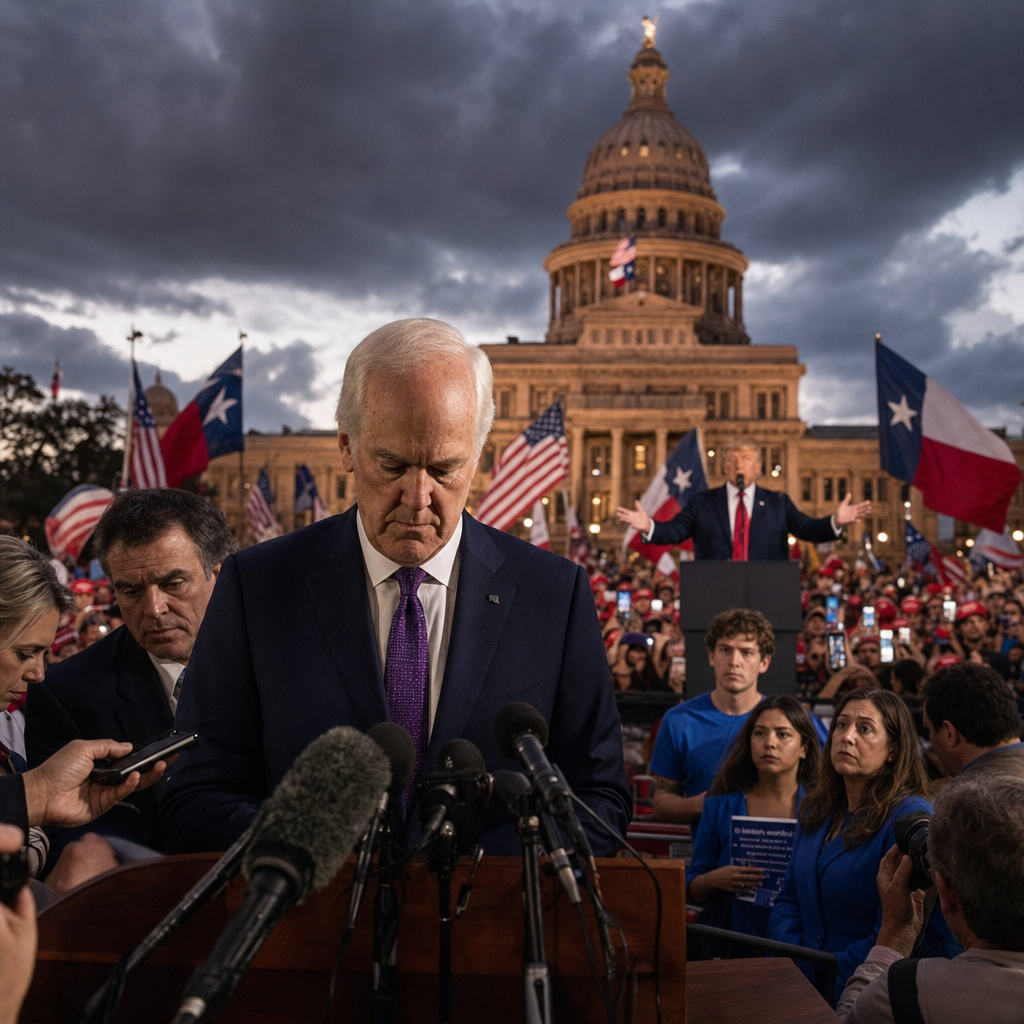
Cornyn Concedes; Trump’s Texas Takeover Deepens
Cornyn is trading personal defeat for party discipline, but Paxton’s win gives Trump-aligned Republicans a risky hold on a seat Democrats think is newly contestable.
Sen. John Cornyn’s decision to back the Republican ticket after losing Texas’s Senate runoff to Attorney General Ken Paxton is the immediate signal, but the power shift is the real story. Cornyn told supporters he has “always supported the Republican ticket” and “intends to do so again” in the general election, even as he acknowledged that “the voters of Texas…made their decision” ( The Hill). The move is designed to limit the damage from a brutal intraparty fight that ended with Trump’s late endorsement of Paxton and an open warning from Cornyn’s allies that the seat could now become easier for Democrats to target (
 Associated Press).
What Paxton’s win changes
Paxton’s victory matters because it converts a reliably Republican Senate seat into a more complicated general-election contest. In its live coverage, The New York Times said Republican leaders were already treating Paxton as a weaker nominee, warning that he could make the seat “more vulnerable to a Democratic upset in the fall” ( The New York Times). That concern is not abstract: Democratic nominee James Talarico has already framed the race as “The People vs. Ken Paxton” and moved quickly to welcome Cornyn voters (The Hill).
This is where the leverage now sits. Trump and the Paxton wing get a nominee who owes his victory to the MAGA base and a presidential endorsement. Democrats get a cleaner contrast: an embattled conservative prosecutor with ethics baggage versus a younger, better-funded challenger trying to nationalize the race. For Senate Republicans, the risk is simple: money that would have gone to defending seats in more competitive states may now have to be spent in Texas, exactly the outcome Cornyn warned about during the primary (Associated Press).
Why Cornyn’s concession still matters
Cornyn’s concession is about containment, not reconciliation. He did not mention Trump or Paxton by name in his remarks, which tells you this is a tactical surrender, not a political embrace (The Hill). He is trying to prevent the runoff from becoming a broader civil war inside Texas Republicans, where business conservatives, Senate leadership, and the Trump base are now pulling in different directions.
The immediate beneficiary is Paxton, who gets the optics of party unity without having to earn Cornyn’s supporters. But the deeper beneficiary may be Talarico, because every week Republicans spend re-litigating the primary is a week not spent defining the Democrat. Politico reported that Paxton’s win was already being treated as a “MAGA coup” while establishment Republicans warned it could make the seat a costly hold in November ( Politico).
What to watch next
Watch two numbers first: whether Cornyn’s donors and institutional allies actually move to Paxton, and whether Talarico converts GOP fatigue into crossover support. Then watch the spending gap. If national Republicans have to pour money into Texas to rescue Paxton, that is money not available in battleground states where the Senate majority may be decided. The next decision point is immediate: whether the NRSC and Senate leadership go from silent acceptance to active support, or keep Paxton at arm’s length heading into the fall.