California Chemical Tank Crisis Eases, But Evacuations Stay
The blast risk at a Garden Grove chemical tank has dropped sharply, but 50,000 evacuees, state powers and liability are still in play.
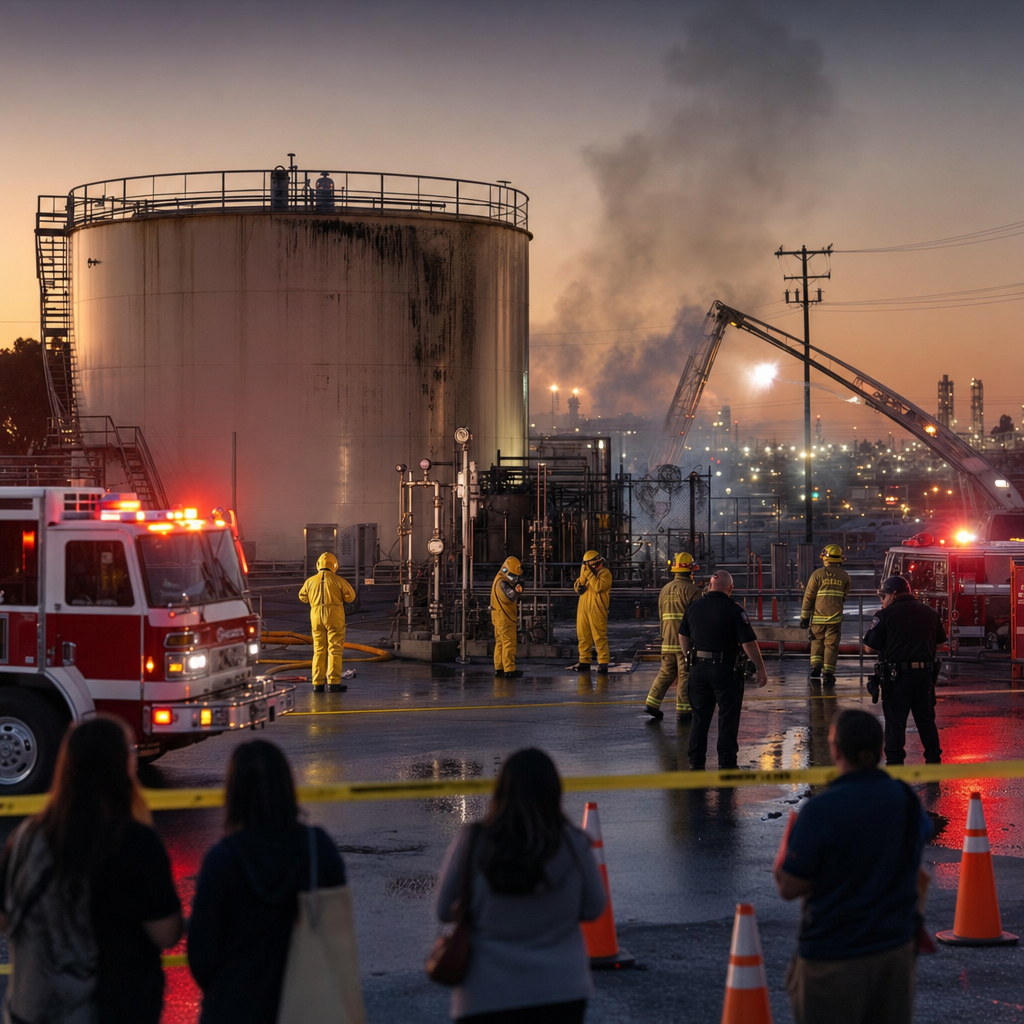
Emergency crews in Orange County say the worst-case explosion scenario has been ruled out after an overheated tank at GKN Aerospace in Garden Grove was cooled and a crack was found that appears to have relieved pressure, CNN reported Monday. The fire authority said the tank is no longer at risk of exploding, though officials stressed they have not eliminated every danger and are still working to fully stabilize the site ( CNN).
CNN).
The real leverage is now with responders, not the company
That matters because the crisis has shifted from an immediate mass-casualty threat to a control problem. The Orange County Fire Authority had spent days spraying water on the tank, monitoring temperatures with drones, and trying to prevent a rupture or ignition, after the pressurized vessel overheated and began venting vapors at the GKN Aerospace site, according to the Associated Press coverage carried by CBC ( CBC News / AP). A damaged valve system had limited crews’ ability to drain the chemical or relieve pressure, leaving cooling as the only practical option (CBC News / AP).
The leverage here sits with local and federal emergency managers, not the plant operator. If the tank stays stable, officials can gradually reopen the area and avoid a toxic spill into storm drains, creeks or the Pacific. If it does not, the same damage that lowered the explosion risk could still turn into a contained chemical release. That is why the incident is no longer about preventing a fireball; it is about containing a hazardous materials problem inside an industrial corridor.
Why this is a governance story, not just a hazmat story
The politics are straightforward: state and local officials absorb the blame if the response fails, while the company faces reputational and legal exposure if the tank’s condition or maintenance was deficient. Bloomberg reported that EPA chief Lee Zeldin said the most likely outcome was a low-volume release that could be monitored and contained, while Gov. Gavin Newsom declared a state of emergency for Orange County and sought federal help ( Bloomberg;
  The Globe and Mail / AP). That tells you who has the real burden now: emergency agencies coordinating across county, state and federal lines.
The broader lesson is about industrial risk in dense suburbs. The tank held methyl methacrylate, a chemical used in plastics manufacturing, at a facility surrounded by homes, schools and major infrastructure. Even with air monitoring showing no immediate dangerous levels, the evacuation orders have persisted for roughly 50,000 residents, which means the economic and political cost is already beyond the plant fence line (CBC News / AP; The Globe and Mail / AP). For a wider view of how local crises become state-power tests, see  United States and Global Politics.
What to watch next
The next decision point is whether the fire authority can confirm the tank is cooling steadily enough to lift evacuation orders. Watch for updated temperature readings, any new EPA assessment, and whether Newsom or the White House moves on a federal emergency declaration. The other signal is legal: if residents’ class-action claims against GKN Aerospace keep advancing, this will quickly become a liability case as much as a public-safety one (The Globe and Mail / AP).