China's Rare-Earth Squeeze on Japan
China halts rare-earth exports to Japan amid Taiwan tensions.
Model Diplomat7 min readAsia
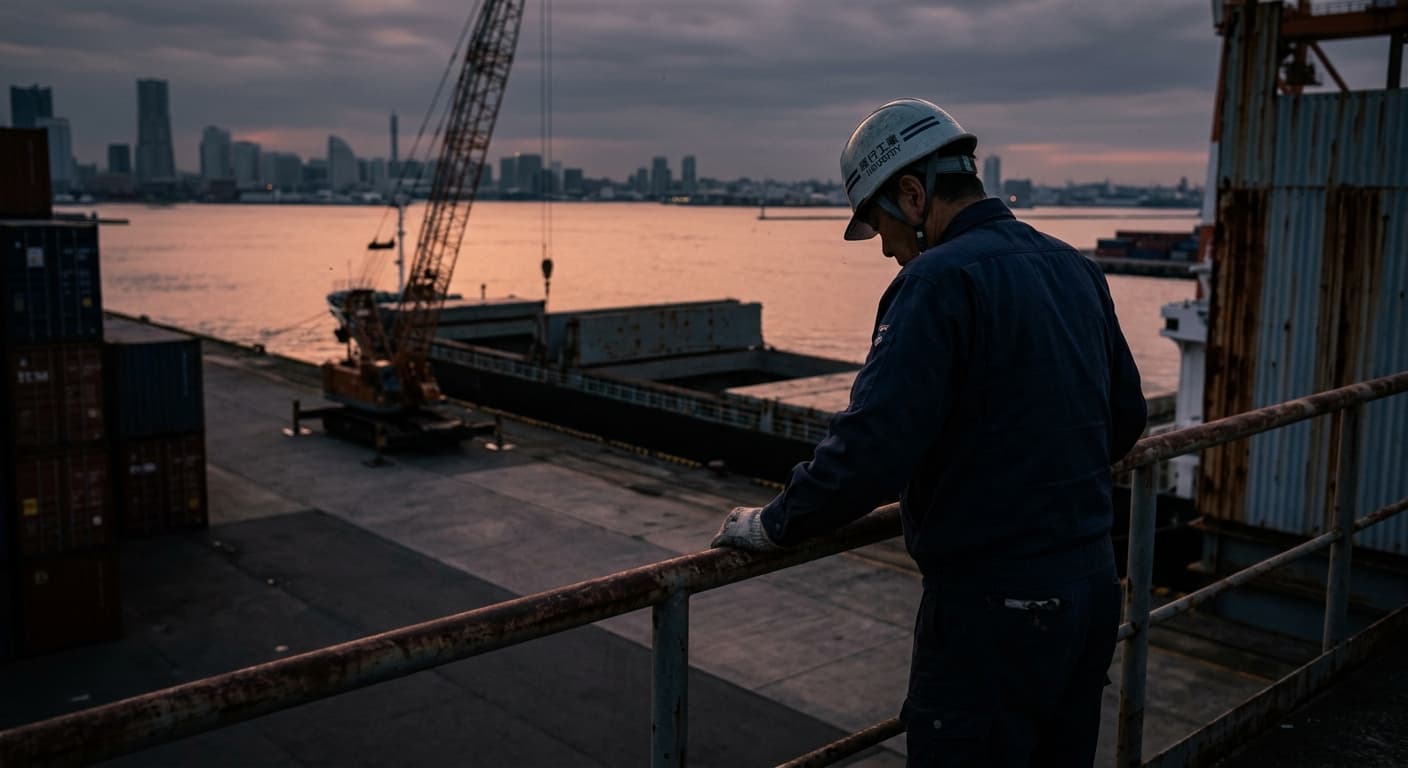
China's Rare-Earth Squeeze on Japan: Six Months of Zero Shipments
Chinese customs data show zero exports of dysprosium, terbium, yttrium and scandium to Japan since January 2026 — a targeted energy-security squeeze tied to Takaichi's Taiwan stance.
China has not shipped a single kilogram of unalloyed dysprosium, terbium, yttrium or scandium to Japan for six straight months, according to Chinese customs data compiled by Kyodo News on July 6, 2026 — a precision-targeted squeeze that turns Beijing's control of the world's heavy rare-earth supply into a foreign-policy instrument against a G7 ally for the first time. The story is not the shortage; it is that China has now openly linked mineral access to another country's position on Taiwan — a doctrine shift that reshapes every capital's assumptions about what "economic security" means for the clean-energy transition, defense industry, and semiconductor manufacturing.
The data: a selective, deniable embargo
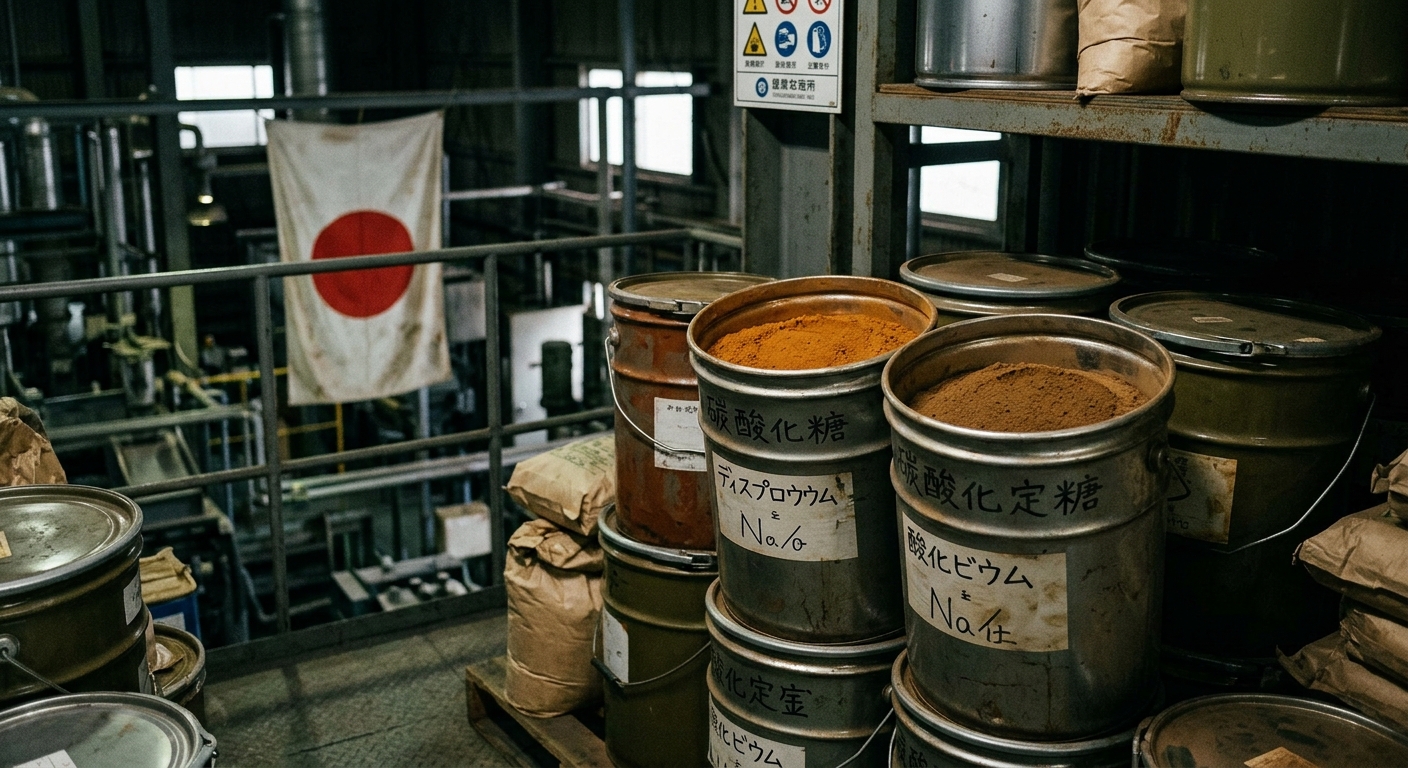
The Kyodo tally is the cleanest evidence yet that the export controls announced on January 6 by China's Ministry of Commerce (MOFCOM) are being enforced product-by-product, not merely written into regulation. Since January, Chinese customs recorded zero Japan-bound shipments of dysprosium and terbium — the two heavy rare earths without which high-performance neodymium-iron-boron magnets cannot function above 100°C, meaning no EV traction motors, no wind-turbine generators, no F-35-class actuators. Yttrium and scandium, essential to aerospace superalloys and jet-engine coatings, are also at zero. Molybdenum powder used in missile components has been stopped since January; selected tungsten items since February; certain gallium products across January–April; antimonial lead every month except February, as Kyodo News reported. Finished rare-earth magnet exports to Japan fell 35% month-on-month in May.
Crucially, this is more calibrated than 2010. Then, China imposed a de facto embargo after the Senkaku fishing-boat clash, denied it existed, and let customs delays do the work. This time, MOFCOM formalized it. The 6 January 2026 measures institutionalize rare-earth leverage inside a security-framed legal regime built on licensing and compliance reviews, as an RSIS Singapore analysis by Janet Fung notes — meaning "even firms producing for civilian markets may experience delayed orders." The
CSIS China Power Project calls the shift decisive: "this latest iteration ties export restrictions to the Taiwan issue," moving critical-minerals policy from trade retaliation to foreign-policy signaling.
Why Beijing pulled this lever now
The trigger is Prime Minister Sanae Takaichi's Diet remark of November 7, 2025, that a Chinese attack on Taiwan could constitute a "survival-threatening situation" for Japan, authorizing collective self-defense. Beijing demanded a retraction; Takaichi refused. As Brookings scholar Wu Xinbo wrote in
Brookings, "Beijing wants Japan — and other countries — to know" that any foreign hint at military involvement in a Taiwan contingency is "completely unacceptable." Rare earths are the credible threat that carries that message.
China's Foreign Ministry has not called it retaliation. MOFCOM's language, quoted verbatim in its January 6 announcement, is that the controls "safeguard national security and interests and fulfil international obligations such as non-proliferation," restricting only items that would "enhance Japan's military capabilities." That framing is deliberate — it mirrors U.S. export-control rhetoric and gives Beijing legal cover at the WTO. But the customs data betray the framing: molybdenum powder and antimonial lead have obvious defense uses; dysprosium and scandium are dual-use in the loosest sense, appearing in everything from Toyota hybrids to Airbus wing skins.
The escalation ladder is now visible. On February 25, MOFCOM added 20 Japanese entities to the dual-use blacklist — Mitsubishi Heavy Industries' shipbuilding arm, Kawasaki Heavy, the Japan Aerospace Exploration Agency, and the National Defense Academy, Al Jazeera reported. On June 29, another 20 firms were added, taking the total to 40 and pulling in Mitsubishi Electric subsidiaries and the National Institute for Defense Studies. In May, Chinese authorities detained two Fuji Electric employees over an alleged attempt to move rare-earth-related products out of the country — a signal to Japanese commercial staff on the mainland.
What Tokyo has, and what it does not
Japan is the world's largest importer of rare-earth metals: 5.2 million kilograms from China in 2024, or 63% of its total, per CSIS citing UN Comtrade. Its residual dependence on China for heavy rare earths — dysprosium and terbium above all — is closer to 90%, because Chinese processors sit on the only large-scale separation and metallization capacity outside a single Lynas line in Malaysia.
Japan's response has three moving parts, all pre-positioned since the 2010 shock:
Stockpiles. METI operates a strategic mineral reserve that industry officials estimate at roughly 60 days of consumption for the most exposed rare earths — enough to blunt the immediate shock but not a year-long freeze. Economy Minister Ryosei Akazawa told his January 9 press conference the government would "take the necessary measures, working in close coordination with the United States, the G7, and other relevant partners, in a resolute and calm manner."
Overseas offtake. In June, Australia's Lynas Rare Earths renewed its supply contract with Japan Australia Rare Earths B.V. (the Sojitz–JOGMEC vehicle) to deliver 7,200 tonnes annually of neodymium and praseodymium through 2038, according to the Lowy Institute. Australia and Japan followed with a joint statement earmarking A$1.67 billion for six critical-minerals projects, the
United States Studies Centre reported. JOGMEC has also signed an MoU with the Brazilian state of Goiás, where U.S. Ex-Im committed more than $500 million in February.
Deep-sea and downstream tech. In February, the Japan Agency for Marine-Earth Science and Technology retrieved rare-earth mud from 6,000 metres near Minami-Torishima Island. Commercialization is targeted for around 2030, the IISS writes, and even at scale the deposit will function "primarily as a high-cost strategic reserve for extreme contingencies rather than a commercially competitive substitute," as a peer-reviewed 2026 analysis in Resources Policy by Qinxue Wang
concluded.
None of this closes the gap in 2026. The IMF's April 2026 World Economic Outlook estimates Japan's rare-earth-linked value added at risk at 1.7% of GDP — the highest exposure of any G7 economy — driven by automotive, renewables and electronics manufacturing. The Fund concluded that Chinese REE dominance "creates potential choke points in the supply chain" and that heavy rare earths score 78 out of 100 on a substitutability index where 100 means no substitute exists.
The G7 answer — and its limits
At Évian on June 15–17, France's G7 presidency delivered what Ifri called an "unexpected success" on economic security. Leaders committed to cut G7 dependence on China for rare earths to no more than 60% by 2030, endorsed a Japan-led initiative on joint stockpiling, and created a non-binding G7 Critical Minerals Resilience and Production Alliance. Japan's Ministry of Foreign Affairs, in a
February 5 joint press statement with the U.S. State Department and the European Commission, had already committed to "border-adjusted price floors and trade policy coordination" — an explicit acknowledgement that non-Chinese mines cannot survive Chinese pricing without policy protection.
The uncomfortable arithmetic: China still controls roughly 69% of global mining and 85–90% of refining, per the Resources Policy study. Even the most bullish "central scenario" only brings China's mining share down to 50–55% by 2035. Beijing knows this. Its January customs data — enforcing a Japan-only freeze on heavy rare earths while general Chinese REE exports kept growing double-digits year-on-year in early 2026, per the IMF — demonstrate that Beijing can now cut off one country without spooking the wider market. That is the doctrine shift.
Diplomat View
The customs data change the analytical baseline. Until January, the working assumption among Japanese, European and U.S. planners was that Chinese export controls were a blunt trade instrument, most likely to be deployed against Washington in tariff fights. What Beijing has demonstrated in the first half of 2026 is a targeted, sustainable, country-specific squeeze — six full months of zero heavy-REE shipments to a single G7 ally, achieved without triggering global price spikes or WTO panels moving faster than politics. That is a more dangerous instrument than the 2010 embargo because it is calibrated: it hurts one target's defense and EV industries while preserving China's revenues from every other buyer.
The forecast: expect Japan's stockpiles to hold through Q4 2026, but expect the political effect to widen — Canberra, Berlin and Seoul will read this as evidence that a Taiwan-adjacent statement now carries measurable industrial cost. The forecast would revise if MOFCOM lifts the January 6 measures after a Takaichi walk-back (unlikely before autumn LDP elections) or if a Lynas/Iluka heavy-REE line comes online in Australia ahead of its 2027 schedule. If neither happens, the next escalation is Chinese licensing friction extended to Japanese-owned processors in Malaysia and Vietnam — the third-country nodes that until now Beijing has left alone.
What to watch next
- August 2026 customs release: Whether June and July Japan-bound heavy-REE exports remain at zero, or whether MOFCOM begins issuing selective licences as a de-escalation signal.
- APEC Shenzhen, November 2026: First scheduled Takaichi–Xi encounter since the November 2025 Diet remarks; a bilateral meeting (or its refusal) will price the political ceiling.
- G7 Critical Minerals Production Alliance milestone, Q4 2026: First project selections and any move toward binding price floors — the mechanism most likely to make non-Chinese heavy-REE mines bankable.
Read today's full |
Discover more
US Politics
House Ethics Committee Pushes Sexual Miscond.
The House Ethics Committee has shifted responsibility for sexual harassment settlement records to the Office of Congressional Workplace Rights, complicating disclosure efforts.

India
BJP's Misunderstanding of Women's Quota Needs
The BJP's linking of the Women Reservation Bill to delimitation risks delaying women's empowerment in India, misreading the aspirations of female voters.

India
Congress Accuses Modi of Stalling Women's Law
Congress accuses Modi of stalling women's reservation law by linking it to delimitation, revealing a deeper electoral strategy.

Conflict & Security
Drone Warfare Killing Aid Workers at Unprec
Over 1,000 humanitarian workers killed in three years as cheap armed drones collapse legal protections. Gaza, Sudan, Ukraine, and DRC see deliberate targeting of aid convoys and hospitals with zero prosecutions.