China’s Diplomatic Wins: Broad but Brittle
Xi's hosting of world leaders lacks substance.
Model Diplomat2 min readAsia
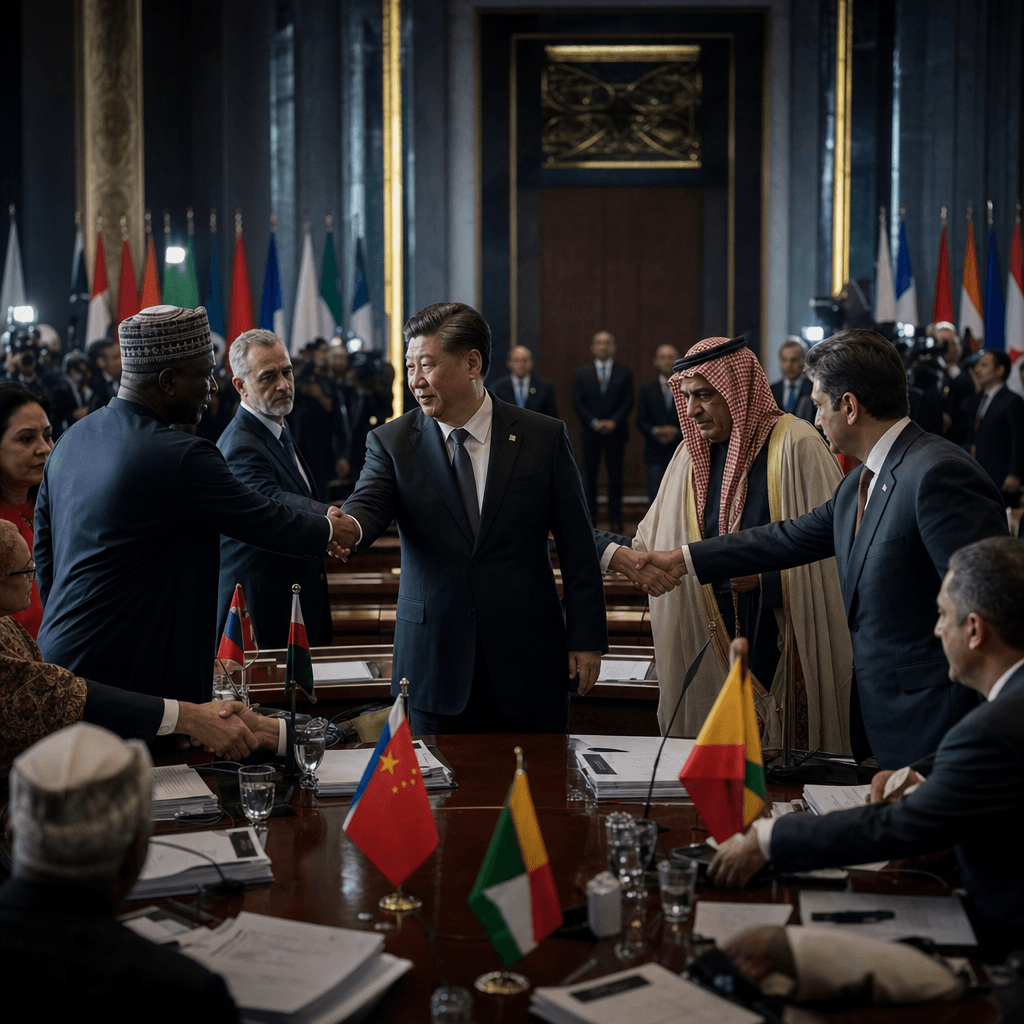
China’s diplomatic wins are broad — and brittle
Xi has made Beijing the stopover for rival leaders, but the deals are thin, the asks are light, and the leverage may not last.
China’s diplomatic edge right now is simple: it can host everyone and commit to almost nothing. The Economist says Xi Jinping has not left China since late October, yet “a dozen heads of state” have come to Beijing and been welcomed with polished protocol and national-pageantry optics (The Economist). That is not coalition-building in the classic sense. It is convening power — and for now, Xi is getting the photo-op dividend at very low cost.
The leverage is in the choreography
Beijing’s advantage is that it offers access without alignment tests. Washington’s latest summit with Xi produced no major breakthrough, but it did let Xi score points while conceding little, according to the Washington Post. The same pattern shows up with Russia: the
BBC reported that Putin’s visit after Trump’s was meant to signal that “all roads now lead to Beijing,” yet the talks yielded no big Russian gas pipeline approval and no sign that China was ready to underwrite Moscow’s war effort on Russia’s terms.
That is why the article’s argument matters. China is not buying loyalty; it is buying optionality. Foreign leaders come because Beijing is useful — for trade, for access, for crisis management, for symbolic balance against the United States. China, in turn, asks little beyond recognition of its centrality. For policymakers following Global Politics, the signal is clear: Beijing can still assemble the room even when it cannot deliver hard settlements.
Broad reach, shallow commitments
The gains are real, but they are not yet durable. The BBC noted that China has repaired ties with several US allies, including Australia, Canada and the UK, while Europe and others see value in dealing with the world’s second-largest economy and its dominance in manufacturing and critical minerals (BBC). That widens Beijing’s diplomatic map. It does not, by itself, create a bloc.
The weakness is that China’s recent diplomacy appears tailored to image management, not burden-sharing. The Economist’s core point — that Beijing “gives little back” — is the important one (The Economist). That approach works best when others want a meeting more than China wants an outcome. It works less well when someone demands enforcement, security guarantees, or a costly concession. On Ukraine, for example, Beijing’s refusal to openly pressure Moscow may preserve Russian dependence, but it also keeps Europe suspicious of China’s claim to even-handedness.
What to watch next
The next test is whether these visits produce binding agreements rather than staged communiqués. Watch for three things: any hard language on trade or technology, any movement on the long-delayed Russia-China gas corridor, and whether Europe responds more skeptically if Beijing continues to dodge Ukraine. If the coming summit season delivers only more protocol and no substance, China’s diplomacy will still look impressive — but its leverage will remain mostly theatrical.
Discover more
Global
Vindman's Call for U.S. Response to China
Rep. Eugene Vindman highlights the urgent need for a U.S. strategy to counter China's gray-zone tactics against Taiwan, emphasizing economic stakes.
Global
Taiwan's Civil Defense: Deterrence Strategy
Taiwan's National Security Council emphasizes civil defense drills as a deterrent against Chinese military aggression, amid budget cuts and rising tensions.
Global
Taiwan Premier's Historic Tokyo Visit
Taiwan Premier Cho Jung-tai's visit to Japan breaks a 54-year precedent, signaling a shift in Indo-Pacific dynamics amid China's coercion.

India
Lipulekh Pass Reopens: India-China Trade
India and China reopen the Lipulekh Pass for cross-border trade, signaling a cautious thaw in relations after years of frozen frontier and diplomatic tensions.