Taiwan Premier's Historic Tokyo Visit
Cho Jung-tai's trip signals a shift in Indo-Pacific dynamics.
Model Diplomat8 min readAsia
China's 'Evil Designs' Rebuke: Taiwan Premier's Tokyo Trip Redraws Indo-Pacific Lines
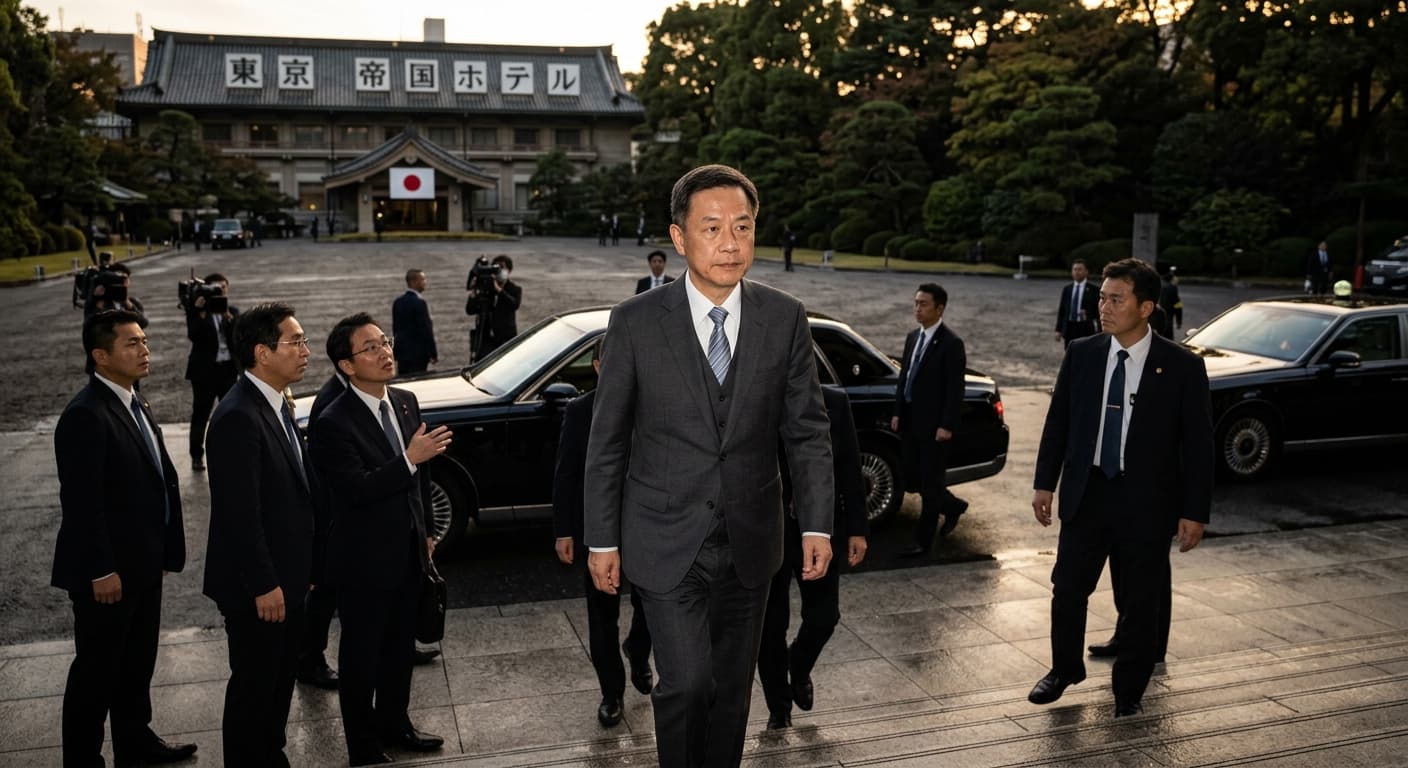
Cho Jung-tai's March 7 Tokyo Dome visit was the first by a sitting Taiwan premier to Japan since 1972 — a symbolic breach Beijing met with fury and threats of retaliation.
Taiwan Premier Cho Jung-tai flew into Haneda on March 7, 2026 to watch a baseball game — and became the first sitting head of Taiwan's cabinet to set foot on Japanese soil in the 54 years since Tokyo switched recognition to Beijing. China's Foreign Ministry called it a "despicable" act "with unspeakable motives" and warned Tokyo it would "pay the price." The trip works because Beijing's four-month pressure campaign against Prime Minister Sanae Takaichi has visibly failed — Japan is calling China's bluff on Taiwan, and Cho's WBC excursion is the quietest, most deniable way to prove it. That is the story that matters for Global Politics: the Takaichi–Xi standoff has re-priced how much sovereignty Beijing can extract from Tokyo on the Taiwan question, and the answer is less than it was a year ago.

What happened, and why the choreography matters
Cho departed Songshan Air Base on a Republic of China Air Force VIP jet in the early hours of March 7, cleared Haneda, watched Taiwan beat the Czech Republic 14–0 at the Tokyo Dome, and was back in Taipei before midnight, per BBC Chinese. He was accompanied by security and personal staff whose airfares Cho paid himself; his cabinet spokesperson said the trip was processed as an ordinary out-of-country application. Chief Cabinet Secretary Minoru Kihara told reporters on March 9 that Cho had no contact with Japanese officials and that Tokyo had "no comment" on a private visit, as
BBC Chinese reported citing Sankei Shimbun.
The choreography is the message. In 2022 then–Vice President Lai Ching-te attended Shinzo Abe's funeral, the highest-ranking Taiwanese to visit Japan since 1972, according to the Council on Foreign Relations. Vice Premier Cheng Wen-tsan followed in 2023, and Foreign Minister Lin Chia-lung in 2024 — all badged as "private" travel. Cho is a rung higher: under Taiwan's constitution the premier is the third figure of state, after the president and vice president. Chengchi University professor Lee Shih-yueh told BBC Chinese the visit signals "a high degree of mutual trust" and marks "a new breakthrough in the level of interaction." That was the tripwire.
Beijing did not miss it. Vice Foreign Minister Sun Weidong summoned Japanese Ambassador Kenji Kanasugi by phone late on March 7. On March 9, spokesperson Guo Jiakun escalated at his regular briefing, an exchange preserved on the ministry's own transcript at the PRC Ministry of Foreign Affairs:
"With unspeakable motives, Cho Jung-tai sneaked into Japan to carry out provocation for 'Taiwan independence.' This is a rather despicable move… The Japanese side will pay the price for emboldening the provocations and shall bear all responsibility for the consequences of such action."
Foreign Minister Wang Yi went further at the parliamentary "two sessions" press conference on March 8, asking rhetorically what "qualification" Japan had to "meddle" in Taiwan and questioning any Japanese right to exercise "self-defence" over the strait, per BBC Chinese. The following day's briefing showed Beijing extending the framing to Taiwan's overseas debt plans, with Guo denouncing what he called "malignant schemes" by the DPP, according to the
PRC Ministry of Foreign Affairs.
Beijing's leverage is thinning, and Tokyo knows it
The rhetoric is louder than the leverage. Since Takaichi told the Diet on November 7, 2025 that a Chinese blockade of Taiwan could constitute a "survival-threatening situation" — the legal trigger under Japan's 2015 security legislation for collective self-defence — Beijing has run the most sustained coercion campaign it has attempted against a G7 country in a decade. It has restricted rare-earth exports, banned Japanese seafood again, cancelled Japanese films and concerts, filed protest letters at the United Nations, and, per NPR, coordinated tools "political, economic and cultural." On June 29, 2026 it added dozens of Japanese entities to its export-control list,
Al Jazeera reported. Beijing's embassy in Tokyo told Chinese citizens on November 14, 2025 to "avoid travelling to Japan in the near future," per
Al Jazeera.
The effect on Japan's economy has been narrower than Beijing hoped. Chinese tourist arrivals collapsed from 716,700 in October 2025 to 330,000 in December 2025 — but total inbound tourism spending in Japan rose 16% year-on-year to $60.1 billion in 2025, according to a CSIS analysis, because the weak yen drew replacement visitors from Taiwan, South Korea, the United States and Hong Kong. Sumitomo Mitsui economist Ryota Abe told
Al Jazeera that even a one-third collapse in Chinese arrivals would clip Japanese GDP by only 0.1 to 0.2 percentage points. Isetan Mitsukoshi's near-12% single-day fall in mid-November has since been recouped as the market absorbed the ceiling on Chinese pain-inflicting power.
Politically, coercion boomeranged. Takaichi called a snap election and, on February 8, 2026, her Liberal Democratic Party took 316 of 465 lower-house seats — the party's biggest majority since 1955 — as confirmed by Al Jazeera. She has since pledged to bring defence spending to 2% of GDP two years early and to complete a revision of Japan's National Security Strategy this year,
BBC News reports. Fudan University's Wu Xinbo, writing for
Brookings, concedes the campaign has "angered the Japanese public" and hurt Chinese airlines and tour operators alongside Japanese department stores — "as was the case after Japan released the treated water," he adds, "China eventually should calm its anger and halt its futile protest." That is a Chinese scholar effectively conceding the coercion cycle has diminishing returns.
That is the backdrop against which Cho stepped off his plane. The visit was calibrated to be legally deniable under Japan's 1972 framework — Tokyo "fully understands and respects" the PRC's position that Taiwan is part of China, per the Japan-China Joint Communique at Japan's Foreign Ministry — while politically visible enough to demonstrate that Beijing's coercion menu is exhausted.
The historical parallel and the domestic backlash
The 1972 precedent is not the only one worth reading. In 2005, then–ROC Vice President Lien Chan travelled to Beijing; in 2015, then-President Ma Ying-jeou met Xi Jinping in Singapore. Both were normalised inside months. What is happening now is the mirror image: a sitting Taiwanese cabinet head is normalising travel to Japan without Beijing being able to price it in. KMT chair Cheng Li-wun's own high-profile Beijing trip in April 2026 — she laid a wreath at Sun Yat-sen's mausoleum in Nanjing and met Xi — was intended, Al Jazeera reported, to reset cross-strait dialogue. Cho's Tokyo detour, coming a month earlier, denied the KMT the framing that only its channel to Beijing can lower temperatures.
Domestically, that is exactly why the KMT is furious. Party secretary-general Lin Pei-hsiang warned that if a "private holiday charter to watch baseball" becomes precedent, any minister could henceforth conscript a military-civilian dual-use tarmac and a state carrier under the same fig leaf, per BBC Chinese. The Taiwan People's Party pressed the same procedural question about the Songshan Air Base departure. The Presidential Office defended the trip as within existing rules, and Karen Kuo — Presidential Office spokesperson — has separately framed Beijing's Japan campaign as a "grave danger to security and stability in the Indo-Pacific," per
Al Jazeera.
The subtle winner in Taipei is Lai Ching-te. His DPP has now demonstrated that its "raise the profile, strengthen the military" playbook, which the party has run since 2016 as noted by Al Jazeera, can produce concrete diplomatic gains without waiting on Washington. That reframes the November 2026 local elections and the 2028 presidential race, in which the DPP has been vulnerable on defence-spending stalemate.
The loser is China's grey-zone playbook, not just its rhetoric
Beijing's coercion doctrine on Taiwan works on an implicit escalation ladder: rhetoric, then travel and trade curbs, then export controls, then military drills. Against Lithuania and against South Korea in the THAAD dispute, the ladder proved credible because the target had asymmetric exposure to Chinese demand. Japan is different. China is Japan's second-largest export market at roughly $125 billion in 2024 per UN Comtrade, Al Jazeera noted, but Tokyo is China's third-largest trading partner and the supplier Beijing cannot easily replace on precision equipment and advanced-node semiconductor tooling. The coercion is symmetric; the political cost is not.
That is why Guo Jiakun's warning that Japan "shall bear all responsibility" reads as ceiling-signalling rather than escalation. Tsinghua University's Zhou Bo told NPR that "given the disparity of military strength… the tail is wagging the dog" — a tell that Beijing sees itself, not Tokyo, as the party losing narrative control. Kiyoteru Tsutsui of Stanford's Shorenstein Center told
BBC News that further pressure "could only make [Takaichi] stronger domestically," so Beijing may in fact rein in the intensity. Cho's visit tests whether that logic holds when a Taiwanese premier — not just a former official — is the trigger.
What to watch
- Chinese military activity. Guo Jiakun on March 9 tellingly deflected a question about a reduction in PLA circumnavigation flights of Taiwan over the previous ten days, saying only "this is not a diplomatic matter," per the
PRC Ministry of Foreign Affairs. Watch whether that restraint continues or reverses in July drills.
- Rare earths and critical minerals. A US–Japan–EU critical-minerals framework is expected in "the coming weeks," per Bloomberg's question at Beijing's
- Trump's Beijing visit and a possible Taiwan arms package. Bloomberg has reported a US arms package for Taiwan is ready for President Trump's approval "right after his trip to China," a claim Beijing addressed at the same briefing. Any package signed within weeks of Cho's Tokyo trip will fuse the Japan-Taiwan and US-Taiwan tracks in Beijing's calculus.
- Taiwan's local elections in November 2026 and the 2028 presidential race. Whether the DPP can convert Cho's symbolism into votes, and whether the KMT's Cheng-Xi channel gains traction, will determine if Cho's precedent hardens or is walked back.
Diplomat View
The takeaway is narrow and falsifiable: Beijing has lost the ability to make Japan pay a proportionate political price for informal Taiwan engagement, and Cho's visit is the demonstration effect. The evidence sits in three numbers — Takaichi's 316 seats, Japan's $60.1 billion inbound tourism revenue in 2025, and the CSIS-documented halving of Chinese arrivals without a corresponding hit to Japanese GDP. The forecast would revise if any of three conditions flips: a PLA live-fire exercise inside Japan's exclusive economic zone near Yonaguni within 90 days; a Trump-Xi deal that includes explicit US pressure on Tokyo to freeze Taiwan-facing visits; or a Chinese export-control action that measurably disrupts Japanese semiconductor equipment shipments to non-Chinese customers. Absent those, expect Taiwan's cabinet-level "private" travel to Japan to normalise within 18 months, and expect the next Beijing rebuke to sound louder — precisely because it will mean less.
The Bottom Line
Beijing's "evil designs" broadside is the sound of leverage running out. Cho Jung-tai's baseball trip is the first sitting-premier visit to Japan since 1972 because Takaichi's landslide, Japan's diversified tourism base, and the exhaustion of China's coercion menu made it survivable. If the pattern holds, the Taiwan-Japan relationship will migrate from "informal" to "quietly official" without a treaty ever being signed — and the Indo-Pacific security map will have shifted by consent, not by crisis.
Discover more
India
Rajnath Singh's Durga Squad for 2026 Polls
Rajnath Singh's Durga Squad promised women's safety in Bengal but has since disappeared from the agenda, revealing BJP's true priorities.
US Politics
House Ethics Committee Pushes Sexual Miscond.
The House Ethics Committee has shifted responsibility for sexual harassment settlement records to the Office of Congressional Workplace Rights, complicating disclosure efforts.
India
BJP's Misunderstanding of Women's Quota Needs
The BJP's linking of the Women Reservation Bill to delimitation risks delaying women's empowerment in India, misreading the aspirations of female voters.
Conflict & Security
Guatemala: El Niño 2026–27 becomes regional security test
UNICEF: 25.8M children face El Niño risks in Latin America; Guatemala maps 188 municipalities for drought and food insecurity amid regional security test.