Taiwan's Civil Defense: Deterrence Strategy
Taiwan's drills seen as deterrence amid rising tensions with China.
Model Diplomat7 min readAsia
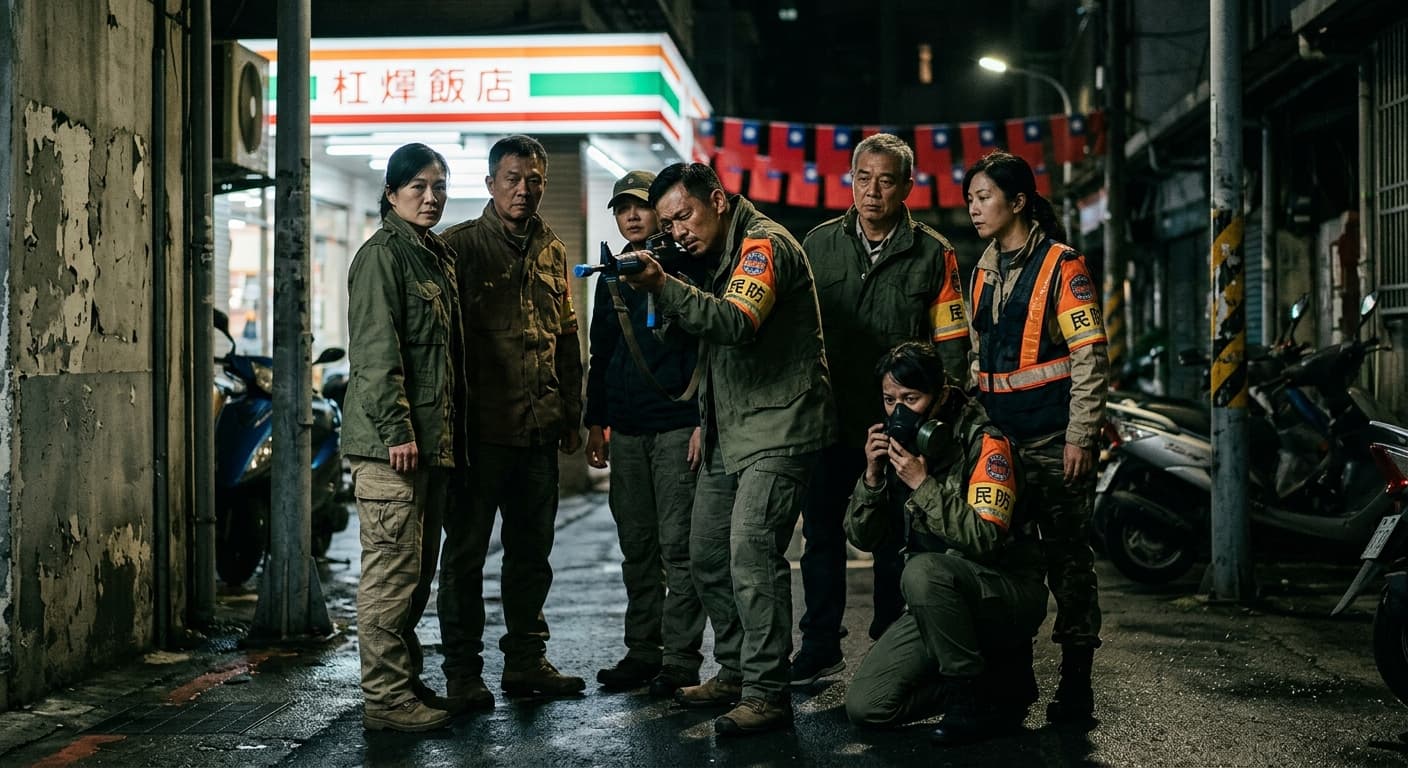
Taiwan's readiness gamble: civil defense as deterrent, not provocation
Taiwan's top security official says drills and resilience are deterrence, not provocation — as Beijing's naval tempo rises and Taipei's own legislature cuts the drone budget.
Taiwan's National Security Council Deputy Secretary-General Lin Fei-fan told a Taipei forum on July 7, 2026 that whole-of-society preparation is deterrence itself — the argument being that a Taiwanese population drilled into muscle memory, plus a 3.32%-of-GDP defense budget, raises the price of a Chinese assault enough to prevent one. The claim matters because it inverts the debate that has dominated cross-Strait analysis for two years: readiness is not a hedge against invasion, it is the strategy to prevent it. And the biggest obstacle to that strategy sits not in Beijing but in Taipei's own opposition-controlled Legislative Yuan, which sliced roughly a third off President Lai Ching-te's flagship special defense budget in May.
Speaking at the Resilient Taiwan Forum, Lin, who oversees the government's whole-of-society resilience program, was blunt about who is provoking whom, according to a Taipei Times report of the speech relayed by Reuters. "All of China's preparations have one clear goal — military aggression and external expansion," he said, adding that Taiwan does not fly a single aircraft or sail a single warship into the mainland's airspace or waters. The
Straits Times carried the same remarks. Lin's warning against Ukraine-style complacency — "If we do not act today, strength will not suddenly appear tomorrow" — is the operative sentence.
The pressure Lin is answering
Lin's speech landed in a specific tactical moment. Taiwan's Ministry of National Defense reported on July 6 that it is tracking an "upward trend" in Chinese naval movements as the peak PLA exercise season opens, according to Reuters via Bilyonaryo. The aircraft carrier Liaoning returned to Qingdao on June 23 after a 40-plus-day West Pacific deployment — the PLAN's longest carrier sortie beyond the first island chain to date, per the
American Enterprise Institute's weekly tracker. On June 5, a Chinese Coast Guard cutter entered restricted waters around Taiwan's Pratas Islands; a survey ship followed the next day, part of a pattern the
Observer Research Foundation counts as 42 incursions since February 2025.
The macro trend is starker. According to Taiwan's National Security Bureau, cited by NPR, 2025 saw a record 3,570 PLA aircraft incursions into Taiwan's surrounding airspace. The Center for Strategic and International Studies' Futures Lab reported in its
Geometry of Coercion index that between 2020 and 2025 the daily average of distinct China Coast Guard vessels in Taiwan's near waters rose more than 500%. Its companion analysis noted the
Liaoning and Shandong spent a combined 58 days outside the first island chain in 2025, nearly double 2024, launching an estimated 1,680 sorties.
That is the pressure Taiwan's civil-defense architecture is now being tuned against — and it is why Lin frames the debate around timing, not principle.
The doctrine: from porcupine to society
The whole-of-society defense resilience concept is not new rhetoric. Lai formalised it on September 26, 2024, chairing the first meeting of a presidential-level committee that meets quarterly with NGOs, businesses, religious groups and academic experts, per a Brookings analysis by Ryan Hass. The committee is organised around five pillars: civilian training, strategic stockpiles, critical infrastructure, medical and welfare continuity, and information and financial networks. It has an operational rhythm — tabletop drills, pillar-by-pillar live exercises, and civilian integration into the Han Kuang war games.
Lin himself set out the doctrine in Foreign Affairs in October 2025. During Han Kuang 2025, he wrote, tanks moved through urban Taipei, more than 20,000 reservists were mobilised, weapons were transported through metro tunnels, and underground parking lots served as bomb shelters. The exercise scale-jumped again in July 2025: a 10-day live-fire drill, 22,000 reservists — roughly 50% more than the previous year — plus concurrent "Urban Resilience" exercises that halted traffic and shuttered shops for 30-minute intervals in major cities, according to the
BBC. This year, an Immediate Combat Readiness Exercise ran June 22–26 as a precursor to Han Kuang 2026, which the
AEI expects in August.
The strategic bet is legible: turn Taiwan into what US de facto ambassador Raymond Greene, in a July 1 speech, called a "hornet's nest" of drones and hardened civilian infrastructure, per Al Jazeera. If Beijing cannot reasonably plan for a quick, low-casualty seizure, the theory says, it will not attempt one.
The internal front: where the strategy is losing
Here is where Lin's speech is doing political work most foreign readers miss.
On November 25, 2025, Lai proposed a NT$1.25 trillion (roughly US$40 billion) eight-year special defense budget on top of a regular budget of NT$949.5 billion — 3.32% of GDP — targeting 5% by 2030, per Al Jazeera. The Ministry of National Defense's daily
PLA Activity bulletins have made the threat legible in near-real time. But the opposition Kuomintang (KMT) and Taiwan People's Party (TPP), which together control the Legislative Yuan, blocked the special budget at least eight times between December 2, 2025 and late January 2026,
NPR reported.
On May 8, 2026, the legislature finally passed a stripped TPP-authored version worth NT$780 billion — roughly a 40% cut, according to BBC Chinese. What survived: US Foreign Military Sales items already approved, including a US$11 billion Trump-administration package notified to Congress in December 2025. What was cut: five committed-procurement projects worth NT$250 billion covering domestic drone mass-production, unmanned surface vessels, an AI-assisted command-and-control system, and the multi-layer T-Dome air-defense integration. The Council on Foreign Relations called the impasse a case of
Taiwan's political polarization playing into China's hands. The Ministry of National Defense responded on June 18 with a smaller NT$210 billion supplementary package aimed at surveillance and unmanned surface drones, per
Al Jazeera.
Lin's "not provocation" framing is aimed as much at Taipei's own swing voters and undecided KMT-leaning centrists as at any foreign audience. The Institute for National Defense and Security Research's March 2026 survey found 62% of Taiwanese respondents support the special defense budget and 58% agree with the framing that "investing in defense is investing in peace." That is the sentiment ceiling Lin is trying to convert into legislative durability before Han Kuang 2026 and before the November local elections.
The Indo-Pacific reframe
Read against the wider region, Lin's speech fits inside a coherent — if fragile — Indo-Pacific realignment.
The RAND Corporation argued in 2025 that civilian resilience is where Taiwan is furthest behind and where marginal investment pays the highest deterrence dividend. The
CFR heard Rush Doshi testify to the Senate Foreign Relations Committee on November 20, 2025 that Beijing is running the "fastest military buildup in modern history" and Washington needs to move faster on arms sales, contingency planning and blockade-scenario preparation. The
Brookings Institution noted in March 2026 that Lai's political capital to push the 5%-of-GDP target through is directly tied to how visibly civil-defense drills demonstrate that spending is used, not banked.
South of the Strait, Japan's own doubling of defense spending, the Philippines' hardening of Second Thomas Shoal positions, and Australia's response to unannounced Chinese live-fire drills in the Tasman Sea in early 2025 — all cited by Lin in Foreign Affairs — make Taiwan's civil-defense posture legible as one node in a distributed deterrence architecture rather than a solo provocation. That is the diplomatic reading Lin wants foreign chancelleries to take home. It is not obvious he will get it: the Trump administration has publicly linked Taipei's willingness to pay for its own defense to Washington's own commitments, per NPR's January 2026 reporting, turning every Legislative Yuan cut into a signalling problem in Washington as well as Beijing.
What to watch next
- August 2026 — Han Kuang 42. Taiwan's largest annual war games move to August this year, per
AEI. Scale, reservist mobilisation numbers, and the depth of civilian integration in Urban Resilience drills will be the readiness benchmark.
- September 2026 — supplementary NT$210 billion drone package vote. The MND's June proposal for surveillance and unmanned surface vessels goes back to the Legislative Yuan. A second KMT/TPP cut would gut Taipei's asymmetric-warfare pivot.
- November 2026 — Taiwan local elections. The KMT chairperson's rejection of Lai's spending plans will be tested at the ballot. INDSR's March survey shows 62% special-budget support: whether that translates into seats will shape 2027 defense-budget politics.
- Late 2026 — Liaoning/Shandong redeployment window. If China sustains the 40-plus-day carrier deployment tempo established this summer, CSIS's blue-water metric will confirm the PLAN's move to a permanent presence beyond the first island chain, hardening the blockade scenario US IndoPacom Commander Samuel Paparo has warned about.
Diplomat View
The defensible thesis is this: Taiwan's readiness posture will hold as rhetoric through 2027, but whether it holds as deterrence depends on a Legislative Yuan vote, not a PLA order of battle. Lin Fei-fan's July 7 speech is best read as an internal political manoeuvre wearing a strategic-communications jacket — an attempt to lock the KMT and TPP into a framing where opposing drone-production budgets equals endorsing Beijing's narrative. If the supplementary NT$210 billion package passes intact this autumn and Han Kuang 42 mobilises civilians on the 2025 scale or larger, Lai's whole-of-society doctrine crosses from concept into operational deterrence. If either fails, Beijing's calculation shifts — not because Taiwan lacks the plan, but because it lacks the political will to fund it. The forecast revises down the moment two conditions co-occur: another Legislative Yuan cut exceeding 20% of the drone-related budget, and a sustained (60+ day) dual-carrier PLAN deployment beyond the first island chain. Both are plausible before year-end.
The Bottom Line
Taiwan's civil-defense push is not a hedge against Chinese invasion — it is the deterrent itself, and it is being fought over in Taipei's parliament more than in the Taiwan Strait. Lin Fei-fan's July 7, 2026 speech reframed readiness as strategy, but the strategy will be judged by whether Lai's opposition-controlled legislature funds the drones, not by whether Beijing accepts the framing. The next 90 days — Han Kuang 42, the NT$210 billion vote, and the carrier deployment tempo — will tell you whether Taiwan's readiness doctrine is a deterrent or a slogan.
Discover more

US Politics
White House Pressures Congress for Crypto Leg
The Trump administration's push for the CLARITY Act aims to reshape crypto regulation, impacting trillions in market value and the Trump family's wealth.
Global Politics
Xi Jinping Calls China-Russia Ties 'Precious'
Xi Jinping's description of China-Russia ties as 'precious' reflects a strategic imbalance, with Beijing dictating terms in the partnership.
India
Women’s Reservation in India
India's 33% women's reservation law is enacted but won't take effect until after 2029 due to political setbacks and census delays.

Conflict & Security
Guatemala: El Niño 2026–27 becomes regional security test
UNICEF: 25.8M children face El Niño risks in Latin America; Guatemala maps 188 municipalities for drought and food insecurity amid regional security test.