Lipulekh Pass Reopens: India-China Trade
India and China resume border trade after six years.
Model Diplomat3 min readAsia
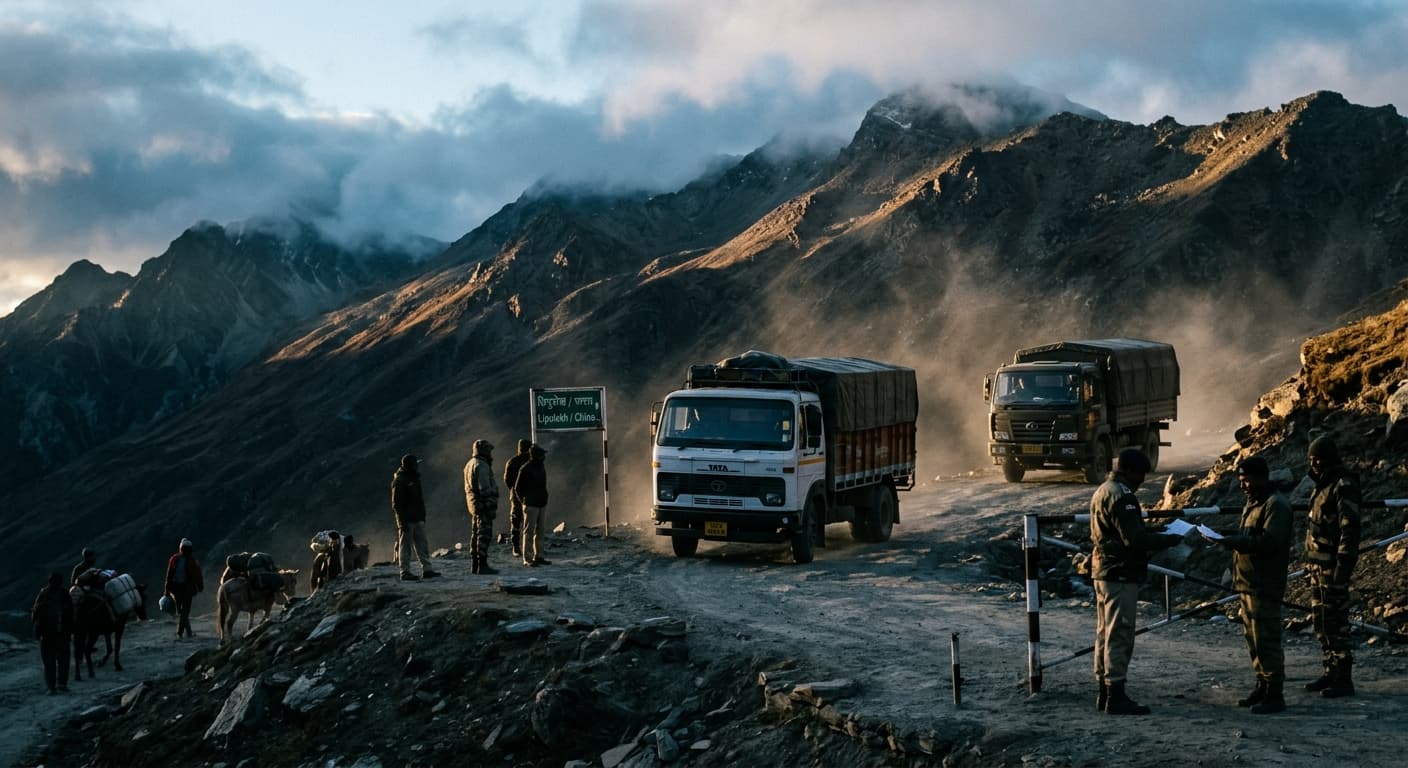
Lipulekh Pass Reopens: India-China Trade Signal in High Himalaya
After six-year closure, India and China resume border trade at 17,000 ft—a low-volume but politically loaded gesture toward normalizing ties.
After six years of lockdown—first due to COVID-19, then the 2020 Galwan Valley clash—India and China have announced the reopening of the Lipulekh Pass for cross-border trade. The ancient footpath at 17,000 feet, linking Uttarakhand's Pithoragarh district to Tibet's Taklakot market, is expected to begin operations in late June. This move is far more about managing bilateral cooling than commerce itself. The trade volumes are modest—the last pre-closure season in 2019 saw
imports of Rs 1.9 crore and exports of Rs 1.25 crore—yet the reopening carries outsize strategic weight. It signals New Delhi and Beijing are intentionally de-escalating, at least in one visible domain.
The reopening was formally approved by India's government in March 2026 and follows a pattern of confidence-building measures.
In June 2025, China allowed the resumption of the Kailash Mansarovar pilgrimage for Indian devotees, and by August of that year, Beijing lifted a five-year embargo on specialty fertilizers and rare earths to India. India reciprocated later that month by easing visa processing for Chinese tourists. Most recently,
Modi and Xi announced the resumption of direct flights between the two countries at the Shanghai Cooperation Organization summit in August 2025.
Yet traders themselves face headwinds. The Lipulekh pass saw its first mechanized overhaul in centuries: a new road completed in 2020 now allows vehicles to reach near the border, replacing the historic mule caravans. But merchants worry about unsold inventory.
Traders stored goods worth crores in Tibet during the closure and must now pay six years of back rent. Beyond logistics: Tibetan salt has been displaced by cheaper plains alternatives, wool markets have shifted, and the yuan's appreciation has made Tibetan goods costlier for Indian buyers. The structural decline in trade—from Rs 14 crore in imports in 2004 to Rs 1.9 crore in 2019—is unlikely to reverse.
Why the Timing Matters
The thaw appears driven by both countries' need to manage Great Power competition without constant crisis. India-China boundary disputes remain unresolved and deep distrust persists on both sides, but allowing commerce to resume and pilgrims to travel signals willingness to compartmentalize. For India, the move also serves a secondary purpose: demonstrating strategic autonomy to Washington. Trump administration tariffs on Indian exports—
reaching 50 percent on some goods and justified as punishment for Russian oil imports—have created incentive for Delhi to show it will not automatically align against Beijing. The Lipulekh reopening, alongside resumed flights and the August 2025 pace of humanitarian measures, broadcasts that India pursues its own interests, not American ones.
China benefits from a similar signal: that bilateral de-escalation is possible without acquiescence. The border remains the fundamental tension point. A May 2026 border affairs working meeting between the two nations acknowledged "lasting peace and tranquility" and prepared ground for the 25th round of boundary talks—but boundary talks do not settle ownership disputes; they manage them. The reopening of Lipulekh is a confidence-building theatre that buys time for both militaries to harden the infrastructure on their respective sides of the Line of Actual Control.
What to Watch
Three moves deserve close observation. First, whether traders actually resume regular cycles or whether the June-September 2026 season becomes a one-off. High storage costs and weak demand may deter participation. Second, Nepal's territorial claim to Lipulekh—rooted in historical treaties—remains an irritant. New Delhi and Kathmandu are managing the friction, but if trade grows and geopolitical stakes rise, Kathmandu may escalate. Third, watch whether India-China ties survive the next flashpoint. Confidence-building measures dissolve swiftly when border incidents occur. The Lipulekh reopening is real, but reversible.
Discover more

India
India-South Korea $50B Trade Expansion Plan
India and South Korea target $50 billion in bilateral trade by 2030, focusing on industrial cooperation and strategic alignment amid US pressures.

Global Politics
US Seizes Iranian Ship, Tensions Surge
The US seizure of the Iranian ship Touska highlights a shift in control over the Strait of Hormuz, favoring Iran's strategic position.

India
UN Expert Albanese: India Violates Law
UN Rapporteur Francesca Albanese accuses India of breaching international law, spotlighting human rights concerns in Kashmir and prompting diplomatic pushback.

Conflict & Security
Drone Warfare Killing Aid Workers at Unprec
Over 1,000 humanitarian workers killed in three years as cheap armed drones collapse legal protections. Gaza, Sudan, Ukraine, and DRC see deliberate targeting of aid convoys and hospitals with zero prosecutions.