Vindman's Call for U.S. Response to China
Addressing Taiwan's gray-zone threats and U.S. strategy
Model Diplomat5 min readAsia
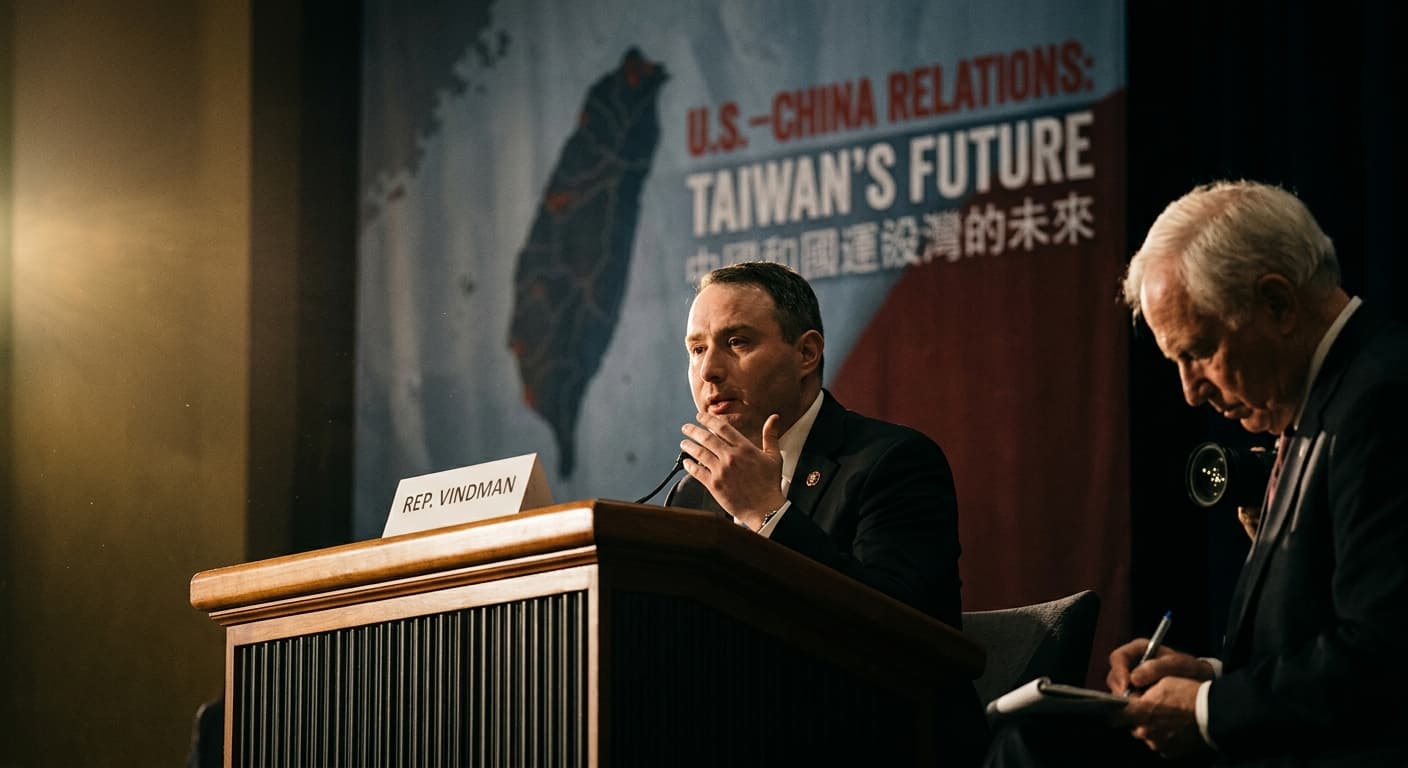
The doctrinal hole Vindman is trying to fill
Rep. Eugene Vindman told a CSIS audience on July 7 that the most dangerous move Beijing can make against Taiwan is not a missile — it is a customs announcement. Congress and the executive branch have grasped the problem in fragments, not doctrine. The House Select Committee on the Chinese Communist Party held its February 11, 2026 hearing, "Lies, Lawfare, and Leverage: The CCP's Gaslighting and Manipulation to Marginalize Taiwan", where Chair John Moolenaar warned that CCP "gray zone tactics reflect a doctrine of incremental aggression" that could "hollow out" Taiwan's democracy long before a shot is fired. Witness Mira Rapp-Hooper urged Congress to insert into the next National Defense Authorization Act "a strategy for immediate execution" on gray-zone coercion. In October 2025 Senate testimony,
Craig Singleton of FDD warned senators that Beijing's campaign is "calibrated to be incremental, ambiguous, and reversible — carefully designed to avoid tripping U.S. redlines while steadily degrading Taiwan's sense of security."
The classified assessment agrees. CSIS's crisis simulation program found that when U.S. players deferred responses to gray-zone provocations to avoid short-term escalation, they inherited "shadow risk" — a higher appetite for risk in the next confrontation, and eventual escalation on worse terms. Twenty separate simulations pointed the same way: no lead U.S. agency owns the gray-zone contingency, and no interagency response has been pre-planned.
A March 2026 Brookings paper by Ryan Hass and David Sacks framed the gap most bluntly: Washington and Taipei have "implicitly accepted Beijing's framing of the gray zone as activity short of a kinetic use of force and, therefore, demanding restraint," when in fact Chinese behavior "reflects a pre-conflict campaign that is designed to weaken Taiwan and set the conditions to prevail in a war." Vindman's fix — a public U.S. commitment to a "comparable allied response" tied to specific gray-zone acts — is what Hass and Sacks call an "escalation ladder" between doing nothing and going to war.
Why the $10 trillion figure is the load-bearing number
The economic stake is what makes the doctrinal gap urgent, and it is what Vindman used to close his speech. Bloomberg Economics' January 2024 modeling — cited by the German Marshall Fund,
Chatham House, and AEI — puts a Chinese air and sea blockade at roughly a 5% cut to global GDP, comparable to the 2008 financial crisis or COVID-19; a full U.S.–China war would cost roughly 10%, or $10 trillion. Chatham House's April 2026 comparison notes that this shock would dwarf the disruption caused by the current Strait of Hormuz closure following the U.S.–Iran war, and hit the European Union and Southeast Asia hardest after Taiwan itself.
The vulnerability runs through one company. Taiwan Semiconductor Manufacturing Co. still produces more than 90% of the world's most advanced chips, and — as Vindman noted — the U.S. reshoring push has not moved that share meaningfully. If Beijing's gray-zone toolkit can throttle chip logistics without firing a shot, a customs inspection at Kaohsiung port carries coercive weight approaching a missile at Hsinchu.
The Trump variable
The unspoken subtext of Vindman's speech is the Trump administration. In May 2026, Washington and Beijing announced a "constructive relationship of strategic stability" — a de facto trade truce. As ExBulletin reported, Beijing has used the truce to intensify pressure on Taipei: more coast guard patrols around outlying islands, first-time enforcement operations east of Taiwan, and expanded diplomatic isolation. The May Trump–Xi understanding, in other words, is being used as cover to run the very gray-zone playbook Vindman is warning about.
That creates a bipartisan problem Republicans have been slow to acknowledge. The FY2026 National Defense Authorization Act authorizes deeper U.S. Coast Guard training with Taiwan's CGA and directs the Department of Defense to co-develop uncrewed capabilities with Taipei, according to an Institute for National Defense and Security Research brief. But the same Trump White House that signed the truce is unlikely to publicize a "comparable allied response" tripwire tied to Chinese customs behavior. Vindman's speech is, functionally, an attempt to force that tripwire onto the record from Congress.
Who benefits, who loses
Beijing is the immediate beneficiary. Every incursion recorded and then normalized — the Kinmen model, the Pratas patrols, the June operation east of Taiwan — accretes into what RUSI calls "legal warfare": a body of "precedent" that recasts coercion as administration. As Shirley Kan put it in her February 2026 House testimony, the "bland, benign term of 'gray zone' belies China's threats that include violence and war."
Taiwan loses twice. Its coast guard is being stretched thin by 13 average weekly CCG entrances around Kinmen and Matsu, per AMTI. The opposition Kuomintang has separately blocked President Lai Ching-te's special defense budget in the legislature, according to Kan. Japan and the Philippines also lose leverage: China cited their EEZ delimitation talks as the pretext for extending "law enforcement" east of Taiwan. Manila's
Coast Guard spokesperson Jay Tarriela has flagged parallel Chinese activity at Scarborough Shoal.
The winner Vindman is implicitly courting is the U.S. Coast Guard, which the Atlantic Council has argued should conduct joint patrols with Taiwan's CGA modeled on its Palau agreement. That is a low-cost, non-Navy escalation ladder rung — and the one the Trump administration would find hardest to explain away as breaking the truce.
Diplomat View
Vindman's speech will not move the Trump White House. It is meant to build the congressional record so that when — not if — Beijing announces mandatory customs inspections or manifest submissions for Taiwan-bound traffic, House Democrats and China-hawk Republicans have a pre-declared response framework to invoke. That framework is the "comparable allied response" doctrine, and its most credible instrument is joint U.S.–Japan–Philippines coast guard patrols inside Taiwan's contiguous zone.
Our forecast: Beijing tests a formalized customs-inspection announcement before Taiwan's January 2028 election cycle, most plausibly in the second half of 2027 as the PLA approaches Xi Jinping's 2027 readiness benchmark. If a U.S.–China trade deal is finalized before then, the Trump administration will absorb the first such provocation rather than break the deal. That is the shadow risk CSIS wargamed — and the specific failure mode Vindman is trying to preempt. What would change this call: a bipartisan gray-zone response provision surviving into the enacted FY2027 NDAA, or a public U.S. Coast Guard joint patrol with Taiwan's CGA. Neither is currently on the calendar.
What to watch next:
- FY2027 NDAA markup (House Armed Services Committee, expected September 2026): whether Rapp-Hooper's proposed gray-zone strategy provision survives conference.
- Taiwan's Han Kuang exercise (annual, July 2026): whether Taipei drills a customs-quarantine scenario, not just a blockade.
- CCG activity east of Taiwan through Q4 2026: if the Ministry of Transport "special enforcement" operation is repeated, the June 2026 incident is confirmed as a new normal, not a one-off.
The Bottom Line
Vindman's July 7 CSIS speech reframes the Taiwan debate: the most likely path to a $10 trillion global shock is not a PLA landing, but a China Coast Guard customs announcement no U.S. administration has pre-committed to answer. Washington's current deterrence posture — built for a war it plausibly will not fight — is being outflanked by a coercion campaign it has no doctrine to counter. Until Congress forces a "comparable allied response" tripwire into law, Beijing has every incentive to keep testing exactly where U.S. red lines aren't.
Discover more

US Politics
White House Pressures Congress for Crypto Leg
The Trump administration's push for the CLARITY Act aims to reshape crypto regulation, impacting trillions in market value and the Trump family's wealth.

India
Women’s Reservation in India
India's 33% women's reservation law is enacted but won't take effect until after 2029 due to political setbacks and census delays.
US Politics
House Ethics Committee Pushes Sexual Miscond.
The House Ethics Committee has shifted responsibility for sexual harassment settlement records to the Office of Congressional Workplace Rights, complicating disclosure efforts.

Economics
Fed's Amex AML order puts correspondent banking on notice
Federal Reserve's Amex AML order requires board-level controls and a 90-day plan; OCC fined the bank $350 million over enterprise-wide deficiencies.