China's Cheap AI Displaces U.S. Competitors
Chinese AI models gain traction in U.S. firms amid export controls.
Model Diplomat7 min readNorth America
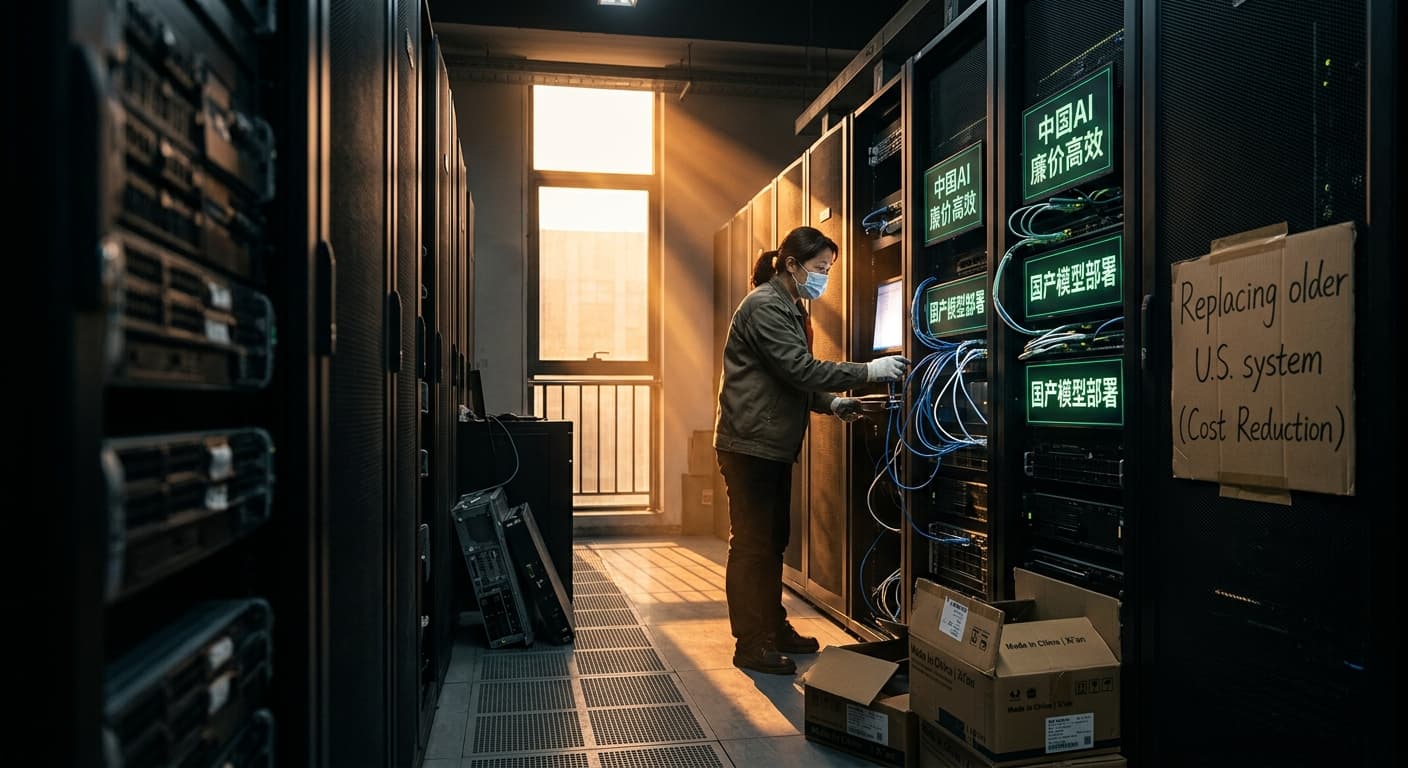
China's Cheap AI Slips Into U.S. Corporate Stacks
Chinese AI models like DeepSeek V4, Kimi K2 and Z.ai's GLM are displacing OpenAI and Anthropic inside U.S. firms as costs surge and export controls whiplash the market.
The story U.S. AI policy was written to prevent is now happening inside U.S. companies. On July 7, Nikkei Asia reported that American corporate use of Chinese open-weight models — DeepSeek V4, Moonshot's Kimi K2, Z.ai's GLM 4.6 — surged in June after Washington's abrupt Mythos and Fable export order forced Anthropic to yank its top models offline. That is the immediate news. The larger point is structural: at roughly 5–20% of frontier U.S. prices, Chinese models have crossed the threshold from curiosity to default for the cost-sensitive tier of American AI workloads, and the Trump administration's own ad-hoc controls are accelerating the switch it was designed to prevent.
The price gap became a policy gap
The economics were already turning before Washington intervened. Chatham House documented that Moonshot's Kimi K2 Thinking lists at $2.50 per million output tokens against $15.00 for Anthropic's Claude Sonnet 4.5, and that Alibaba's Qwen-Plus and Kimi K2 were trained for a small fraction of the billions OpenAI now spends per model generation. Airbnb CEO Brian Chesky told analysts in October 2025 that his company "relies heavily" on Qwen because it is "fast and cheap," while Social Capital's Chamath Palihapitiya migrated much of his firm's work to Kimi K2 as "way more performant" and "a ton cheaper" than OpenAI or Anthropic, according to
Al Jazeera. Andreessen Horowitz partner Martin Casado, in the same reporting, put the number at roughly 80% of U.S. AI startups he sees now running on a Chinese open-source model.
OpenRouter, the AI inference marketplace that hosts most frontier models side-by-side, provides the cleanest signal. A large empirical study of 100 trillion tokens routed through the platform, released as an arXiv preprint in 2026, showed the shift toward open-weight models is now dominant across coding and agentic workloads. The
ATOM Report, a separate audit of the open-model ecosystem, put Chinese models' share of open-weight inference tokens on OpenRouter at 72.7% by January 2026, up from 2.8% fourteen months earlier — a near-complete inversion of the Meta-led U.S. open-source dominance that peaked at 37.4% in January 2025.
Mythos, Fable, and Washington's own goal
The Mythos–Fable episode is the case study. On June 9, 2026, Anthropic launched Claude Fable 5 and Mythos 5, its most capable cyber-tuned models. Three days later, on June 12, Commerce Secretary Howard Lutnick sent a letter — first documented in detail by CSIS — ordering Anthropic to suspend access for "any foreign national, whether inside or outside of the United States, including foreign national Anthropic employees." Unable to verify user citizenship at the API layer, Anthropic pulled the models globally.
The legal footing was contested from day one. CSIS analysts noted that the Bureau of Industry and Security cited the Export Control Reform Act's "informed" authority — a provision never previously used for a worldwide model control — and Section 744.22, which by statute applies only to a narrow set of adversarial military-intelligence end users. The Peterson Institute's PIIE analysis concluded bluntly that "the sudden US action, without any public criteria or carve-outs for allies, is likely to boost international adoption of Chinese AI models because Chinese firms tend to release their models as open weight." That is precisely what the OpenRouter data over the following three weeks showed.
By June 30, Lutnick reversed course. In a follow-up letter reported by the BBC, Commerce wrote that Anthropic had "agreed to proactively detect and address security risks associated with the models" and would notify the government of malicious activity — and the restrictions were lifted. But the eighteen-day blackout was long enough for procurement teams at U.S. firms to test, benchmark and, in many cases, permanently reroute workloads to Chinese alternatives. Anthropic itself framed the episode as evidence that a "narrow potential jailbreak" should not be grounds for pulling a commercial model deployed to hundreds of millions of users.
The distillation front — and why it matters
The second front is intellectual property. On April 23, 2026, the White House issued NSTM-4, formally accusing "foreign entities, principally" Chinese, of running "industrial-scale" distillation campaigns against U.S. frontier models — using tens of thousands of accounts, jailbreaking techniques and API queries to extract capabilities from proprietary systems. The Council on Foreign Relations
documented that DeepSeek V4 was released the day after that memorandum, and that Anthropic and OpenAI have separately alleged campaigns involving over 24,000 fake accounts and more than 16 million interactions.
That accusation reframes the price war. If Chinese labs are training partly on outputs distilled from Claude and GPT — a claim also flagged in Dmitri Alperovitch's April 16, 2026 testimony to the House Select Committee on the CCP — then their sub-$3 pricing is subsidized by U.S. R&D as much as by Beijing. CFR estimates DeepSeek V4 is priced "at least four times cheaper" than comparable U.S. models and trails the frontier by roughly three to six months, consistent with a broader seven-month U.S. lead. That is a small enough gap that price wins the enterprise buying decision for anything short of frontier reasoning.
Who benefits, who loses
The winners are not the obvious ones. Peterson's PIIE puts the counter-intuitive point sharply: Microsoft and Google cloud revenues grew 26% and 48% respectively in the year since the DeepSeek shock, because whether a U.S. developer runs DeepSeek V4 or Claude on rented GPUs, the hyperscaler collects rent either way. Google is more than doubling capital expenditures to serve the backlog. Nvidia — despite the January 2025 rout that briefly shed roughly $600 billion in market cap, per the
BBC — remains the picks-and-shovels beneficiary of every inference workload, Chinese or American.
The losers are Anthropic and OpenAI in the middle-tier commercial market. Anthropic's revenue run rate has climbed to roughly $9 billion, from $1 billion a year earlier, but that growth is coming from a narrower band of high-value coding and agentic workloads where Claude's benchmark lead is decisive. Everything below that — customer support, retrieval-augmented generation, batch summarization, internal tooling — is migrating. Nikkei's July 7 report names Coinbase and Uber among the "big-name users" running Chinese open-weight models. The lock-in that Peterson's Mert Demirer research found — where firms allocate 90% of usage to a single model — is now working in Beijing's favor for the first time.
The MERICS analysis captures the strategic logic: Chinese labs cannot benefit directly from foreign hosting revenue, because third-party platforms like OpenRouter capture the fees. But wide diffusion buys market share, developer mindshare, and — critically — a fait accompli that constrains any future U.S. attempt to draw a hard software curtain. Once a Fortune 500 workflow depends on GLM 4.6, ripping it out for policy reasons carries a business cost.
The historical parallel
There is a specific analogy worth naming. In the 2010s, U.S. solar manufacturers pioneered the technology and lost the scaling game to Chinese producers who drove polysilicon costs down 90% and captured the global market. The Financial Times warned in early 2025 that DeepSeek was the software analog: American labs pioneering an inherently expensive frontier, Chinese firms optimizing behind them at a fraction of the cost. The arXiv "Tiered Super-Moore"
study puts empirical numbers on it — a roughly 600-fold decline in token prices between 2020 and 2026, with software and architectural innovation, not chips, accounting for 103.7% of the cost reduction. That is the finding U.S. policymakers most need to internalize: export controls on hardware are not slowing the software cost curve that is eroding U.S. commercial dominance.
The counter-argument, made by CFR and the Stanford FSI, is that the U.S. still leads at the frontier, that Chinese labs are compute-constrained — DeepSeek itself has admitted the "performance gap between closed-source and open-source models appears to be widening" — and that adoption in regulated Fortune 500 sectors will remain American. That is likely correct for the top 20% of workloads. It is the other 80% that is quietly changing hands.
What to watch
- GPT-5.6 release conditions. OpenAI has reportedly agreed to give the U.S. government approval rights over customers for its next flagship, per
Al Jazeera. If the Mythos-style staggered release becomes the norm, expect another migration event.
- BIS's replacement for the AI diffusion rule. The January 2025 rule remains unenforced since the May 2025
BIS announcement; a formal successor would either legitimize or unwind the ad-hoc regime.
- DeepSeek R2 and Alibaba Qwen4. Both are reportedly bottlenecked by chip access; a delay signals export controls are biting, a release signals they are not.
- The classified NSA benchmarking process authorized by the June 2, 2026
executive order — its threshold for "covered frontier model" will define which U.S. releases get held back and, by extension, which Chinese alternatives get another opening.
The Bottom Line
Chinese open-weight models are not winning the AI race — they are winning the AI adoption race inside the United States, in the tier below the frontier, on price. Washington's June export controls on Anthropic's Mythos accelerated exactly that outcome, and lifting them on June 30 did not reverse the migration. If the Trump administration wants to prevent U.S. commercial AI from following U.S. solar into a Chinese-scaled market, the leverage point is inference cost — not another export control letter.
Discover more
Global Politics
Xi Jinping Calls China-Russia Ties 'Precious'
Xi Jinping's description of China-Russia ties as 'precious' reflects a strategic imbalance, with Beijing dictating terms in the partnership.

US Politics
Virginia's Redistricting Referendum
Virginia's redistricting referendum is drawing a flood of dark money, shaping future elections and the fight for congressional control amid party stakes.

India
Congress Accuses Modi of Stalling Women's Law
Congress accuses Modi of stalling women's reservation law by linking it to delimitation, revealing a deeper electoral strategy.

Conflict & Security
Drone Warfare Killing Aid Workers at Unprec
Over 1,000 humanitarian workers killed in three years as cheap armed drones collapse legal protections. Gaza, Sudan, Ukraine, and DRC see deliberate targeting of aid convoys and hospitals with zero prosecutions.