China's 200,000-Chip Quota for Nvidia
Beijing limits Nvidia chip purchases to 200,000 units.
Model Diplomat7 min readAsia
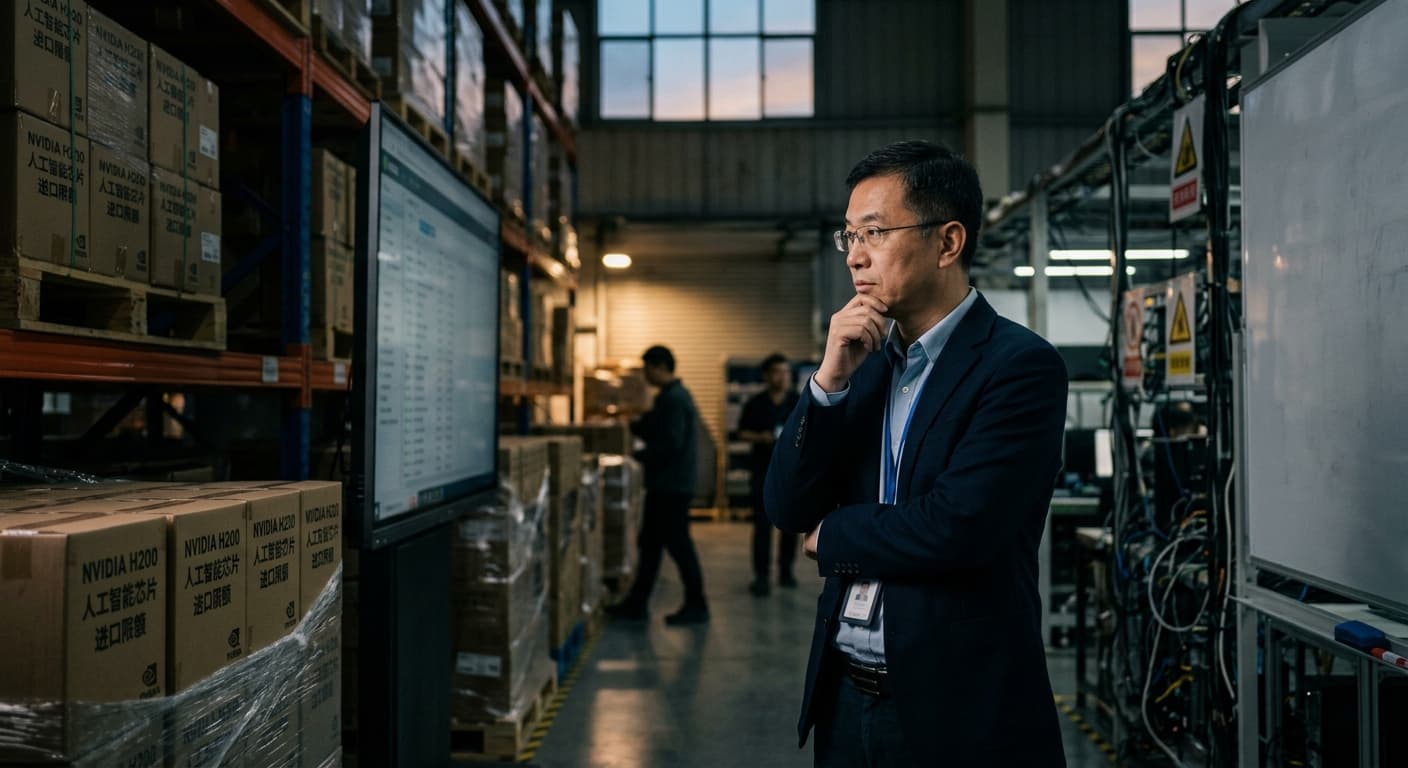
China's 200,000-Chip Quota: Beijing Sets the Price of Nvidia's Return
China will let Alibaba, ByteDance and DeepSeek buy fewer than 200,000 Nvidia H200 chips — training only, not inference. What the cap reveals about who now sets AI chip export policy.
Beijing plans to green-light purchases of fewer than 200,000 Nvidia H200 accelerators for Alibaba, ByteDance and DeepSeek — less than half what the three firms requested and a fraction of what U.S. law now permits — with the chips ring-fenced for model training only, The Information reported on July 8, 2026. The number is the news. The framing is the story: seven months after Donald Trump reopened the H200 corridor in exchange for a 25% U.S. cut, it is the Cyberspace Administration of China — not the Bureau of Industry and Security — that is rationing Nvidia's access to its second-largest market. Export controls have not disappeared. Their author has changed.
That inversion is the argument. Washington spent four years using licence caps to slow Chinese AI. Beijing is now using the same instrument, in reverse, to slow Nvidia — and to buy training compute it cannot yet make, while keeping the far larger inference market for Huawei, Cambricon and the domestic ecosystem it has spent $200 billion cultivating.
What Beijing actually approved
The reported deal, first surfaced by Qianer Liu of The Information and mirrored by Reuters and other outlets, has three load-bearing terms.
First, the buyer list is narrow: Alibaba, ByteDance and DeepSeek — the three firms whose foundation models are furthest along the frontier. Tencent, JD.com and Baidu, all cleared by the U.S. Commerce Department in May under BIS's export licence, are not on Beijing's initial list, according to Startup Fortune's reconstruction of The Information's reporting.
Second, the cap is severe. The reported aggregate is under 200,000 units. For scale: analysts at the Center for a New American Security calculate that the January 2026 BIS rule permits China to import roughly 850,000 H200-equivalents in a single year — more than twice China's total domestic production, which CNAS pegs at around 390,000 H200-equivalents in 2026 averaged across SemiAnalysis and Bloomberg estimates. Beijing has therefore voluntarily accepted less than a quarter of the ceiling Washington set.
Third — and this is the least-reported term — the chips are earmarked for training the largest foundation models, not for inference. That is a deliberate industrial-policy carve-out. Training is where Huawei's Ascend 910C still lags Nvidia most visibly on memory bandwidth and interconnect. Inference — the vastly larger recurring workload that actually serves users — is where domestic silicon is now good enough, and where Beijing wants the revenue to accrue at home.
The regulator on both sides is now Beijing
Read against the last thirteen months of policy, the sequencing is unmistakable.
On December 8, 2025, Trump announced H200 sales to "approved" Chinese customers in exchange for a 25% tax on Nvidia's revenue. On January 13, 2026, BIS codified the reversal, capping China-bound shipments at 50% of U.S. volumes and requiring "robust" know-your-customer checks — a regime the Council on Foreign Relations judged "strategically incoherent and unenforceable" in the same month. The rule text is in the
Federal Register at RIN 0694-AK-series.
Then Beijing stepped in. In January, Chinese customs officials instructed agents that H200s were "not permitted" to enter the country despite valid BIS licences, CSIS documented in April 2026. The Cyberspace Administration of China had already, in
November 2025, blocked ByteDance from deploying Nvidia chips in new state-linked data centres, extending an
August boycott order that also carried an antimonopoly probe against Nvidia.
The result: as of Nvidia's May 21, 2026 earnings, the company had shipped zero H200s into China, and Jensen Huang told CNBC he had "largely conceded" the market to Huawei. Nvidia's guidance for the current quarter assumes no data-centre revenue from China, the BBC reported — even as overall revenue hit $81.6 billion. Brookings' John Villasenor put it more bluntly:
"the ball game is over, and the U.S. has lost" the AI chip market in China.
The July 8 report is the first crack in that posture — but it is a controlled crack, on Beijing's terms.
Why 200,000, and why now
Three pressures forced Beijing's hand in the same week.
Compute scarcity is biting the frontier. DeepSeek's December 2025 technical paper accompanying the v3.2 model release named compute access as its single largest constraint. Premier Li Qiang has said the same publicly. Alibaba's Qwen team and ByteDance's Doubao unit have both been running training clusters at capacity. The Information's sister reporting this week noted
Zhipu AI is now scoping its own custom silicon precisely because neither Nvidia nor Huawei can be counted on to deliver at scale.
Huawei is not closing the gap fast enough at the top end. CFR's chip-by-chip analysis this year found Huawei will produce 5% of Nvidia's global AI compute in 2025, falling to 4% in 2026, and that the Ascend 950 series scheduled for 2026 has a lower total processing performance than the 910C already in service. AEI's April 2026 study of ASML deep-ultraviolet lithography flows into China suggested Huawei can print 1.6 million logic dies this year —
enough for volume, not enough for frontier training. Brookings notes that Chinese labs including
MiniMax, Moonshot and Alibaba are compensating with algorithmic efficiency and INT4 quantisation, but algorithmic gains do not fully substitute for hardware at frontier scale.
The July 8 window is politically cheap. Trump publicly told reporters after his November 2025 meeting with Xi Jinping that China had chosen not to buy H200s "because they want to develop their own." Beijing can now buy a symbolic tranche without appearing to capitulate: fewer than 200,000 chips, restricted to training, split across three national champions. The optics preserve the self-reliance narrative Xi has personally staked, while topping up the compute stack DeepSeek and Alibaba need to keep pace with GPT-5 and Gemini 3.
Who wins, who loses
Nvidia gets a face-saving datapoint, not a business. Fewer than 200,000 H200s across three buyers, each shipped via Taiwan through a U.S. customs collection point that levies a 25% duty, is what CSIS calls "stop-and-start" commercial momentum. Nvidia's stock rose about 1% on the report — Wall Street's polite acknowledgment that the number is small. Huang has already priced China at zero.
Huawei loses the top of the pyramid but keeps the pyramid. By reserving Nvidia access for training only, Beijing has quietly conceded that Ascend cannot yet train models at DeepSeek's frontier. RAND's August 2025 assessment noted Chinese firms already prefer even performance-degraded Nvidia chips over Huawei's for training. But Huawei retains the far larger inference market — the recurring revenue that funds its next-generation R&D. MERICS analyst Antonia Hmaidi's assessment that
"Nvidia will maintain its dominance" needs updating: Nvidia will dominate a shrinking training slice inside a growing Chinese market.
The 25% U.S. revenue cut is real money. On a rough estimate — 200,000 H200s at roughly $30,000 landed — Washington collects around $1.5 billion in fees on this tranche alone. Bernstein Research told the BBC in August 2025 the Trump chip-tax structure could generate $2 billion. That is not export-control policy. It is industrial-policy revenue-sharing dressed as export control — and CSIS's April blog explicitly flagged this as
national-security cover for a fiscal instrument.
The losers are Tencent, Baidu and JD.com. All three were cleared by BIS in May. None appear on Beijing's July shortlist. Baidu's own Q1 2026 results showed AI-cloud revenue up 49% year-on-year — the compute demand is there; the political favour is not.
Diplomat View
The July 8 quota is not the end of decoupling. It is the moment decoupling formalised its terms of trade. Beijing has demonstrated it can now do to Nvidia what BIS spent 2022–2025 doing to Huawei: choose the buyers, cap the volumes, and dictate the use case. Under the reported deal, fewer than 200,000 H200s enter China — one-quarter of what the U.S. rule permits and one-third of what Chinese firms demanded — and only for training, the workload Huawei cannot yet serve. The bet on Diplomat's side of the table is that this settles into a durable equilibrium through 2027: symbolic Nvidia access at the frontier, domestic silicon for everything else, with Blackwell and Vera Rubin remaining Beijing's real strategic ask. This forecast would be revised if (a) BIS approves Blackwell or GB300 exports to any Chinese entity, (b) Huawei's Ascend 950 hits volume production with HBM3 memory, or (c) DeepSeek's next model release ships trained on Ascend hardware. Any one of the three collapses the current arrangement.
What to watch
- August 2026: Nvidia's fiscal Q2 earnings will disclose whether any H200s have actually crossed the Chinese border under the new arrangement, or whether — as with the January licences — approvals stall at the loading dock.
- October 2026: The BIS "Framework for Artificial Intelligence Diffusion" successor rule is due for review; watch whether Congress attaches Blackwell restrictions to the FY27 NDAA, which the
June 2026 BIS clarification on Chinese subsidiaries flagged as a live loophole.
- Late 2026: Huawei's Ascend 950 launch, and whether any of DeepSeek, Alibaba or ByteDance publicly commits to training a next-generation frontier model on Chinese silicon. That decision, more than any BIS rule, will settle whether the H200 corridor stays open past 2027.
The bottom line: Beijing's 200,000-chip cap is not a concession to Nvidia — it is Nvidia's admission ticket, priced by the Cyberspace Administration of China and payable to the U.S. Treasury at 25%. The regulator setting the volume of America's most strategic export to its chief rival is now in Beijing. That, not the number, is the story of July 8, 2026.
Discover more

US Politics
SNAP Food Assistance Faces Legal Challenges
In 2026, SNAP faces stricter eligibility rules and mounting legal challenges, threatening food assistance for the millions of Americans who rely on the program.
India
700 Activists Accuse PM Modi of MCC Breach
Over 700 activists allege PM Modi breached election code with a televised address attacking opposition parties just before state elections.
US Politics
House Ethics Committee Pushes Sexual Miscond.
The House Ethics Committee has shifted responsibility for sexual harassment settlement records to the Office of Congressional Workplace Rights, complicating disclosure efforts.

Economics
Fed's Amex AML order puts correspondent banking on notice
Federal Reserve's Amex AML order requires board-level controls and a 90-day plan; OCC fined the bank $350 million over enterprise-wide deficiencies.