Chile's $3.2B Lithium Boom Locks In China's
China's grip on lithium exports deepens with Chile's surge.
Model Diplomat9 min readSouth America
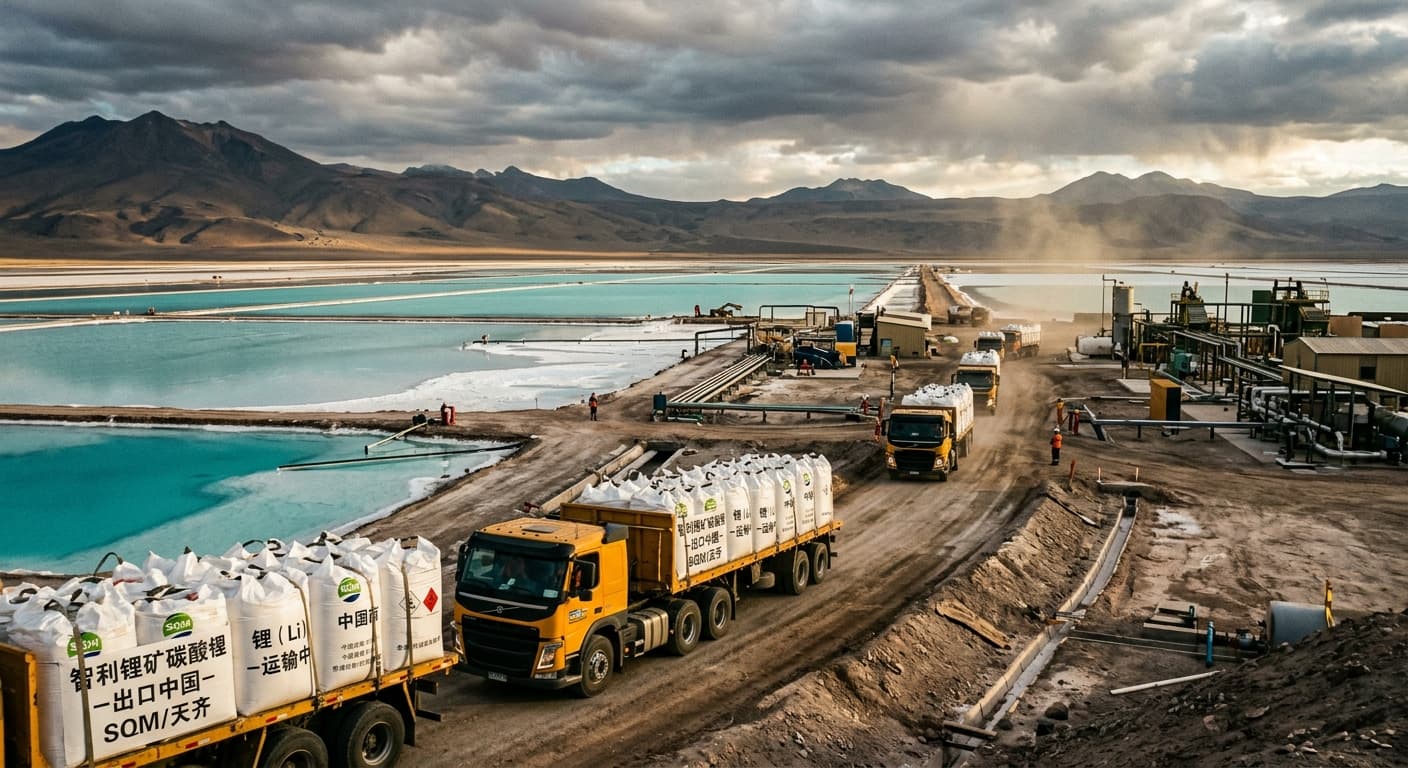
Chile's $3.2B Lithium Boom Locks In China's Grip on Batteries
Chile's H1 2026 lithium exports hit US$3.218 billion, 55% bought by China — a critical-minerals surge that entrenches Beijing's refining monopoly.
Chile's lithium exports reached US$3.218 billion in the first half of 2026, nearly tripling year-on-year and marking the strongest first half since the 2023 super-cycle peak, according to customs data compiled by La Tercera. But the geopolitical story sits inside one number: 55% of Chilean lithium carbonate — US$1.754 billion worth — went to a single buyer, China. Chile's record windfall is not a Western energy-security win. It is a China-security win, purchased on Chilean soil, delivered through a state-controlled joint venture partly financed by Chinese equity, and priced into a benchmark migrating to Guangzhou. The white-gold boom that Washington and Brussels hoped would seed a "friendshored" battery supply chain is, in fact, deepening the very refining chokepoint the
International Energy Agency has warned could become critical minerals' "OPEC moment."
The number that reframes the boom
The H1 2026 figure represents a 188% jump from the US$1.118 billion Chile shipped in H1 2025, driven almost entirely by price. Battery-grade carbonate roughly doubled from about US$9,000 per tonne a year ago to close to US$19,000 by June, according to La Tercera's read of Chilean customs and Central Bank data. Sulfate exports — an intermediate refining product barely visible in Chile's export book two years ago — leapt from US$94 million to US$711 million. Lithium alone accounted for roughly 5% of Chile's total US$60 billion in H1 exports, up from about 2% a year earlier; the metal briefly outweighed the entire fruit-export sector.
That reversal has a specific trigger, and it is not domestic. In November 2025, SQM CEO Ricardo Ramos told investors the market had flipped from oversupply to "a tighter market environment" as energy-storage demand outran forecasts and Chinese converters cut output. SQM's Q1 2026 earnings release, filed via the Financial Times markets service, put global lithium demand on track to exceed 1.9 million tonnes of lithium-carbonate equivalent this year, up roughly 25%. Ramos told shareholders the company had upgraded its own sales-growth guidance from 10% to 15% mid-year.
Two supply shocks then compounded the demand pulse. Zimbabwe, the world's fastest-growing spodumene supplier, halted all raw-mineral and lithium-concentrate exports on February 25, 2026 — a full year ahead of the previously scheduled January 2027 ban — according to a mines ministry directive reported by Al Jazeera. Zimbabwe had exported 1.128 million tonnes of spodumene in 2025, most of it to Chinese refineries. Simultaneously, high-cost Chinese lepidolite mines in Jiangxi throttled back output on razor-thin converter margins. Chile's brine, cheaper than anyone else's, was the only supply that could scale on short notice.
Who actually captured the upside
The Chilean state is the visible winner. In January 2026, Codelco and SQM completed the launch of Nova Andino Litio, the public-private joint venture that governs Salar de Atacama production through 2060. The European Commission cleared the merger in March 2025 as Case M.11734, published on EUR-Lex, which formally recorded Codelco and SQM's joint control of the new vehicle and its lease through December 31, 2030 with automatic extension. By Q1 2026 the venture was operating at full capacity and generated more than US$530 million in payments to CORFO, local governments and taxes in a single quarter, per SQM's own filing.
Under terms outlined in the Chamber of Deputies' briefing on the Codelco-SQM agreement, Chile will capture roughly 80% of the operating margin over the joint venture's life through Corfo payments, regional transfers, taxes and Codelco's dividend. Chile's Central Bank, in its June 2026
Monetary Policy Report, quietly upgraded medium-term investment expectations by 33% on the strength of mining projects, with lithium and copper cited as anchors. The 2022 precedent is telling: at the last price peak, lithium alone delivered US$5.4 billion in fiscal revenue — 1.8% of GDP, more than double Codelco's copper contribution that year — according to figures the same Chamber briefing draws from Cochilco.
The invisible winner is China. Beijing does not appear on Chilean concession maps, yet sits at both ends of the trade. Tianqi Lithium has held a 22% stake in SQM since 2018, as documented by Stiftung Wissenschaft und Politik, which also notes that several Chinese companies have applied to bid for CEOLs in Chile's remaining strategic salt flats. Downstream,
Wood Mackenzie estimates that Chinese-controlled entities will account for 81% of global spodumene refinery output by 2027 and 50% of total lithium production when overseas Chinese-owned mines are included. Argus, citing the IEA's 2025 Global Critical Minerals Outlook, reports China will control 62% of all lithium refining by 2030 while producing only 22% of the raw mineral. Chile's surge is being funnelled straight into that bottleneck.
The friendshoring gap
The Trump administration's January 15, 2026 executive order on processed critical minerals, analysed by the Center for Strategic and International Studies, explicitly targets midstream processing rather than mining. CSIS notes the order's central acknowledgment: "Mining a mineral domestically would not safeguard the national security of the United States if the United States remains dependent on a foreign country for" processing. The order authorises the Commerce Secretary to negotiate offtake and processing deals with allied producers, backed by the threat of import restrictions or minimum prices if talks stall.
Chile is a logical target. It is not one of the bilateral deals struck so far — CSIS lists Ukraine, Saudi Arabia, Thailand, Malaysia, Japan and the Democratic Republic of the Congo as the Trump-era counterparties. Instead, Washington has been picking a different fight. Trump's Section 232 copper tariffs, unveiled in July 2025, hit only 0.1% of Chile's copper exports to the US in direct volume, per Council on Foreign Relations analysis, but they collapsed Chilean public opinion of Washington. CFR's Will Freeman reports that a majority of Chileans now favour deepening trade ties with Beijing and view China as a more positive global influence than the United States. Chile's incoming government — to be elected in November 2026 — will inherit that political fact, regardless of ideology.
The EU has moved faster and more concretely. The EU-Chile Interim Trade Agreement entered into force on February 1, 2025, containing a dedicated Energy and Raw Materials chapter and a critical raw materials memorandum of understanding. Chile already supplies 62.9% of EU lithium imports according to Commission data, and in November 2024 the two sides agreed a Global Gateway roadmap covering lithium, copper and green-hydrogen projects. Brussels has quietly done what Washington has not: locked in a rules-based procurement channel to Chilean brine, complete with sustainability standards Chinese buyers have not been asked to meet.
The Zimbabwe parallel — and the historical one
The Zimbabwe comparison is instructive because it shows what capture looks like at the extraction end. Zimbabwean lithium exports rose from US$84.19 million in Q1 2025 to US$178.64 million in Q1 2026, according to Minerals Marketing Corporation figures reported by Al Jazeera; Chinese firms including Sinomine, Huayou and Tsingshan own virtually every producing mine. Harare gets rent. Beijing gets the mineral, the refining margin, and — increasingly — the pricing power.
Chile is a wealthier version of the same trade. The historical analogue that matters is the 1970s, when non-OPEC producers such as Mexico and Norway captured extraction booms while the Gulf retained price-setting power. Chile is repeating that pattern in reverse for the twenty-first century's most strategic mineral. It is capturing extraction rents through Nova Andino Litio while ceding refining, benchmark pricing and end-use fabrication to a single foreign hub. Beijing's Guangzhou Futures Exchange launched a lithium-carbonate contract that within three weeks had more open interest than London, Singapore and CME's rival contracts combined, the Financial Times reported. The benchmark is migrating. So is the currency: Chinese converters increasingly price contracts in renminbi. When Chile sells to China at Guangzhou-referenced prices in renminbi, the fiscal windfall is real but the strategic autonomy is fictional.
The Carnegie Endowment draws the policy conclusion Washington has so far dodged: the United States must "support value-added processing in these jurisdictions, so that all countries can benefit from a global mining diversification push." That is the pitch Chile has been making for its Instituto Tecnológico del Litio, part of the
Estrategia Nacional del Litio registered with the UN's SDG partnership platform. That institute is not yet operational, and no US financing commitment has been announced.
Second-order effects
Three consequences follow that policymakers are underpricing.
First, Chile's fiscal boom hardens Nova Andino Litio politically. With over half a billion dollars per quarter flowing to the treasury, Congress, communities and Codelco, any incoming administration will find it politically expensive to reopen the deal — even one on the right that would prefer a competitive tender. SQM's original acquisition of a 49% share of the venture, valued at what the Chamber briefing suggests could have been US$9–10 billion under a licitación, is now a fait accompli.
Second, price strength revives Chile's competitive moat over harder-rock producers. Chile's brines carry the world's highest lithium concentrations and the cheapest solar-evaporation costs, as documented in an MDPI Resources review of the global lithium market. At US$19,000 per tonne, Australian spodumene and North American clay projects come back online — but so do the Chilean expansion projects, notably Rio Tinto and Codelco's Salar de Maricunga joint venture and CleanTech Lithium's Laguna Verde CEOL formally agreed with the Chilean Mining Ministry in Q2 2026 per an
FT-hosted filing. None of these adds meaningful volume before 2028.
Third, technology risk is starting to erode the pure lithium bull case. CATL's June 2026 launch of a field-validated sodium-ion energy storage system — with 200 GWh of planned production capacity in China alone, per its PR Newswire filing — puts an explicit ceiling on grid-storage lithium demand. CATL's own marketing frames sodium as a "practical solution for managing lithium price volatility." If sodium takes 20% of stationary storage by 2030, Cochilco's long-term price assumption of US$18,000 per tonne looks generous.
What to watch next
- November 16, 2026 — Chilean presidential election first round. A right-wing win would likely open Salar Futuro and secondary salt flats to a broader field of investors; a continuity government keeps Nova Andino as the central vehicle. Both scenarios remain compatible with a deeper China relationship, per CFR polling.
- Salar Futuro environmental submission — SQM's April 2026 earnings call flagged imminent filing. Once submitted, the permitting clock starts on what Ramos called a "new benchmark" project; first output is not expected before 2030.
- US Section 232 lithium investigation — the January 15, 2026 EO explicitly leaves the door open to minimum import prices on processed critical minerals. A formal probe would be the clearest signal that Washington intends to compete for Chilean midstream, not merely restrict Chinese downstream.
- Yichun and Jiangxi lepidolite restart — the swing supply that could break the current price rally. Any signal of production resumption at CATL-linked mines would push carbonate prices back toward US$12,000 per tonne on consensus forecasts tracked by Cochilco.
Diplomat View
Chile's US$3.2 billion print is being read in Santiago as vindication of the Boric government's national lithium strategy: state on top, private capital operating, communities compensated. That reading is correct and insufficient. The strategic reality is that Chile has become the pivot between two mutually exclusive futures — a Chinese-anchored battery supply chain in which Beijing sets the price, holds the refining and books the downstream margin, or a Western-anchored one that does not yet exist because Washington chose tariffs over processing subsidies for allied jurisdictions. On current trajectory, the first future wins by default. The forecast changes if any of three specific things happen before end-2027: a US Development Finance Corporation or Defense Production Act package for Chilean midstream refining of at least US$500 million; an EU Global Gateway commitment that funds a battery-grade conversion plant on Chilean soil rather than another MOU; or a Chinese misstep — an export restriction, a Tianqi divestment demand, or Guangzhou pricing intervention — that gives Santiago cause to rebalance. Absent one of those, H1 2026 will be remembered as the moment Chile monetised the transition and China locked it in.
The Bottom Line
Chile's record H1 2026 lithium haul is not a Western energy-security win. It is a Chinese one, delivered through a Chilean state-controlled joint venture and priced into a market Beijing increasingly benchmarks in renminbi. Until Washington and Brussels finance midstream refining in Chile itself, every dollar of Santiago's white-gold boom deepens the very chokepoint their critical-minerals strategies were designed to break.
Discover more
US Politics
House Ethics Committee Pushes Sexual Miscond.
The House Ethics Committee has shifted responsibility for sexual harassment settlement records to the Office of Congressional Workplace Rights, complicating disclosure efforts.
India
700 Activists Accuse PM Modi of MCC Breach
Over 700 activists allege PM Modi breached election code with a televised address attacking opposition parties just before state elections.
International Relations
Economist Impact Sustainability Week 2026
Economist Impact Sustainability Week 2026 spotlights the energy transition, AI in clean technology, and supply chain resilience as themes for global leaders.

Economics
Fed's Amex AML order puts correspondent banking on notice
Federal Reserve's Amex AML order requires board-level controls and a 90-day plan; OCC fined the bank $350 million over enterprise-wide deficiencies.