Canada–Germany LNG Deal: Berlin's First Non-U
Canada to export LNG to Germany for 20 years.
Model Diplomat7 min readEurope
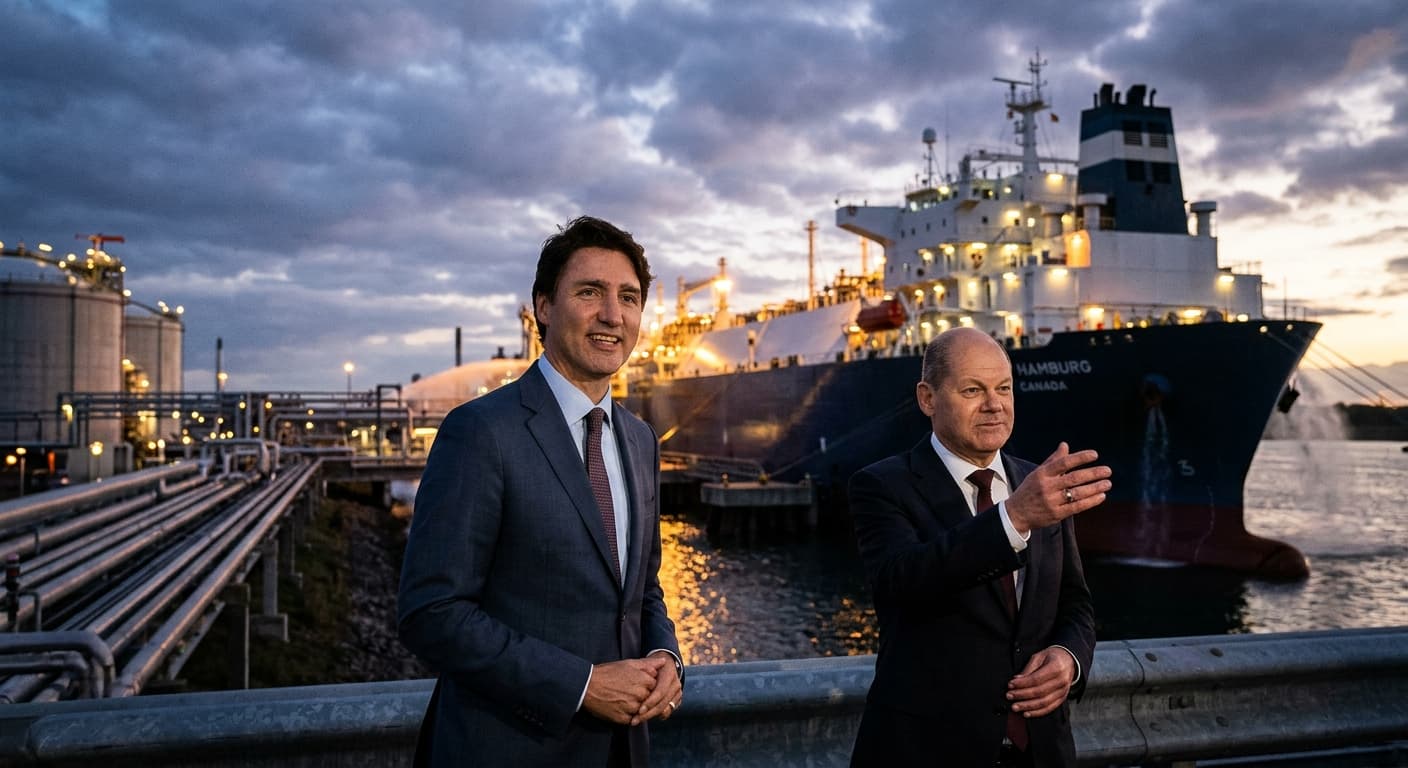
Canada–Germany LNG Deal: Berlin's First Non-US Hedge
Canada will export 1 million tonnes of LNG a year to Germany's SEFE for up to 20 years — Berlin's first long-term supply outside the US–Qatar duopoly.
Canada's May 28 agreement to ship one million tonnes of liquefied natural gas per year to Germany's state-owned SEFE is small in volume but decisive in geometry: it is the first long-term LNG contract that gives Berlin a supplier outside the US–Qatar duopoly now locking in most of Europe's post-Russian gas order — and it arrives exactly as an EU regulation makes the ban on Russian molecules binding law. The deal, anchored on British Columbia's still-unbuilt Ksi Lisims project, does not solve Germany's energy problem. It repositions who has leverage over Germany's energy problem — and the answer, increasingly, is not Washington.
What was signed, and what was not
Energy Minister Tim Hodgson announced the offtake in Vancouver on May 28, 2026, standing beside BC Premier David Eby. According to Natural Resources Canada, SEFE — the former Gazprom Germania, nationalised by Berlin in November 2022 — will buy 1 million tonnes per annum for up to 20 years, beginning in the early 2030s. Hodgson told reporters "the world trusts Canada," according to the
BBC.
What was not signed matters as much. Ksi Lisims — a floating liquefaction facility on Nisg̱a'a Nation territory on BC's north coast, co-developed with Rockies LNG and Texas-based Western LNG — has no final investment decision. The federal Major Projects Office lists the file as active but pre-FID; Environment Minister Julie Dabrusin issued the
Impact Assessment Act decision statement only in September 2025, and BC Hydro's 600 MW power supply MOU dates to January 20, 2026. Volumes will not move before roughly 2030. The SEFE contract is, in effect, the commercial anchor Ksi Lisims needs to persuade lenders — not gas in a tanker.
Why Berlin needed a third supplier
Germany's post-Nord Stream gas system is now dangerously well-diversified — in one direction. The Centre for Eastern Studies (OSW) reports that more than 90% of Germany's direct LNG imports in 2025 came from the United States, the highest US share of any European buyer. The Center for American Progress puts the 2024 figure at
86%. Norway supplies roughly 60% of Germany's overall gas via pipeline under a $55 billion Equinor–SEFE contract
Brookings documented in December 2023. Qatar begins delivering roughly 2 million tonnes per year through ConocoPhillips into Brunsbüttel in 2026, per the
15-year deal signed in Doha.
That is the entire portfolio: one pipeline supplier, one dominant LNG supplier, one hedge — each sitting on a chokepoint or a political risk. The Atlantic Council called it in June: the EU's task is to replace Russia "on terms that do not reproduce the concentration risk in a different direction." Berlin has just done exactly that with the United States.
The regulatory clock has forced the issue. On January 26, 2026, the Council of the EU gave final approval to Regulation (EU) 2026/261, the "REPower Gas Regulation," which imposes a legally binding, phased prohibition on imports of Russian pipeline gas and LNG. The
Council statement required member states to submit national diversification plans by March 1, 2026. That is the document that turned the Canadian offtake from a nice-to-have into a portfolio requirement.
The Trump problem, priced in
The unspoken driver is Washington. President Donald Trump has spent 2025–26 wielding LNG export approvals as trade leverage: a 20-year offtake with Saudi Arabia, non-binding letters pushed on India and Bangladesh, and Qatari LNG investment folded into a broader economic package during his May 2025 Gulf trip, per the Center for American Progress analysis. The
CSIS modeling published in May 2026 is explicit: "concentration risk is not just about the security of molecules; it is about the political cost of dependency." At 55% US market share of European LNG, CSIS finds, Washington gains "significant leverage in trade and regulatory negotiations."
Germany is well past that threshold on direct flows. Berlin sees it. So does Ottawa. Hodgson's own August 2025 speech at the Canadian Embassy in Berlin framed the pitch bluntly: Canada is "experiencing a trade war with our closest and largest trading partner," and is "re-shaping" its export portfolio accordingly. What Ottawa is selling Berlin is not molecules. It is North American gas without the White House attached.
Prime Minister Mark Carney's parallel moves confirm the strategy. On January 16, 2026, Carney told Al Jazeera in Beijing that Canada would produce 50 million tonnes of LNG annually by 2030, "all destined for Asian markets." On July 3, 2026, he secured an
Alberta–federal pipeline framework to expand oil exports beyond the US. The Ksi Lisims SEFE deal is the same pattern, applied to Europe: double non-US exports; make each new customer a diplomatic hedge.
The climate math nobody in Vancouver said out loud
The awkward line in the environmental critique is not that Ksi Lisims is dirty — it is that it may be redundant. According to a Center for American Progress analysis, German gas demand was 73 bcm in 2024, roughly 14% below the 2018–21 average, while planned LNG import capacity is on track for 58 bcm by 2030 — against a maximum forecast national demand of 74 bcm. Overcapacity of at least 50 bcm is baked in if every planned project proceeds. The OSW commentary reaches the same conclusion from the supply side: more than 300 bcm of new global LNG capacity comes online by 2030, half of it outside the United States, likely producing "a global oversupply, heightened competition, and lower prices."
That is the risk Ksi Lisims sponsors have to price. Ecojustice, cited by the BBC, calls it "a stranded-asset fossil fuel project that has failed for decades to attract" investment. First Nations opposition is real: nine Ontario First Nations launched a constitutional challenge to Carney's "One Canadian Economy Act," per
BBC reporting. On the other side, Nisg̱a'a President Eva Clayton told a February 2026 parliamentary committee the project would bring "30 billion [Canadian] dollars in investment" and "strengthen Canada's leadership in low-emission LNG," according to
Al Jazeera. The Nisg̱a'a are not spectators; under their 2000 modern treaty, the terminal sits on their land, and they are a project co-owner.
The wider strategic case holds even if the climate math is uncomfortable. CSIS argued that Canada offers Asia and Europe "the stability of North America without the complex politics of the United States" — and that is the geopolitical premium SEFE is paying for.
What history says about the parallel
Anyone reading this as a repeat of the 2022 Trudeau–Scholz LNG dance is misreading it. Then, Al Jazeera reported, PM Justin Trudeau publicly threw "cold water" on direct LNG-to-Germany exports, calling for a "business case" and steering Scholz toward hydrogen instead. The International Institute for Sustainable Development called the whole idea a "fundamental mismatch": Canada could not ramp up before 2025, and by then Europe's crisis would be over.
Both those forecasts were wrong. Europe's crisis is not over — it is codified in EU law. And Canada, in June 2025, loaded its first LNG cargo ex-Kitimat under LNG Canada Phase I, per Hodgson's Berlin speech. Ksi Lisims is the second act. The four-year lag from Scholz's Montreal ask to Hodgson's Vancouver signature is roughly how long it takes to reverse a policy consensus that treated Canadian LNG as too slow to matter. Carney's One Canadian Economy Act — passed in mid-2025 to fast-track "nation-building" projects — is the domestic instrument that made the reversal stick.
Diplomat View
The Canada–Germany deal is not a climate story, and it is barely an energy-supply story. It is a hedge against Washington, priced in molecules — the first long-term LNG contract Berlin has signed with a G7 ally that is neither the United States nor a Gulf transit-dependent supplier. That is why SEFE, a state entity whose entire post-2022 mandate is supply security, agreed to a 20-year offtake for a facility that does not yet have a final investment decision.
The forecast: Ksi Lisims takes FID by end-2027, backed by the SEFE contract plus at least one Asian offtaker Carney secures on the back of his China opening. First cargo lands in Wilhelmshaven or Brunsbüttel in 2031–32, replacing roughly 1.5% of German gas demand at the margin — but functioning as political insurance well above its physical share. What would break this call: (a) an Indigenous or environmental court ruling that stalls Ksi Lisims past 2028; (b) a Carney government loss to a Conservative opposition that reshuffles the fast-track list; or (c) an EU-US trade détente under a post-Trump administration that removes the concentration-risk premium Berlin is currently paying for Canadian gas.
What to watch next
- Q4 2026 – Q2 2027: Ksi Lisims final investment decision. Watch for a second European or Asian offtake announcement — sponsors need at least 3–4 MTPA committed to trigger FID on a 12 MTPA nameplate facility.
- March–September 2026: EU member-state national diversification plans under Regulation 2026/261 are filed and reviewed by the Commission. Germany's plan will name Canada explicitly — the first time a Canadian project appears in EU statutory energy planning.
- G7 Ministerial, fall 2026: Critical Minerals Production Alliance ministerial meeting flagged in Hodgson's Berlin speech; the LNG deal is the template for parallel critical-minerals offtakes.
- BC provincial politics: Premier Eby's LNG-friendly posture is contested inside the NDP. A cabinet reshuffle or 2028 election shift could reintroduce permitting risk.
The Bottom Line
One MTPA is roughly 2% of German gas demand. The deal is about portfolio geometry: the first long-term contract that lets Berlin tell Washington its LNG dependency is no longer a one-way street. If Ksi Lisims takes FID, Ottawa will have converted a decade of failed export projects into the most consequential piece of transatlantic energy diplomacy since Nord Stream — proof that in a tariff war, the reliable G7 supplier commands a premium the cheapest one never will.
Discover more
US Politics
SNAP Food Assistance Faces Legal Challenges
In 2026, SNAP faces stricter eligibility rules and mounting legal challenges, threatening food assistance for the millions of Americans who rely on the program.

India
BJP's Misunderstanding of Women's Quota Needs
The BJP's linking of the Women Reservation Bill to delimitation risks delaying women's empowerment in India, misreading the aspirations of female voters.

US Politics
House Ethics Committee Pushes Sexual Miscond.
The House Ethics Committee has shifted responsibility for sexual harassment settlement records to the Office of Congressional Workplace Rights, complicating disclosure efforts.

Conflict & Security
Drone Warfare Killing Aid Workers at Unprec
Over 1,000 humanitarian workers killed in three years as cheap armed drones collapse legal protections. Gaza, Sudan, Ukraine, and DRC see deliberate targeting of aid convoys and hospitals with zero prosecutions.