Canada-Germany NATO Partnership Agreement
A strategic pivot away from US influence
Model Diplomat8 min readNorth America
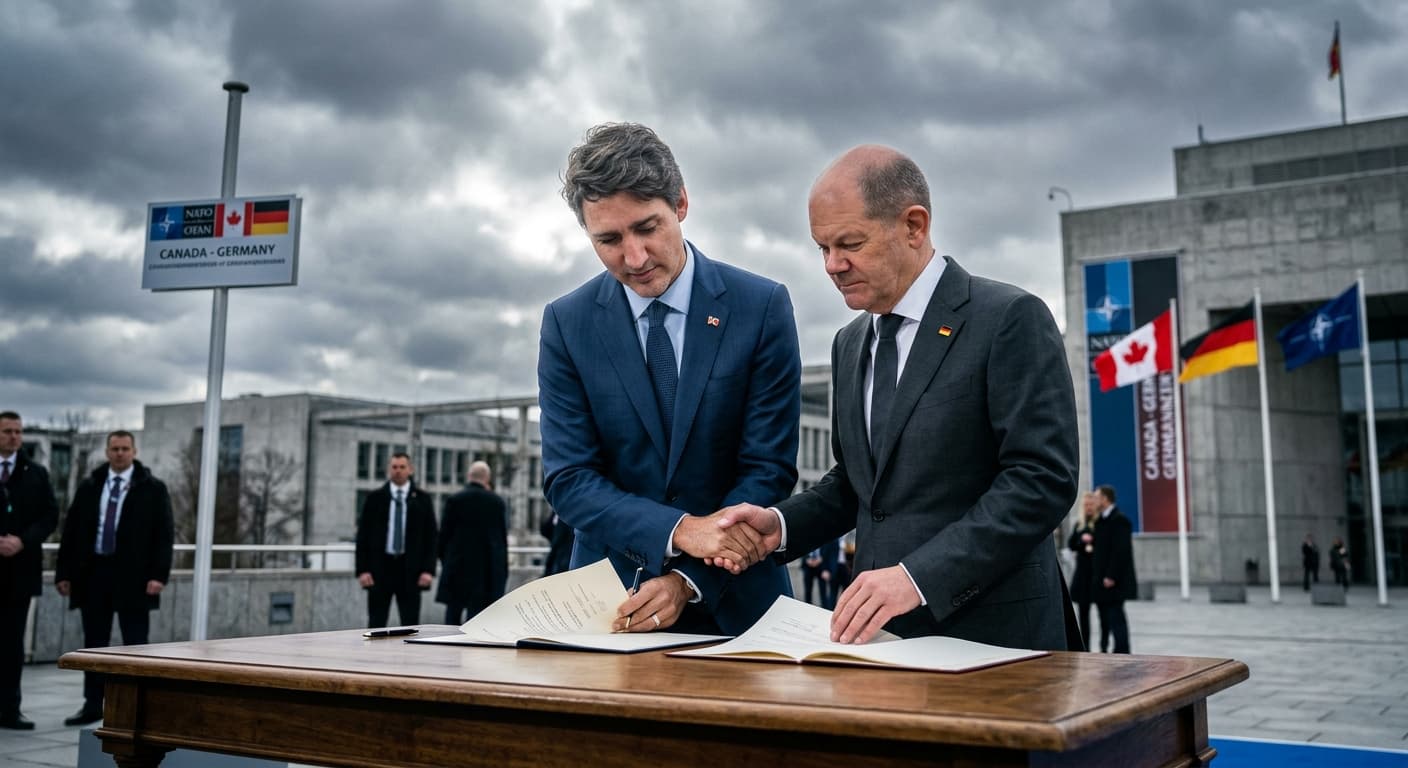
Carney and Merz Bind Canada and Germany Into a NATO-Within-NATO
At the Ankara NATO summit, Mark Carney and Friedrich Merz launched a Canada-Germany Strategic Partnership Agreement — a treaty-level pivot away from Washington.
On July 7, 2026, on the margins of the NATO summit in Ankara, Prime Minister Mark Carney and Chancellor Friedrich Merz announced formal negotiations toward a Canada-Germany Strategic Partnership Agreement, to be finalised before December 31, 2026. The joint statement released by the Prime Minister's Office commits both governments to a single umbrella framework covering defence, critical minerals, energy, AI and space, and investment — the first time Ottawa has bound itself to a European capital at treaty level outside the EU or NATO chapeau. The deal is the load-bearing beam of Carney's "variable geometry" doctrine: it converts a year of ad hoc Canada-Germany transactions — a C$60-billion-plus submarine order, a 20-year LNG contract, a critical-minerals pact — into a durable bilateral architecture designed to function whether or not Washington remains a reliable ally.
The announcement lands 24 hours after Carney picked Germany's ThyssenKrupp Marine Systems (TKMS) to build up to 12 submarines for the Royal Canadian Navy, as Al Jazeera reported, in a contract Canadian outlets value at C$20-30 billion for hulls and up to C$50 billion including lifetime support. That is not a coincidence of scheduling. It is the down payment on the political framework announced the next morning in Ankara.
The thesis: a NATO-within-NATO takes shape
Read the PMO readout narrowly and it is a workplan. Read it in the sequence of the past 90 days and it is something else: the codification of a middle-power bloc engineered to run parallel to a NATO that no longer trusts its hegemon.
The context is on the record. President Donald Trump arrived in Ankara having called German defence spending "ridiculous" on the eve of the summit, per Al Jazeera's coverage, and having on May 1 begun withdrawing roughly 5,000 US troops from Germany
as part of a Pentagon force-posture review. Carney, for his part, told 41 million Canadians in March 2025 that the old US-Canada relationship "is over" — a moment the Council on Foreign Relations calls the
start of Canada's pivot away from Washington. Carnegie's Sophia Besch, quoted by Al Jazeera, describes what Europeans now hope for as "a more orderly version of the transition" from a US-led to a Europe-led NATO — with the underlying fear that "a botched handover…opens up a deterrence and defence gap."
Merz, elected in April 2025 on a CDU-CSU-SPD coalition, needs precisely what Carney is offering: a democratic, non-Russian, non-Chinese supplier of critical minerals, uranium, and LNG, plus a NATO ally willing to plant capital in the German defence-industrial base. Carney needs precisely what Merz is offering: an industrial partner willing to build submarines in Kiel and Bremen for the Royal Canadian Navy without waiting for a US export licence, and a political anchor inside the EU's €800-billion ReArm Europe / Readiness 2030 architecture.
What is actually in the agreement
The joint statement, in the leaders' own words, sets out five pillars:
"Amongst others, key areas of cooperation will include: Security and Defence; Technology, Artificial Intelligence and Space; Supply Chains and Critical Minerals; Energy; and Investment."
Each pillar already has a signed deliverable under it — the Strategic Partnership Agreement is the political instrument that binds them into a single, hard-to-unwind package.
Defence. TKMS, jointly with Norway's Kongsberg, will supply the 212CD submarine to Canada. The Stimson Center estimates the total package at C$60 billion for the acquisition and two to three times that once operations and maintenance are counted, with first delivery targeted for 2034 and TKMS reallocating production slots from the German and Norwegian navies to make Canada the first-of-class recipient — a level of industrial priority Berlin does not extend lightly. The
BBC's summit reporting notes that Ankara also produced Airbus transport-aircraft contracts and a Swedish GlobalEye AWACS replacement — evidence that European industrial answers to US retrenchment are now scaling.
Energy. In May 2026, Canada's energy minister Tim Hodgson signed a 20-year contract with Germany's state utility Securing Energy for Europe (SEFE) to deliver one million tonnes of LNG per year from the Ksi Lisims project on Canada's Pacific coast beginning in the early 2030s. It is the first long-term Canadian LNG contract to Europe; in 2024, virtually all Canadian LNG went south to the United States.
Critical minerals. Berlin and Ottawa signed a joint declaration of intent on critical-minerals cooperation on August 26, 2025, in a partnership the Konrad-Adenauer-Stiftung's Dr. Lilit Klein describes as aimed squarely at reducing German dependence on Chinese and Russian supply chains. Canada's roughly 200 mines extracting critical minerals become, in Berlin's strategic reading, a practical alternative to authoritarian suppliers.
Trade base. According to Global Affairs Canada, two-way merchandise trade hit C$34.3 billion in 2025 — a 61.1% jump since pre-CETA levels — with German direct-investment stock in Canada at C$40.5 billion, making Germany Canada's sixth-largest foreign investor and its largest EU trading partner.
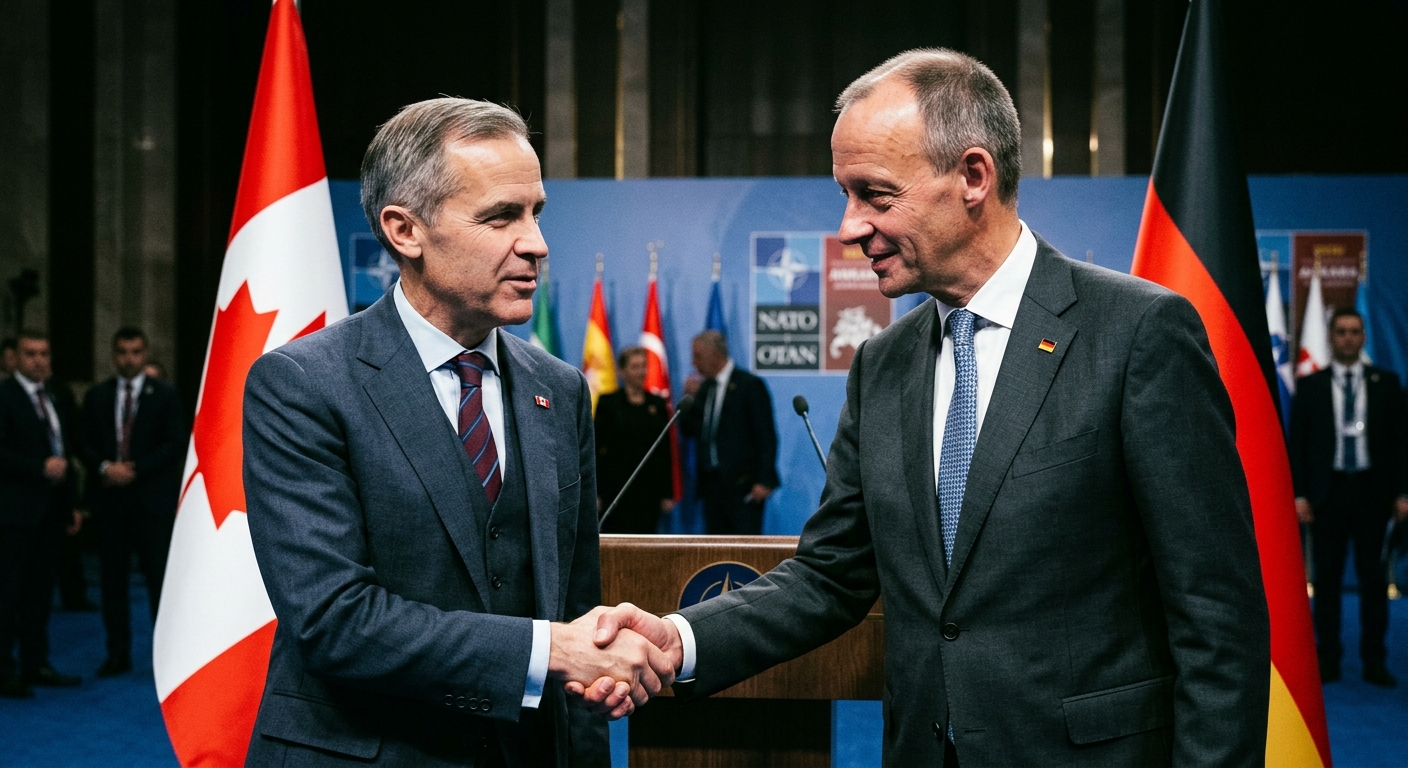
Who benefits, who loses
The clearest winner is ThyssenKrupp. TKMS was floated as an independent entity by German industrial conglomerate ThyssenKrupp in 2024-25; the Canadian order, layered on top of German and Norwegian domestic orders, transforms it from a subscale European yard into the anchor supplier for a NATO conventional-submarine standard. The 212CD, which completed its Critical Design Review in 2024, becomes the de facto NATO non-nuclear submarine — with three navies (German, Norwegian, Canadian) sharing training pipelines, spares, and combat-system upgrades. That is a moat US and Asian competitors will struggle to breach for a generation.
The second winner is the Merz government's political project at home. Merz has staked his chancellorship on a rearmament pitch that Trump has now publicly derided; he defended it in Ankara by insisting, per Al Jazeera, that "this is the greatest effort we have ever made to strengthen our defence capabilities." A Canadian sovereign customer paying up to C$50 billion over the life of the fleet, plus a 20-year LNG offtake to SEFE, is the industrial-policy validation Merz needs to sell to a sceptical Bundestag and a nervous CDU base.
The clearest loser is Hanwha Ocean and, by extension, Seoul's Indo-Pacific defence pitch. The Asia Pacific Foundation's Vina Nadjibulla writes that Ottawa's choice reflects "the enduring pull of NATO, Arctic capability, transatlantic defence-industrial integration and procurement risk" — a polite way of saying the Indo-Pacific tilt lost to the Atlantic when hard money moved. Carney called Korean President Lee Jae Myung over the weekend to soften the blow and plans further talks on the Ankara margins, but the industrial die is cast.
The second loser is the US defence-industrial complex. Carney has said explicitly, per the BBC, that "the days of our military sending 70 cents of every dollar to the United States are over." Canada has already replaced US-built early-warning aircraft with Sweden's GlobalEye, and CFR notes it has signalled its next fighter purchase will come from European rather than US suppliers, putting the F-35 follow-on order into serious doubt.
The non-obvious angle: this is SAFE by another name
Read alongside the June 23, 2025 Canada-EU Security and Defence Partnership, the Canada-Germany deal is the bilateral leg of Canada's insertion into the EU's Security Action for Europe (SAFE) instrument — the €150-billion loan facility that sits inside the €800-billion ReArm Europe plan.
The French think tank IRIS notes that SAFE requires third countries to sign bilateral agreements with the EU defining participation terms and — crucially — restrictions on third-country control over defence-product design. As IRIS puts it, the EU is using SAFE to offer partners "an alternative to American industrial domination in the defence sector", with a 65% European-content threshold on jointly procured equipment. The Canada-Germany Partnership Agreement, negotiated in parallel with Canada's SAFE bilateral, gives Berlin — the largest single European contributor to SAFE — a bespoke channel to pull Canadian industry inside that wall on preferential terms.
The Arctic dimension is the second half of the story. A recent SWP Berlin research paper documents the maritime security partnership already established by Germany, Norway and Canada — Denmark joined in June 2025 — as the operational template for Merz's Arctic ambitions. CIGI's Wesley Wark separately observes that Carney's "variable geometry" doctrine has begun to
take institutional shape in Nordic-Canadian Arctic diplomacy, with strategic partnerships declared across defence, critical minerals and intelligence sharing between January and April 2026. On July 8, 2026, Carney, Merz and Norwegian Prime Minister Jonas Gahr Støre are set to issue a trilateral statement — three of the four 212CD navies formalising the political geometry behind their submarine standard.
Put plainly: Canada is buying its way into the EU defence market by making Germany its industrial patron, and Germany is buying its way into Canadian critical minerals, LNG and Arctic geography by making Canada its extra-EU supplier of last resort. Both are hedging against the same risk — a United States that treats allies as tariff targets and, per NPR's reporting on "NATO 3.0", treats the alliance as a vehicle for extracting spending pledges while shifting its own focus elsewhere.
The historical parallel that reframes it
The closest historical analogue is not a NATO-era arrangement. It is the 1936 Anglo-Canadian re-orientation, when a Britain increasingly worried about US isolationism and continental European rearmament tightened its industrial and defence ties with Ottawa as a hedge against a Washington it could not count on. That arrangement did not replace the transatlantic system — it insured against its failure. The Carney-Merz framework does the same thing 90 years later, from the opposite direction: this time it is the United States that has become the variable, and Germany and Canada — two systemically important democratic middle powers with combined GDP north of US$6 trillion — that are building the hedge.
The KAS analysis on the Canada-EU SDP frames the same insight in current terms: the partnership represents "a reconfiguration of roles and responsibilities within the liberal international order" rather than a rupture from it. The bloc is not anti-American. It is post-American — designed to function whether or not Washington chooses to lead.
What to watch next
Three catalysts will determine whether this framework holds or dissolves into another Hydrogen Alliance–style rhetorical husk — the Macdonald-Laurier Institute has warned that the 2022 Canada-Germany green-hydrogen deal delivered "little more than risk and rhetoric" after Canadian taxpayers absorbed hundreds of millions in exposure while Berlin diversified its suppliers.
- December 31, 2026: the target date for signature of the Strategic Partnership Agreement. Watch for whether the text is binding, whether it includes financial commitments beyond declarations of intent, and whether it survives a Bundestag budget cycle already straining under the €500-billion special defence fund.
- End of 2026 / early 2027: TKMS wants the submarine contract finalised by year-end; Ottawa says by end of 2027 at the latest. A slip past mid-2027 will fuel Canadian opposition claims that Hanwha's cheaper, faster bid should have won.
- Ksi Lisims final investment decision: without it, the SEFE LNG contract remains contingent. Energy Minister Hodgson said the German offtake should unlock financing "in a matter of months," per the BBC — a claim testable by early 2027.
The Bottom Line
The Canada-Germany Strategic Partnership Agreement is not a bilateral upgrade. It is the operational core of a middle-power hedge against a United States that Ottawa and Berlin have concluded, on the evidence of tariffs, troop withdrawals and Greenland threats, they can no longer count on. If Carney and Merz sign the text by December 31 and the C$60-billion submarine order clears procurement, the Ankara summit will be remembered not for what Trump extracted from NATO, but for the parallel architecture two of its members quietly built inside it.
Discover more

US Politics
SNAP Food Assistance Faces Legal Challenges
In 2026, SNAP faces stricter eligibility rules and mounting legal challenges, threatening food assistance for the millions of Americans who rely on the program.

India
Yamini Aiyar on Modi's Federalism Shift
Yamini Aiyar critiques Modi's shift from equity-based to performance-based federalism, highlighting implications for India's political landscape.
Global Politics
Xi Jinping Calls China-Russia Ties 'Precious'
Xi Jinping's description of China-Russia ties as 'precious' reflects a strategic imbalance, with Beijing dictating terms in the partnership.

Conflict & Security
Drone Warfare Killing Aid Workers at Unprec
Over 1,000 humanitarian workers killed in three years as cheap armed drones collapse legal protections. Gaza, Sudan, Ukraine, and DRC see deliberate targeting of aid convoys and hospitals with zero prosecutions.