Brazil's Ethanol Tariff Standoff with U.S.
Brazil refuses to negotiate ethanol in tariff talks with the U.S.
Model Diplomat8 min readAmericas
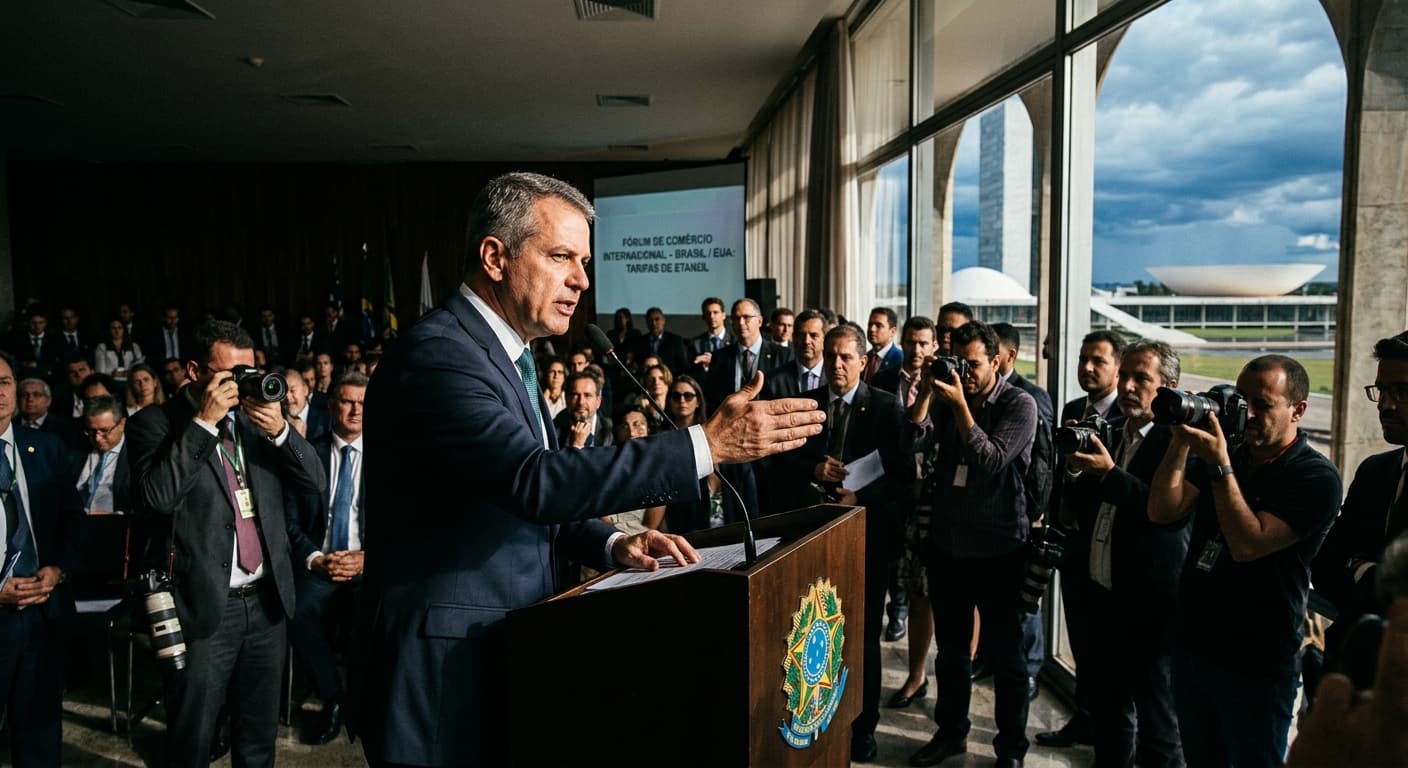
Why Brazil is fencing ethanol off from the Trump tariff deal
Brazil is negotiating down a proposed 25% U.S. tariff but refusing to put ethanol on the table — because unbundling it from sugar would gut the northeast.
Brazil's negotiators walked out of a July 7, 2026 technical round with the Office of the U.S. Trade Representative claiming progress on cross-border crime cooperation — and drawing one hard line: ethanol stays off the agenda. The refusal is not sentimental. Brasília has calculated that trading ethanol tariff concessions for relief from a proposed 25% Section 301 duty would import U.S. corn ethanol into a market already saturated by domestic supply, while leaving Brazilian sugar stranded behind an American tariff wall of roughly 100%. The angle worth watching is not whether Lula's team wins a tariff deal — it is that Brazil is treating its ethanol tariff as a hostage for a sugar market opening the United States will never grant.
The negotiation, in the specifics
Development, Industry and Trade Minister Márcio Elias Rosa emerged from a fresh round of talks with USTR staff on Tuesday, telling reporters that Washington had shown "receptivity" on integrated cooperation against transnational crime — a priority President Luiz Inácio Lula da Silva has personally requested, according to Brazil Economy. A further technical meeting and a political session with USTR Jamieson Greer are expected before the U.S. public consultation closes, according to reporting corroborated by
Informativo DF.
The scoping strategy is deliberate. "The president's main direction is that we will not leave the table and we will also not allow other topics to be discussed," Elias Rosa said, quoted by Jornal Ilustrado. On ethanol he was more explicit: "It is a shame that other people think differently so that American ethanol can enter the Brazilian market with ease," according to
AjuNews. The industry showed up in force at USTR's July 6 hearing in Washington: UNICA (sugarcane growers), the União Nacional do Etanol de Milho (corn ethanol producers) and the Confederação da Agricultura e Pecuária do Brasil submitted joint testimony arguing that the collapse in U.S. ethanol shipments to Brazil since 2023 reflects the rise of domestic corn-ethanol capacity, not the 18% Mercosur tariff — a defense summarized in the
Brazil Economy report.
Why the sugar wall makes ethanol non-negotiable
The Brazilian position rests on a single structural fact: the U.S. sugar program is politically untouchable. American raw and refined sugar imports are governed by tariff-rate quotas set at "the minimum level necessary to comply with obligations under international trade agreements," under 7 U.S. Code §1359kk. Over-quota sugar faces prohibitive duties, effectively pricing Brazilian cane out of the U.S. market. A 2024
U.S. Government Accountability Office review found that USTR still allocates the WTO raw-sugar TRQ using a country-share formula built on 40-year-old data — locking Brazil's quota near the level fixed after Cuba's 1960 exclusion.
That is the constraint Elias Rosa invoked when he told reporters that "our sugar faces a surcharge in the United States of nearly 100%. You cannot dissociate the two chains." In Brazil, roughly the same industrial complex processes cane into either sugar or ethanol depending on world prices — the "flex mill" model documented in the American Journal of Agricultural Economics by Drabik, de Gorter, Just and Timilsina. Concede on the 18% import duty on U.S. corn ethanol and Brazilian mills lose the price floor that lets them shift output between the two products; leave sugar barriers untouched, and they lose their upside market as well. The asymmetry is the argument.
The bigger game: PIX, Bolsonaro, and Section 301
The ethanol carve-out is a small piece of a much larger squeeze. On June 2, 2026, USTR issued its Section 301 determination against Brazil, proposing tariffs of up to 25% on most Brazilian goods, according to Al Jazeera. The 107-page determination bundles eight complaints together: PIX, the Central Bank of Brazil's instant-payments platform, is named more than twenty times, per the
Atlantic Council. Ethanol tariffs and alleged illegal deforestation ride along. So do preferential tariff arrangements Brazil maintains with Mexico and India — arrangements the Council on Foreign Relations noted are hypocritically comparable to U.S. preference schemes, in a
CFR analysis that catalogued the case's expediency.
Two of USTR's grievances are load-bearing; the rest are ballast. That is the Peterson Institute's read. Monica de Bolle and colleagues argue that "throwing everything against the wall to see what sticks is far harder to litigate cleanly at the WTO than a stand-alone payments complaint about PIX," in a June 2026 PIIE analysis. In that view the tariff threat is a compliance perimeter — a way to force Brazilian regulators to restructure PIX under the shadow of correspondent-banking pressure. The July 15 decision date, PIIE argues, "sets the moment by which the trade track must resolve into action or accommodation."
The politics behind the case are equally naked. According to a July 2025 CRS memo, the investigation was self-initiated three days after Trump wrote Lula a letter tying tariffs to the Brazilian Supreme Court's prosecution of former president Jair Bolsonaro, per Congress.gov. On July 6, Flavio Bolsonaro publicly asked Trump to delay any final tariff until after Brazil's 2026 elections,
Al Jazeera reported. Brasília reads that request as confirmation the case is a domestic-political instrument, not a trade grievance. Fighting it as a trade grievance — narrowly, technically, and only on the tariff track — is Lula's counter-move.

The historical parallel: 2012, in reverse
The current standoff inverts the 2012 settlement. On December 31, 2011, the U.S. let its 54-cent-per-gallon import tariff and its offsetting blender's tax credit for corn ethanol expire together — the outcome UNICA's Marcos Jank had waited three decades to see, per an Economist account of the moment. Peer-reviewed work from Iowa State's Food and Agricultural Policy Research Institute had already shown the two policies largely canceled out under the U.S. renewable-fuel mandate, in a
FAPRI paper by Babcock, Moreira and Peng. Trade opened; two-way flows emerged; Brazilian mills exported sugarcane ethanol north to satisfy the advanced-biofuel mandate, while U.S. corn ethanol moved south in Brazil's dry-season shortfalls, a dynamic analyzed by
Debnath, Whistance and Thompson.
Brazil quietly reintroduced its 18% ethanol tariff in 2017, and U.S. corn-ethanol producers have wanted it removed ever since. The USTR's Section 301 case revives that fight. But the underlying economics have shifted decisively: Brazil's own corn-ethanol industry, virtually nonexistent a decade ago, has expanded to the point that domestic demand no longer requires U.S. imports at scale — the argument the União Nacional do Etanol de Milho carried into USTR's July 6 hearing. Peer-reviewed research by Machado Neto in Renewable and Sustainable Energy Reviews has documented that Brazilian ethanol imports track blending mandates and domestic supply gaps, not tariffs — undercutting the USTR's causal claim.
The winners and losers if ethanol stays out
The immediate winner from Brazil's carve-out is São Paulo's flex-mill industry and its northeastern sugar producers, who preserve pricing power in both product markets. The immediate loser is the U.S. Renewable Fuels Association's Midwest membership, which sees the largest structural biofuels market in the emerging world remain fenced off. A quieter loser is any Brazilian exporter of iron and steel, machinery, or fuels — the categories exposed to the 25% Section 301 rate. According to the Congressional Research Service, the United States imported $42.3 billion of Brazilian goods in 2024, including $8.5 billion of fossil fuels and byproducts and $4.7 billion of iron and steel — categories with no USTR exemption. The Atlantic Council estimates the Section 301 line item could add $6.2 billion in tariff revenue on top of an existing forced-labor tariff, per an
Atlantic Council analysis.
The second-order beneficiary is Beijing. The Atlantic Council's US-Brazil trade dashboard shows Brazilian shipments diverging from the pre-tariff trend line since mid-2025, with commodities most likely to reroute to China. CSIS's Ryan Berg has argued Brazil should keep "calibrated pressure tools" in reserve — a temporary tax hike on U.S. corn ethanol, a review of tax exemptions on streaming services, a reopening of the Alcântara Launch Center safeguards agreement — as reminders that "interdependence goes both ways," in a
CSIS brief. Ethanol, in other words, is doubling as a bargaining chip and a red line at the same time.
What Brazil can actually give
Elias Rosa's crime-cooperation offer is not incidental. It maps directly onto the State Department's Foreign Terrorist Organization designation of Comando Vermelho and PCC — the parallel pressure track PIIE identified — and gives Washington a face-saving deliverable that does not require Brazil to touch PIX, sugar, ethanol, or Bolsonaro. Compare Mexico's playbook: repeated tariff postponements obtained by President Claudia Sheinbaum through technical dialogue and offers on border security and semiconductor investment, avoiding public confrontation, as CSIS's Berg noted. Lula is trying to replicate that arc without Sheinbaum's advantages — a shared border, a USMCA framework, and a president unwilling to tie tariffs to a domestic prosecution.
Brazil also has a legal counterweight. Law No. 15,122, the so-called Reciprocity Law that entered into force in April 2025, gives the executive authority to suspend trade, investment and intellectual-property concessions in response to unilateral measures — implemented through Decree No. 12,551 and an Interministerial Committee for Economic and Trade Countermeasures, according to the CEBRI-Journal. Brasília has not used it. Keeping it on the shelf, while narrowing negotiations to the tariff track, is the substance of Elias Rosa's approach.
What to watch
- July 15, 2026 — USTR's window to move from proposed to final Section 301 action closes; Section 301 requires a decision within 30 days of the June 2 determination, per
Congress.gov.
- Any political meeting between Elias Rosa and Jamieson Greer this week — the last chance to convert crime-cooperation goodwill into a tariff pause before the deadline.
- The Federal Register notice on exclusions — whether ethanol appears on any expanded exemption list will signal whether the U.S. corn lobby got its ask or Brasília held the line.
Diplomat View
Brazil's decision to fence off ethanol is the clearest tell yet that Lula's team has diagnosed the Section 301 case correctly: it is not a trade complaint, it is a compliance perimeter, and the correct defense is to narrow rather than broaden. The bet is falsifiable. If USTR moves to a final 25% rate on July 15 with no ethanol carve-out on the U.S. side, Brazil's strategy will have bought symbolic sovereignty at the cost of a real tariff shock to iron, steel, machinery and fuels — categories with no exemption and no political constituency in Washington. If instead the tariff is delayed, softened, or wrapped into a broader crime-cooperation MoU, Elias Rosa will have proven that the Mexico playbook works even without Mexico's geography. What would change the forecast: any signal that Trump personally links tariff relief to a pardon or trial delay for Bolsonaro. That collapses the trade track into the political one, and ethanol stops being the story.
The bottom line: Brazil is willing to eat a 25% tariff on steel and machinery before it will open its ethanol market, because giving up the 18% duty without a matching cut in the U.S. sugar wall would decouple a sugar-ethanol production complex that has been integrated for a century. This is not protectionism as reflex; it is protectionism as the only rational move in a negotiation the other side is refusing to hold on trade terms.
Discover more

US Politics
House Ethics Committee Pushes Sexual Miscond.
The House Ethics Committee has shifted responsibility for sexual harassment settlement records to the Office of Congressional Workplace Rights, complicating disclosure efforts.
US Politics
Virginia's Redistricting Referendum
Virginia's redistricting referendum is drawing a flood of dark money, shaping future elections and the fight for congressional control amid party stakes.

International Relations
Pakistan's Key Role in US-Israel-Iran Meddle
Pakistan is seeking to mediate the US-Israel-Iran conflict, balancing high-stakes diplomacy against severe economic pressures and steep regional challenges.

Conflict & Security
Drone Warfare Killing Aid Workers at Unprec
Over 1,000 humanitarian workers killed in three years as cheap armed drones collapse legal protections. Gaza, Sudan, Ukraine, and DRC see deliberate targeting of aid convoys and hospitals with zero prosecutions.