Brazil's Ethanol Deal: A Strategic Carve-Out
Brazil protects ethanol from US trade negotiations over sugar concerns.
Model Diplomat8 min readAmericas
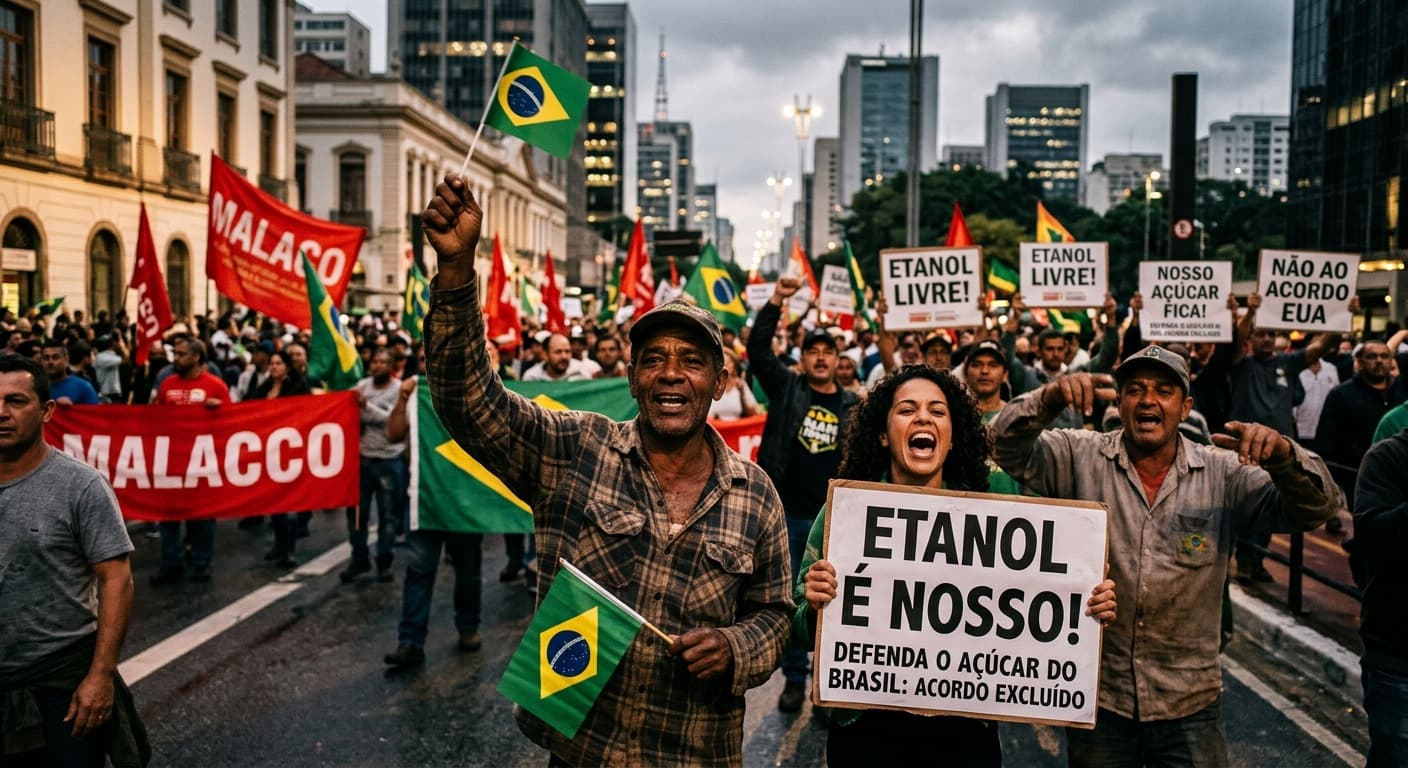
Why Brazil Is Walking Away From an Ethanol Deal With the US
Brasília is close to a deal with USTR ahead of the July 15, 2026 tariff deadline — but has ring-fenced ethanol. The reason is sugar, not fuel.
Brazil's negotiators told Washington on July 7 that they will accept a narrow, tariff-focused settlement with the United States — but ethanol will not be inside it. That single carve-out, in a talk that otherwise moved forward, is the most consequential decision Brasília has taken in this round: it protects a US$40 billion sugar-ethanol complex, calls Washington's bluff on the 18% import tariff the USTR calls "unreasonable," and quietly links any future ethanol concession to a US sugar market that has been closed to Brazilian cane for four decades. The Lula government is betting that the Trump administration wants a headline more than it wants corn ethanol exports — and that Iowa's lobby is not strong enough to blow up a deal over 53 million dollars in trade.
The talks matter because the clock runs out on July 15, 2026. That is the statutory deadline under Section 301 of the Trade Act of 1974 for US Trade Representative Jamieson Greer to decide whether to impose the 25% retaliatory tariff on Brazilian goods that his office proposed on June 1, according to the USTR press release announcing the affirmative determination. Development, Industry, Trade and Services Minister Márcio Elias Rosa said this week that a broad accord before the deadline is "improbable," but that Brazil sees "openness" from Washington on transnational-crime cooperation — a topic President Lula personally requested be elevated, as
Brazil Economy reported.
The Section 301 file, and what changed on June 1
The Section 301 investigation was opened at Trump's direction on July 15, 2025, according to the notice of initiation in the Federal Register. It bundled six grievances into one docket: Brazil's Pix instant-payment system and digital regulation; the tariff preferences Brasília extends to India and Mexico; anticorruption enforcement; patent backlogs at INPI; illegal Amazon deforestation; and ethanol.
On June 1, 2026, USTR ruled all six areas "actionable" and posted a proposed remedy of 25% tariffs on Brazilian goods, with exemptions for coffee, beef, orange juice, aircraft parts and rare earths, BBC News Brasil reported. The 107-page Federal Register notice is the primary document on which the case rests: it argues, in language Greer will lift verbatim on July 15, that Brazil "abruptly discontinued" reciprocal ethanol treatment in 2017. In numerical terms, US ethanol exports to Brazil peaked at $76 million in 2018, collapsed to $140,000 in 2023, and recovered only to $53 million in 2024 — figures documented in the
initiation notice.
Section 301 is the crucial legal wrapper. As the Congressional Research Service noted in its briefing on the Brazil investigation, the tool survives the judicial scrutiny that killed Trump's IEEPA tariffs at the Supreme Court in February 2026. That is why Brasília cannot simply litigate its way out: Section 301 is designed to withstand exactly the sort of WTO challenge Brazil has threatened.
The angle: ethanol is a sugar story
The single most important thing to understand about Brazil's refusal to negotiate ethanol is that it is not about ethanol. It is about sugar — and, more specifically, about a US market Brazilian cane cannot enter.
Brazil's sugarcane mills produce sugar and ethanol interchangeably from the same feedstock. When international sugar prices rise, mills shift the cane crush toward sugar; when fuel demand tightens, they swing back to ethanol. That physical integration is the structural fact that governs every negotiation. UNICA, the sugarcane industry association, reports the sector generates roughly $40 billion in annual revenue across 360 mills and supports 2.3 million jobs, according to its overview submitted to the United Nations. Brazil is the world's largest sugar exporter with a 40–50% share of the global market.
The US sugar market, meanwhile, is one of the most protected in the world. Over-quota raw sugar entering the United States faces a tariff of 15.36 cents per pound — a rate the Congressional Research Service confirms was set in 1994 and has never been indexed. WTO tariff-rate quotas, meanwhile, are allocated by USTR "on an historical market share basis" that reflects trade patterns from 1975 to 1981, a method the US Government Accountability Office called "40-year-old data" that "doesn't reflect current market conditions" in its
GAO-24-106144 report. Recent USDA data cited by
economists at NDSU show that inflation has eroded about 49% of the real value of the over-quota tariff since 1995, but the political ceiling on Brazilian access has held firm.
Brasília has repeatedly offered Washington the same swap: raise Brazil's US sugar quota, and Brazil will cut the 18% ethanol tariff. As Welber Barral, a former Brazilian foreign-trade secretary who testified for UNICA at the USTR hearing on July 7, told BBC News Brasil, "The US is unilaterally demanding that Brazil reduce the tariff without even responding to the Brazilian proposal." Trade officials call this the açúcar-etanol linkage. It is the reason ethanol was quarantined from the current round.
Who benefits, who loses
The immediate winner from the carve-out is the cluster of Northeastern Brazilian mills whose exposure to the ethanol swing is highest. Research published in the Brazilian Revista de Economia e Sociologia Rural shows that shocks to sugar and ethanol demand hit Norte-Nordeste employment harder than the Center-South — a politically sensitive geography for the Lula coalition, where mill closures translate directly into PT electoral losses.
The immediate loser is the US corn belt. American ethanol exports to Brazil have never recovered from the 2017 tariff shift; Reuters-tracked USDA data cited in the USTR notice put 2024 shipments at roughly $53 million, less than what a mid-size midwestern plant produces in a quarter. Iowa senators and Nebraska corn growers have lobbied hard for the Section 301 hammer — the July 6-7 hearing panel roster placed the Renewable Fuels Association, Growth Energy and the National Corn Growers Association on the same panel as UNICA and the Brazilian Corn Ethanol Association (UNEM). But the numbers are small in relative terms. Total US ethanol production reached 15.1 billion gallons in 2024. The Brazil market at its 2018 peak absorbed less than half a percent of that.
The counter-intuitive winner is Brazil's own corn-ethanol industry — the fastest-growing biofuel segment in the country, based in the Cerrado. UNEM's members produce corn ethanol from Center-West grain, and would be the most exposed to any duty-free flood of subsidised US corn ethanol. By keeping the 18% wall in place, Lula is protecting UNEM as much as UNICA. Andrea Almeida, UNEM's representative at the USTR hearing, argued in Brazil Economy's reporting that the priority should be expanding global biofuel demand rather than trading tariffs.
The political overlay: Flávio, Eduardo, and the October vote
The Section 301 file cannot be read outside Brazil's 2026 election cycle. Senator Flávio Bolsonaro travelled to Washington to testify at the July 6 hearing and, according to Al Jazeera, asked Trump to defer any tariff decision until after Brazil's October presidential vote — a request that would let a Bolsonaro-family candidate campaign without the political drag of a US tariff shock. Márcio Elias Rosa told BBC News Brasil that Flávio, his brother Eduardo, businessman Paulo Figueiredo and Jair Bolsonaro would be "responsible" for any new tarifaço, and that Flávio's Washington trip was a "salvo-conduto" — a safe-conduct pass — dressed as diplomacy.
The Council on Foreign Relations, in an analysis of the Section 301 case, argued that several new USTR charges "are not credible" on their own trade merits and that the file is unusually politicised for a 301 action. CSIS reached a similar conclusion in
its options paper, recommending Brazil pursue the "discreet" Mexico-style track — technical dialogue, no public confrontation — while keeping calibrated pressure tools ready, including "a temporary increase in the import tax on corn ethanol." That is precisely the posture Rosa has adopted.
The negotiating logic
Brazil's play is coherent once the arithmetic is on the table. The 25% Section 301 tariff would layer on top of a 15% baseline reciprocal tariff already in place after the Supreme Court's February 2026 IEEPA ruling, per the Atlantic Council US-Brazil trade dashboard. The US Q3 2025 goods-and-services surplus with Brazil already hit a multi-year high of $33.5 billion despite the tariff hits, which weakens Washington's economic-pain argument.
Brasília's calculation is that Greer will settle for a narrow win — a cooperation deal on transnational organised crime, cosmetic movements on Pix and IP, and a delay on tariffs — because the alternative is an election-year confrontation with a country that supplies 20% of US coffee, orange juice, and cane sugar imports, per the Atlantic Council data. Ethanol is the one file where Brazil holds a first-order defensive interest and Washington holds a small offensive one. That is the definition of an issue you leave off the table.
The risk: Section 301 authority is durable. Even if the July 15 deadline is deferred, the file remains open and can be reactivated within 30 days of any renewed USTR determination.
Diplomat View
Brazil's calculation is sound on the numbers, and vulnerable on the politics. The economic case for the carve-out is overwhelming: $40 billion in sector revenue against $53 million in US ethanol exports, with an integrated cane industry that cannot be re-engineered by 2027 even if Brasília wanted to. Expect a narrow, face-saving Section 301 settlement — or a short deferral — by mid-August, with ethanol untouched and a Pix-and-IP fig leaf for USTR. The forecast changes if two conditions flip. First, if Trump personally elevates ethanol as a symbolic Iowa deliverable ahead of the US 2026 midterms — turning a small trade number into a large political one. Second, if a Bolsonaro-aligned candidate wins in October and signals willingness to unilaterally cut the 18% tariff, which would blow open the açúcar-etanol linkage Brasília has defended for a decade. Watch Greer's July 15 decision text: if it names ethanol as a specific product action rather than a horizontal tariff, the compromise has failed.
What to watch next
- July 15, 2026 — USTR statutory deadline for Section 301 action. Greer's options: impose the 25% tariff, defer, or narrow to product-specific measures.
- August 2026 — Final Section 301 Federal Register notice with any product exclusions; the USTR update page is
here.
- October 4, 2026 — First round of Brazil's presidential election. A Bolsonaro-family finalist would reset the ethanol calculus overnight.
- December 2026 — USDA's expected delivery of its raw-sugar TRQ allocation review to USTR, per
GAO recommendations. Any move to modernise the 1975-81 quota base is the only lever that could unlock the ethanol swap.
The Bottom Line
Brazil is not defending a fuel tariff. It is defending the sugar-ethanol swing that underwrites 2.3 million jobs and a US$40 billion export complex — and it will not surrender that on Iowa's timetable. If Washington wants Brazilian ethanol tariffs down, it will have to open the US sugar market first, and USTR has spent thirty years refusing to do so. That is why the July 15 deal, if it comes, will look like progress on paper and stalemate on the one issue that actually matters to both sides.
Discover more
US Politics
House Ethics Committee Pushes Sexual Miscond.
The House Ethics Committee has shifted responsibility for sexual harassment settlement records to the Office of Congressional Workplace Rights, complicating disclosure efforts.

International Relations
Pakistan's Key Role in US-Israel-Iran Meddle
Pakistan is seeking to mediate the US-Israel-Iran conflict, balancing high-stakes diplomacy against severe economic pressures and steep regional challenges.
Global Politics
Trump's Conflicting Messages on Iran War
Trump's mixed messages on Iran reflect a strategy of audience management, benefiting Tehran amid a complex geopolitical landscape.

Conflict & Security
Drone Warfare Killing Aid Workers at Unprec
Over 1,000 humanitarian workers killed in three years as cheap armed drones collapse legal protections. Gaza, Sudan, Ukraine, and DRC see deliberate targeting of aid convoys and hospitals with zero prosecutions.