Brazil Becomes Trump's Section 301 Guinea Pig
Brazil's 25% tariff tests post-IEEPA trade architecture
Model Diplomat10 min readAmericas
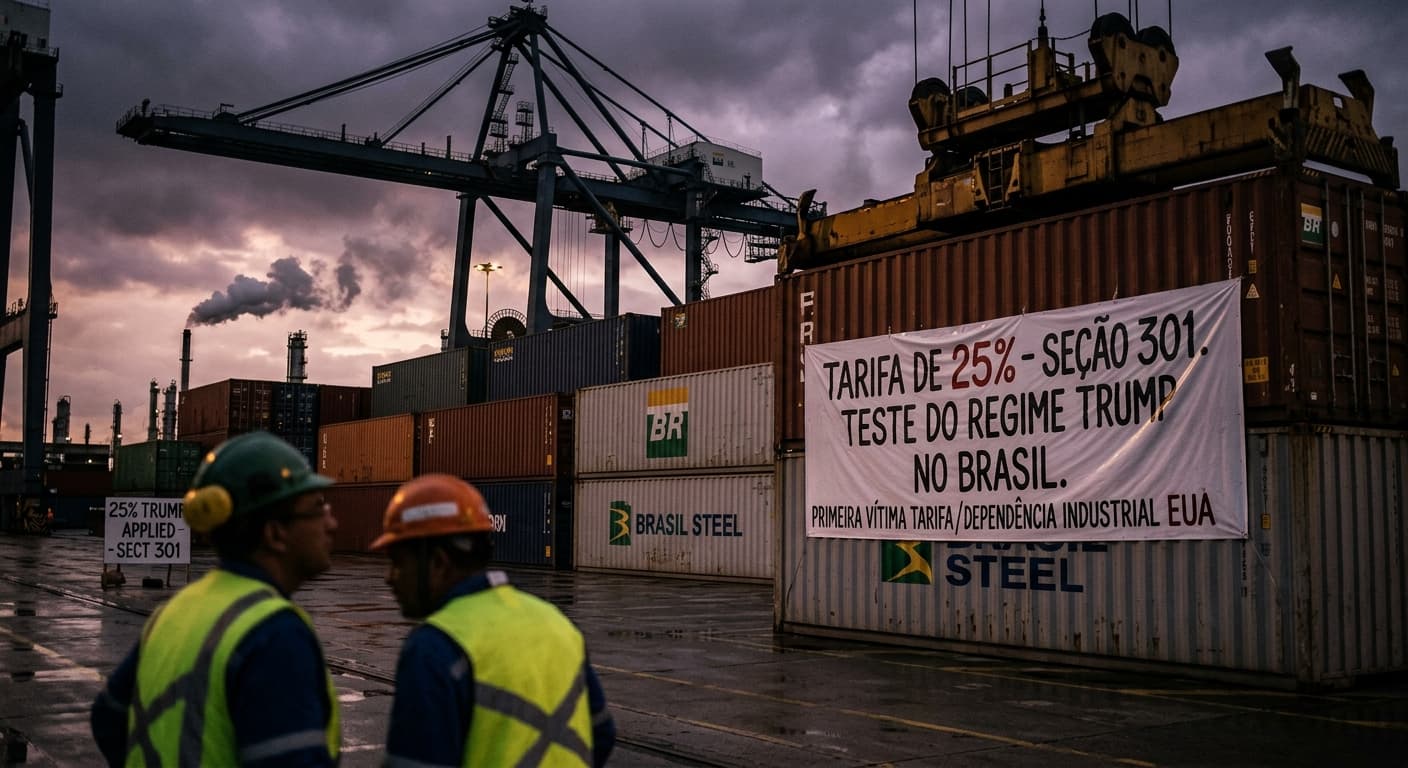
Brazil Becomes Trump's Section 301 Guinea Pig — And a Test Case for the Post-IEEPA World
On July 22, 2026, a 25% US tariff on Brazilian goods enters force, pushing Brazil's effective US rate from 1.19% to 14.42% in 18 months — the steepest climb for any major trading partner under Trump. The real story is not the headline number. It is that Brazil is the first completed test of Washington's post-IEEPA tariff architecture, and the cavernous exemption list reveals exactly where America's dependence overrules its trade-war rhetoric.
The 25% tariff on Brazilian imports that takes effect today was born not from a trade deficit — the US ran a $14.4 billion surplus with Brazil in 2025 — but from a legal vacuum. When the Supreme Court struck down the IEEPA-based tariff regime on February 20, the administration needed a durable replacement. Section 301 of the Trade Act of 1974, with its investigative process and public-comment scaffold, became the chosen instrument. Brazil was the first country to go through the full year-long investigation, public hearing, comment period, and final determination. Every other trading partner now facing Section 301 probes — 60 countries on forced labor, 16 on excess capacity — is watching what happens in Brasília today.
The effective rate tells the story better than the nominal 25%. According to the Global Trade Alert analysis, Brazil's trade-weighted US tariff, which stood at 1.19% when Joe Biden left office in January 2025, will spike to 18.17% for four days starting today as the new Section 301 overlaps with the expiring Section 122 surcharge, then settle at 14.42% on July 26 — still a 13.2 percentage point jump that makes Brazil the country most tariffed by Trump's second term BBC Brasil. Only about $8.5 billion of Brazil's $39.6 billion in 2024 exports to the US will actually pay the full 25%, while $20.1 billion sits in the exemption annex and another $7.3 billion is carved out under Section 232 metals tariffs
Global Trade Alert.
The IEEPA Hangover: Why Section 301, Why Now
When the Supreme Court ruled that the president cannot use IEEPA to impose sweeping tariffs, the administration lost its fastest tool. Within hours, USTR Jamieson Greer signaled that Section 301 would be the primary vehicle to rebuild the tariff wall — and he described it as "incredibly legally durable" Global Trade Alert.
Section 301 requires no national-security finding and no statutory cap on tariff rates. But it does require an administrative record: investigations, consultations, public hearings, and a determination that foreign practices are "unreasonable or discriminatory and burden or restrict US commerce." The Brazil investigation, launched on July 15, 2025 — the same week Trump had slapped a 50% IEEPA tariff on Brazil, largely in response to the prosecution of ally Jair Bolsonaro — became the template.
The process was exhaustive. USTR held two public hearings, received over 360 written comments, convened more than 30 negotiation sessions with Brazilian officials, and on June 1, 2026, issued a 107-page determination that Brazilian practices across six areas were actionable under Section 301(b) USTR Final Action Press Release. On July 15, the final action was announced: 25% on substantially all Brazilian goods, with a list of exemptions, effective July 22.
The original PEGN report notes that the tariff covers items including footwear, machinery, and ethanol, while preserving beef, coffee, orange juice, crude oil, aircraft, semiconductors, strategic minerals, pulp, and pig iron PEGN.
The Six Grievances — and the One That Actually Bites
The USTR's determination catalogues six areas where Brazil's acts, policies, and practices were found unreasonable:
-
Digital trade and electronic payments: Brazilian courts issued secret orders directing US platforms — X, Meta, Google — to remove political content and suspend US accounts, sometimes globally. Brazil's central bank, as both regulator and operator of the Pix payment system, created what USTR called a conflict of interest that disadvantaged US competitors through mandatory free access for individuals and fee caps for businesses
USTR Initiation Document.
-
Unfair, preferential tariffs: Brazil granted Mexico and India preferential rates on thousands of tariff lines — in some cases 10 to 100 percentage points below the MFN rate — covering sectors where both countries are globally competitive, disadvantaging US motor vehicles, chemicals, and machinery
-
Anti-corruption enforcement and IP protection: Brazil's failure to enforce anti-corruption measures and intellectual property rights, including patent examination delays for biopharmaceuticals and inadequate anti-piracy measures.
-
Ethanol market access: Brazil walked away from a previously balanced tariff arrangement in 2017. US ethanol exports to Brazil fell 87% from a peak of $761 million in 2018 to $96 million in 2025
-
Illegal deforestation: Brazilian farmers and ranchers used illegally deforested land for agricultural production, gaining competitive advantage through lower land and input costs.
Yet only one of these areas has a straightforward economic lever: ethanol. The Economist noted that Pix, Brazil's beloved digital-payments system that now processes over 40 billion transactions annually, became a source of national pride after being "assaulted by Donald Trump" The Economist. The deforestation claim, while serious, was met with Brazilian officials pointing to a $424.5 billion US trade surplus with Brazil over the past 15 years, as noted in the PEGN report.
"Extensive negotiations with Brazil over the past year have not resolved these issues, but we remain open to continuing negotiations," Greer said in a statement Al Jazeera.
The Brazilian government's response was blunt. Itamaraty called the determination "a lamentable milestone in the history of Brazil-US relations" and declared it would not recognize the legitimacy of unilateral investigations outside WTO frameworks. Brazil will immediately trigger its Lei de Reciprocidade Econômica and file a dispute at the WTO's solution mechanism PEGN.
The Exemptions: A Map of American Dependence
The list of products that escape the 25% tariff — covering roughly 65% of Brazilian exports to the US by value, according to Peterson Institute economist Monica de Bolle — is the most revealing document in this dispute BBC Brasil. It is a reverse map of where US industry cannot afford disruption.
Crude oil, Brazil's top export to the US at nearly $6 billion in 2024, is exempt because Gulf Coast refineries like Valero and Marathon depend on heavy Brazilian crude to blend with light shale oil CSIS. Pig iron — where Brazil supplies more than 50% of US consumption — was added to the exemption list in the final order after US foundries argued that integrated steel producers consume over 95% of domestic output and the Russia-Ukraine war had curbed alternative supply
Global Trade Alert. Beef and coffee, both up over 11% in US consumer prices year on year, remain untouched.
Embraer's commercial jets, worth $3.2 billion and representing 60% of the company's sales, were carved out with an effective 2.5% rate. Aircraft parts for US manufacturers like Pratt & Whitney remain unaffected. The exemptions, de Bolle concluded, "reveal the limits of American protectionism" — the US, despite its rhetoric, is deeply integrated with the Brazilian economy and cannot easily decouple BBC Brasil.
The products that do pay are primarily manufactured goods with fewer anchor industries in the US: footwear, apparel, machinery, wood products, and sugar. The Global Trade Alert analysis identifies machinery as the single largest duty burden at $0.35 billion annually, followed by wood products at $0.32 billion and sugar at $0.21 billion Global Trade Alert. These are sectors where Brazilian exporters will struggle most to redirect sales — specialized machinery and components are harder to reroute than commodities.
Brazilian footwear, which sent over $31 million in leather-sole shoes to the US in 2024 alone, faces a particularly sharp adjustment WITS World Bank. Unlike soybeans or crude oil, handcrafted leather shoes made in Rio Grande do Sul cannot simply be sold to China overnight.
What's hit and what's spared: Brazil's export basket under the Section 301 tariff
Based on 2024 trade data and USTR Annex exemptions. Effective rate as of July 26, 2026.
| Product Category | Annual US Imports (bn USD) | Section 301 Status | Effective Tariff |
|---|---|---|---|
| Crude Oil | 6.0 | Exempt (Annex) | 0% |
| Aircraft & Parts | 3.2 | Carved out (2.5% effective) | 2.5% |
| Coffee (all forms) | 1.9 | Exempt (Annex) | 0% |
| Pig Iron | 1.5 | Exempt (added in final order) | 0% |
| Beef | 0.9 | Exempt (Annex) | 0% |
| Orange Juice | 0.6 | Exempt (Annex) | 0% |
| Cellulose/Pulp | 1.5 | Exempt (Annex) | 0% |
| Machinery | ~3.0 | HIT | 25% |
| Wood Products | ~1.3 | HIT | 25% |
| Footwear & Apparel | ~0.5 | HIT | 25% |
| Sugar | ~0.8 | HIT | 25% |
| Ethanol | ~0.1 | HIT | 25% |
Source: Global Trade Alert / St. Gallen Endowment, USTR Federal Register notice July 15, 2026. Total imports $39.6bn (2024).
Political Crossfire: Bolsonaro, Lula, and the October Election
The tariff lands three months before Brazil's October 2026 presidential election, and the politics are combustible. President Luiz Inácio Lula da Silva has accused Flávio Bolsonaro, the son of jailed former president Jair Bolsonaro and now a presidential hopeful, of lobbying Washington to impose the tariffs as a political weapon. In a social media post, Lula called Bolsonaro's request for Trump to delay the tariffs until after the election "yet another act of treason against the Fatherland" Al Jazeera.
Bolsonaro denies the accusation, arguing that the tariffs would hand Lula "the political victory it has been engineering" by allowing him to rally nationalist sentiment. A Quaest poll last month found 47% of Brazilians agreed with Lula's claim that the Bolsonaro family encouraged the tariffs, while 35% sided with Bolsonaro. Secretary of State Marco Rubio, in a response to Bolsonaro's letter, said the US still had "substantial differences" with Brazil, showing no sign of a delay.
The political dimension is not incidental. The original 50% IEEPA tariff imposed in July 2025 included a 40% component explicitly framed as punishment for the prosecution of Jair Bolsonaro, a Trump ally. The Section 301 investigation that culminates today was launched the same week. Whether the trade action is genuinely about Pix and deforestation or about pressuring Lula's government ahead of an election — or both — is now a live question in Brasília.
Brazil's Countermoves: Reciprocity, WTO, and the Forced-Labor Wildcard
Brazil's response is three-track: legal, retaliatory, and defensive. The Lei de Reciprocidade Econômica, passed by Congress in April 2025 and sanctioned by Lula in July 2025, authorizes the government to impose retaliatory tariffs, suspend trade concessions, or even suspend intellectual property rights in response to unilateral trade measures BBC Brasil. Finance Minister Dario Durigan confirmed on July 14 that the government was likely to resume the reciprocity process, which had been suspended during earlier negotiations.
Simultaneously, Brazil is filing a formal dispute at the World Trade Organization, arguing that the US has violated core WTO principles including most-favored-nation treatment and negotiated tariff ceilings. Historically, WTO dispute resolution has been slow and the US has blocked appointments to the Appellate Body, meaning any ruling could take years and face enforcement deadlock.
The domestic mitigation plan, branded Plano Brasil Soberano, includes expanded export credit through a R$30 billion fund, tax rebates for affected exporters, and public procurement programs for perishable goods that cannot be redirected BBC Brasil. ApexBrasil, the trade promotion agency, has outlined a R$130 million plan to diversify exports away from the US market.
The wildcard is the separate Section 301 investigation into forced labor, covering 60 countries, which is set to conclude later this month. The USTR has proposed 12.5% additional duties on the 45 countries it found to have wholly failed to prohibit imports of goods made with forced labor, including Brazil, China, and India Al Jazeera. If imposed, the combined rate on affected Brazilian products could reach 37.5%, as the PEGN report warns
PEGN.
The Council on Foreign Relations has noted that the Trump administration is "well on its way toward ensuring that, through a patchwork of investigations, the United States will ultimately have tariffs similar to those imposed under IEEPA" — but whether those tariffs achieve the stated objective of reindustrializing the US economy is "an open question" CFR.
Diplomat View
The Brazil Section 301 action is not primarily about Brazil. It is the proof of concept for a post-IEEPA tariff regime that must withstand legal scrutiny while delivering the protectionist architecture Trump's base demands. The 107-page USTR report and the elaborate exemption annex do two things simultaneously: they build the administrative record courts require, and they expose where American industry will not tolerate disruption.
Brazil's effective rate of 14.42% is high enough to cause real damage to sectors like footwear and wood products, but low enough — and porous enough through exemptions — that the macroeconomic impact on Brazil's $2.1 trillion economy will be contained. The political impact may be larger: Lula now has a nationalist foil three months before an election, and the Bolsonaro family's entanglement with Washington gives the incumbent a weapon he will use.
The forecast: The forced-labor investigation will yield additional duties, but at the lower 10% rather than 12.5% level for Brazil, reflecting the same carve-out logic. Brazil's WTO challenge will take years and produce no enforcement. The reciprocity law will be used selectively — likely on US corn ethanol and a handful of symbolic consumer goods — rather than broadly, to preserve negotiation space. If the October election produces a Bolsonaro victory, expect rapid de-escalation; if Lula wins, the tariff stays and the relationship freezes.
What would change this forecast:
- July 26: The expiration of the Section 122 surcharge provides a clean read on the standalone Section 301 rate; if markets react badly, exemptions may widen.
- Late July: The forced-labor Section 301 determination; if Brazil gets the full 12.5%, expect Brasília to escalate reciprocity measures within 30 days.
- October 2026: Brazilian general election — the single largest variable in the bilateral trade trajectory for 2027 and beyond.
The Bottom Line
Brazil today becomes the first full test of whether Section 301 can serve as a permanent replacement for the IEEPA tariff regime. The 25% headline is less important than the exemption list, which reveals exactly where US industry holds veto power over its own government's trade policy. The next administration in Brasília — Lula or Bolsonaro — will determine whether this tariff is a four-year fixture or a bargaining chip that expires shortly after inauguration day.
Discover more

US Politics
House Ethics Committee Pushes Sexual Miscond.
The House Ethics Committee has shifted responsibility for sexual harassment settlement records to the Office of Congressional Workplace Rights, complicating disclosure efforts.

US Politics
SNAP Food Assistance Faces Legal Challenges
In 2026, SNAP faces stricter eligibility rules and mounting legal challenges, threatening food assistance for the millions of Americans who rely on the program.
Global Politics
Trump's Conflicting Messages on Iran War
Trump's mixed messages on Iran reflect a strategy of audience management, benefiting Tehran amid a complex geopolitical landscape.

Conflict & Security
Drone Warfare Killing Aid Workers at Unprec
Over 1,000 humanitarian workers killed in three years as cheap armed drones collapse legal protections. Gaza, Sudan, Ukraine, and DRC see deliberate targeting of aid convoys and hospitals with zero prosecutions.