Australia's Pacific Treaty Sweep: Six Deals
Canberra's rapid treaty signings face political risks.
Model Diplomat7 min readOceania
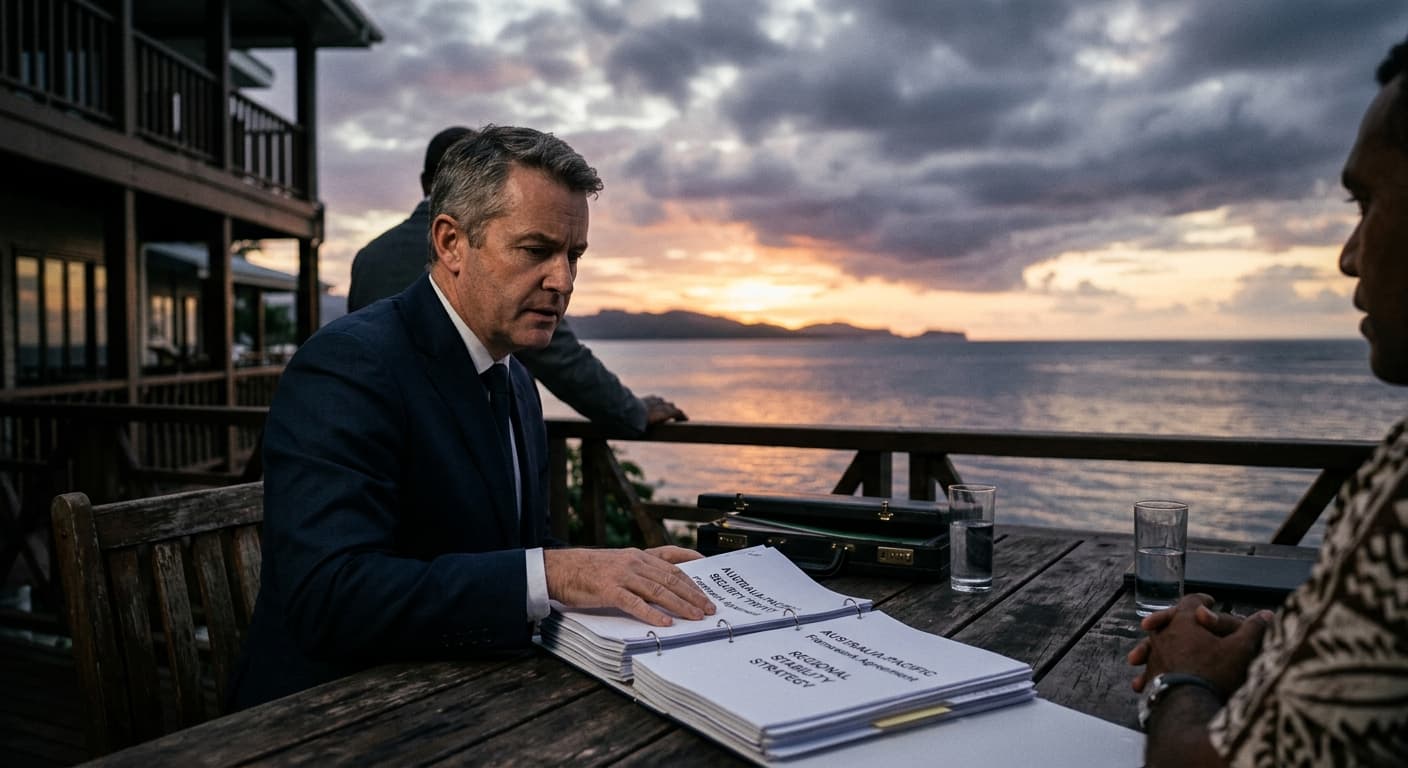
Australia's Pacific Treaty Sweep: Six Deals, One Fragile Window
Canberra has signed six Pacific security treaties in 32 months, culminating in Fiji's Ocean of Peace Alliance on July 6, 2026 — but the political scaffolding holding the streak together is thinner than it looks.
In the ten days between June 29 and July 8, 2026, Anthony Albanese collected three signatures that would have been considered improbable eighteen months ago: the Nakamal Agreement with Vanuatu, the Vuvale Union and Ocean of Peace Alliance with Fiji, and an in-principle commitment from Solomon Islands' new prime minister Matthew Wale to conclude a "comprehensive" treaty by year's end. The angle that matters is not that Australia is winning — it is that Canberra is racing to lock in treaty text before the leaders who signed it are voted out. Every one of these instruments outlives its signatory by design; the durability question is whether the successor governments will still recognise the bargain.
The streak, in specifics
The Nakamal Agreement, signed at Parliament House in Canberra on June 29, commits Australia to A$500 million over 10 years and — critically — bars foreign military bases from Vanuatu's territory. Vanuatu will "consult" Canberra on third-party investment in critical infrastructure, according to reporting by Al Jazeera, but the outright veto Australia originally sought was stripped from the final text after Prime Minister Jotham Napat's coalition partners baulked in September 2025. Vanuatu also committed to turning to Australia, New Zealand or France first in any major natural disaster.
Seven days later in Suva, Albanese and Fijian Prime Minister Sitiveni Rabuka signed both a treaty-level Vuvale Union — elevating the 2019 Fiji-Australia Vuvale Partnership across security, economic and people-to-people pillars — and, in a surprise move, the Ocean of Peace Alliance, Fiji's first-ever mutual defence pact and Australia's fourth after the United States, New Zealand and Papua New Guinea. The BBC reported the treaty is backed by
more than A$1 billion in Australian spending over a decade on transnational crime, health and infrastructure.
Hours after the signing, China conducted its first-ever submarine-launched ballistic missile test into international waters of the Pacific, a move CSIS analysts called an intentional escalation of the strategic backdrop. Foreign Minister Penny Wong, standing in Suva, said the launch was "in the context of a rapid military build-up by China" and risked "destabilising" the region.
Albanese then flew to Honiara. On July 8, he and Prime Minister Wale announced formal negotiations on a comprehensive treaty — building on the 2017 bilateral security treaty and a A$190 million policing package signed with the previous Manele government in December 2025. As PACNEWS reported, Albanese paired the announcement with an education assistance package and confirmation that Solomon Islands is reviewing all its security agreements — including the 2022 pact with Beijing.
The primary document that anchors the model
The Falepili Union with Tuvalu is the template. Its treaty text, published by Australia's Department of Foreign Affairs and Trade, contains the clause every subsequent Pacific instrument echoes in varying strength. Under Article 4, Tuvalu commits that it "shall mutually agree with Australia any partnership, arrangement or engagement with any other State or entity on security and defence-related matters." The DFAT explanatory memorandum confirms the treaty was "the first legally binding" recognition of continuing statehood for a climate-threatened nation, in exchange for what is effectively a Canberra veto over third-country security dealings.
That is the trade. Nauru accepted a version of it in December 2024. PNG accepted a diluted version in the Pukpuk Treaty of October 2025, which the Al Jazeera report notes explicitly preserves PNG's "third-party" defence relationships. Vanuatu accepted a still-weaker version in Nakamal — consultation, not consent. Fiji's Ocean of Peace text is not yet public but is expected to mirror Pukpuk. The pattern is unmistakable: each successive treaty gives Canberra less exclusivity but more geographic coverage.
What Canberra has actually bought
The Lowy Institute's 2026 poll, released the same week as the Suva signing, is the sharpest evidence that the treaty streak has not translated into perceived influence. The poll found 39% of Australians now name China as the most influential outside power in the Pacific Islands, against just 33% for their own country — a reversal of the 2025 finding. Foreign policy approval of the Albanese government has fallen 13 points since 2024, to 37%.
That gap between diplomatic output and public perception matters because it constrains Albanese's negotiating room at home. Connor Graham of the Lowy Institute, whose analysis anchored the Islands Business piece, writes that Australia is "moving with urgency, banking agreements with Fiji and Solomon Islands while the political window remains open."
The political window is the real story. Rabuka faces an election by early February 2027 with a coalition that lost two deputy prime ministers — Manoa Kamikamica and Biman Prasad — to anti-corruption charges in October 2025. CSIS analysts describe Fiji's political environment as one where "traditional partners are treading very carefully" as domestic machinations unfold. Rabuka himself has conceded his party was "caught napping."
Wale governs on a 26–22 parliamentary margin, in a country where — as the BBC noted — no incumbent has ever been re-elected and only two prime ministers since 1978 have completed a full term. His "review" of the 2022 China security pact is politically incendiary; the Chinese police contingent remains in Honiara, and Beijing controls a Pacific Games stadium worth $119 million.
The historical parallel that reframes this
The comparison analysts avoid making is the most instructive one: this is Canberra's Melanesian equivalent of the U.S. Compacts of Free Association with Palau, the Federated States of Micronesia and the Marshall Islands. Under those compacts, Washington provides economic assistance in exchange for exclusive defence access. Australia is now building a functional equivalent — but without the constitutional integration that makes the Compacts durable. What binds a compact state to Washington is the passport, the postal service and the federal transfer. What binds Suva or Honiara to Canberra is a treaty text and a decade of aid.
That is why the Falepili visa pathway and the Vuvale Skills Hub matter more than the mutual defence clauses. Albanese, launching Fiji's new skills program on July 6, pledged 145 million Fijian dollars for digital transformation and ship-maintenance training. The 280-visa Falepili pathway, according to DFAT's explanatory memorandum, was structured for indefinite permanent residency because temporary schemes had a "revolving door" effect. Canberra has learned that treaty text without human integration produces the Kilman problem: Vanuatu's Sato Kilman, who
pledged in 2023 to "revisit" the earlier Australian security pact after his predecessor was ousted over it.
Beijing's counter-move is already visible
China's response is running on two tracks. The first is rhetorical: Foreign Ministry spokesperson Guo Jiakun said the Nakamal deal must not "target any third party or be used as a tool for geopolitical rivalry," standard boilerplate now attached to every Pacific pact. The second is material: Vanuatu is set to sign a separate economic agreement with China, whose loans built Port Vila's presidential complex, parliament and roads. China remains Vanuatu's largest external creditor and, per Al Jazeera, has funded expansion of the Luganville wharf — long identified by Australian analysts as a potential dual-use facility.
In Fiji, the QUAD announced a joint port development at Suva and Lautoka in May 2026, with a study underway with the U.S. Millennium Challenge Corporation. As Al Jazeera reported, Suva Port authorities have discussed $181 million in upgrades and a $1.82 billion relocation plan. That is the economic scaffolding beneath the Ocean of Peace Alliance — and it is Washington-and-Tokyo-financed, not purely Australian.
The Lowy Poll's most under-discussed number is trust: 61% of Australians now see China more as an economic partner than security threat, an 11-point jump from 2025. Support for working with allies to deter Chinese military force is down six points. The domestic political ground under Albanese's Pacific push is softer than the treaty pace suggests.
Diplomat View
The treaties will outlast Albanese, Rabuka, Napat and Wale — that is their point. But two of the four are exposed to leadership change within 18 months, and the Ocean of Peace text remains unpublished. The falsifiable call: if Rabuka loses in early 2027 to a successor from within his own party (the greatest threat, per Fijian analysts), expect the Ocean of Peace mutual defence obligation to be renegotiated within its first three years, not repudiated. If Wale's coalition collapses before end-2026, the Solomon Islands comprehensive treaty will be shelved, not signed, and Australia's streak will read as five-of-six rather than six-of-six. The revision trigger: watch whether the Ocean of Peace Alliance text, when published, contains a Falepili-style "mutual consent" clause on third-party security engagements or the weaker Pukpuk-style "consultation" language. That single verb determines whether Canberra has built a Pacific alliance system or a Pacific promise system.
Forward look — what to watch:
- August–September 2026: Publication of the Ocean of Peace Alliance treaty text and Australian parliamentary tabling via the Joint Standing Committee on Treaties.
- September 2026: 55th Pacific Islands Forum Leaders' Meeting — first regional test of whether Rabuka's "Zone of Peace" framing survives contact with Beijing-aligned members Solomon Islands (under review) and Kiribati.
- End-2026: Target date for signature of the Australia-Solomon Islands comprehensive treaty; Wale's parliamentary majority is the binding constraint.
- By early February 2027: Fijian general election. A change of government would trigger the first real stress test of a Vuvale Union that has yet to be ratified in Suva.
The Bottom Line
Australia has signed six Pacific security instruments in 32 months and is racing to sign a seventh before political windows in Suva and Honiara close. The treaties are engineered to bind successor governments, but three of the six signatory leaders face electoral or coalition risk inside 18 months — which is why the durability of Albanese's streak will be judged not by ink but by whether the successors ratify, honour or quietly redraft what they inherit. The Pacific is no longer a diplomatic contest Canberra is winning against Beijing; it is one Canberra is trying to lock in before the ground shifts underneath both of them.
Discover more

US Politics
SNAP Food Assistance Faces Legal Challenges
In 2026, SNAP faces stricter eligibility rules and mounting legal challenges, threatening food assistance for the millions of Americans who rely on the program.
International Relations
Economist Impact Sustainability Week 2026
Economist Impact Sustainability Week 2026 spotlights the energy transition, AI in clean technology, and supply chain resilience as themes for global leaders.

India
Delhi CM Rekha Gupta Blasts Opposition's Delm
Delhi CM Rekha Gupta's remarks on women's quota defeat reveal BJP's strategy for the 2029 Lok Sabha elections, focusing on delimitation.

Economics
Fed's Amex AML order puts correspondent banking on notice
Federal Reserve's Amex AML order requires board-level controls and a 90-day plan; OCC fined the bank $350 million over enterprise-wide deficiencies.