Australia's Pacific treaty streak: how long?
Canberra's new pacts face political tests ahead.
Model Diplomat8 min readOceania
Australia's Pacific treaty streak: how long can it hold?
Canberra signed three Pacific security pacts in nine days — but Fiji's election and the Solomons' revolving door will test whether the paper survives the politicians who signed it.
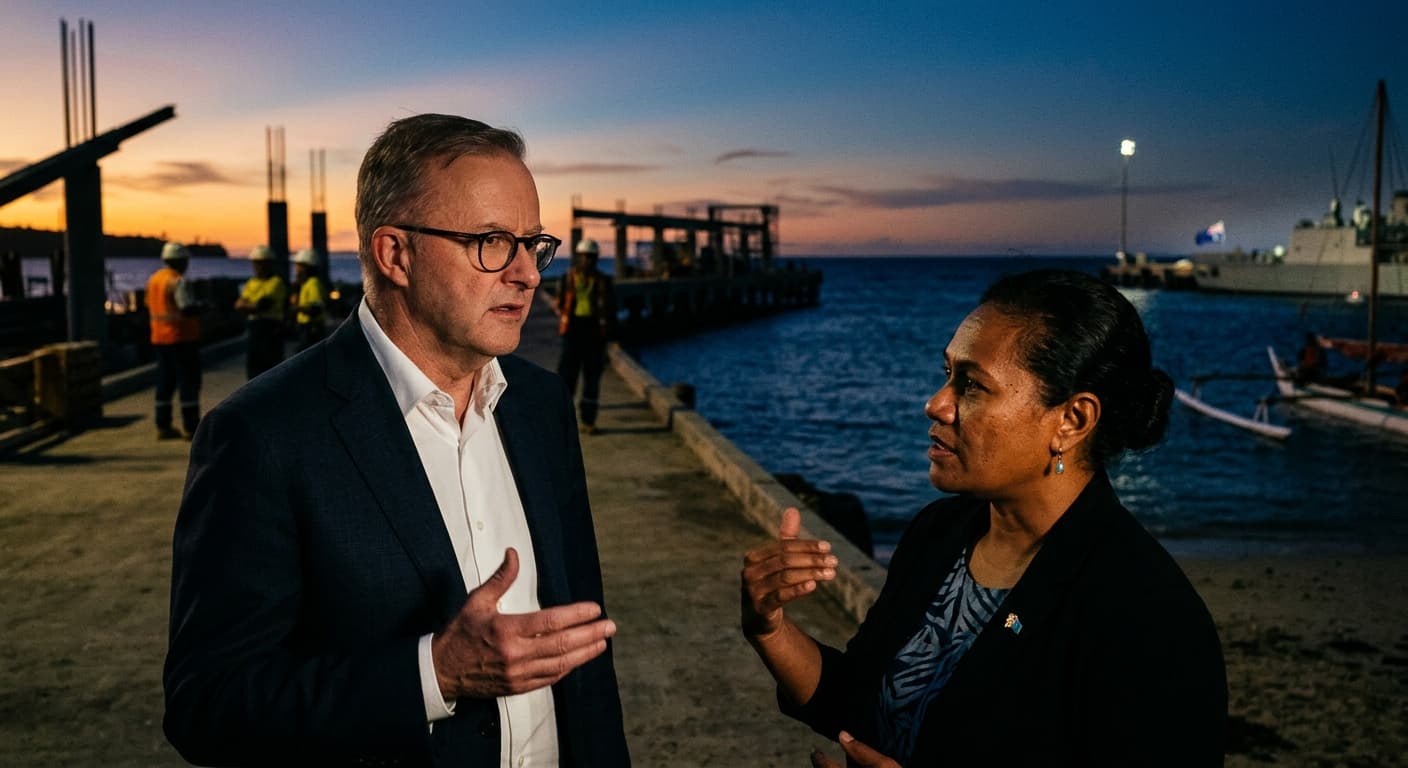
Between June 29 and July 8, 2026, Australia locked in three new security agreements with Pacific Island states — the Nakamal Agreement with Vanuatu, the Vuvale Union with Fiji, and the Ocean of Peace Alliance, only Australia's fourth formal alliance in seven decades — while opening comprehensive treaty talks in Honiara and bringing the Pukpuk Treaty with Papua New Guinea into force. The thesis: Prime Minister Anthony Albanese has bought a paper architecture designed to bind future governments to Canberra, not just today's leaders. Whether it holds turns on two elections — Fiji's, by early February 2027, and the Solomon Islands' revolving-door parliament — and on whether Australia's own voters keep giving him the mandate to spend on it.
The nine-day sweep
The tempo alone is unusual. On June 29 in Canberra, Albanese and Vanuatu Prime Minister Jotham Napat signed the Nakamal Agreement, a 10-year deal worth roughly A$500 million that, as Al Jazeera reported, bars foreign military bases on Vanuatu's soil and requires Port Vila to consult Canberra on third-party investment in critical infrastructure. It stops short of the outright veto Australia's negotiators originally sought — Vanuatu's coalition partner rejected an earlier draft in September 2025 over fears of foregoing Chinese infrastructure money, per
Al Jazeera.
A week later in Suva, Albanese and Fiji's Sitiveni Rabuka signed two instruments in a single ceremony. The Vuvale Union upgrades the 2019 Fiji–Australia Vuvale Partnership to treaty status across security, economic and people-to-people pillars, backed by more than A$1 billion in Australian spending over a decade on transnational crime, health and infrastructure, according to the BBC. The Ocean of Peace Alliance, unveiled the same day, extends mutual-defence language along the lines of Canberra's Pukpuk Treaty with Port Moresby. In the Australian government's own words, the Ocean of Peace is Australia's "fourth formal Alliance" — its first with a small Pacific state — per the
Prime Minister's Office.
From Suva, Albanese flew to Honiara, becoming the first foreign leader to attend Solomon Islands' independence day and opening negotiations with new Prime Minister Matthew Wale on a comprehensive treaty targeted for end-2026. On July 8, back on Australian soil, Albanese hosted the leaders of PNG, Samoa and Tonga in Brisbane — the same day the Pukpuk Treaty with PNG entered into force. The Australian government's own release described the sequence as "historic," a term it deployed three times in a single press notice.
What Australia actually bought
Strip away the ceremonial vocabulary and three things stand out.
First, Canberra has moved from bespoke aid packages to treaty-level scaffolding. The Falepili Union with Tuvalu, which entered into force in 2024, was the world's first climate-mobility treaty and mutually obliges the parties to "consider and mutually agree" any third-party security arrangement — a provision confirmed at the PIF joint press conference. The Pukpuk Treaty goes further: as CSIS documented, it commits the two states to "act to meet the common danger" of an armed attack and enables up to 10,000 PNG personnel to serve in the Australian Defence Force, per its
analysis. The Ocean of Peace Alliance appears to mirror that language, though the text was not published on signing day.
Second, the money is real. The BBC has documented A$500 million to Vanuatu over a decade, and Albanese has committed more than A$1 billion to Fiji over the same horizon. According to the Lowy Institute's Pacific Aid Map, Australia already accounts for 38% of all official development finance to the Pacific from 2008–2023, dwarfing China's 9% share, per
Lowy's 2025 key findings. What the 2026 treaty stack does is convert that spending advantage into legally binding architecture that Beijing cannot match by writing bigger cheques alone.
Third, the pattern is exclusionary by design. Nakamal explicitly names Australia as Vanuatu's "primary policing partner" and bans foreign bases. The Nauru–Australia Treaty of December 2024 gives Canberra a veto over third-party security arrangements. Even the softer Vuvale Partnership text on DFAT's website commits Fiji and Australia to safeguard the region as "a zone of peace against a changing climate and geostrategic contest" — diplomatic code for containing China's security footprint.
Beijing's opening — and its ceiling
China's public response has been calibrated but unmistakable. Foreign Ministry spokesperson Guo Jiakun told reporters, per Al Jazeera, that Beijing hopes Pacific cooperation "will not target any third party or be used as a tool for geopolitical rivalry." On the Fiji signing, Rabuka insisted the alliance "does not threaten Fiji's relationship with China," per the BBC.
But Beijing's leverage is structural rather than diplomatic. In Vanuatu, China remains the largest external creditor and — as CSIS documented — was in parallel negotiations for its own agreement with Port Vila even as Canberra was closing Nakamal. In the Solomon Islands, the 2022 China security pact has never been publicly released, and Chinese police and infrastructure are, in the assessment of Lowy's Connor Graham (quoted by the
BBC), now "embedded." Wale, elected in May 2026 in a 26–22 parliamentary vote, has moderated his old China-hawk stance and pledged only to "review" — not repudiate — the Beijing agreement.
That gap between paper commitments and material dependence explains why 39% of Australians told the 2026 Lowy Institute Poll that China holds most influence in the Pacific Islands, versus 33% for Canberra — a reversal from 2025's numbers, and a finding that Lowy analysts explicitly describe as sitting "at odds with the resources Australia commits to the region," per the Poll methodology page.
The fragility beneath the streak
Two capitals — Suva and Honiara — carry the highest political risk in the treaty stack.
In Fiji, Rabuka is heading into an election due by early February 2027 with a wounded coalition. Two of his deputy prime ministers, Manoa Kamikamica and Biman Prasad, resigned within days of each other last October after being charged by Fiji's anti-corruption commission, as Islands Business reported. Rabuka himself has conceded his party was "caught napping." Analysts consulted by Lowy's Connor Graham judge his re-election prospects as uncertain, with the biggest threat coming from inside his own People's Alliance.
In the Solomon Islands, the arithmetic is worse. Wale governs with a slim majority, cobbled together in May 2026 to oust former Prime Minister Jeremiah Manele in a no-confidence vote. Since Solomon Islands independence in 1978, only two prime ministers have completed a full parliamentary term and no incumbent has ever been re-elected, per Lowy's Interpreter analysis. Wale's own foreign minister nominee in the previous government, Peter Shanel Agovaka, is a China-friendly rival still active in parliament.
That is why Australia is racing to lock in binding legal architecture rather than statements of intent. Ratified treaties survive changes of government; personal rapport does not. The Falepili Union already required both Australian and Tuvaluan parliamentary approval before entry into force — a precedent Canberra clearly hopes to replicate for Vuvale and, eventually, the Solomon Islands agreement.
The counter-risk sits inside Australia itself. The 2026 Lowy Poll showed satisfaction with the Albanese government's foreign-policy performance dropped 12 points from 2024, with only 37% rating it "quite good" or better, according to the Lowy Poll landing page. Support for working with allies to deter Chinese military force fell six points to 54%. That is a domestic mandate under quiet erosion — even as the diplomatic output accelerates.
The regional geometry has shifted
The Ocean of Peace framing did not originate in Canberra. It was Rabuka's initiative, pitched in a July 2024 speech at Australia's National Press Club and later endorsed by the full Pacific Islands Forum. In a Suva press conference on 8 May 2026, Australian Foreign Minister Penny Wong explicitly credited Rabuka for being "the driving force of this concept," describing the Vuvale Union as giving "practical expression" to a Pacific-authored idea.
That distinction matters. Every Pacific security pact Beijing has floated — the 10-nation communiqué Wang Yi proposed in 2022, the Comprehensive Strategic Partnership with the Cook Islands in 2025 — has come under fire in the region as a great-power document dropped on small states. Australia's treaty stack, by contrast, absorbs and codifies rhetoric coined by Pacific leaders themselves: vuvale (Fijian for "family under one roof"), falepili (Tuvaluan for "neighbourly duty"), pukpuk (Tok Pisin for "crocodile"), nakamal (a Vanuatu community meeting place).
That branding is not decoration. It gives incoming governments in Suva, Honiara and Port Vila fewer nationalist arguments to tear the paper up. If a post-Rabuka Fijian coalition wanted to walk away from the Ocean of Peace, it would be walking away from a Rabuka-authored concept endorsed by the entire Pacific Islands Forum. That is a higher political cost than repudiating a foreign-imposed pact.
Diplomat View
The treaty streak is real, but its durability is uneven. Nakamal and Vuvale will likely survive — both are backed by parliamentary structures Australia has deliberately used to lock in ratification, and both encode Pacific-authored rhetoric that raises the political cost of repudiation. The Ocean of Peace Alliance's fate hinges almost entirely on Fiji's February 2027 election: if Rabuka loses to a challenger from within his own People's Alliance rather than to a Fiji First–aligned bloc, the alliance holds. If the challenger comes from outside the current coalition and campaigns explicitly against alignment, expect a review, not a repudiation — Pacific states rarely tear up treaties, they slow-walk them.
The Solomon Islands treaty is the most fragile link and, therefore, the highest-value prize. Canberra should sign it before Wale loses the parliamentary numbers that produced him. Our forecast: a Solomon Islands comprehensive treaty is signed but not ratified before end-2026, with ratification stretching into 2027 and vulnerable to a change of government. What would revise the forecast: (a) a Rabuka loss to an anti-alignment coalition; (b) public release of the 2022 China–Solomon Islands security pact showing exclusivity clauses incompatible with the Australian treaty; or (c) an Australian federal decision to cut Pacific ODF below current trajectories in the 2026–27 budget update.
What to watch next
- Fiji general election, due by early February 2027 — the single most important test of whether the Ocean of Peace Alliance outlives its authors.
- Ratification of the Ocean of Peace Alliance and Vuvale Union in Australia's Joint Standing Committee on Treaties — parliamentary hearings scheduled for the second half of 2026.
- Solomon Islands comprehensive treaty text — targeted for signature by end-2026; watch for whether it includes an exclusivity or third-party-consultation clause matching Nakamal.
- Australia's next federal budget update — whether the A$1 billion Fiji commitment and A$500 million Vanuatu commitment are locked into forward estimates or subject to review.
- Pacific Islands Forum Leaders Meeting, September 2026 — first regional test of whether the Australia-authored architecture is treated as a Pacific consensus or as Canberra's bilateral project.
The bottom line: Australia has built the most consequential Pacific security architecture since ANZUS, but it has built it on political ground that shifts every election cycle. The paper is stronger than the personalities that signed it — but only if it survives its first change of government, and that test arrives, at the latest, in early 2027.
Discover more

Global
World Normalises Taliban as Afghan Women Eras
UN data shows Afghan women erased from public life as Russia recognises the Taliban, EU hosts officials in Brussels, and ICC warrants for gender persecution go unenforced.
Economics
US Tariffs on Brazil: A Political Play
US imposes 25% tariff on Brazil but exempts 66% of exports, targeting manufactured goods ahead of Brazil's October election. Analysis of the political calculus, exemptions, and Brazil's response options.
Economics
Trump's 50% Tariff on Canada Ends USMCA's Tar
Trump invokes Section 338 of the Tariff Act of 1930 for the first time, imposing 50% tariffs on $20 billion of Canadian goods and ending the USMCA tariff shield.
Global
The Drone-Corridor Sleight of Hand
A Taipei Times editorial proposes a Taiwan-India drone corridor using Tamil Nadu factories to assemble Taiwanese components, exploiting dual-use tech classification to avoid Beijing's red lines while purging Chinese parts from supply chains.