Strait of Hormuz at Near-Standstill as Med
Shipping at 16% of pre-war levels as mediators test MOU's limits
Model Diplomat9 min readMiddle East
Strait of Hormuz at Near-Standstill as Gulf Mediators Test Diplomatic Channels Around a Collapsing US-Iran MOU
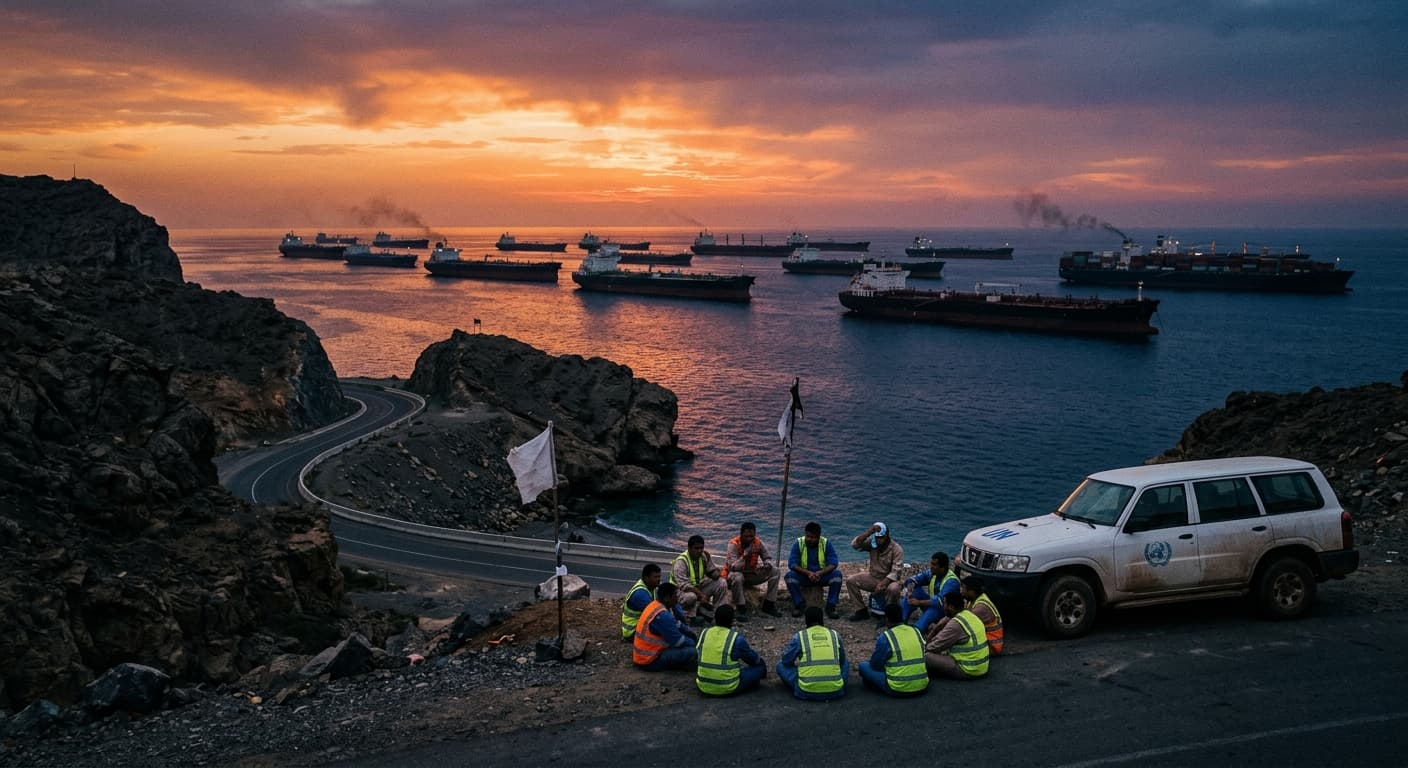
Gulf-state mediators led by Qatar are racing to salvage a performance-based US-Iran MOU that has functionally broken down over Hormuz control, with shipping traffic at 16% of pre-war levels and 6,000 seafarers stranded as of July 10, 2026.
On July 10, 2026, Qatari negotiators met Iranian officials in Tehran to de-escalate the worst fighting since the June 17 memorandum of understanding was signed, even as the Strait of Hormuz's US-backed shipping route fell to zero transits and roughly 6,000 seafarers remained stranded aboard hundreds of vessels. The scramble by five regional mediators — Qatar, Pakistan, Turkey, Egypt, and Saudi Arabia — is not a peacemaking exercise. It is a test of whether the MOU's "performance-based" framework can survive its first real crisis, or whether the agreement's deliberate ambiguity over who controls Hormuz has made it unenforceable from the start.
The Performance-Based Framework Meets Its First Failure
A senior US official delivered the verdict on July 9 in a statement that frames the entire diplomatic squeeze now underway: "The MOU is performance-based, and Iran's actions constitute failed performance at an unacceptable level" (JINSA Iran War Update, July 10, 2026). The phrasing is precise. The agreement signed by President Donald Trump and Iranian President Masoud Pezeshkian at the G7 summit in Versailles was never a treaty — it was a 14-point framework in which sanctions relief, a $300 billion reconstruction fund, and the unfreezing of Iranian assets would flow only as Iran complied with its commitments on Hormuz transit, nuclear downblending, and cessation of hostilities across all fronts including Lebanon (
BBC News, June 18, 2026).
The architecture gave Washington leverage: Iran would move first, Washington would reward compliance. But the architecture assumed Iran and the United States shared the same interpretation of what compliance meant. They do not.
The dispute centers on Article 5 of the MOU, which states that Iran "will make arrangements using its best efforts for the safe passage of commercial vessels, with no charge for 60 days only, from the Persian Gulf to the Sea of Oman" and that Iran "will conduct dialogue with the Sultanate of Oman to define the future administration and maritime services" in the strait (BBC News, full MOU text). Tehran reads this as a grant of traffic-management authority over the waterway. Washington reads it as an obligation not to impede transit. Both interpretations are defensible from the text — which is the problem.
Iran's Khatam al-Anbiya Central Headquarters declared that "the only safe route for the passage of commercial ships and oil tankers in the strait is the route determined by the Islamic Republic of Iran" (BBC News). The US military's Central Command rejected this outright, posting: "TRUTH: Iran does not control the Strait of Hormuz. Since early May, US forces have helped facilitate the successful transit of more than 800 commercial vessels and 380 million barrels of crude oil" (
Al Jazeera). These are not reconcilable positions, and the MOU provides no mechanism to reconcile them.
The Numbers Tell the Story
The shipping data is the clearest measure of the MOU's functional collapse. Before the war, roughly 130 to 138 ships transited Hormuz daily. After the MOU was announced on June 14, the daily average rose to 22.3 ships, with at least 588 vessels transiting between June 14 and July 9 (JINSA Iran War Update, July 10, 2026). Traffic peaked at 72 ships on June 24, with the US-backed Omani route reaching 28 vessels on June 25 — overtaking the Iranian-designated route for the first time.
Then Iran struck ships on the Omani route on June 25 and 27. By July 9, no large vessel had crossed the Omani lane with its AIS transponder on since July 7. Lloyd's List Intelligence reported traffic "effectively grinding to a halt," with only five vessels tracked crossing on July 9, down from 45 on Monday (Al Jazeera, July 10, 2026). The UN's International Maritime Organization confirmed that 136 ships and 2,900 seafarers have been evacuated to date, but the IMO's Secretary-General Arsenio Dominguez insisted all transit should be avoided "until the necessary safety conditions are in place" (
UN News, July 9, 2026).
Oil prices have been remarkably stable, which obscures the underlying fragility. Brent crude stood at $76.58 per barrel on July 10, up about $4 from the previous week but down from wartime highs. TD Securities commodity strategist Bart Melek warned that "as oil inventories of oil and product wane, stressing supply chains," Brent could move "$10-$15 higher into the summer" (Al Jazeera). The relative calm reflects market confidence that the situation will stabilize — a confidence the shipping data does not support.
Who Holds Leverage, and Why They're Using It
The power dynamic is more complex than a binary US-Iran standoff. Five distinct actors are pursuing incompatible goals through the same diplomatic channel.
Iran's hardliners have the strongest hand. Supreme Leader Mojtaba Khamenei, who succeeded his father in March, stated in his first address that "the lever of closing the Strait of Hormuz must certainly continue to be used" (Al Jazeera). His adviser, Majid Shakeri, framed the choice starkly: "Either we hold on to this strait, or we go and become martyrs for it one by one" (
Al Jazeera, July 8, 2026). Control of Hormuz is the last deterrent Iran possesses after losing its navy, much of its missile manufacturing, and its supreme leader in the first days of the war. The hardline position is coherent: revenue is subordinate to control.
Iran's reformists are the immediate losers. The reformist newspaper Ham Mihan published an editorial on July 9 warning that public threats against foreign leaders, including Trump, "risk provoking US retaliation" and criticized the judiciary for prosecuting "minor dissent" while ignoring calls to assassinate Trump (Institute for the Study of War, July 8, 2026). The reformist faction, which backed the MOU and the diplomatic opening, is being outflanked by hardliners who can point to the US revoking oil waivers as proof that negotiations produce nothing.
The Gulf states are the mediators with the most to lose. Qatar's Prime Minister Sheikh Mohammed bin Abdulrahman Al Thani told Iranian Foreign Minister Abbas Araghchi on July 9 that both sides should implement the MOU to end the war (Al Jazeera). But Qatar, Kuwait, and Bahrain have no alternative route around Hormuz — they are structurally exposed to whatever transit regime emerges. Saudi Arabia and the UAE have pipeline options but have hedged: Riyadh refused to allow the US access to its airspace for Project Freedom, the naval escort initiative, over what JINSA reported as "distrust in Riyadh of Washington's handling of the war with Iran" (
JINSA, July 10, 2026).
Israel is operating on a separate track entirely. Prime Minister Benjamin Netanyahu stated on July 9 that "with or without an agreement, Iran will not possess nuclear weapons" and that "the war is not over" (JINSA, July 10, 2026). The Wall Street Journal reported the same day that Israel shared intelligence with the US about a new Iranian plot to assassinate Trump. Unattributed airstrikes hit sites in Iran on July 9 after CENTCOM indicated its operations had ended; a US official told CNN the US military was not responsible. Israel's interests are not served by a US-Iran deal that leaves Iran's nuclear infrastructure under Iranian supervision with IAEA inspectors Iran has not yet admitted to bombed sites.
The Nuclear Verification Gap
The nuclear track is where the MOU's performance-based logic is most exposed. The agreement commits Iran to downblend its stockpile of 60 percent enriched uranium — estimated at 440 kg — on site under IAEA supervision. IAEA Director-General Rafael Grossi stated that the MOU "explicitly" requires IAEA supervision and that inspections "are going to happen" (Al Jazeera, June 24, 2026).
Iran's Deputy Foreign Minister Kazem Gharibabadi countered that access to attacked nuclear sites would be "solely examined and resolved within the framework of a final agreement" and was contingent on "the other party's practical action in terminating all sanctions" (Al Jazeera, June 26, 2026). Iran suspended IAEA cooperation after the June 2025 strikes. The MOU did not restore it — it deferred the question.
This is the structural flaw the mediators cannot fix. The performance-based framework requires verification of compliance, but the verification mechanism itself is contingent on compliance. If Iran will not admit inspectors until sanctions are lifted, and Washington will not lift sanctions until inspectors verify downblending, the sequence deadlocks. The Congressional Research Service noted in its assessment that the MOU's vague language on Hormuz administration reflects a broader pattern — the agreement is a framework for managing conflict, not a comprehensive settlement (CRS, US-Iran Ceasefire and Negotiations: Assessment and Issues for Congress).
The Tanker War Parallel
The current dynamics echo the 1980s Tanker War more than any recent precedent. During the Iran-Iraq War, both sides attacked neutral shipping in the Gulf, and the United States reflagged Kuwaiti tankers and provided naval escorts. The conflict persisted for years without a decisive resolution, settling into a pattern of episodic escalation and grudging de-escalation. The difference today is scale: Hormuz carries roughly one-fifth of global oil and LNG, and Iran's closure threat has already produced what the UN called "the biggest supply disruption in history."
Negar Mortazavi, a senior fellow at the Center for International Policy, framed the current moment precisely: "This was a framework for managing conflict, not a comprehensive peace agreement. Both sides are now testing its limits and trying to establish their own interpretation of what was signed. What we're seeing is a struggle over implementation as much as a return to confrontation" (Al Jazeera).
The non-obvious consequence of the MOU's unraveling may be that it strengthens CENTCOM's parallel-route strategy rather than Iran's toll-demand leverage. If the Omani route is too dangerous to use, the US and Gulf partners will accelerate diversification — longer Cape of Good Hope routing, enhanced naval escorts, and investment in redundancy. This would reduce Iran's chokepoint leverage over time even as Tehran demonstrates its ability to disrupt in the short term. The immediate winner is Iran's hardline bloc. The structural winner, if the US sustains the effort, may be Washington.
Diplomat View
The MOU is not dead — it is performing exactly as its design permits, which is badly. The performance-based framework was built to give Washington the option to withhold concessions without formally withdrawing from the process, and it is doing precisely that. Trump declared the ceasefire "over" on July 9 but left the door open to talks, and a US official confirmed on July 10 that the administration "remains committed to finding a resolution" (JINSA, July 10, 2026). This is not contradiction — it is the framework functioning as intended: pressure without exit.
The forecast hinges on two variables. First, whether Iran's Araghchi trip to Oman produces a compromise on Article 5 interpretation — likely a face-saving formula in which Iran "coordinates" transit while Oman and the US manage the southern lane. Second, whether the IAEA gains access to bombed nuclear sites before the 60-day window expires on August 16. If either fails, the MOU expires into a return to strikes, and Brent likely clears $90.
The conditions for revision: if Iran admits IAEA inspectors to Fordow or Natanz before August 1, the diplomatic track survives. If CENTCOM reports a sustained resumption of Omani-route traffic above 20 vessels per day for five consecutive days, Iran has de-escalated under pressure. If neither benchmark is met by August 10, the framework has failed and the 60-day clock runs out.
What to Watch
- July 11–12: Iranian Foreign Minister Abbas Araghchi travels to Oman for talks on Hormuz administration — the first test of whether Article 5 can be reinterpreted without either side conceding.
- August 16: The 60-day MOU window expires unless extended by mutual consent. This is the hard deadline for a final deal or a return to open hostilities.
- July 15–16: Israel-Lebanon talks scheduled in Italy, per a framework the US describes as leading to "technical teams" working on "all issues outlined in the framework" — a separate track that could complicate or reinforce the Iran negotiations depending on Hezbollah's posture.
The bottom line: The US-Iran MOU's deliberate ambiguity over Hormuz control has produced the first crisis the agreement was designed to defer rather than resolve. The mediators in Doha, Islamabad, and Tehran are not negotiating peace — they are negotiating whether a framework built on sequential compliance can survive when both sides interpret the sequence differently. If the Oman talks fail, the 60-day clock becomes a countdown to renewed war, and the Strait of Hormuz becomes the battlefield rather than the bargaining chip.
Discover more

US Politics
House Ethics Committee Pushes Sexual Miscond.
The House Ethics Committee has shifted responsibility for sexual harassment settlement records to the Office of Congressional Workplace Rights, complicating disclosure efforts.
US Politics
SNAP Food Assistance Faces Legal Challenges
In 2026, SNAP faces stricter eligibility rules and mounting legal challenges, threatening food assistance for the millions of Americans who rely on the program.

US Politics
Virginia GOP Rallies Rural Voters Against Red
Virginia Republicans are mobilizing rural voters against a Democratic-led redistricting referendum, a fight seen as pivotal to control in the 2026 midterms.

Economics
Fed's Amex AML order puts correspondent banking on notice
Federal Reserve's Amex AML order requires board-level controls and a 90-day plan; OCC fined the bank $350 million over enterprise-wide deficiencies.