Pakistan-US trade talks mask scramble for CP
Tariff talks mask a scramble for minerals, ports, and counterweight to China's CPEC
Model Diplomat9 min readSouth Asia
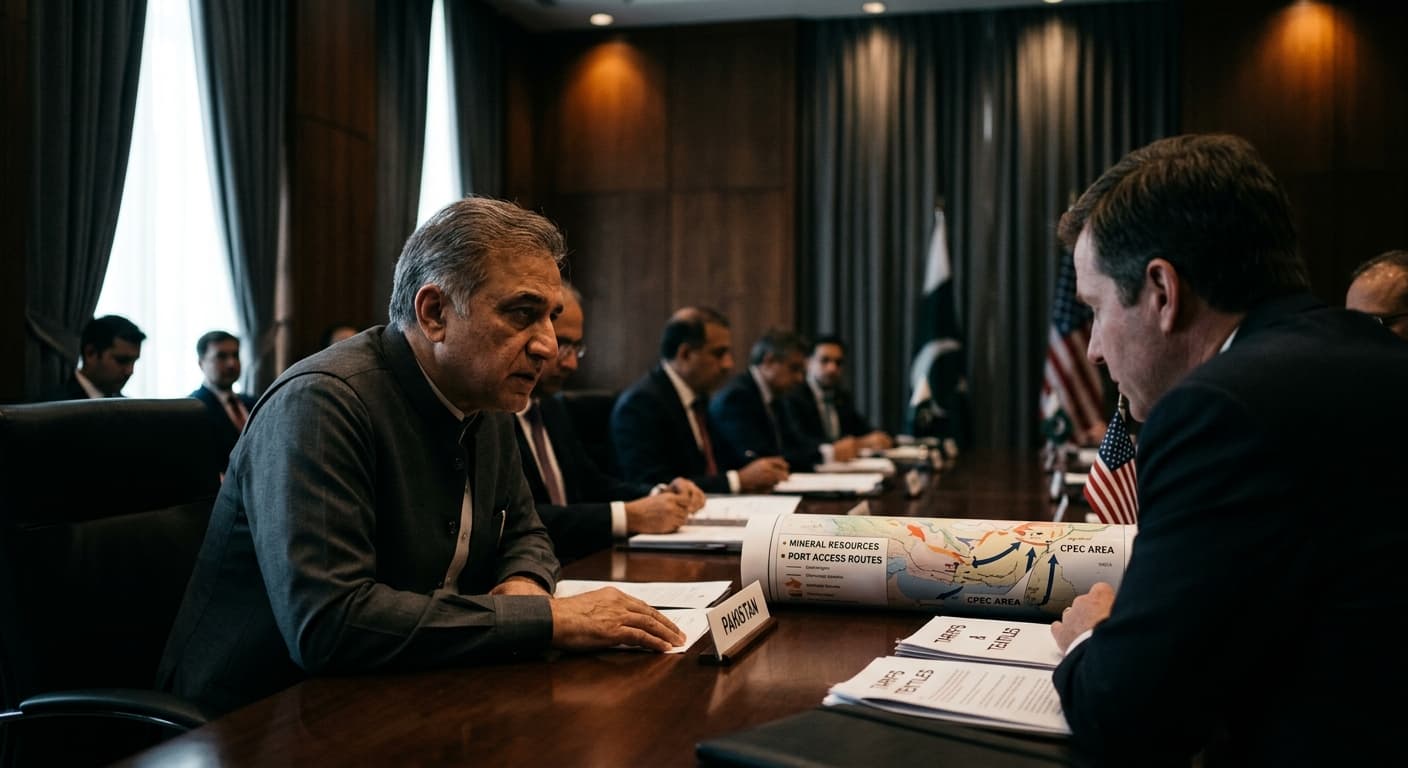
Pakistan's Trade Talks With US Mask a Scramble for China's Doorstep
Pakistan and the US resumed Reciprocal Trade Agreement negotiations in Washington on July 9, 2026, as a 150-day tariff window nears expiry — but the real stakes are minerals, ports, and counterweight to China's CPEC, not textiles.
Pakistan and the United States opened a fresh round of negotiations on an Agreement on Reciprocal Trade (ART) in Washington on July 9, 2026, with Islamabad's Commerce Secretary Jawad Paul leading a delegation that includes labour, foreign-office, and embassy officials. The talks, confirmed by Pakistan's Foreign Office spokesperson Tahir Andrabi, are the third formal exchange since President Donald Trump's "Liberation Day" tariffs imposed a 29 percent duty on Pakistani exports in April 2025. What looks like a routine tariff negotiation is in fact a strategic recalibration: Washington is using tariff relief to buy economic footholds at the doorstep of China's $62 billion Belt and Road corridor, while Islamabad is trading mineral access and port geography for a locked-in rate that protects its $5.5 billion export lifeline. The urgency is sharpened by a hard deadline — July 24, 2026, when the temporary global tariff under Section 122 of the Trade Act expires, potentially resetting the entire tariff architecture.
From 29 percent to 19: the tariff bargain
Pakistan's initial tariff trajectory under Trump's reciprocal regime was punishing. The April 2, 2025 executive order set a 29 percent rate on Pakistani goods, effective April 9, raising the average duty on Pakistani exports from 4–5 percent to roughly 39 percent when stacked on existing Most Favored Nation rates, according to analysis by ISSI. The U.S. Administration cited Pakistan's alleged 58 percent tariff and non-tariff barriers on U.S. goods as justification — claims that remain unverified.
Islamabad negotiated that rate down to 19 percent by the August 1, 2025 deadline, formalized in a White House executive order that set Pakistan's reciprocal tariff alongside countries like Indonesia, Malaysia, the Philippines, and Thailand — all at 19 percent. That placed Pakistan below India (25 percent), Bangladesh (20 percent), and Sri Lanka (20 percent), giving it the lowest rate of any South Asian country, as
BBC News noted. According to reporting compiled by
ORF, Pakistan agreed to zero-percent tariffs on over 4,000 U.S. import items in exchange for the 19 percent rate, plus commitments on energy, mining, and cryptocurrency cooperation.
The initial deal also opened cooperation beyond tariffs. Trump publicly confirmed an energy partnership built around joint development of Pakistan's oil reserves, with secondary provisions covering mining, IT, and digital infrastructure, as Mettis Global reported. Pakistani Foreign Minister Ishaq Dar, speaking at the
Atlantic Council on July 25, 2025, framed the emerging relationship as one that should be "strategic, stable" and move beyond a "transactional" dynamic. He said the deal would be concluded "in days, not weeks." Momentum stalled after the August agreement, with talks resuming only after a virtual session in May 2026 between Commerce Minister Jam Kamal Khan, Secretary Paul, and Deputy U.S. Trade Representative Rick Switzer.
The deadline that drives everything: July 24, 2026
The negotiations are not happening in a policy vacuum. They are racing a statutory clock. On February 20, 2026, the U.S. Supreme Court ruled that the reciprocal tariffs imposed under the International Emergency Economic Powers Act (IEEPA) were unlawful, effectively invalidating the legal basis for the 19 percent rate Pakistan had negotiated, as Al Jazeera reported. Trump immediately signed an executive order under Section 122 of the Trade Act of 1974 to impose a blanket 10 percent tariff on all countries, raised to 15 percent on February 22. The
European Parliament's trade committee noted that Section 122 tariffs are capped at 15 percent and time-limited to 150 days — after which congressional approval is required for extension.
That 150-day window expires on July 24, 2026. The Council on Foreign Relations observed that Section 122 cannot target individual countries, meaning the negotiated 19 percent rate Pakistan secured is legally defunct. The uniform 15 percent global rate actually gives Pakistan no advantage over any competitor — Bangladesh, Vietnam, and Sri Lanka all face the same 15 percent. The ART framework Islamabad is negotiating is an attempt to lock in a preferential rate before the Section 122 authority lapses and before the U.S. Trade Representative finalizes a new tariff regime under Section 301 investigations.
The USTR concluded forced-labor investigations into 60 economies in June 2026, proposing a 10 percent tariff on 16 economies — including Pakistan, Canada, Mexico, the EU, and the UK — that have relevant laws but were found to enforce them inadequately, and 12.5 percent on the remaining 44, including China and India, according to the Atlantic Council.
CSIS noted that USTR's 98-page report devoted only two or three paragraphs to each country, simply asserting failure to enforce without presenting evidence. Pakistan's inclusion in the 10 percent tier rather than the 12.5 percent tier is a modest benefit — but only if the ART does not stack on top of it.
The Congressional Research Service confirmed that USTR may aim to finalize Section 301 tariff actions by late July 2026, aligning with the Section 122 expiration. This means the Washington round is not about textiles — it is about positioning Pakistan inside whatever tariff architecture replaces the current one.
Minerals, ports, and the China counterweight
The non-tariff provisions of the ART are where the strategic calculus sits. In September 2025, Pakistan's military-run Frontier Works Organisation signed a $500 million memorandum of understanding with U.S. Strategic Metals (USSM), a Missouri-based company, to export antimony, copper, gold, tungsten, and rare earth elements, as Al Jazeera reported. Pakistan shipped its first batch of rare earth minerals to the U.S. on October 2, 2025. The FWO already operates mines in Waziristan and holds exploration licences in the Chagai Belt in Balochistan and in Gilgit-Baltistan.
The deeper prize is Reko Diq, a copper-gold deposit in Balochistan estimated to contain 14.6 million tons of copper and 26 million ounces of gold. CSIS noted that in December 2025, the U.S. Export-Import Bank approved $1.25 billion in financing for copper and gold mining at Reko Diq, on top of $300 million from the Asian Development Bank and $300 million from the Japan Bank for International Cooperation. Chinese firms hold stakes in four of Pakistan's six active critical minerals projects, and nearly all of Pakistan's 24,000–46,000 metric tons of 2024 copper production was shipped to China. Reko Diq, entering preproduction, would shift that landscape.
But the security environment is deteriorating. Barrick Mining Corporation, the operator of Reko Diq, announced on April 2, 2026 that it was slowing development activity and continuing project review until mid-2027 due to "escalation of security risks and increased security incidents," as Barrick's announcement via the Financial Times noted. The previously disclosed Phase 1 capital cost of $5.6–6.0 billion could see "significant increases." This is the structural constraint that makes Pakistan's mineral diplomacy more aspiration than pipeline.
The port geography is equally sensitive. Reports indicate Islamabad floated an invitation to the U.S. to build a deep-sea port at Pasni on the Arabian Sea, roughly 112 kilometers from the Chinese-operated Gwadar port, as ORF documented. Gwadar is operated under a 40-year build-operate-transfer deal with China Overseas Ports Holding Company, in which China retains 91 percent of gross port revenue, as the
Middle East Institute noted. A U.S. port at Pasni would give Washington a commercial — and potentially military — foothold near the Strait of Hormuz, directly challenging the southern terminus of the China-Pakistan Economic Corridor.
Pakistan also leveraged a cryptocurrency channel to gain access to the Trump administration. In January 2026, Pakistan's Finance Ministry signed an MoU with SC Financial Technologies, an affiliate of World Liberty Financial — the Trump family-linked crypto venture — to explore the USD1 stablecoin for cross-border payments, as Al Jazeera reported. Six months later, no pilot project has been launched, no licenses issued, and no known transactions have occurred using the stablecoin. Karachi-based economist Khurram Husain told Al Jazeera the MoU was "nothing more than an instrument of access. Access was the calculation, and it paid off spectacularly."
Who benefits, who loses
The winners are narrow. Pakistan's textile exporters — who account for nearly 60 percent of total exports and are concentrated in cotton, apparel, and bedwear — gain most from a locked-in preferential rate. The IMF noted that the U.S. is Pakistan's largest single-country export destination, and that textiles and apparel are the largest segment of that trade. A 19 percent rate versus India's 25 percent and Bangladesh's 20 percent gives Pakistani textiles a structural edge in the U.S. market, as
BBC News observed.
The Pakistani military is a second beneficiary. The FWO, headed by a two-star general, controls the mineral concessions that are the currency of the U.S. relationship. Army Chief Field Marshal Asim Munir was hosted for lunch at the White House in June 2025 — the first time a U.S. president received a Pakistani army chief who was not also head of state, per Al Jazeera. Vice President JD Vance credited Munir with helping broker a framework for peace between Washington and Tehran, calling him a "great statesman." The minerals and port access flow through institutions the military controls.
China is the quiet loser — or at least the party whose monopoly is being contested. ORF argued that Pakistan's rapprochement with the U.S. is tactical and temporary, and that Pakistan's "loyalties stay with China." But there are tangible costs: China has reportedly stopped funding key CPEC projects including the Main Line-1 railway upgrade, and there are reports that a planned $3.5 billion investment in Gwadar Port has been quietly diverted to Kyaukpyu Port in Myanmar, as
ORF noted. Chinese state media launched what ORF described as an "anti-Pakistan campaign" after Munir and Sharif visited the White House in September 2025 and showed Trump samples of rare earths.
Pakistan's civilian exporters and ordinary taxpayers face a more ambiguous outcome. The IMF's third review, completed in March 2026, noted that program implementation remained "broadly aligned" and that GDP growth accelerated in FY26H1, but warned that the Middle East conflict "casts a cloud over the outlook." The
World Bank projected the current account deficit to widen to 1.2 percent of GDP in FY26 from a surplus in FY25, driven by food export declines and rising imports. A durable trade deal with the U.S. would help stabilize external accounts; a failure would compound pressure on an IMF program that runs through 2027.
Diplomat View
The ART negotiations are not really about tariff rates — they are about whether Pakistan can sustain a two-track relationship with Washington and Beijing without one side revoking access. The Section 122 expiration on July 24, 2026 is the proximate catalyst, but the deeper question is whether the mineral and port concessions Islamabad has offered are enough to keep Pakistan inside a U.S. preferential lane after the Section 301 regime takes effect.
The forecast hinges on three variables. First, whether USTR finalizes the Section 301 forced-labor tariffs before or after the July 24 deadline — a delay gives Pakistan negotiating room; a rapid finalization compresses it. Second, whether Barrick's slowdown at Reko Diq collapses the U.S. minerals investment thesis or merely defers it — a mid-2027 review means no material copper flows before 2029 at the earliest. Third, whether China's quiet pressure on CPEC financing pushes Pakistan closer to Washington or triggers a course correction back toward Beijing, as ORF's analysis of the "China constraint" suggests is the historical pattern.
The most likely outcome is a signed ART framework by September 2026 that locks in a rate at or near the proposed Section 301 tier — 10 percent — in exchange for formalized mineral-supply and digital-trade commitments. That would be a better rate than Pakistan has ever had with the U.S., but one secured by concessions that constrain Islamabad's freedom to maneuver between its two largest patrons. The loser is not China, which remains Pakistan's largest creditor and arms supplier. The loser is the coherence of Pakistan's non-aligned posture, which is being traded away one tariff point at a time.
What to watch:
- July 24, 2026 — Section 122 150-day window expires; Congress must act or the administration must find alternative authority
- Late July 2026 — USTR expected to finalize Section 301 forced-labor tariff rates; Pakistan's 10 percent proposal enters implementation
- September 2026 — Target window for ART framework signing, based on the pace of the current Washington round and prior negotiating cycles
Discover more

Global Politics
U.S. Naval Blockade Heightens Iran Tensions
The U.S. naval blockade of Iran collapsed oil exports, creating a new maritime regime in Hormuz that favors Tehran.

US Politics
US Launches $166B Tariff Refund Portal
The US is launching a $166 billion tariff refund portal to aid importers hit by Trump-era tariffs, with major implications for trade and supply costs.
US Politics
House Ethics Committee Pushes Sexual Miscond.
The House Ethics Committee has shifted responsibility for sexual harassment settlement records to the Office of Congressional Workplace Rights, complicating disclosure efforts.

Economics
Fed's Amex AML order puts correspondent banking on notice
Federal Reserve's Amex AML order requires board-level controls and a 90-day plan; OCC fined the bank $350 million over enterprise-wide deficiencies.