AU's $3.4trn Trade Vision vs. Sahel Barriers
The AU's call for trade integration faces Sahel's tariff walls.
Model Diplomat8 min readAfrica
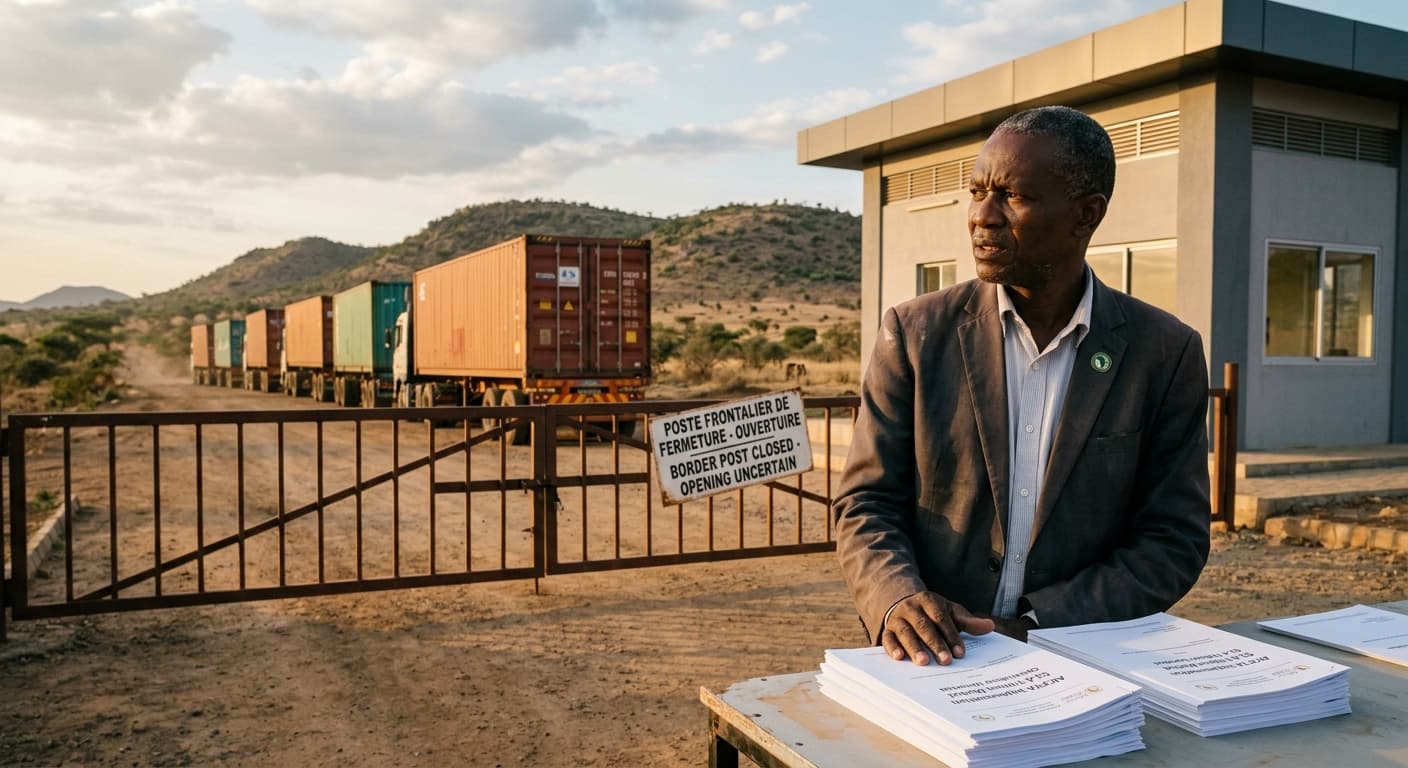
The AU's $3.4trn pitch collides with a Sahel that has walled itself off
The African Union's Africa Integration Day call to dismantle trade barriers arrives as Mali, Burkina Faso and Niger build a rival tariff wall — and the Sahel's jihadist economy fills the gap.
On July 7, 2026, African Union Commission Chairperson Mahmoud Ali Youssouf used Africa Integration Day to press the continent's 55 states to tear down non-tariff barriers and unlock what he called a $3.4 trillion, 1.3-billion-person market under the African Continental Free Trade Area (AfCFTA), according to Channel Africa. The awkward fact behind the speech is that West Africa is moving in the opposite direction: three of Youssouf's member states — Mali, Burkina Faso and Niger — left ECOWAS on January 29, 2025 and, two months later, imposed a 0.5% common tariff on imports from every other African country, according to an
IMF Niger Country Report. The AU is asking for integration; the Sahel is buying sovereignty at the border.
That gap is the story. Every dollar not traded across a Sahel checkpoint is taxed by a junta, extracted by a Russian-linked mining venture, or captured by al-Qaeda affiliate Jama'at Nusrat al-Islam wal-Muslimin (JNIM), which has spent nine months choking Bamako's fuel supply. Youssouf's $3.4 trillion figure is real. So is the parallel political economy now hardening around Africa's most violent region.
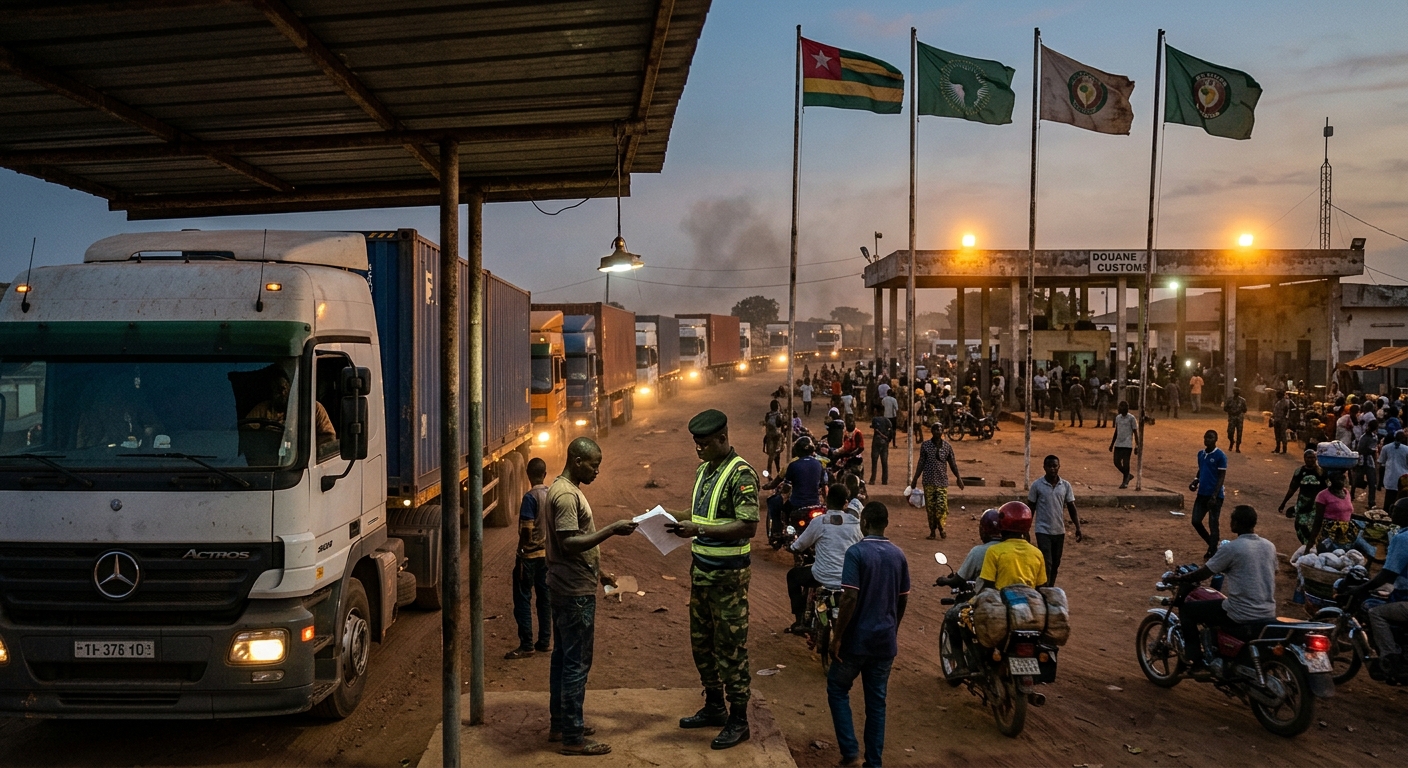
What Youssouf actually said, and why the numbers don't move
The AUC Chair, a Djiboutian diplomat in office since March 2025, repeated a diagnosis African leaders have been reciting since the AfCFTA was launched in 2021. Intra-African trade sits at 16–18% of the continent's total, versus more than 60% in Asia and above 70% in Europe. Trade among African economies did expand 5.5% in 2025 to $213.8 billion, per the African Trade Report 2026 issued by the African Export-Import Bank (Afreximbank). But the ratio is stuck.
The reason is not tariffs — those are largely gone on paper. It is what economists call the "trade-enabling environment." An IMF Selected Issues Paper on WAEMU released in April 2025 concluded that non-tariff measures and a "challenging trade environment (e.g., limited transport infrastructure and cumbersome Customs and border processes)" hamper trade even among the eight countries of the West African Economic and Monetary Union, which share a single currency and common external tariff, according to the fund's analysis. Burkina Faso, Niger and Mali rank particularly low on trade infrastructure, security and governance in the same paper.
The Brookings Foresight Africa 2026 chapter puts a sharper number on it: only 100 of the AfCFTA's roughly 4,500 tariff-line products are actively traded under its preferences, and deeper integration could raise intra-African trade by up to 109%, versus roughly 16% under the current "shallow" agreements, according to Brookings. The IMF's Managing Director Kristalina Georgieva, addressing the Africa Forward Summit in May 2026, made the same argument in plainer terms: "eliminating tariff and non-tariff barriers in line with the continental free trade area can increase income per capita by more than 10 percent," according to her
prepared remarks.
Youssouf's speech was a plea for implementation. The political actor most credibly refusing to implement went unnamed.
The Sahel's counter-integration
The Alliance of Sahel States (AES) is now a functioning parallel bloc. Since the three juntas exited ECOWAS in January 2025 — a departure ECOWAS confirmed in its own press statement carried by Al Jazeera — they have inaugurated a Sahel Investment and Development Bank, launched an AES passport, floated a common currency to replace the CFA franc, and announced a 6,000-troop joint force. A confederal summit in Bamako in late 2025 was, in Al Jazeera's words, "a ribbon-cutting moment" for an alternative regional architecture — one that now has its own bank, passport, currency proposal and joint force.
The economic backbone of that architecture is the 0.5% import levy the three states jointly imposed on March 28, 2025. Chatham House warns the tariff hits "coastal ECOWAS countries with which they share a long history of economic integration and unimpeded trade, such as Nigeria," and reads it as evidence that "AES leaders continue to prioritize symbolically loaded political gestures ahead of trade, the cost of living and development," according to a Chatham House brief. The three countries account for only around 8% of pre-split ECOWAS GDP, on a base of $761 billion — but their 80 million people and their transit corridors are anything but marginal to the coastal economies.
Two facts anchor the analysis. First, Sahel landlocked states still depend on ports in Abidjan, Lomé, Cotonou, Tema and Dakar; ECOWAS has kept the free-trade scheme open to AES goods, according to the BBC. Second, the AES has not withdrawn from the AfCFTA. In principle, the continental agreement should override the ECOWAS-AES rupture. In practice, it does not — because the AfCFTA lacks binding enforcement in the areas that matter most.
The jihadist economy is the real non-tariff barrier
The trade story and the security story are the same story. JNIM has, since September 2025, blockaded fuel highways into Bamako from Senegal and Côte d'Ivoire. The Malian defence minister, Sadio Camara, was killed in late April 2026 in a coordinated JNIM-Tuareg offensive that also forced the withdrawal of the Kremlin-controlled Africa Corps, according to a detailed account in Al Jazeera. ACLED data cited by the BBC records at least 69 JNIM drone strikes across Mali and Burkina Faso since 2023, with JNIM operating in 11 of Burkina Faso's 13 regions and now conducting cross-border raids into Benin and Togo, according to
the BBC.
That is a non-tariff barrier no AfCFTA protocol can lift. In May 2026, JNIM fighters burned a tomato lorry carrying Ghanaian traders near Titao, killing at least 20 people, according to the BBC. More than three million people have been displaced across the Sahel and 80,000 Burkinabès now live in Ivorian refugee camps, per UN data cited by
the BBC. Cross-border trade in the region's most integrated corridor — the tomato-and-onion routes linking the Sahel to Ghanaian and Ivorian ports — is being priced out by insurance, ransom risk and destroyed vehicles.
The revenue captured by the alternative economy is now measurable. UNODC estimates most artisanal Sahel gold ends up in the United Arab Emirates, and Russian paramilitaries have been paid in gold or mining concessions in Mali and Burkina Faso, according to the BBC. Burkina Faso and Mali are each building state-owned refineries. This is integration — vertical, extractive and outside AfCFTA rules — happening in real time.
What the AU can actually do
The AU's leverage is thin. Youssouf's Commission has no enforcement power over member states, and the AfCFTA's dispute settlement mechanism, based in Kigali, has yet to hand down a decision that has moved a border. The primary AU instrument still on the table is the 2018 Protocol on Free Movement of Persons, which requires 15 ratifications to enter into force and has, per a UN OSAA policy brief, been ratified by only four states as of the most recent count in an OSAA policy brief. Ratifications by Rwanda, São Tomé and Príncipe, Niger and Mali are not enough — and both Niger and Mali are now outside ECOWAS.
The IMF has quietly become a more consequential enforcer than the AU. A May 2023 IMF departmental paper valued full AfCFTA implementation at a $3.4 trillion market and framed trade integration as "an important element of a strategy for African countries to cope with rapid population growth, climate change, and emerging geopolitical fragmentation." Niger's Extended Credit Facility, extended to December 2026, ties disbursements to trade-facilitation reforms; Mali has implemented only about a third of paperless-trade measures against Benin's 86%.
The AU-EU Luanda Summit of November 2025 produced a joint pledge to "accelerate the implementation of the African Continental Free Trade Area" and to invest in the Lobito Corridor, connecting the DRC's copper belt to the Angolan coast, according to the joint declaration. But the Lobito Corridor is southern-Africa geography. It does nothing for the Sahel routes JNIM has closed.
The AU-UN Joint Communiqué issued in Addis Ababa on May 13, 2026 reiterated the "centrality of sustainable infrastructure, energy transition, digital transformation, youth employment, women's economic empowerment, and regional integration, including through the African Continental Free Trade Area," according to the UN Secretary-General's office — and expressed "deep concern" over armed conflicts without connecting the two.
Forward look — the catalysts that will move this
- Late 2026, WTO MC14 in Cameroon. The AU-EU Luanda text committed both blocs to a "meaningful, balanced and inclusive outcome" at the World Trade Organization's 14th Ministerial Conference. It is the first WTO ministerial hosted on African soil and the venue where the AfCFTA will either graduate from aspiration to an externally credible framework, or not.
- End-2026, ECOWAS standby force deployment. ECOWAS defence chiefs agreed in early 2026 to mobilise an initial 2,000 troops against cross-border armed groups by year-end, per
Al Jazeera. Whether the force operates alongside or in de facto opposition to the AES's 6,000-troop joint force will define the region's security geometry through 2027.
- December 2026, Niger IMF review. The seventh review of Niger's ECF, extended to December 2026, is the primary Western financial lever left on any AES state — and the moment when AES economic policy meets a hard external constraint.
Diplomat View
The AU's $3.4 trillion pitch is intellectually correct and politically inert. Youssouf can list the barriers; he cannot dismantle them, because the states building the tallest walls — Mali, Burkina Faso, Niger — have concluded that sovereignty at the border pays better than integration through it. The gold-and-security economy under Africa Corps, the JNIM fuel blockade around Bamako, and the AES 0.5% levy are now the operative regional architecture in the Sahel, not the AfCFTA. Our call: continental trade will keep growing at the 5–6% clip Afreximbank recorded in 2025; the intra-African share will remain stuck below 20% through 2027; and the Sahel corridor will actively subtract from that total. What would revise this forecast: a JNIM-Bamako negotiated settlement that reopens the Senegal–Mali fuel highway; a Nigerian-Ivorian diplomatic push that quietly rescinds the AES levy; or a WTO MC14 outcome in Yaoundé that binds AfCFTA rules of origin to external market access. Absent one of those, Africa Integration Day is a slogan competing with a customs house — and the customs house is winning.
Discover more

US Politics
House Ethics Committee Pushes Sexual Miscond.
The House Ethics Committee has shifted responsibility for sexual harassment settlement records to the Office of Congressional Workplace Rights, complicating disclosure efforts.
India
700 Activists Accuse PM Modi of MCC Breach
Over 700 activists allege PM Modi breached election code with a televised address attacking opposition parties just before state elections.
International Relations
Economist Impact Sustainability Week 2026
Economist Impact Sustainability Week 2026 spotlights the energy transition, AI in clean technology, and supply chain resilience as themes for global leaders.

Economics
Fed's Amex AML order puts correspondent banking on notice
Federal Reserve's Amex AML order requires board-level controls and a 90-day plan; OCC fined the bank $350 million over enterprise-wide deficiencies.