Araghchi warns Trump: no deal under threats
Iran's foreign minister ties nuclear deal to US threats' end.
Model Diplomat8 min readMiddle East
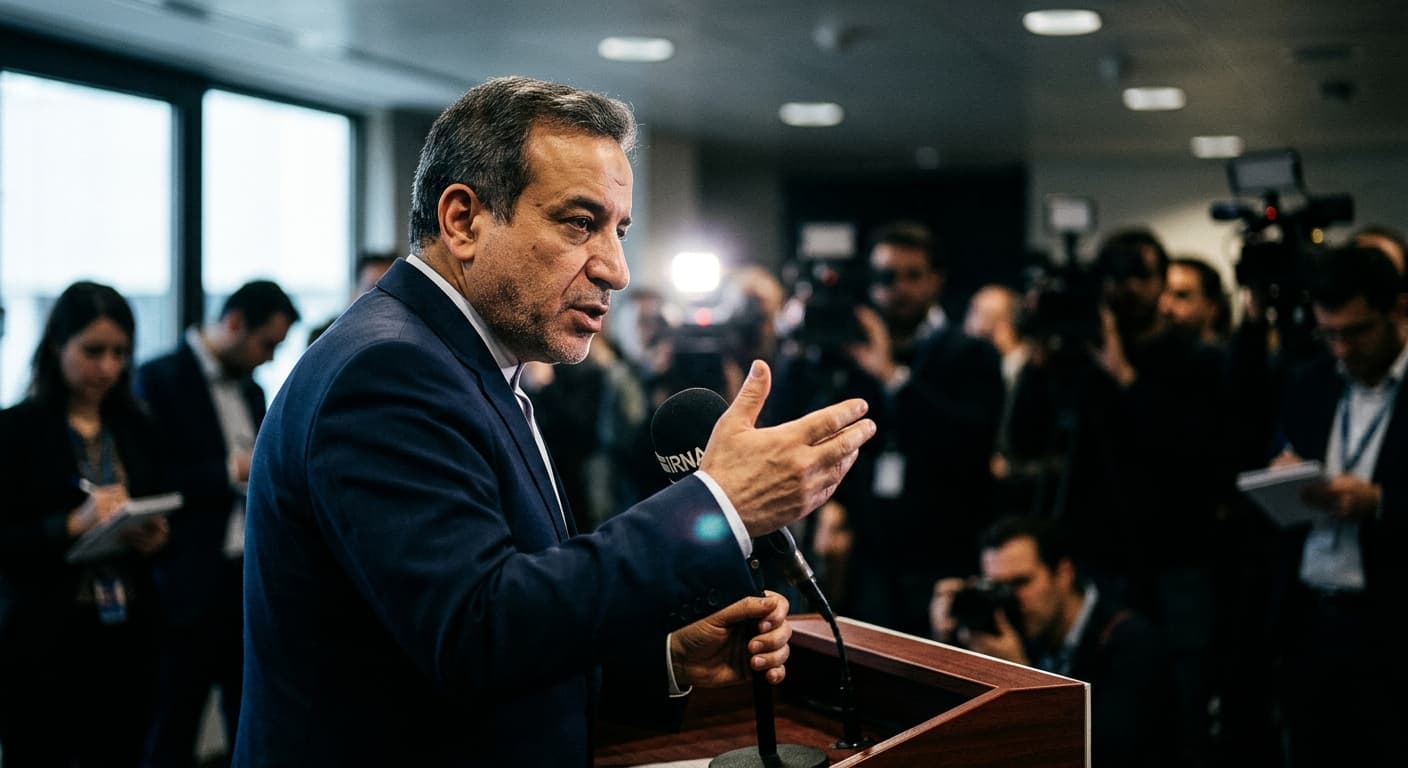
Araghchi warns Trump: no deal under threats, as Hormuz burns
Iran's foreign minister ties any final nuclear deal to an end to US threats — as a Qatari LNG tanker burns off Oman and the 60-day MoU window narrows.
Iran's foreign minister Abbas Araghchi told Donald Trump on July 7, 2026, that Tehran will not negotiate a final deal "under the shadow of threats," hours after a Qatari LNG carrier was set ablaze in the Strait of Hormuz — a warning that reframes the US–Iran memorandum of understanding not as a diplomatic breakthrough but as a leverage contest in which the mediator, Qatar, has just been attacked by the state it is mediating for. The thesis: Araghchi's hardline stance is not brinkmanship — it is a bid to lock Trump into a strategic retreat before the 60-day negotiating window closes on August 18, and it is working because Gulf capitals now fear an Emirati-Israeli maximalist path more than they fear a weakened Iran.
The day, in specifics
At dawn on July 7, 2026, the Qatari-flagged LNG tanker Al Rekayyat was struck on its port side by a projectile near Limah, Oman, catching fire while heading south out of the Strait of Hormuz. A second tanker reported structural damage hours later. The UK Maritime Trade Operations centre logged both incidents, according to Al Jazeera. Qatar's foreign ministry spokesman Majed Al-Ansari held Iran "fully legally responsible," calling the attack "a grave and blatant violation of international law." Iranian state television said the vessel had ignored warnings; Tehran did not directly claim it.
Hours later, Araghchi issued the warning that gives this liveblog its centre of gravity: no negotiations on a final deal while Trump's public threats continue. The line echoes his January 30, 2026 statement in Istanbul — that Iran "has no problem with negotiations, but negotiations cannot take place under the shadow of threats" — reported by Al Jazeera. What was posture in January is doctrine now.
The two events are connected. Attacking a Qatari tanker while telling Trump to stop threatening is a coordinated signal: Iran will not be pushed to concessions by US military build-up, and it can still turn the region's most important waterway into a war zone at will.
Why "no talks under threats" is a strategic play, not a tantrum
The MoU signed in Geneva on June 19, 2026 — a 14-point document brokered by Pakistan and Qatar — gave both sides a 60-day runway to negotiate a final agreement, with the Strait of Hormuz reopened, a US naval blockade lifted within 30 days, and $24 billion in frozen Iranian assets tied to progress, per the Al Jazeera summary of the draft. That clock runs out on August 18.
Tehran's calculation is straightforward. Under Mojtaba Khamenei — installed by the Assembly of Experts on March 8, 2026, after his father was killed in the opening US–Israeli strikes, per the BBC — the regime's legitimacy rests on being seen to resist. Mojtaba has not appeared in public since his appointment; his family was killed in the same strike; his standing as a mid-ranking cleric is contested. He cannot afford to be photographed conceding under threat. Iran specialist Afshon Ostovar told
NPR that his selection means "the regime wants to preserve as much of the status quo as possible."
Araghchi's demand functions on three levels. It sets a rhetorical price of admission Trump must pay — dropping "finish the job" threats — before Tehran will discuss uranium down-blending or missile-range caps. It signals to hardliners at home that the foreign ministry is not selling out. And it forces the mediators, Qatar and Pakistan, to lean on Washington rather than Tehran, because only Trump can visibly de-escalate rhetoric.
The BBC's reporting that Iran has responded to a US 15-point plan with a five-point counter — including a commitment "never to pursue nuclear weapons," IAEA supervision of uranium disposition, and lifting of all international sanctions — tells you the substance exists. What Araghchi is negotiating for is the framing.
The Gulf pivot Trump has not priced in
The Al Rekayyat strike should, in theory, have united the Gulf Cooperation Council against Iran. It has not. Instead, the war has hardened a rift the Trump administration keeps treating as manageable.
Riyadh, Doha, Muscat, and Kuwait City want a diplomatic settlement — even one that leaves Iran's nuclear latent capacity partly intact — because they fear the alternative. As Foreign Affairs' Sanam Vakil argued in "Can Saudi Arabia Keep Hedging?", Riyadh "does not trust Washington to restore regional security after the conflict ends" and has positioned itself between Oman/Qatar (which will work with Iran postwar) and the UAE/Bahrain (which want the Islamic Republic broken). Brookings' Jeffrey Feltman put it more bluntly: the war has revealed the US as "an unpredictable, unreliable partner," and the Gulf will now
diversify away from Washington toward Europe, South Korea, and — critically — a Pakistan–Egypt–Turkey–Saudi quartet that gives Riyadh strategic weight beyond the GCC.
The Gulf International Forum's Kenneth Katzman documents the structural rift: the UAE, which attacked two Iranian oil facilities on the day the ceasefire was signed and received an Israeli Iron Dome battery, stands "well outside the Gulf consensus." Everyone else wants de-escalation.
Araghchi knows this. Attacking a Qatari tanker is a calibrated provocation — painful enough to remind Doha that Iran can hurt it, but not so catastrophic that Qatar walks away from mediation. Qatar's condemnation was legalistic, not vengeful. Within hours, its foreign ministry was still coordinating with Witkoff and Kushner.
Why oil markets are shrugging — and why that will not last
Brent crude sat at roughly $72 a barrel on July 6, 2026 — below the $72.48 pre-war settlement of February 27 — according to Al Jazeera's market coverage. That is remarkable given the day's events. It reflects a market betting that the MoU holds, that Saudi Arabia has more than doubled shipping volume since June 17, and that Iran has pushed roughly 50 million barrels to market since the US blockade lifted.
That complacency is the vulnerability. MarineTraffic recorded 38 transits through Hormuz on July 2, down from a pre-war baseline near 130. At least 49 attacks on commercial vessels have been logged in the strait since fighting began on February 28, per Al Jazeera. Tehran has repeatedly asserted the sole right to control passage. The Persian Gulf Strait Authority, an Iranian body, told shippers on June 25 that "consequences arising from passage through unauthorised routes shall be the responsibility of the owner, operator, and vessel commander."
Rory Johnston of Commodity Context has argued that if the strait remains contested, markets are "mortgaging the present for an even worse outcome in the future," as he told NPR in March. The insurance math already reflects this: Lloyd's war-risk premiums for Hormuz transits jumped orders of magnitude after February, and JPMorgan Chase estimated regional shipping insurance needs at around $350 billion versus a US-offered ceiling of $20 billion.
The strategic point is not that oil will spike tomorrow. It is that every attack degrades the credibility of the MoU's Article on freedom of navigation without moving prices — which reduces Tehran's marginal cost of coercion. Iran can attack tankers, watch Brent stay near $72, and pocket the leverage.
The primary documents that matter
Two official statements this month reveal what allies actually think.
On July 2, 2026, UK Minister of State James Kariuki told the UN Security Council that Britain "strongly condemns Iran's reckless attacks against Bahrain and Kuwait, and on international shipping in the Strait of Hormuz," backing IMO evacuation efforts and calling for "the right of transit passage to be fully restored… in accordance with international law, as reflected in the United Nations Convention on the Law of the Sea." The full text is on GOV.UK.
The next day, Keir Starmer and Emmanuel Macron issued a joint statement declaring that Oman had agreed to work with the UK and France to secure its territorial waters, and that both governments "stand ready to deploy the wider Multinational Military Mission to support freedom of navigation." Denmark has joined. Notably absent from that coalition: the United States as lead. Europe is stepping into the vacuum Feltman predicted.
IAEA Director General Rafael Grossi has separately said, per the BBC, that inspections "will indeed take place" under the MoU's explicit language on IAEA supervision of down-blending — but Iran's foreign ministry says any access remains subject to procedures set by parliament and the Supreme National Security Council. That is the fight Araghchi is protecting: control of the sequencing.
What Trump loses if he keeps threatening
Trump's instinct — "make a deal or finish the job" — worked to force Iran to the table when the leverage was one-way. It is not anymore. Two shifts, both non-obvious, have altered the balance.
First, the GCC diplomatic bloc now has a real interest in seeing threats de-escalate. If Trump ratchets up rhetoric and Iran retaliates against Gulf infrastructure, Riyadh's East–West pipeline and Abu Dhabi's crude pipeline — the workarounds that kept oil flowing during the strait's closure — become targets. That is why Wall Street Journal reporting cited by Al Jazeera had Trump telling advisers he prefers to give diplomacy a chance and is willing to extend the 60-day truce.
Second, the mediation architecture has quietly shifted center of gravity from Washington to Doha and Islamabad. The MoU's articles 5 and 6 place Gulf states at the heart of the agreement, and Qatar is now effectively representing GCC interests at the table, as Bourse & Bazaar Foundation's Mehran Haghirian told Al Jazeera. Araghchi's demand is aligned with what the mediators want to hear from Trump: quieter rhetoric, more space.
What to watch next
- August 18, 2026 — the 60-day MoU deadline. Trump has signalled willingness to extend "with mutual consent." Watch whether Araghchi tables the extension as conditional on a public US shift in tone.
- The IAEA's next Board of Governors quarterly meeting in September 2026. Grossi has said inspections are being scheduled; if Iran continues to withhold access to the bombed Natanz, Fordo, and Isfahan sites, expect a European-sponsored resolution.
- Multinational Military Mission deployment. If UK–France–Denmark ships enter Omani waters to escort tankers, the political optics change: Europe becomes the guarantor of the strait, not the US Fifth Fleet.
- Any Israeli strike inside Iran during the negotiating window. Netanyahu's cabinet has not accepted the MoU's ceasefire architecture as final. A single strike collapses the framework Araghchi is exploiting.
Diplomat View
Araghchi's "no talks under threats" line is not a wall — it is a bridge disguised as one. Read carefully, it is a request for Trump to trade rhetoric for substance: quiet the Truth Social posts, and Iran will engage on down-blending and IAEA access. The bet here is that Trump's pragmatic instinct, evidenced by his stated preference for extending the truce, will outweigh Netanyahu's maximalism and the UAE's push to "finish the job." If it does, expect an MoU extension by mid-August with a face-saving Iranian gesture on inspections — probably at Bushehr, not Fordo. If it does not — if Israel strikes, if the UAE escalates, or if Trump escalates threats after another tanker incident — the mediation architecture collapses, oil breaks $100 within a week, and Riyadh accelerates its pivot to the Pakistan–Egypt–Turkey quartet. The forecast revises the moment either the White House stops mentioning military options publicly, or Israel hits Iranian soil.
The Bottom Line
Iran is not rejecting a deal — it is repricing one. Araghchi has bet that the Gulf's exhaustion with war, Europe's move to secure Hormuz without Washington, and Trump's own reluctance to reopen the front give Tehran room to force the US to swallow its rhetoric before conceding anything material. The tanker attack was the punctuation mark: mediators can be hit, markets will not panic, and the clock still runs to August 18.
Discover more

US Politics
House Ethics Committee Pushes Sexual Miscond.
The House Ethics Committee has shifted responsibility for sexual harassment settlement records to the Office of Congressional Workplace Rights, complicating disclosure efforts.
Global Politics
US-Iran Tensions Rise
Tensions escalate in the Strait of Hormuz as Iran and the US clash over maritime control, with a ceasefire hinging on a contested MoU paragraph.
US Politics
Virginia's Redistricting Referendum
Virginia's redistricting referendum is drawing a flood of dark money, shaping future elections and the fight for congressional control amid party stakes.

Conflict & Security
Drone Warfare Killing Aid Workers at Unprec
Over 1,000 humanitarian workers killed in three years as cheap armed drones collapse legal protections. Gaza, Sudan, Ukraine, and DRC see deliberate targeting of aid convoys and hospitals with zero prosecutions.